

What Is a Tag Question?
A tag question is a short question added to the end of a statement.
It is used to confirm information, check agreement, or make conversation sound more natural.
Simple Definition
A tag question turns a statement into a question by adding a mini-question (tag) at the end.
Examples:
- You speak English, don’t you?
- She is your teacher, isn’t she?
To put it simply, tag questions are:
- Is that correct?
- Do you agree?
- Am I right?
Why Are Tag Questions Used in English?
Tag questions are used to:
- Ask for confirmation
It’s cold today, isn’t it? - Seek agreement
This movie is interesting, isn’t it? - Sound polite or friendly
You can help me, can’t you? - Keep a conversation going
Nice weather today, isn’t it?
Basic Rules of Tag Questions
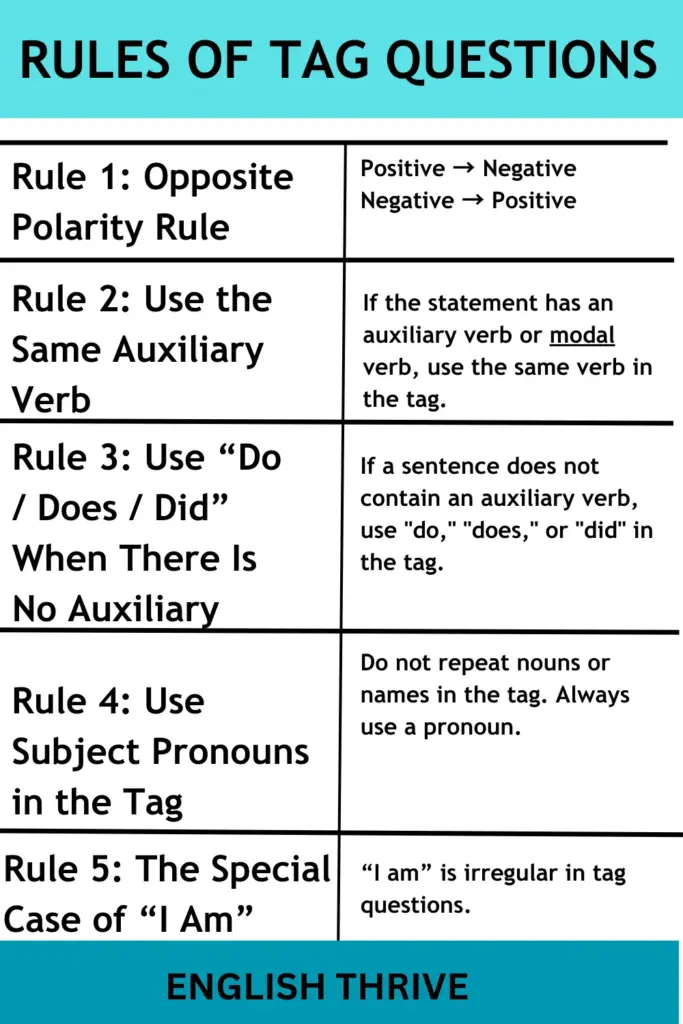
Rule 1: Opposite Polarity Rule
👉 Positive statement → Negative tag
👉 Negative statement → Positive tag
Examples:
- She is happy, isn’t she?
- He isn’t ready, is he?
Rule 2: Use the Same Auxiliary Verb
If the statement has an auxiliary verb or modal verb, use the same verb in the tag.
Examples:
- She is coming, isn’t she?
- They have finished, haven’t they?
- You can swim, can’t you?
- He will help, won’t he?
➡️ Only the positive/negative form changes, not the verb.
Rule 3: Use “Do / Does / Did” When There Is No Auxiliary
If a sentence does not contain an auxiliary verb, use “do,” “does,” or “did” in the tag.
Examples:
- You like coffee, don’t you?
- She works here, doesn’t she?
- He played well, didn’t he?
This rule applies to:
- Present Simple
- Past Simple
Rule 4: Use Subject Pronouns in the Tag
Do not repeat nouns or names in the tag. Always use a pronoun.
Examples:
- John is late, isn’t he?
- Sarah and Emma are friends, aren’t they?
- The dog looks hungry, doesn’t it?
Rule 5: The Special Case of “I Am”
“I am” is irregular in tag questions.
✔ Correct:
- I am late, aren’t I?
❌ Incorrect:
- I am late, amn’t I? ❌
Negative form:
- I’m not wrong, am I?
Tag Question Structure
Statement + Comma + Auxiliary/Modal + Subject Pronoun
Example:
- You are ready, aren’t you?
Common Tag Question Examples
General Examples
- She is your sister, isn’t she?
- You don’t live here, do you?
- We finished the work, didn’t we?
- He can drive, can’t he?
- It was a good idea, wasn’t it?
Each tag:
- Repeats the auxiliary verb
- Matches the subject pronoun
- Changes positive ↔ negative
Tag Questions by Tense
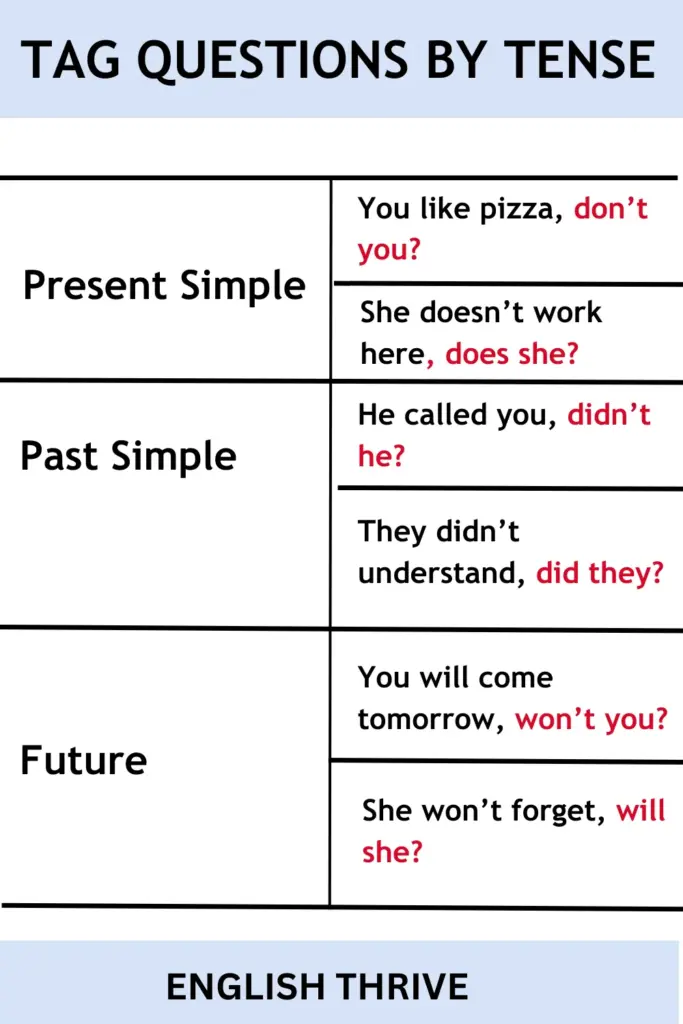
Present Simple
- You like pizza, don’t you?
- She doesn’t work here, does she?
Past Simple
- He called you, didn’t he?
- They didn’t understand, did they?
Future
- You will come tomorrow, won’t you?
- She won’t forget, will she?
Tag Questions with Modal Verbs
Modal verbs stay the same in the tag.
- You can swim, can’t you?
- He should study more, shouldn’t he?
- We must leave now, mustn’t we?
Special Cases in Tag Questions
Tag Questions with “Let’s”
When a sentence starts with “Let’s,” the tag is always “shall we?”
Examples:
- Let’s go home, shall we?
- Let’s start the meeting, shall we?
Used for:
- Suggestions
- Invitations
- Group decisions
Imperatives with Tag Questions
Imperatives are commands or requests. The tag adds politeness or tone, not a real question.
Polite invitations
- Take a seat, won’t you?
Requests
- Help me with this, can you?
Strong commands
- Close the door, will you?
Negative Adverbs
Words like “never,” “hardly,” “rarely,” “seldom,” and “barely” are negative in meaning, so the tag is positive.
Examples:
- He never listens, does he?
- She hardly eats, does she?
Indefinite Pronouns
With nobody, somebody, everybody, someone, and no one, use “they” in the tag.
Examples:
- Nobody called, did they?
- Everybody knows the answer, don’t they?
Intonation in Tag Questions
Rising Intonation
Rising intonation is used when you are not sure.
- You’re coming tomorrow, aren’t you?
Falling Intonation
Falling intonation is used when you expect agreement.
- It’s a beautiful day, isn’t it?
How to Answer Tag Questions Correctly
Always answer according to the truth, not the question form.
Examples:
- Snow is white, isn’t it? → Yes, it is.
- Snow isn’t black, is it? → No, it isn’t.
- She doesn’t live here, does she? → Yes, she does.
Yes = true, No = false
Same-Way Tag Questions
These express emotion, not real questions.
Positive–Positive
- So you passed the exam, did you?
Negative–Negative
- You didn’t call me, didn’t you?
Tag Question Exercises With Answers
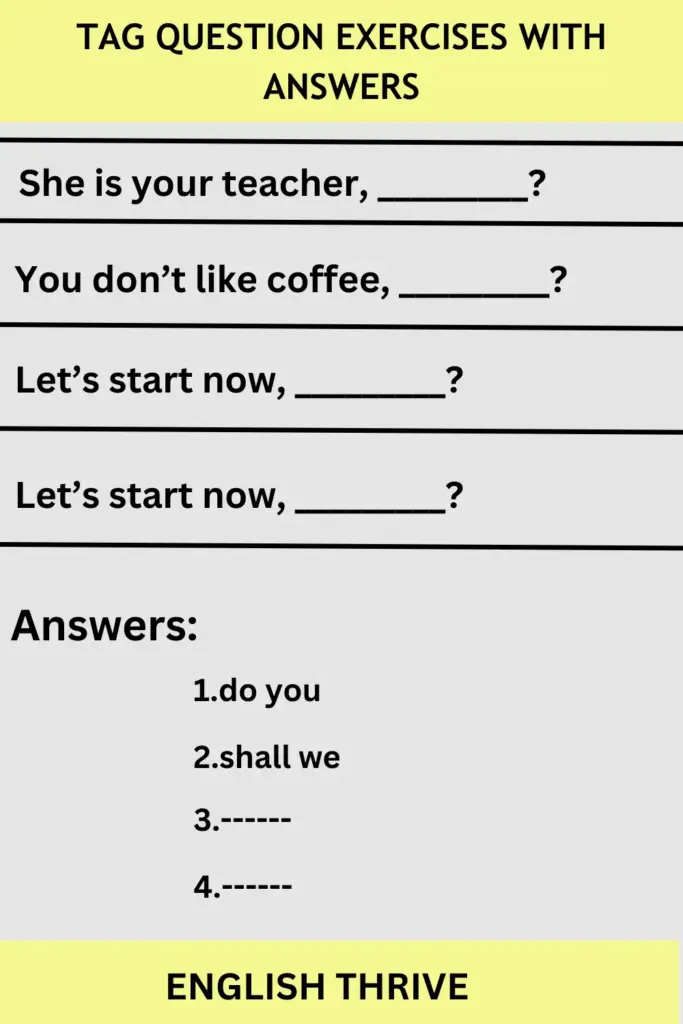
Exercise 1: Fill in the Blanks
- She is your teacher, _________?
- You don’t like coffee, _________?
- Let’s start now, _________?
- Nobody called me, _________?
Answers:
- isn’t she
- do you
- shall we
- did they
Conclusion
Tag questions are an important part of English. People use them every day. They help us check information, ask for agreement, and speak politely.
To use tag questions well, learn the basic structure first. Find the auxiliary verb. Use the correct pronoun. Change the sentence from positive to negative, or from negative to positive.
Intonation is also important. In speaking, rising and falling tones change meaning. Always answer tag questions based on facts, not on the sentence form.
With regular practice, tag questions become easy. They help students in exams and in daily conversations. Using them correctly makes your English clear, friendly, and natural.