

Looking for vocabulary words with meaning and sentence examples you can actually use? Below are 100 useful English words, each with its part of speech, a simple meaning, and a natural example sentence. The list is split into four sets of 25, so you can learn one set per week and review the rest.
These words are common in exams like IELTS and TOEFL, in school essays, and in everyday conversation. Learn the meaning first, read the example sentence aloud, and then write your own sentence with the word.
Why Is It Important to Learn Vocabulary Words?
Vocabulary is the foundation of any language. The more words you know, the more clearly you can express your thoughts, emotions, and ideas. Learning new words helps you:
- Communicate clearly: You can say exactly what you mean.
- Understand more: Books, news, films and conversations become easier to follow.
- Do better in exams and at work: A strong vocabulary improves essays, reports and interviews.
- Speak with confidence: You spend less time searching for the “right” word.
Expanding your vocabulary is not about memorising definitions. It is about learning how words work in real sentences. For a step-by-step method, read our guide on how to improve vocabulary in English.
100 Vocabulary Words with Meaning and Sentence
Each table shows the word, its part of speech, its meaning, and an example sentence that shows how the word is used in context.
Set 1: Words 1–25
| # | Word | Part of Speech | Meaning | Example Sentence |
|---|---|---|---|---|
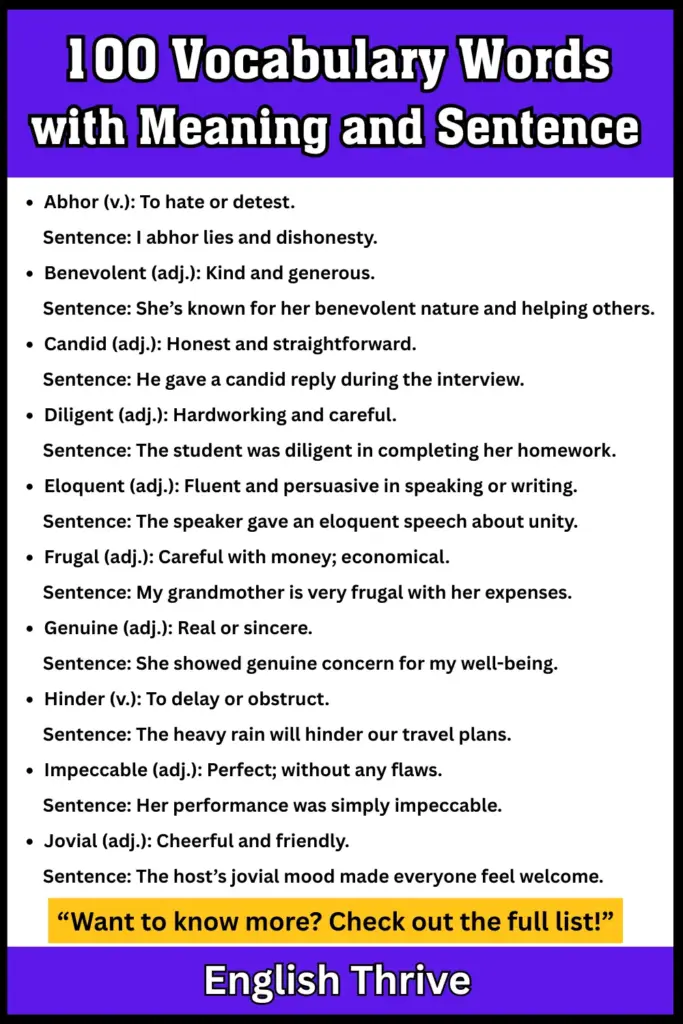
| 1 | Abhor | Verb | To hate or detest. | I abhor lies and dishonesty. |
| 2 | Benevolent | Adjective | Kind and generous. | She’s known for her benevolent nature and helping others. |
| 3 | Candid | Adjective | Honest and straightforward. | He gave a candid reply during the interview. |
| 4 | Diligent | Adjective | Hardworking and careful. | The student was diligent in completing her homework. |
| 5 | Eloquent | Adjective | Fluent and persuasive in speaking or writing. | The speaker gave an eloquent speech about unity. |
| 6 | Frugal | Adjective | Careful with money; economical. | My grandmother is very frugal with her expenses. |
| 7 | Genuine | Adjective | Real or sincere. | She showed genuine concern for my well-being. |
| 8 | Hinder | Verb | To delay or obstruct. | The heavy rain will hinder our travel plans. |
| 9 | Impeccable | Adjective | Perfect; without any flaws. | Her performance was simply impeccable. |
| 10 | Jovial | Adjective | Cheerful and friendly. | The host’s jovial mood made everyone feel welcome. |
| 11 | Keen | Adjective | Eager or enthusiastic. | He’s very keen to learn new skills. |
| 12 | Lucid | Adjective | Clear and easy to understand. | The teacher gave a lucid explanation of the topic. |
| 13 | Meticulous | Adjective | Very careful and precise. | The artist was meticulous about every brushstroke. |
| 14 | Novel | Adjective | New or original. | She came up with a novel idea for the project. |
| 15 | Obsolete | Adjective | Outdated or no longer used. | Many old computer systems are now obsolete. |
| 16 | Prudent | Adjective | Wise and careful in decision-making. | It’s prudent to save money for emergencies. |
| 17 | Quaint | Adjective | Attractively old-fashioned. | They stayed in a quaint little cottage by the lake. |
| 18 | Resilient | Adjective | Able to recover quickly from difficulties. | Children are often resilient after setbacks. |
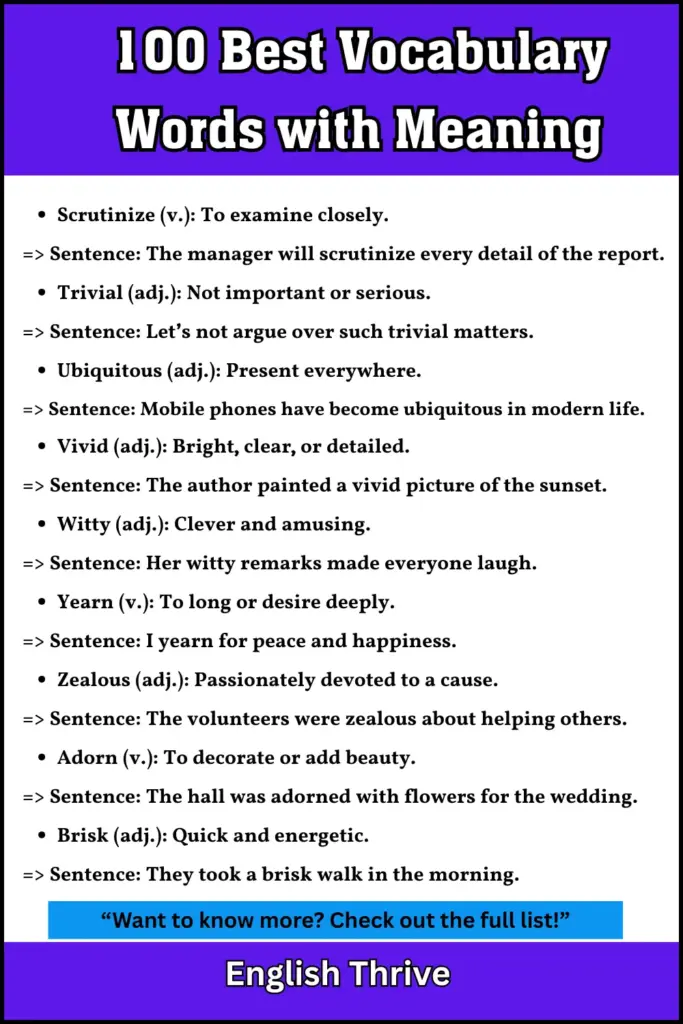
| 19 | Scrutinize | Verb | To examine closely. | The manager will scrutinize every detail of the report. |
| 20 | Trivial | Adjective | Not important or serious. | Let’s not argue over such trivial matters. |
| 21 | Ubiquitous | Adjective | Present everywhere. | Mobile phones have become ubiquitous in modern life. |
| 22 | Vivid | Adjective | Bright, clear, or detailed. | The author painted a vivid picture of the sunset. |
| 23 | Witty | Adjective | Clever and amusing. | Her witty remarks made everyone laugh. |
| 24 | Yearn | Verb | To long or desire deeply. | I yearn for peace and happiness. |
| 25 | Zealous | Adjective | Passionately devoted to a cause. | The volunteers were zealous about helping others. |
Set 2: Words 26–50
| # | Word | Part of Speech | Meaning | Example Sentence |
|---|---|---|---|---|
| 26 | Adorn | Verb | To decorate or add beauty. | The hall was adorned with flowers for the wedding. |
| 27 | Brisk | Adjective | Quick and energetic. | They took a brisk walk in the morning. |
| 28 | Commence | Verb | To begin or start. | The meeting will commence at 10 a.m. |
| 29 | Defy | Verb | To resist or challenge authority. | The protesters chose to defy the curfew. |
| 30 | Emerge | Verb | To come into view or become known. | New leaders will emerge after the election. |
| 31 | Flourish | Verb | To grow or develop successfully. | Small businesses can flourish with good marketing. |
| 32 | Gracious | Adjective | Kind and polite. | She was gracious in accepting the award. |
| 33 | Humble | Adjective | Modest and not proud. | Despite his success, he remains humble. |
| 34 | Illuminate | Verb | To light up or clarify. | Streetlights illuminate the road at night. |
| 35 | Jubilant | Adjective | Extremely joyful. | The crowd was jubilant after the victory. |
| 36 | Kindle | Verb | To spark or inspire. | The teacher’s words kindled a love for reading in her students. |
| 37 | Linger | Verb | To stay longer than expected. | The sweet aroma lingered in the air. |
| 38 | Magnify | Verb | To make something appear larger or more important. | Don’t magnify small problems into big ones. |
| 39 | Nimble | Adjective | Quick and light in movement. | The cat made a nimble jump onto the wall. |
| 40 | Optimistic | Adjective | Hopeful about the future. | She remained optimistic despite the challenges. |
| 41 | Perplex | Verb | To confuse or puzzle. | The strange question perplexed the students. |
| 42 | Quench | Verb | To satisfy thirst or desire. | A glass of water will quench your thirst. |
| 43 | Revere | Verb | To show great respect. | People revere scientists for their discoveries. |
| 44 | Serene | Adjective | Calm and peaceful. | The lake looked serene in the morning light. |
| 45 | Tedious | Adjective | Boring and repetitive. | Filling out forms can be a tedious task. |
| 46 | Ultimate | Adjective | Final or most important. | Success is the ultimate goal of hard work. |
| 47 | Venture | Verb | To take a risk or go on a journey. | They ventured into the forest to explore. |
| 48 | Wane | Verb | To decrease or fade away. | His enthusiasm began to wane after months of effort. |
| 49 | Yield | Verb | To produce or give in. | Hard work always yields good results. |
| 50 | Zenith | Noun | The highest point or peak. | The singer’s career reached its zenith last year. |
Set 3: Words 51–75
| # | Word | Part of Speech | Meaning | Example Sentence |
|---|---|---|---|---|
| 51 | Ample | Adjective | Enough or more than enough. | There was ample food for everyone at the party. |
| 52 | Blissful | Adjective | Extremely happy. | They spent a blissful weekend by the beach. |
| 53 | Cautious | Adjective | Careful to avoid risk. | Be cautious while driving in the rain. |
| 54 | Deter | Verb | To discourage or prevent. | The security cameras deter theft. |
| 55 | Elated | Adjective | Very happy or excited. | She was elated after hearing the good news. |
| 56 | Foster | Verb | To encourage growth or development. | Good teachers foster creativity in their students. |
| 57 | Gloomy | Adjective | Dark or depressing. | The weather looks gloomy today. |
| 58 | Heed | Verb | To pay attention to. | You should heed your teacher’s advice. |
| 59 | Idle | Adjective | Not active or working. | The machines lay idle during the power cut. |
| 60 | Jargon | Noun | Special language used by a profession. | Medical jargon can be confusing for patients. |
| 61 | Kudos | Noun | Praise or recognition. | Kudos to you for completing the project early! |
| 62 | Lenient | Adjective | Not strict or harsh. | The teacher was lenient during the test. |
| 63 | Marvel | Verb | To be amazed. | We marveled at the beauty of the waterfall. |
| 64 | Naive | Adjective | Lacking experience or wisdom. | He’s too naive to see through their lies. |
| 65 | Oblige | Verb | To do something as a favor or duty. | Could you oblige me by closing the door? |
| 66 | Perish | Verb | To die or be destroyed. | Many plants perished in the drought. |
| 67 | Radiant | Adjective | Shining brightly. | Her radiant smile lit up the room. |
| 68 | Solemn | Adjective | Serious and dignified. | The ceremony had a solemn atmosphere. |
| 69 | Tactful | Adjective | Careful not to offend. | He gave a tactful response to the question. |
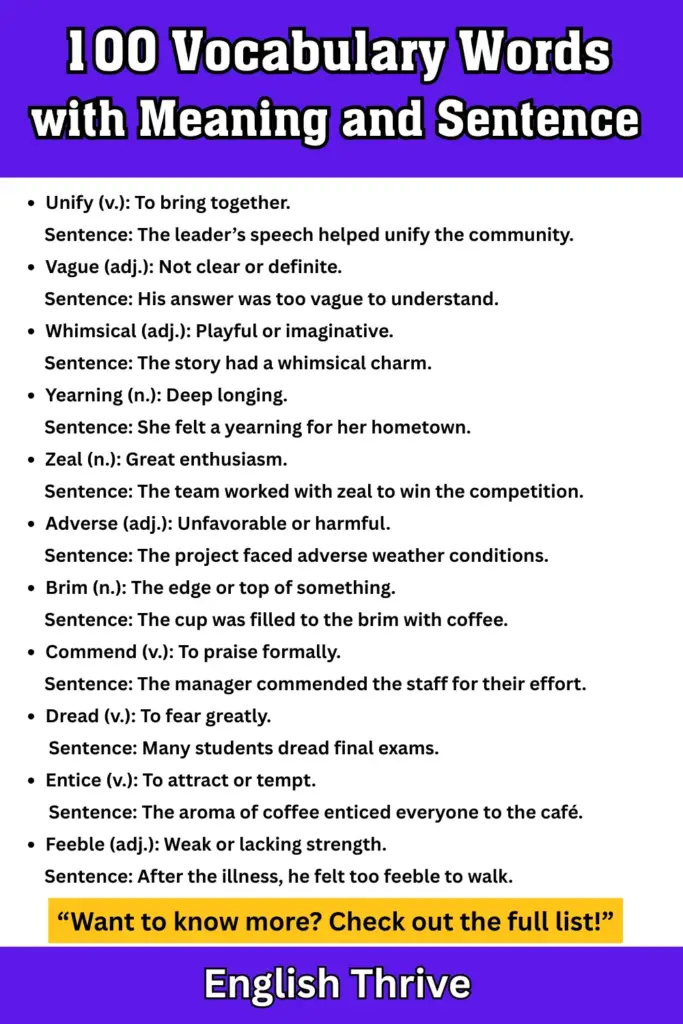
| 70 | Unify | Verb | To bring together. | The leader’s speech helped unify the community. |
| 71 | Vague | Adjective | Not clear or definite. | His answer was too vague to understand. |
| 72 | Whimsical | Adjective | Playful or imaginative. | The story had a whimsical charm. |
| 73 | Concise | Adjective | Short and clear, using few words. | Please keep your answer concise and to the point. |
| 74 | Tenacious | Adjective | Determined; not giving up easily. | The tenacious climber reached the summit despite the storm. |
| 75 | Adverse | Adjective | Unfavorable or harmful. | The project faced adverse weather conditions. |

Set 4: Words 76–100
| # | Word | Part of Speech | Meaning | Example Sentence |
|---|---|---|---|---|
| 76 | Brim | Noun | The edge or top of something. | The cup was filled to the brim with coffee. |
| 77 | Commend | Verb | To praise formally. | The manager commended the staff for their effort. |
| 78 | Dread | Verb | To fear greatly. | Many students dread final exams. |
| 79 | Entice | Verb | To attract or tempt. | The aroma of coffee enticed everyone to the café. |
| 80 | Feeble | Adjective | Weak or lacking strength. | After the illness, he felt too feeble to walk. |
| 81 | Gratify | Verb | To please or satisfy. | It gratified her to see her hard work pay off. |
| 82 | Hindrance | Noun | Something that delays progress. | Lack of funds became a major hindrance. |
| 83 | Improvise | Verb | To make or do something without preparation. | The actor had to improvise his lines on stage. |
| 84 | Juggle | Verb | To balance several tasks at once. | She juggles work, studies, and family responsibilities. |
| 85 | Kindred | Adjective | Related or similar in nature. | They are kindred spirits who think alike. |
| 86 | Lucrative | Adjective | Profitable or rewarding. | Freelancing can be a lucrative career. |
| 87 | Mourn | Verb | To express sorrow for a loss. | The family mourned the passing of their pet. |
| 88 | Nurture | Verb | To care for and encourage growth. | Parents nurture their children’s talents. |
| 89 | Obscure | Adjective | Not clear or well-known. | The meaning of the poem was obscure. |
| 90 | Profound | Adjective | Deep or meaningful. | The book had a profound impact on me. |
| 91 | Reckless | Adjective | Careless of consequences. | His reckless driving caused the accident. |
| 92 | Sustain | Verb | To support or maintain. | The bridge can sustain heavy loads. |
| 93 | Thrive | Verb | To grow or succeed. | Plants thrive in sunlight and water. |
| 94 | Uplift | Verb | To inspire or raise morally. | The movie uplifted everyone’s spirits. |
| 95 | Ponder | Verb | To think about something carefully. | She pondered the question for a moment before answering. |
| 96 | Wander | Verb | To move aimlessly. | The child wandered off into the park. |
| 97 | Yearlong | Adjective | Lasting a full year. | The project was a yearlong effort. |
| 98 | Zest | Noun | Great enthusiasm or energy. | She approaches every task with zest. |
| 99 | Amiable | Adjective | Friendly and pleasant. | The new neighbor is very amiable. |
| 100 | Brilliant | Adjective | Exceptionally clever or impressive. | That’s a brilliant idea for the presentation! |
How to Learn These Words Quickly
- Learn 5 words a day: Small daily sets are easier to remember than 100 words at once.
- Say the example sentence aloud: Hearing the word in context helps your memory.
- Write your own sentence: Connect each word to your own life, for example “I am diligent about my morning study.”
- Review after 1, 3 and 7 days: Spaced review moves words into long-term memory.
- Group similar words: Learn pairs like frugal / lucrative or jubilant / gloomy together.
Practice Exercise: Choose the Right Word
Fill in each blank with a word from the list above. Answers are below.
- She was ________ after hearing she had passed the exam. (very happy)
- Mobile phones have become ________ in modern life. (found everywhere)
- Be ________ while crossing a busy road. (careful)
- Many old computer systems are now ________. (no longer used)
- The teacher gave a ________ explanation, so everyone understood. (clear)
- Good teachers ________ creativity in their students. (encourage)
- Let’s not argue over such ________ matters. (unimportant)
- Please keep your answer ________. (short and clear)
- Heavy rain will ________ our travel plans. (delay)
- The ________ climber never gave up. (determined)
Answers: 1. elated, 2. ubiquitous, 3. cautious, 4. obsolete, 5. lucid, 6. foster, 7. trivial, 8. concise, 9. hinder, 10. tenacious
FAQs about Vocabulary Words with Meaning and Sentence
What are rich vocabulary words?
Rich vocabulary words are precise and expressive words such as eloquent, prudent, resilient and profound. They help you say more with fewer words.
What are 10 vocabulary words in English with meaning?
- Diligent – hardworking
- Elated – very happy
- Frugal – careful with money
- Jovial – cheerful
- Lucid – clear
- Meticulous – very careful
- Prudent – wise
- Resilient – recovers quickly
- Trivial – unimportant
- Zealous – passionate
How many new words should I learn per day?
Five to ten words a day is realistic for most learners. It is better to learn five words well and use them than to read fifty and forget them.
How can I use new vocabulary in a sentence?
Copy the structure of the example sentence, then change the subject and details. For example, “The student was diligent” can become “My brother is diligent at work.”
Are these words useful for IELTS and TOEFL?
Yes. Words like ubiquitous, scrutinize, profound, sustain and foster are common in academic reading and writing. See also our list of advanced IELTS vocabulary words.
More Vocabulary Lists
- New Vocabulary Words with Meaning and Sentences
- A to Z Vocabulary Words with Meaning and Sentences
- 1000 Daily Use English Words with Meaning
- Normal vs Advanced English Vocabulary Words
Conclusion
Learning vocabulary words with meaning and sentence examples is the fastest way to use new words correctly. Start with one set of 25 words, review it often, and use each word in your own sentences. Over a few weeks, you will notice your speaking and writing become clearer and more confident.