

The fastest way to improve your English vocabulary is to read every day, write new words in a vocabulary journal, review them with spaced repetition, and use at least three new words in your own speaking or writing each day. Reading gives you new words in context; reviewing and using them is what makes them stick.
In this guide you will find 15 practical strategies, a ready-made 30-day vocabulary plan, a sample vocabulary journal, and free tools that work for students, exam candidates and adult learners.
Best Ways to Learn Vocabulary: Quick Summary
| Method | How to do it | Time per day | Best for |
|---|---|---|---|
| Read every day | Read one short article or story and note 5 new words | 10–15 min | All levels |
| Vocabulary journal | Write word, meaning, your own sentence and a synonym | 5 min | Remembering words |
| Spaced repetition | Review words after 1, 3 and 7 days (Anki or paper cards) | 5–10 min | Long-term memory |
| Learn in context | Guess the meaning from the sentence before using a dictionary | While reading | Fluent reading |
| Use new words | Say or write at least 3 new words in your own sentences | 5 min | Speaking and writing |
| Word families and roots | Learn create → creation → creative → creatively | 5 min | Exams and essays |
Why Improving Your Vocabulary Is Important
Vocabulary is at the heart of communication. The more words you know, the more ideas you can express. Here’s why it matters:
- Improves communication and clarity: You can express complex thoughts with precision.
- Boosts confidence in speaking and writing: You feel sure about your choice of words.
- Expands reading comprehension: You understand books, essays, and news with ease.
- Enhances academic and career success: A wide vocabulary improves essays, reports, and professional communication.
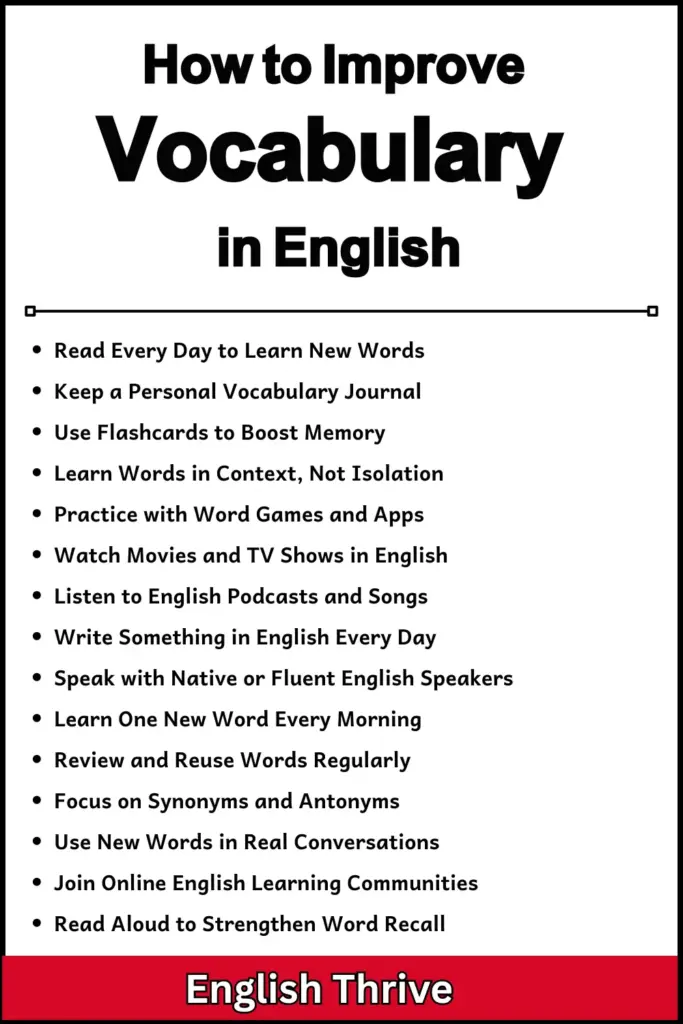
How to Improve Vocabulary in English: 15 Proven Tips That Actually Work
1. Read Widely and Consistently
Reading is the most natural and effective way to expand vocabulary. When you read, your brain learns how words appear in real contexts.
How to practice:
- Read books, newspapers, blogs, and short stories that match your level.
- Highlight or note new words.
- Try to understand their meaning from context before looking them up.
Where to read:
- BBC Learning English Reading Materials
- The Guardian Learning English
- Project Gutenberg (Free English eBooks)
Notes: Start with graded readers or children’s storybooks—they’re short, simple, and effective.
2. Keep a Vocabulary Journal
Writing words down helps you remember them longer.
A vocabulary journal turns passive learning into active recall.
How to make one:
- Divide your notebook into columns: Word | Meaning | Example Sentence | Synonym.
- Review your list every weekend.
- Write personal examples like “I am thrilled to meet you.”
Digital alternative:
- Use Notion or Google Sheets to track words digitally.
Note: Group words by themes (e.g., “Travel Vocabulary,” “Emotions,” “Business Terms”).
Sample vocabulary journal:
| Word | Meaning | My Example Sentence | Synonym |
|---|---|---|---|
| diligent | hardworking and careful | I am diligent about my morning study. | industrious |
| resilient | able to recover quickly | My team was resilient after the loss. | tough |
| concise | short and clear | Write a concise summary of the article. | brief |
3. Use Flashcards or Vocabulary Apps
Flashcards are perfect for quick review sessions.
Apps make it easier with spaced repetition—showing words just before you forget them.
Top Flashcard Tools:
- Quizlet—Create your own flashcard sets or use others’.
- WordUp App—Learn vocabulary through short videos and real-life examples.
- Vocabulary.com—Fun quizzes and word games with explanations.
- Memrise—Teaches vocabulary through video clips and pronunciation guides.
Note: Practice at least 10–15 minutes daily.
4. Learn from Context, Not Translation
Instead of translating every word into your native language, try understanding it from the real context.
This helps your brain connect meaning directly in English—a powerful habit for fluency.
Steps:
- Guess what the word might mean from the sentence.
- Look up its meaning in an English-English dictionary.
- Note its part of speech (noun, verb, adjective, etc.) and example.
- Learn synonyms and antonyms.
Recommended Tools:
5. Watch and Listen to English Content
Listening builds natural vocabulary retention. When you hear words repeatedly in context, you internalize pronunciation and meaning effortlessly.
Watch:
Listen:
Note: Turn on English subtitles while watching movies or shows—it reinforces word spelling and usage.
6. Play Word Games and Quizzes
Learning English With Games and Quizzes makes it more fun and enjoyable.
Try these:
Challenge yourself: Set a weekly “10 new words” goal from the games you play.
7. Learn Word Roots, Prefixes, and Suffixes
When you know the meaning of word parts, you can guess many unfamiliar words.
| Root | Meaning | Example Words |
|---|---|---|
| bio | life | biology, biography, antibiotic |
| graph | write | autograph, paragraph, telegraph |
| spect | look | inspect, spectator, respect |
Learn more:
8. Practice Speaking and Writing Regularly
You must use new words to remember them.
How to practice:
- Speak English daily—even to yourself!
- Write one short paragraph every day using 3–5 new words.
- Join language exchange apps like HelloTalk or Tandem.
Example: Instead of saying “I’m happy,” try “I’m delighted” or “I’m thrilled.”
9. Subscribe to a “Word of the Day”
This simple habit ensures consistent learning.
Best Sources:
Note: Write a mini paragraph using each new word. That’s how you retain it.
10. Use a Dictionary and Thesaurus Smartly
Dictionaries and thesauruses are more than definition tools—they’re windows into word families, pronunciation, and grammar.
Learn to:
- Check pronunciation using audio icons.
- Identify part of speech and usage examples.
- Explore synonyms and antonyms to find better expressions.
11. Join a Book Club or Study Group
Learning in a group helps you stay accountable.
Where to join:
Note: Choose a new book each month and share vocabulary lists with your peers.
12. Focus on Word Forms
Every English word can appear in multiple forms.
Learning them prevents grammar mistakes and enriches your writing.
| Base Verb | Noun | Adjective | Adverb |
|---|---|---|---|
| Create | Creation | Creative | Creatively |
| Decide | Decision | Decisive | Decisively |
| Educate | Education | Educational | Educationally |
Exercise: Write one example sentence using each form.
13. Practice, Review, and Repeat
Vocabulary improvement depends on spaced repetition—reviewing at intervals before forgetting.
Try:
- Anki Flashcards—a free SRS-based system.
- Brainscape—adaptive learning flashcards.
- Weekly quizzes with your friends or study partners.
Rule: “Review 10 words today, 5 tomorrow, and 2 next week—never forget again.”
14. Advanced Tips for Serious Learners
Take your vocabulary to the next level with immersive techniques:
- Switch your phone and apps to English.
- Set goals like “10 new words a day.”
- Read English articles aloud to improve pronunciation.
- Watch shows without subtitles once a week.
- Label objects around your room in English.
Example: Say “refrigerator,” “desk,” or “mirror” instead of their native terms daily.
15. Common Mistakes to Avoid
❌ Memorizing word lists without context.
❌ Ignoring pronunciation.
❌ Learning too many words at once.
❌ Skipping reviews or never using the words again.
✔ Do this instead: Learn fewer words, but use them often in writing and conversation.
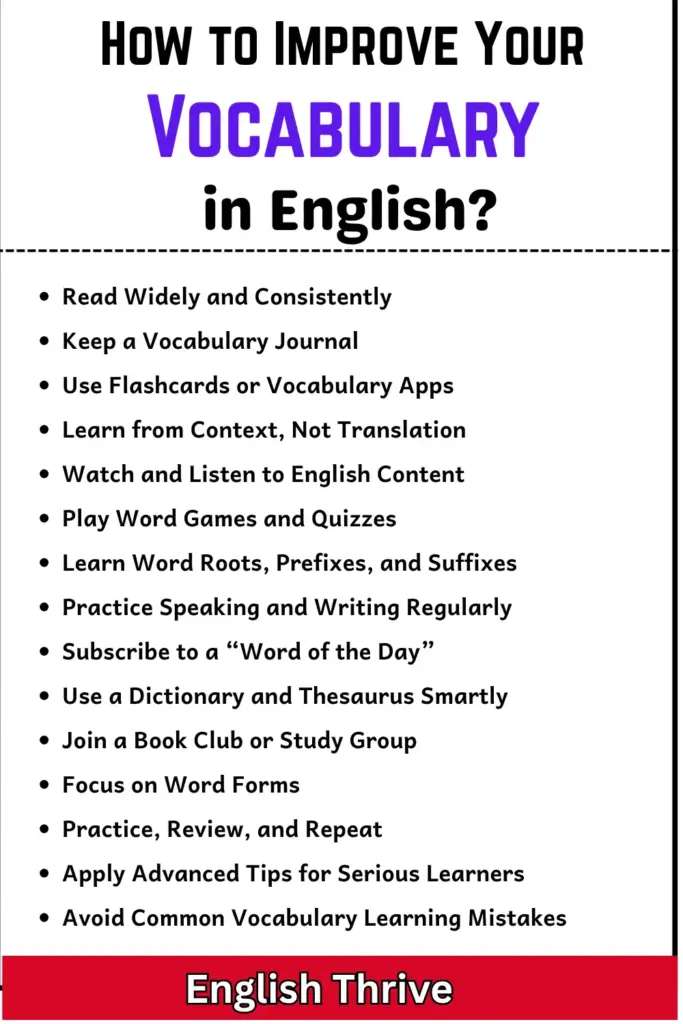
30-Day Plan to Improve Your Vocabulary
Follow this simple plan for one month. It takes about 20 minutes a day.
| Week | Daily Task (20 min) | Weekly Goal |
|---|---|---|
| Week 1 | Read one short article and note 5 new words with meanings. | 35 new words in your journal |
| Week 2 | Review last week’s words with flashcards, then add 5 new words. | Use 10 words in short paragraphs |
| Week 3 | Learn one word family a day (create – creation – creative – creatively). | 7 word families mastered |
| Week 4 | Speak or write for 5 minutes using at least 3 new words. | Test yourself on all 100+ words |

Ready-Made Word Lists to Practise With
Use these lists as your daily reading material:
- 100 Vocabulary Words with Meaning and Sentence – four sets of 25 words with examples
- 120 Basic English Vocabulary for Beginners
- 1000 Daily Use English Words with Meaning
- 75 Advanced IELTS Vocabulary Words
- 500 Idioms and Their Meanings
FAQs about How to Improve Vocabulary in English
1. How can I improve my English vocabulary fast?
Read daily, use flashcards, and apply new words in your writing and speaking. Try tools like Vocabulary.com or WordUp.
2. What are some daily habits to build vocabulary?
Read one article, learn one “word of the day,” and review your vocabulary journal.
3. Which app is best for improving English vocabulary?
Quizlet, Memrise, and Vocabulary.com are among the best.
4. How can I remember new words permanently?
Use spaced repetition systems like Anki and review weekly.
5. How can kids improve their English vocabulary?
Read illustrated storybooks, play word games, and watch educational YouTube channels like British Council Kids.
6. How many words do I need to speak English fluently?
Around 2,000–3,000 common words cover most everyday conversation. For academic reading and exams such as IELTS, aim for 5,000 or more.
7. How long does it take to improve vocabulary?
If you learn 5 words a day and review them, you can add about 150 words a month. Most learners notice clearer speaking and writing within 4–6 weeks.
8. What is the best way to learn vocabulary?
The best way is to combine reading with active use: meet new words in context, write them in a journal, review them with spaced repetition, and use them in your own sentences within a day.
Final Thoughts
Building your English vocabulary takes time, but it’s one of the most rewarding habits you’ll ever develop.
“Every new word you learn is a new door to understanding.”
Stay curious, keep reading, and challenge yourself daily. If you continuously keep trying, you’ll notice your confidence, fluency, and comprehension soar.
To Learn More, Read This Article: 100 Best Vocabulary Words with Meaning and Sentence