

Learning new vocabulary words is one of the most effective ways to improve your English skills. Vocabulary will help you a lot if you want to think clearly and confidently. Each new word you learn will give you a new way to describe ideas, emotions, and experiences.
A rich vocabulary doesn’t just make you fluent – it makes communication easier and more natural. In this guide, you’ll discover useful new English vocabulary words with meanings and example sentences. It shows how each word works in real life.
Let’s start your journey towards becoming more fluent, confident, and expressive in English.
Why Learning New Vocabulary Words Is Important
Building a strong vocabulary is about more than memorizing definitions—it’s about understanding how words fit into everyday communication. Here’s why it’s so important:
1. Improves Communication and Expression
The more words you know, the more precisely you can express your ideas. Instead of saying “good,” you can say amazing, wonderful, or delightful—each adds a different tone and meaning. Vocabulary gives you the tools to say exactly what you mean.
2. Builds Confidence in Speaking and Writing
Knowing the right words increases confidence in conversations, presentations, writing, and everyday communication.
As your vocabulary grows, speaking and writing become smoother, clearer, and more natural.
3. Enhances Academic and Professional Success
A strong vocabulary is vital for success in both education and work. It improves reading comprehension, essay writing, interview performance, and professional communication. Using advanced vocabulary can help you stand out in competitive environments.
A–Z List of New Vocabulary Words with Meaning and Sentences
Below is a curated list of advanced vocabulary words from A to Z, each with clear meanings and example sentences.
A to S Vocabulary Words
| Word | Meaning | Example Sentence |
|---|---|---|
| Beseech | To ask someone urgently and sincerely to do something | I beseech you to reconsider your decision. |
| Defer | To postpone or delay something until a later time | The committee decided to defer the announcement until next week. |
| Elucidate | To make something clear; to explain | The teacher elucidated the complex concept using simple examples. |
| Pragmatic | Dealing with things in a sensible and realistic way | She offered a pragmatic solution instead of an emotional one. |
| Quintessential | Representing the best or most typical example of something | Leonardo da Vinci is the quintessential Renaissance artist. |
| Resilient | Able to recover quickly from difficulties or setbacks | Children are often more resilient than adults when facing change. |
| Scrutinize | To examine or inspect closely and carefully | The detective scrutinized the evidence for hidden clues. |
T to Z Vocabulary Words
| Word | Meaning | Example Sentence |
|---|---|---|
| Tenacious | Persistent; determined to achieve something | She remained tenacious even when the task seemed impossible. |
| Ubiquitous | Present, appearing, or found everywhere | Social media has become ubiquitous in our daily lives. |
| Venerable | Deserving great respect due to age, wisdom, or character | The venerable leader was admired by generations of citizens. |
| Wary | Cautious and alert about possible danger or problems | You should be wary of websites that ask for personal information. |
| Xenophile | A person who is attracted to foreign cultures and people | As a xenophile, he enjoys learning about traditions from around the world. |
| Yearn | To have a deep, strong desire for something | She yearned for a peaceful life in the countryside. |
| Zealous | Showing great energy or enthusiasm for a cause | The volunteers were zealous in their efforts to help the community. |
100 New Vocabulary Words with Meaning
Here is a collection of 100 powerful English vocabulary words with short and clear definitions to enhance your writing, speaking, and comprehension.

A to E
- Abate – To reduce in amount or intensity
- Abridge – To shorten a text without losing meaning
- Adorn – To decorate or make more beautiful
- Affluent – Having a lot of money; wealthy
- Alleviate – To ease pain or make something less severe
- Ambiguous – Having more than one possible meaning
- Amiable – Friendly and pleasant
- Anomaly – Something unusual or unexpected
- Antiquated – Old-fashioned or outdated
- Apathy – Lack of interest or emotion
- Appease – To calm or satisfy someone’s demands
- Arduous – Very difficult or tiring
- Articulate – Able to express ideas clearly and effectively
- Ascend – To move upward or rise
- Aspire – To have an ambitious goal or dream
- Audacious – Extremely bold or daring
- Benevolent – Kind and generous
- Blissful – Full of happiness or joy
- Boisterous – Noisy and full of energy
- Brazen – Shamelessly bold or disrespectful
- Candid – Honest and straightforward
- Capricious – Changing mood or behavior suddenly
- Cautious – Careful to avoid risks
- Chronic – Long-lasting or recurring frequently
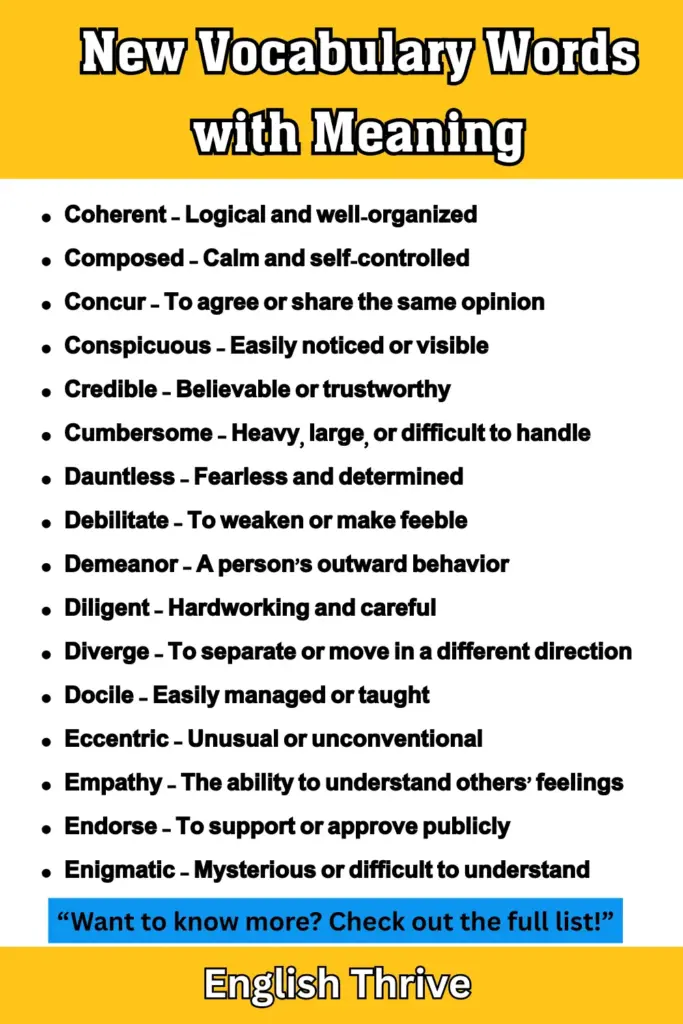
- Coherent – Logical and well-organized
- Composed – Calm and self-controlled
- Concur – To agree or share the same opinion
- Conspicuous – Easily noticed or visible
- Credible – Believable or trustworthy
- Cumbersome – Heavy, large, or difficult to handle
- Dauntless – Fearless and determined
- Debilitate – To weaken or make feeble
- Demeanor – A person’s outward behavior
- Diligent – Hardworking and careful
- Diverge – To separate or move in a different direction
- Docile – Easily managed or taught
- Eccentric – Unusual or unconventional
- Eloquent – Fluent and persuasive in speaking or writing
- Empathy – The ability to understand others’ feelings
- Endorse – To support or approve publicly
- Enigmatic – Mysterious or difficult to understand
- Entail – To involve something as a necessary part
- Eradicate – To destroy completely
- Erratic – Unpredictable or inconsistent
- Exemplify – To serve as an example of something
- Exorbitant – Unreasonably high in amount or price
- Exquisite – Extremely beautiful or delicate
- Extol – To praise highly or enthusiastically
- Exuberant – Full of excitement or energy
- Evoke – To bring a feeling or image to mind
F to Z
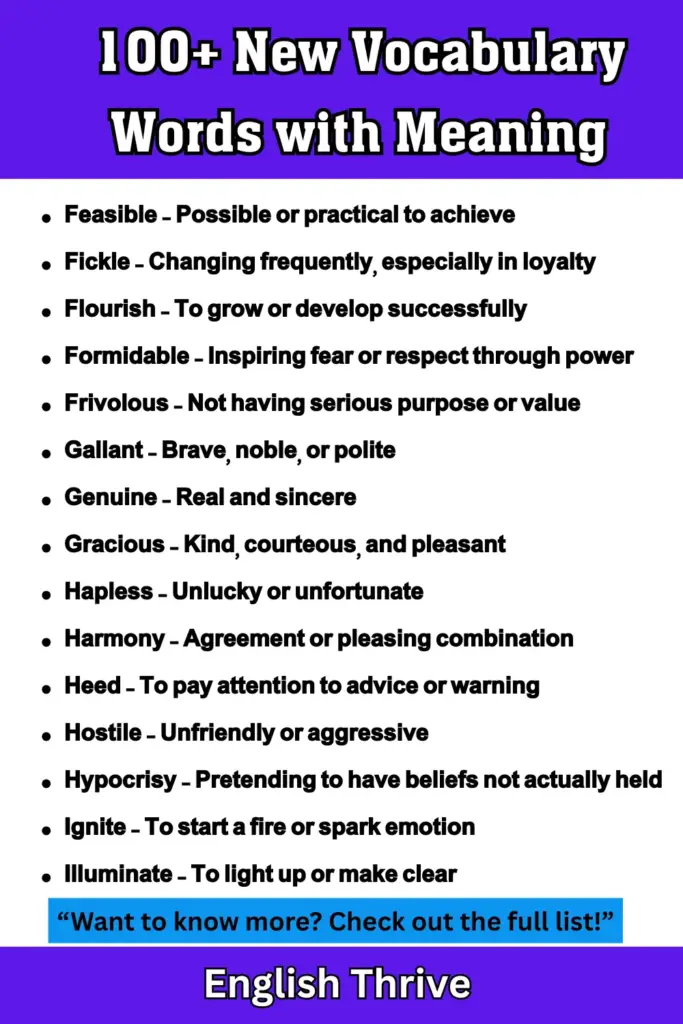
- Feasible – Possible or practical to achieve
- Fickle – Changing frequently, especially in loyalty
- Flourish – To grow or develop successfully
- Formidable – Inspiring fear or respect through power
- Frivolous – Not having serious purpose or value
- Gallant – Brave, noble, or polite
- Genuine – Real and sincere
- Gracious – Kind, courteous, and pleasant
- Hapless – Unlucky or unfortunate
- Harmony – Agreement or pleasing combination
- Heed – To pay attention to advice or warning
- Hostile – Unfriendly or aggressive
- Hypocrisy – Pretending to have beliefs not actually held
- Ignite – To start a fire or spark emotion
- Illuminate – To light up or make clear
- Immaculate – Perfectly clean or pure
- Imminent – About to happen very soon
- Impeccable – Faultless; without flaws
- Incessant – Continuing without stopping
- Incite – To encourage or stir up
- Indignant – Angry because of unfair treatment
- Inevitable – Certain to happen; unavoidable
- Ingenious – Clever, original, and inventive
- Inhibit – To prevent or slow down
- Insipid – Lacking flavor or interest
- Intrepid – Fearless and adventurous
- Judicious – Showing good judgment
- Keen – Sharp, eager, or enthusiastic
- Laudable – Worthy of praise
- Lucrative – Producing a lot of money; profitable
- Luminous – Bright or glowing
- Magnanimous – Generous and forgiving
- Meticulous – Paying great attention to detail
- Munificent – Extremely generous
- Nefarious – Wicked or criminal
- Nostalgic – Missing or longing for the past
- Oblivious – Unaware or not conscious of something
- Omnipotent – Having unlimited power
- Opaque – Not transparent or hard to understand
- Opulent – Rich and luxurious
- Pensive – Deeply thoughtful
- Perilous – Full of danger or risk
- Persevere – To continue despite difficulty
- Plausible – Seeming reasonable or possible
- Prodigious – Remarkably great in size or degree
- Prudent – Acting with care and thought
- Ravenous – Extremely hungry
- Serene – Calm, peaceful, and untroubled
- Tactful – Showing sensitivity when dealing with others
- Vigilant – Watchful and alert to danger
50 New Words with Meanings and Sentences
Below is a list of 50 practical vocabulary words ideal for conversations, writing improvement, and exams.
| Word | Meaning | Example Sentence |
|---|---|---|
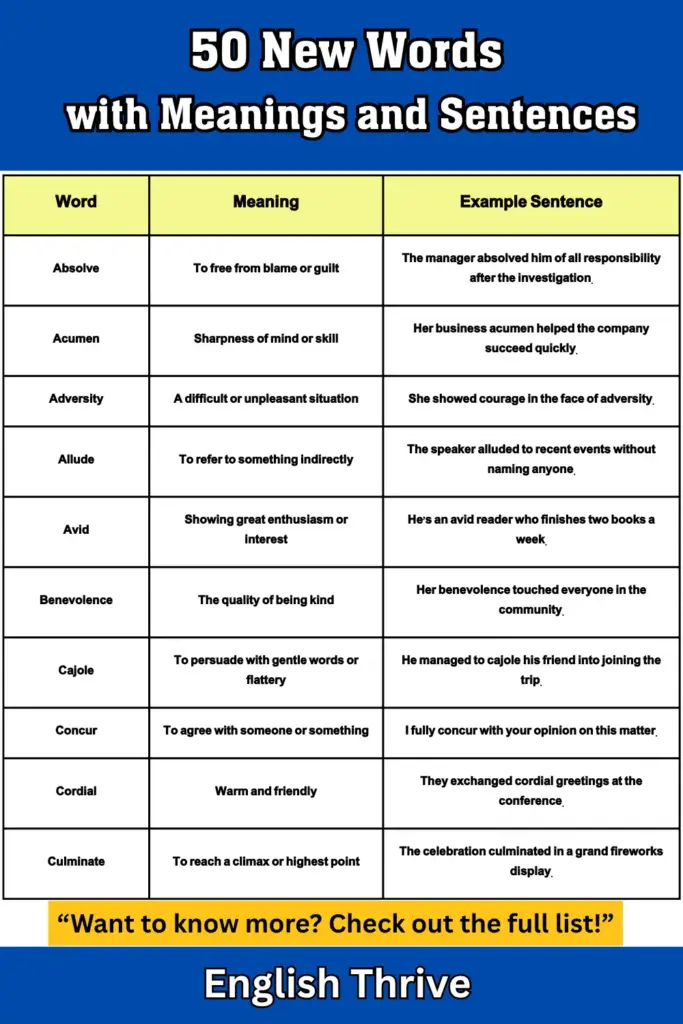
| Absolve | To free from blame or guilt | The manager absolved him of all responsibility after the investigation. |
| Acumen | Sharpness of mind or skill | Her business acumen helped the company succeed quickly. |
| Adversity | A difficult or unpleasant situation | She showed courage in the face of adversity. |
| Allude | To refer to something indirectly | The speaker alluded to recent events without naming anyone. |
| Avid | Showing great enthusiasm or interest | He’s an avid reader who finishes two books a week. |
| Benevolence | The quality of being kind | Her benevolence touched everyone in the community. |
| Cajole | To persuade with gentle words or flattery | He managed to cajole his friend into joining the trip. |
| Concur | To agree with someone or something | I fully concur with your opinion on this matter. |
| Cordial | Warm and friendly | They exchanged cordial greetings at the conference. |
| Culminate | To reach a climax or highest point | The celebration culminated in a grand fireworks display. |
| Defiant | Showing resistance or disobedience | The child gave a defiant look to his teacher. |
| Diligent | Hardworking and careful | She’s a diligent student who always submits work on time. |
| Dismal | Depressing or gloomy | The weather was dismal after three days of nonstop rain. |
| Eminent | Famous and respected | The award was presented to an eminent scientist. |
| Entice | To attract or tempt | The aroma of food enticed everyone into the kitchen. |
| Erudite | Having great knowledge or learning | The professor was an erudite scholar of philosophy. |
| Futile | Pointless or without result | All attempts to fix the old car proved futile. |
| Gregarious | Sociable and fond of company | She’s a gregarious person who enjoys meeting new people. |
| Hinder | To delay or obstruct progress | Bad weather may hinder the construction project. |
| Impartial | Treating all sides fairly | A good judge must remain impartial in all cases. |
| Incisive | Showing sharp understanding | Her incisive analysis revealed the truth behind the issue. |
| Indolent | Lazy or avoiding activity | His indolent attitude prevented him from achieving goals. |
| Irate | Very angry | The irate customer demanded to speak with the manager. |
| Lucid | Clear and easy to understand | The teacher gave a lucid explanation of the problem. |
| Malicious | Intending to do harm | The hacker launched a malicious attack on the website. |
| Mundane | Ordinary or uninteresting | She wanted to escape her mundane routine. |
| Naïve | Lacking experience or sophistication | He’s too naïve to see that she’s lying. |
| Nimble | Quick and light in movement | The nimble dancer impressed the audience with her agility. |
| Obsolete | Out of date; no longer used | Many think CDs are obsolete in the digital era. |
| Ostentatious | Showy or intended to attract attention | His ostentatious display of wealth made others uncomfortable. |
| Palpable | Easily noticed or felt | There was a palpable sense of excitement in the air. |
| Pinnacle | The highest point or peak | Winning the award was the pinnacle of her career. |
| Placid | Calm and peaceful | The lake looked placid under the morning sun. |
| Poignant | Deeply touching or emotional | The movie’s ending was poignant and made everyone cry. |
| Precarious | Not secure; dangerous | The ladder looked precarious, so I didn’t climb it. |
| Prolific | Producing many works or results | The prolific writer published five novels in one year. |
| Rational | Based on reason or logic | Let’s make a rational decision instead of an emotional one. |
| Reclusive | Avoiding the company of others | The artist lived a reclusive life in the countryside. |
| Refute | To prove something wrong | The scientist refuted the old theory with new evidence. |
| Reluctant | Unwilling or hesitant | She was reluctant to share her personal story. |
| Revere | To show deep respect | Students revere their teacher for her kindness. |
| Scrupulous | Extremely careful and honest | He’s known for his scrupulous attention to detail. |
| Skeptical | Doubting or questioning something | She remained skeptical of the claim until she saw proof. |
| Solemn | Serious or sincere in manner | The ceremony was solemn and respectful. |
| Sporadic | Occurring irregularly or infrequently | We have sporadic meetings throughout the year. |
| Stringent | Strict or precise | The school follows stringent rules for discipline. |
| Transient | Lasting only a short time | Beauty is transient, but kindness is everlasting. |
| Turmoil | A state of great confusion or disorder | The country was in turmoil after the election results. |
| Vehement | Showing strong feeling or passion | He made a vehement argument in defense of his idea. |
| Vivid | Producing clear, strong images | I still have vivid memories of my childhood summers. |
Tips for Learning and Remembering New Words
Learning vocabulary becomes easier and more effective when it’s part of your daily routine. Here are proven strategies:
1. Keep a Vocabulary Notebook
Write new words along with meanings, pronunciation, and example sentences.
Review weekly and highlight words you use naturally.
Pro Tip: Organize words by category (verbs, adjectives, nouns).
2. Read and Listen to English Daily
Exposure helps you learn words in real context.
Use books, news articles, podcasts, and videos.
Recommended sources: BBC Learning English, The Guardian, Grammarly Blog.
3. Use Flashcards & Digital Apps
Flashcards reinforce memory through repetition.
Useful apps:
-
Quizlet
-
Memrise
-
WordUp
Spend at least 10 minutes reviewing daily.
4. Play Word Games and Puzzles
Games like Wordle, Scrabble, and crosswords help strengthen recall and spelling.
5. Practice Speaking and Writing
Use new words in:
-
Journals
-
Essays
-
Conversations
-
Social media captions
6. Learn Words in Groups
Group words by themes to remember them more easily.
Examples:
-
Emotion words
-
Academic words
-
Work-related words
7. Use Spaced Repetition
Review new words over time:
Day 1 → Day 3 → Day 7 → Day 15
This method helps store words in long-term memory.
Useful Vocabulary Words for Daily Conversations
Learning advanced vocabulary is helpful, but the words you use every day are even more important. . Below is a list of useful vocabulary words for daily English conversations:
Everyday Life & Routine Words
| Word | Meaning | Example Sentence |
|---|---|---|
| Arrange | To organize or plan something | Let’s arrange a meeting for tomorrow morning. |
| Assist | To help or support someone | Can you assist me with my homework? |
| Purchase | To buy something | We purchased a new table for the living room. |
| Borrow | To take something temporarily | May I borrow your umbrella? |
| Maintain | To keep something in good condition | It’s important to maintain your car regularly. |
| Complete | To finish or make something whole | I finally completed my project on time. |
| Organize | To arrange items or plans neatly | She loves to organize her study desk. |
| Decide | To make a choice after thinking | I can’t decide what to wear tonight. |
Conversation & Expression Words
| Word | Meaning | Example Sentence |
|---|---|---|
| Agree | To have the same opinion | I completely agree with your suggestion. |
| Apologize | To say sorry for something | I apologize for being late to the meeting. |
| Complain | To express dissatisfaction | She complained about the noise next door. |
| Suggest | To offer an idea or plan | May I suggest a better approach? |
| Interrupt | To stop someone from speaking | Please don’t interrupt while I’m talking. |
| Explain | To make something clear | Could you explain how this app works? |
| Promise | To assure someone you will do something | I promise to call you as soon as I arrive. |
| Thank | To express gratitude | I want to thank you for your help today. |
Work & Study Vocabulary
| Word | Meaning | Example Sentence |
|---|---|---|
| Achieve | To successfully reach a goal | She worked hard to achieve her dream. |
| Collaborate | To work together with others | Our team will collaborate on the next project. |
| Contribute | To give or add something to help | Everyone should contribute to group discussions. |
| Evaluate | To assess or judge something | Teachers evaluate students based on performance. |
| Present | To show or share information formally | I have to present my report to the manager. |
| Prepare | To get ready for something | You should prepare for the interview carefully. |
| Organize | To plan or manage activities | We need to organize the files by topic. |
| Submit | To send or deliver formally | Please submit your assignment before Friday. |
Emotions & Feelings Vocabulary
| Word | Meaning | Example Sentence |
|---|---|---|
| Admire | To respect or look up to someone | I really admire your confidence. |
| Appreciate | To recognize the value of something | I truly appreciate your support. |
| Regret | To feel sorry about something | I regret not taking that opportunity earlier. |
| Delighted | Very pleased and happy | I’m delighted to see you again! |
| Annoyed | Slightly angry or irritated | She was annoyed by the constant noise. |
| Grateful | Feeling thankful | I’m grateful for your help today. |
| Worried | Feeling anxious or concerned | He looked worried about the results. |
| Relieved | Feeling calm after stress | I was relieved to hear the good news. |
Travel & Social Situations Vocabulary
| Word | Meaning | Example Sentence |
|---|---|---|
| Book | To reserve something (like a ticket or hotel) | We need to book our seats in advance. |
| Depart | To leave a place | The train will depart at 8 a.m. |
| Arrive | To reach a destination | They arrived late because of traffic. |
| Explore | To travel through a new place | We plan to explore the old town tomorrow. |
| Assist | To help someone in need | The staff will assist you with your luggage. |
| Discover | To find something new | We discovered a beautiful café near the park. |
| Relax | To rest and enjoy yourself | Let’s relax after a long day of work. |
| Invite | To ask someone to come or join | We’d like to invite you to our wedding. |
Daily Action & Habit Vocabulary
| Word | Meaning | Example Sentence |
|---|---|---|
| Wake | To stop sleeping | I usually wake up at 6 a.m. |
| Brush | To clean with a brush | Don’t forget to brush your teeth. |
| Cook | To prepare food | My mom loves to cook new recipes. |
| Exercise | To work out or stay fit | I exercise for 30 minutes every morning. |
| Study | To learn or review lessons | You should study for your test tonight. |
| Shop | To buy goods from stores | We went to shop for clothes at the mall. |
| Clean | To remove dirt or mess | Please clean your room before guests arrive. |
| Rest | To relax and regain energy | You should rest after such a long day. |
How to Practice New Vocabulary in Sentences
It’s not enough to just know new words — you must use them. Here are a few smart ways to practice:
1. Fill-in-the-Blank Exercises
Create small exercises for yourself.
Example:
“I was so ______ when I heard the good news.”
(Answer: elated, thrilled, delighted)
2. Write Short Paragraphs
Pick five new words each day and use them in a paragraph or short story.
Example:
“After a hectic morning, Sarah felt drained but resolute to finish her project before the deadline.”
3. Engage in Real Conversations
Talk with friends, tutors, or language partners online.
Platforms like HelloTalk and Tandem connect you with native speakers for free.
Challenge yourself to use at least two new words per conversation.
4. Record and Listen to Yourself
Speaking out loud helps reinforce memory.
Record short audio notes using new words, then play them back to correct pronunciation and usage.
5. Use New Words in Writing Tasks
Whenever you write an email, caption, or essay, consciously include one new word.
This habit ensures that new vocabulary becomes part of your active English, not just your passive memory.
FAQs about New Vocabulary Words with Meaning
Q1. How can I learn new vocabulary words quickly?
Start with 10–15 new words each week. Use flashcards, write example sentences, and review regularly. Reading and speaking daily will naturally expand your vocabulary.
Q2. What are some simple daily habits to build vocabulary?
Read English books, listen to podcasts, keep a journal, and play word games. Even 15 minutes of exposure daily makes a difference.
Q3. How do I remember new words permanently?
Use spaced repetition — review at intervals (after 1 day, 3 days, and 7 days). Write personal sentences with each word to connect meaning and memory.
Q4. How many words should I learn per day?
For long-term retention, 5–10 words per day is ideal. Focus on understanding and using them rather than memorizing large lists.
Q5. Where can I get printable lists of English vocabulary words?
You can download free resources and vocabulary lists from trusted educational platforms like British Council, Cambridge Dictionary, and EnglishThrive.com.
Final Thoughts
Expanding your English vocabulary is like adding colors to your communication palette. Each new word lets you express yourself more vividly and precisely. Don’t try to memorize hundreds of words at once — focus on small, consistent learning.
“A new word each day is a new door to understanding the world.”
Make learning fun, be curious about words you hear or read, and soon you’ll notice a remarkable improvement in your fluency and confidence.
Keep practicing, and your vocabulary will grow naturally over time.