

Linking verbs are essential components of English grammar, acting as bridges between the subject and a word that describes or renames it. Unlike action verbs that show an action, linking verbs connect the subject to additional information.
Understanding linking verbs is crucial for constructing grammatically correct and meaningful sentences. This article provides a comprehensive guide to linking verbs, covering their definition, structure, types, usage rules, common mistakes, and practice exercises.
Whether you are a beginner or an advanced learner, this resource will enhance your understanding and mastery of linking verbs.
Definition of Linking Verbs
A linking verb, also known as a copula, connects the subject of a sentence to a subject complement. The subject complement is a word or group of words that describes or renames the subject. In simpler terms, a linking verb doesn’t show action; instead, it equates the subject with a description or identification. Linking verbs create a state of being or a connection between two elements in a sentence.
The primary function of a linking verb is to establish a relationship between the subject and its complement. This complement can be an adjective (describing the subject) or a noun (renaming the subject).
Without a linking verb, the sentence would lack a clear connection between the subject and the information provided about it.
Examples:
- She is a doctor. (is links ‘She’ to ‘doctor,’ a noun renaming the subject)
- The soup tastes delicious. (tastes links ‘The soup’ to ‘delicious,’ an adjective describing the subject)
Structural Breakdown
The structure involving a linking verb typically follows a simple pattern: Subject + Linking Verb + Subject Complement. Understanding this structure is crucial for identifying and using linking verbs correctly. Let’s break down each component:
- Subject: The noun or pronoun that the sentence is about.
- Linking Verb: The verb that connects the subject to its complement.
- Subject Complement: The word or group of words that describes or renames the subject. This can be a predicate nominative (noun) or a predicate adjective (adjective).
Predicate Nominative: A noun or pronoun that renames the subject. For example, in the sentence “John is the president,” ‘president’ is the predicate nominative.
Predicate Adjective: An adjective that describes the subject. For example, in the sentence “The sky is blue,” ‘blue’ is the predicate adjective.
Consider these examples to illustrate the structural breakdown:
- Subject: He, Linking Verb: is, Subject Complement: tall (Predicate Adjective)
- Subject: They, Linking Verb: are, Subject Complement: students (Predicate Nominative)
- Subject: The food, Linking Verb: seems, Subject Complement: good (Predicate Adjective)
Types of Linking Verbs
Linking verbs can be categorized into several types based on their function. The most common linking verb is the verb “to be” in its various forms (am, is, are, was, were, be, being, been).
However, other verbs can also function as linking verbs depending on the context.
Forms of “To Be”
The most common linking verbs are forms of the verb “to be.” These forms include am, is, are, was, were, be, being, and been. These verbs directly connect the subject to its complement, indicating a state of being.
Examples:
- I am a teacher.
- She is happy.
- They are friends.
- He was tired.
- We were late.
Sense Verbs
Sense verbs describe sensory experiences and can act as linking verbs when they connect the subject to an adjective that describes its sensory quality. Common sense verbs include look, smell, taste, sound, and feel.
Examples:
- The flower smells sweet.
- The music sounds beautiful.
- The fabric feels soft.
- The food tastes delicious.
- He looks sad.
Verbs of Becoming and Remaining
These verbs indicate a change in state or a continuation of a state. Common verbs in this category include become, seem, appear, grow, remain, and stay.
Examples:
- He became a doctor.
- She seems upset.
- They appear confident.
- He grew old.
- They remained silent.
- She stayed calm.
Examples of Linking Verbs
To further illustrate the use of linking verbs, here are several examples categorized by the type of linking verb used. These examples are presented in tables for clarity.
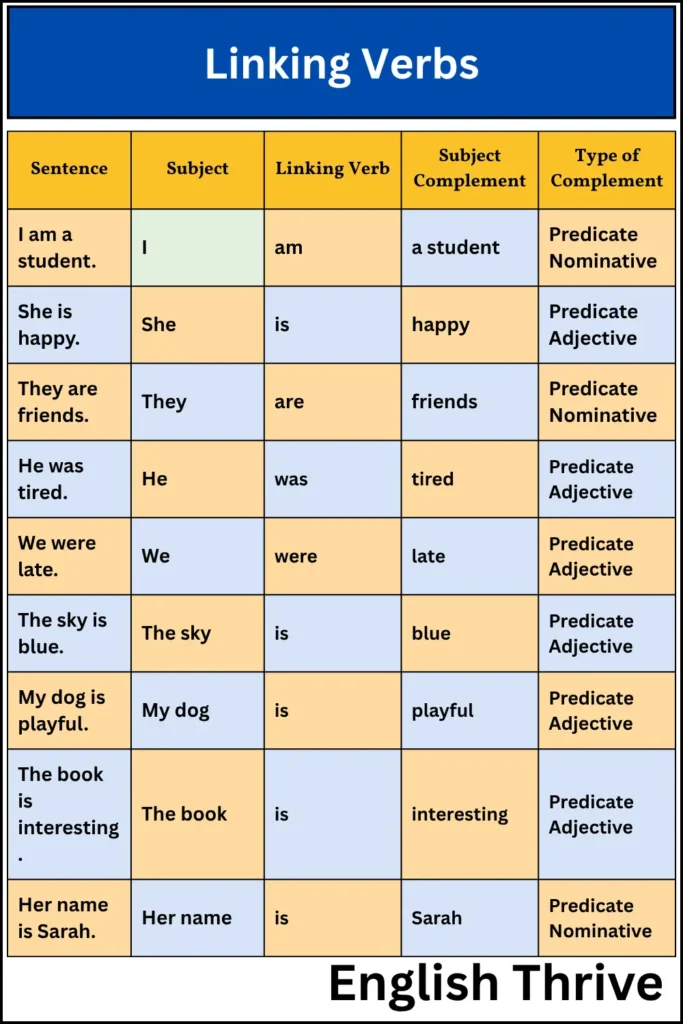
Examples with “To Be” Verbs
This table provides examples of sentences using different forms of the “to be” verb as linking verbs, connecting the subject to a subject complement.
| Sentence | Subject | Linking Verb | Subject Complement | Type of Complement |
|---|---|---|---|---|
| I am a student. | I | am | a student | Predicate Nominative |
| She is happy. | She | is | happy | Predicate Adjective |
| They are friends. | They | are | friends | Predicate Nominative |
| He was tired. | He | was | tired | Predicate Adjective |
| We were late. | We | were | late | Predicate Adjective |
| The sky is blue. | The sky | is | blue | Predicate Adjective |
| My dog is playful. | My dog | is | playful | Predicate Adjective |
| The book is interesting. | The book | is | interesting | Predicate Adjective |
| Her name is Sarah. | Her name | is | Sarah | Predicate Nominative |
| Our team is the best. | Our team | is | the best | Predicate Nominative |
| The weather is cold. | The weather | is | cold | Predicate Adjective |
| My favorite color is green. | My favorite color | is | green | Predicate Nominative |
| The movie was exciting. | The movie | was | exciting | Predicate Adjective |
| The concert was amazing. | The concert | was | amazing | Predicate Adjective |
| His job is an engineer. | His job | is | an engineer | Predicate Nominative |
| They have been busy. | They | have been | busy | Predicate Adjective |
| She will be a star. | She | will be | a star | Predicate Nominative |
| He might be correct. | He | might be | correct | Predicate Adjective |
| I should be studying. | I | should be | studying | Predicate Adjective |
| You must be joking. | You | must be | joking | Predicate Adjective |
| We are being careful. | We | are being | careful | Predicate Adjective |
| It is being renovated. | It | is being | renovated | Predicate Adjective |
| They were being honest. | They | were being | honest | Predicate Adjective |
| The task was being completed. | The task | was being | completed | Predicate Adjective |
Examples with Sense Verbs
This table illustrates how sense verbs connect the subject to an adjective that describes a sensory quality. In these cases, the sense verb acts as a linking verb.
| Sentence | Subject | Linking Verb | Subject Complement | Type of Complement |
|---|---|---|---|---|
| The flower smells sweet. | The flower | smells | sweet | Predicate Adjective |
| The music sounds beautiful. | The music | sounds | beautiful | Predicate Adjective |
| The fabric feels soft. | The fabric | feels | soft | Predicate Adjective |
| The food tastes delicious. | The food | tastes | delicious | Predicate Adjective |
| He looks sad. | He | looks | sad | Predicate Adjective |
| The coffee smells strong. | The coffee | smells | strong | Predicate Adjective |
| The cake tastes amazing. | The cake | tastes | amazing | Predicate Adjective |
| The plan sounds perfect. | The plan | sounds | perfect | Predicate Adjective |
| The weather feels humid. | The weather | feels | humid | Predicate Adjective |
| She looks tired. | She | looks | tired | Predicate Adjective |
| The air smells fresh. | The air | smells | fresh | Predicate Adjective |
| The wine tastes bitter. | The wine | tastes | bitter | Predicate Adjective |
| The idea sounds interesting. | The idea | sounds | interesting | Predicate Adjective |
| The blanket feels warm. | The blanket | feels | warm | Predicate Adjective |
| He looks healthy. | He | looks | healthy | Predicate Adjective |
| The perfume smells floral. | The perfume | smells | floral | Predicate Adjective |
| The soup tastes salty. | The soup | tastes | salty | Predicate Adjective |
| The story sounds unbelievable. | The story | sounds | unbelievable | Predicate Adjective |
| The leather feels smooth. | The leather | feels | smooth | Predicate Adjective |
| She looks beautiful. | She | looks | beautiful | Predicate Adjective |
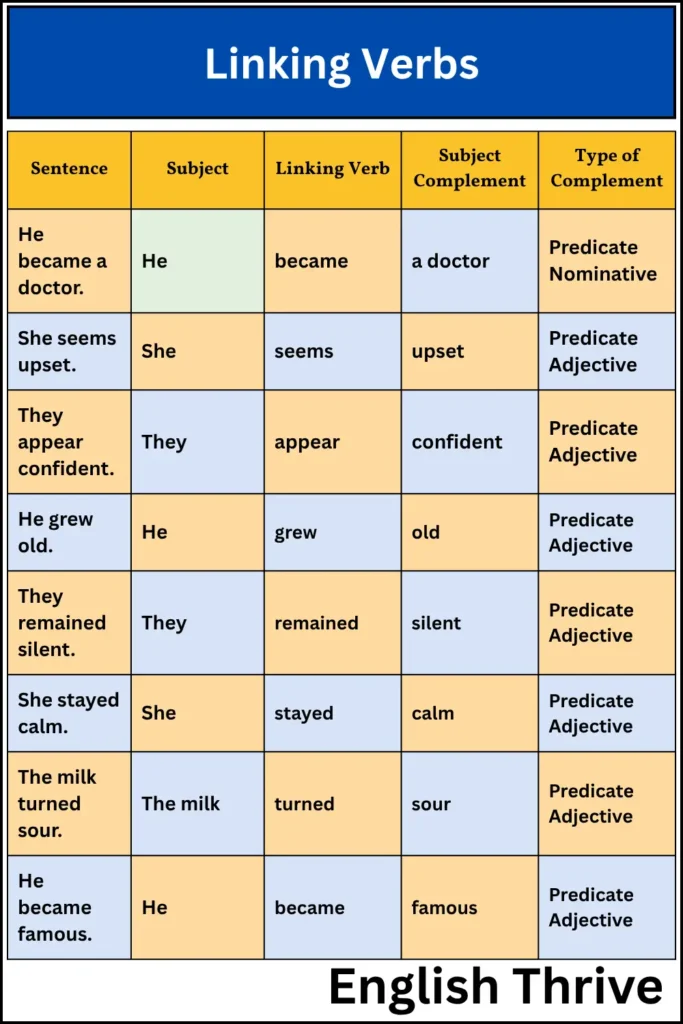
Examples with Verbs of Becoming and Remaining
This table includes sentences where verbs of becoming or remaining act as linking verbs, connecting the subject to a subject complement that indicates a change or continuation of state.
| Sentence | Subject | Linking Verb | Subject Complement | Type of Complement |
|---|---|---|---|---|
| He became a doctor. | He | became | a doctor | Predicate Nominative |
| She seems upset. | She | seems | upset | Predicate Adjective |
| They appear confident. | They | appear | confident | Predicate Adjective |
| He grew old. | He | grew | old | Predicate Adjective |
| They remained silent. | They | remained | silent | Predicate Adjective |
| She stayed calm. | She | stayed | calm | Predicate Adjective |
| The milk turned sour. | The milk | turned | sour | Predicate Adjective |
| He became famous. | He | became | famous | Predicate Adjective |
| She appears happy. | She | appears | happy | Predicate Adjective |
| The situation remained tense. | The situation | remained | tense | Predicate Adjective |
| He grew tired. | He | grew | tired | Predicate Adjective |
| She stayed positive. | She | stayed | positive | Predicate Adjective |
| The leaves turned brown. | The leaves | turned | brown | Predicate Adjective |
| He became successful. | He | became | successful | Predicate Adjective |
| She seems worried. | She | seems | worried | Predicate Adjective |
| The water remained cold. | The water | remained | cold | Predicate Adjective |
| He grew weak. | He | grew | weak | Predicate Adjective |
| She stayed confident. | She | stayed | confident | Predicate Adjective |
| The weather turned bad. | The weather | turned | bad | Predicate Adjective |
| He became a leader. | He | became | a leader | Predicate Nominative |
Usage Rules
Using linking verbs correctly involves understanding certain rules and guidelines. Here are some key points to remember:
- Agreement: The linking verb must agree in number with the subject. If the subject is singular, the verb must be singular; if the subject is plural, the verb must be plural. For example: “She is a teacher” (singular) vs. “They are teachers” (plural).
- Subject Complements: Ensure that the subject complement appropriately describes or renames the subject. The complement should provide meaningful information about the subject.
- Distinguishing Linking Verbs from Action Verbs: Some verbs can function as both linking verbs and action verbs. To determine the function, consider whether the verb connects the subject to a description or shows an action. For example: “He looks tired” (linking verb) vs. “He looks at the picture” (action verb).
- Adjectives vs. Adverbs: After a linking verb, use an adjective to describe the subject, not an adverb. For example: “She seems happy” (correct) vs. “She seems happily” (incorrect).
Example of Subject-Verb Agreement:
- The cat is small. (Singular subject, singular verb)
- The cats are small. (Plural subject, plural verb)
Example of Distinguishing Linking Verbs from Action Verbs:
- Linking Verb: The soup tastes good. (Tastes connects ‘soup’ to the description ‘good’)
- Action Verb: He tastes the soup carefully. (Tastes shows the action of tasting)
Common Mistakes
Learners often make specific mistakes when using linking verbs. Recognizing these errors and understanding how to correct them is crucial for improving accuracy.
Here are some common mistakes:
- Using Adverbs Instead of Adjectives: A common error is using an adverb to describe the subject after a linking verb. The correct form is to use an adjective.
- Incorrect Verb Agreement: Failing to match the verb form to the subject’s number (singular or plural) is another frequent mistake.
- Confusing Linking Verbs with Action Verbs: Not recognizing when a verb is acting as a linking verb versus an action verb can lead to incorrect sentence construction.
Examples of Common Mistakes:
| Incorrect | Correct | Explanation |
|---|---|---|
| She seems happily. | She seems happy. | Adverbs (happily) should not follow linking verbs; adjectives (happy) should. |
| They is ready. | They are ready. | The verb must agree with the subject. ‘They’ is plural, so ‘are’ is correct. |
| He looks the picture. | He looks at the picture. | ‘Looks’ is used as an action verb, requiring a preposition (‘at’) to specify the object. |
| The food tastes strangely. | The food tastes strange. | Use an adjective (strange) to describe the subject after the linking verb ‘tastes’. |
| I is a student. | I am a student. | The verb ‘to be’ must agree with the subject ‘I’; the correct form is ‘am’. |
| The flowers smells nicely. | The flowers smell nice. | Use an adjective (nice) to describe the subject after the linking verb ‘smell’. |
| She feels badly. | She feels bad. | Use an adjective (bad) to describe the subject’s state after the linking verb ‘feels’. |
Practice Exercises
To reinforce your understanding of linking verbs, complete the following exercises. Identify the linking verbs in each sentence and the subject complements they connect.
Exercise 1: Identifying Linking Verbs
Identify the linking verb and subject complement in each sentence.
| Question | Your Answer |
|---|---|
| 1. The cake tastes delicious. | |
| 2. She is a doctor. | |
| 3. They seem happy. | |
| 4. He became a teacher. | |
| 5. The music sounds beautiful. | |
| 6. I am tired. | |
| 7. The fabric feels soft. | |
| 8. They were late. | |
| 9. He looks sad. | |
| 10. We are friends. |
Answer Key:
| Question | Answer |
|---|---|
| 1. The cake tastes delicious. | Linking Verb: tastes, Subject Complement: delicious |
| 2. She is a doctor. | Linking Verb: is, Subject Complement: a doctor |
| 3. They seem happy. | Linking Verb: seem, Subject Complement: happy |
| 4. He became a teacher. | Linking Verb: became, Subject Complement: a teacher |
| 5. The music sounds beautiful. | Linking Verb: sounds, Subject Complement: beautiful |
| 6. I am tired. | Linking Verb: am, Subject Complement: tired |
| 7. The fabric feels soft. | Linking Verb: feels, Subject Complement: soft |
| 8. They were late. | Linking Verb: were, Subject Complement: late |
| 9. He looks sad. | Linking Verb: looks, Subject Complement: sad |
| 10. We are friends. | Linking Verb: are, Subject Complement: friends |
Exercise 2: Choosing the Correct Linking Verb
Choose the correct linking verb to complete each sentence.
| Question | Options | Your Answer |
|---|---|---|
| 1. She ______ a talented artist. | (a) is, (b) are, (c) am | |
| 2. The flowers ______ sweet. | (a) smells, (b) smell, (c) smelling | |
| 3. They ______ happy to be here. | (a) is, (b) am, (c) are | |
| 4. He ______ a doctor last year. | (a) become, (b) became, (c) becoming | |
| 5. The music ______ beautiful. | (a) sound, (b) sounds, (c) sounding | |
| 6. I ______ ready to go. | (a) is, (b) are, (c) am | |
| 7. The cookies ______ delicious. | (a) taste, (b) tastes, (c) tasting | |
| 8. We ______ excited about the trip. | (a) is, (b) are, (c) am | |
| 9. She ______ tired after the long day. | (a) look, (b) looks, (c) looking | |
| 10. The situation ______ tense. | (a) remain, (b) remains, (c) remaining |
Answer Key:
| Question | Answer |
|---|---|
| 1. She ______ a talented artist. | (a) is |
| 2. The flowers ______ sweet. | (b) smell |
| 3. They ______ happy to be here. | (c) are |
| 4. He ______ a doctor last year. | (b) became |
| 5. The music ______ beautiful. | (b) sounds |
| 6. I ______ ready to go. | (c) am |
| 7. The cookies ______ delicious. | (a) taste |
| 8. We ______ excited about the trip. | (b) are |
| 9. She ______ tired after the long day. | (b) looks |
| 10. The situation ______ tense. | (b) remains |
Exercise 3: Correcting Mistakes with Linking Verbs
Identify and correct the mistakes in the following sentences.
| Question | Your Answer |
|---|---|
| 1. She seems happily. | |
| 2. They is ready. | |
| 3. The food tastes strangely. | |
| 4. I is a student. | |
| 5. The flowers smells nicely. | |
| 6. He looks the picture. | |
| 7. She feels badly. | |
| 8. We was late. | |
| 9. It soundly good. | |
| 10. They becomes doctors. |
Answer Key:
| Question | Corrected Answer |
|---|---|
| 1. She seems happily. | She seems happy. |
| 2. They is ready. | They are ready. |
| 3. The food tastes strangely. | The food tastes strange. |
| 4. I is a student. | I am a student. |
| 5. The flowers smells nicely. | The flowers smell nice. |
| 6. He looks the picture. | He looks at the picture. |
| 7. She feels badly. | She feels bad. |
| 8. We was late. | We were late. |
| 9. It soundly good. | It sounds good. |
| 10. They becomes doctors. | They become doctors. |
Advanced Topics
For advanced learners, understanding the nuances of linking verbs can further refine their language skills. Here are some advanced topics related to linking verbs:
- Linking Verbs with Gerunds and Infinitives: Linking verbs can connect subjects to gerunds (verb forms ending in -ing that function as nouns) and infinitives (to + verb). For example: “His favorite activity is reading” (gerund) or “Her goal is to succeed” (infinitive).
- Subjective vs. Objective Complements: While linking verbs primarily connect subjects to subject complements, understanding the difference between subjective and objective complements can enhance sentence analysis.
- Intensive Pronouns as Subject Complements: Intensive pronouns (e.g., myself, yourself, himself) can sometimes function as subject complements after linking verbs for emphasis. For example: “The winner is myself.”
Example of Linking Verb with Gerund:
- Her hobby is painting. (Painting is a gerund acting as the subject complement.)
Example of Linking Verb with Infinitive:
- His aim is to learn. (To learn is an infinitive acting as the subject complement.)
FAQs About Linking Verbs
Here are some frequently asked questions about linking verbs to clarify common points of confusion:
What is the difference between a linking verb and an action verb?
Linking verbs connect the subject to a description or renaming, while action verbs show an action performed by the subject. For example, “She is a teacher” (linking) vs. “She teaches English” (action).
How can I identify a linking verb in a sentence?
Look for verbs that connect the subject to an adjective or noun that describes or renames it. If you can replace the verb with a form of “to be” and the sentence still makes sense, it’s likely a linking verb.
Can a verb be both a linking verb and an action verb?
Yes, some verbs can function as both, depending on the context. For example, “He looks tired” (linking) vs. “He looks at the sky” (action).
What is a subject complement?
A subject complement is a word or group of words that follows a linking verb and describes or renames the subject. It can be an adjective (predicate adjective) or a noun (predicate nominative).
Why is it important to use adjectives instead of adverbs after linking verbs?
Adjectives describe nouns (subjects), while adverbs describe verbs, adjectives, or other adverbs. After a linking verb, you need to describe the subject, so an adjective is appropriate.
Conclusion
Mastering linking verbs is crucial for constructing grammatically sound and meaningful sentences in English. This article has provided a comprehensive overview of linking verbs, including their definition, structure, types, usage rules, common mistakes, and practice exercises.
By understanding the function and application of linking verbs, learners can significantly enhance their writing and speaking skills.
Remember to practice identifying and using linking verbs in various contexts. Pay attention to subject-verb agreement and the correct use of adjectives as subject complements.
With consistent effort and attention to detail, you can confidently incorporate linking verbs into your everyday communication, leading to more precise and effective expression.