Understanding how to express happiness effectively is crucial for clear and engaging communication. Similes, a type of figurative language, offer a vivid and creative way to convey the feeling of happiness by comparing it to something else.
This article provides a comprehensive guide to similes for being happy, covering their definition, structure, types, usage rules, common mistakes, and practice exercises. Whether you are an English language learner, a writer, or simply someone who wants to enhance their vocabulary, this article will equip you with the knowledge and skills to use similes for expressing happiness with confidence and accuracy.
Definition of Similes
A simile is a figure of speech that directly compares two different things, highlighting a common quality or characteristic. It is used to make descriptions more vivid, engaging, and relatable by drawing a connection between something familiar and something less known.
Similes are essential tools in both writing and everyday communication, adding color and depth to language.
Key Characteristics of a Simile:
- Comparison: It explicitly compares two unlike things.
- Comparison Words: It uses words such as “like” or “as” to make the comparison.
- Purpose: It aims to create a clearer or more vivid image in the reader’s or listener’s mind.
Structural Breakdown
Components of a Simile
A simile consists of three main components: the subject (the thing being described), the comparison word (like or as), and the object of comparison (the thing to which the subject is being compared). Understanding these components is crucial for constructing effective and meaningful similes.
Subject: This is the thing that is being described or whose state is being illustrated. It could be a person, an object, a feeling, or an idea.
Comparison Word: This is the word that explicitly makes the comparison. The most common comparison words are “like” and “as”.
Object of Comparison: This is the thing to which the subject is being compared. It should share a common characteristic with the subject to make the simile relevant and understandable.
Comparison Words: “Like” and “As”
The words “like” and “as” are the most commonly used comparison words in similes. While they are often interchangeable, there are subtle differences in their usage.
“Like” is generally used when making a simple comparison, whereas “as” can be used in more complex or formal constructions.
Using “Like”: “Like” is a preposition that indicates similarity. It is straightforward and widely used in both formal and informal contexts.
Using “As”: “As” can function as both a conjunction and a preposition. When used as a conjunction, it can introduce a clause that provides further explanation or context for the comparison.
Types of Similes for Happiness
Nature-Based Similes
Nature-based similes draw comparisons between happiness and elements of the natural world. These similes often evoke feelings of peace, freedom, and beauty, making them particularly effective for conveying a sense of profound happiness.
Abstract Concept Similes
Abstract concept similes compare happiness to intangible ideas or emotions. These similes can be more nuanced and require a deeper understanding of both the subject and the object of comparison.
Object-Based Similes
Object-based similes compare happiness to tangible objects. These similes can be very concrete and relatable, making them easily understandable for a wide audience.
Activity-Based Similes
Activity-based similes compare happiness to specific actions or experiences. These similes can convey a sense of energy, excitement, and fulfillment.
Examples of Similes for Being Happy
Nature-Based Examples
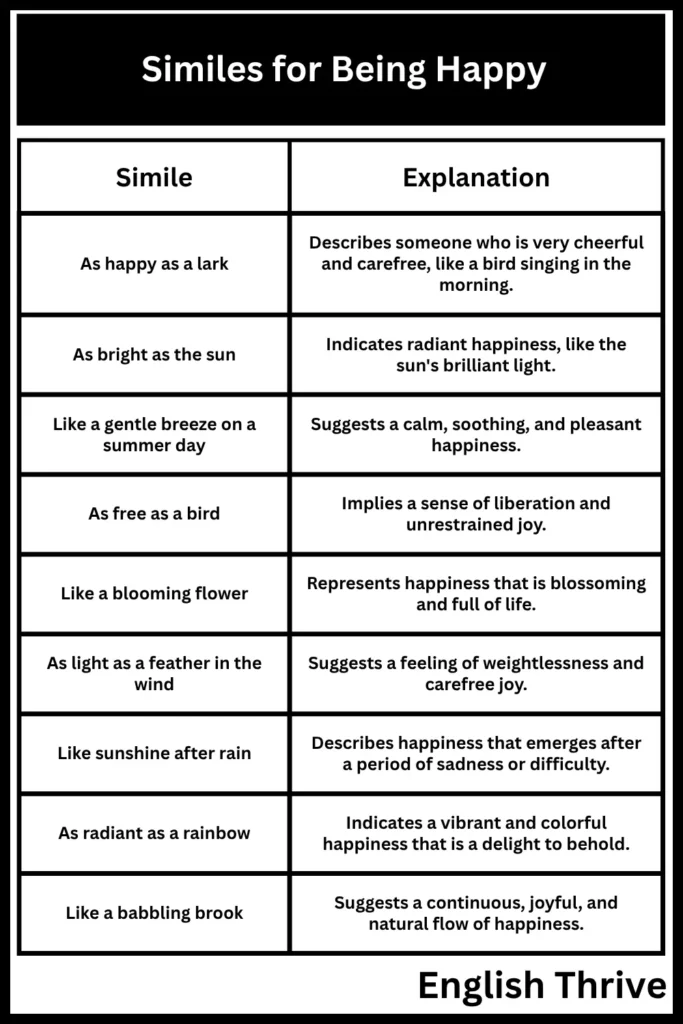
The following table provides examples of nature-based similes used to describe happiness. These similes often invoke feelings of peace, tranquility, and natural beauty, effectively conveying a sense of joy and contentment.
| Simile | Explanation |
|---|---|
| As happy as a lark | Describes someone who is very cheerful and carefree, like a bird singing in the morning. |
| As bright as the sun | Indicates radiant happiness, like the sun’s brilliant light. |
| Like a gentle breeze on a summer day | Suggests a calm, soothing, and pleasant happiness. |
| As free as a bird | Implies a sense of liberation and unrestrained joy. |
| Like a blooming flower | Represents happiness that is blossoming and full of life. |
| As light as a feather in the wind | Suggests a feeling of weightlessness and carefree joy. |
| Like sunshine after rain | Describes happiness that emerges after a period of sadness or difficulty. |
| As radiant as a rainbow | Indicates a vibrant and colorful happiness that is a delight to behold. |
| Like a babbling brook | Suggests a continuous, joyful, and natural flow of happiness. |
| As serene as a calm sea | Implies a deep, peaceful, and undisturbed happiness. |
| Like stars twinkling in the night sky | Represents a subtle yet constant and beautiful happiness. |
| As refreshing as a cool mountain stream | Indicates a revitalizing and invigorating happiness. |
| Like a butterfly dancing in the meadow | Describes a light, playful, and carefree happiness. |
| As warm as the summer sun | Implies a comforting and enveloping happiness. |
| Like leaves rustling in the autumn breeze | Suggests a gentle, subtle, and peaceful happiness. |
| As vibrant as a field of wildflowers | Indicates a lively, colorful, and diverse happiness. |
| Like a river flowing towards the sea | Represents a steady, purposeful, and fulfilling happiness. |
| As clear as a mountain spring | Suggests a pure, unadulterated, and transparent happiness. |
| Like the first bloom of spring | Describes happiness that is fresh, new, and full of promise. |
| As vast as the open sky | Implies a boundless, expansive, and limitless happiness. |
| Like sunlight filtering through the trees | Suggests a gentle, filtered, and comforting happiness. |
| As steady as the mountains | Implies a strong, unwavering, and reliable happiness. |
| Like the sound of waves crashing on the shore | Describes a powerful, rhythmic, and soothing happiness. |
| As gentle as falling snow | Suggests a quiet, peaceful, and delicate happiness. |
| Like the scent of pine trees in the forest | Indicates a refreshing, invigorating, and natural happiness. |
Abstract Concept Examples
The following table provides examples of similes that compare happiness to abstract concepts. These similes delve into the intangible aspects of happiness, offering a deeper understanding of its nature.
| Simile | Explanation |
|---|---|
| As light as a dream | Suggests a happiness that is ethereal and almost unreal. |
| Like a song in my heart | Describes a happiness that is melodic and uplifting. |
| As warm as love | Implies a comforting and affectionate happiness. |
| Like a burst of inspiration | Represents a sudden and exhilarating happiness. |
| As clear as truth | Indicates a genuine and unadulterated happiness. |
| Like a feeling of accomplishment | Suggests a happiness derived from achieving a goal. |
| As satisfying as justice | Implies a happiness that comes from fairness and rightness. |
| Like a sense of belonging | Describes a happiness rooted in connection and acceptance. |
| As comforting as hope | Suggests a happiness that provides reassurance and optimism. |
| Like a moment of clarity | Represents a happiness that comes from understanding and insight. |
| As fulfilling as purpose | Indicates a happiness derived from having a meaningful direction. |
| Like a gift from the universe | Describes a happiness that feels unexpected and fortunate. |
| As empowering as freedom | Suggests a happiness that comes from autonomy and independence. |
| Like a spark of creativity | Represents a happiness that ignites imagination and innovation. |
| As soothing as peace | Implies a calm and tranquil happiness. |
| Like a wave of nostalgia | Describes a bittersweet happiness tinged with memories. |
| As profound as wisdom | Suggests a deep and insightful happiness. |
| Like a rush of adrenaline | Represents an exciting and invigorating happiness. |
| As gentle as kindness | Implies a tender and compassionate happiness. |
| Like an echo of laughter | Describes a lingering and joyful happiness. |
| As pure as innocence | Implies a happiness free from corruption. |
| Like a beacon of hope | Suggests a happiness that guides and inspires. |
| As boundless as imagination | Represents a limitless and creative happiness. |
| Like a breath of fresh air | Describes a revitalizing and invigorating happiness. |
| As deep as understanding | Implies a happiness rooted in comprehension. |
Object-Based Examples
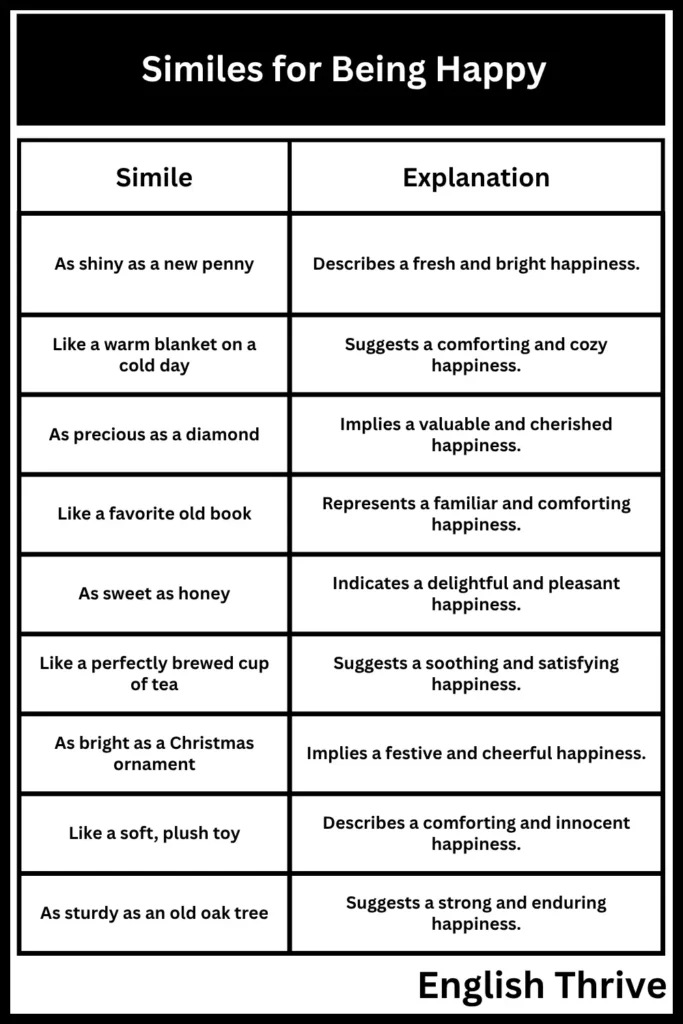
The following table provides examples of similes that compare happiness to tangible objects. These similes offer concrete and relatable imagery, making the feeling of happiness more accessible and understandable.
| Simile | Explanation |
|---|---|
| As shiny as a new penny | Describes a fresh and bright happiness. |
| Like a warm blanket on a cold day | Suggests a comforting and cozy happiness. |
| As precious as a diamond | Implies a valuable and cherished happiness. |
| Like a favorite old book | Represents a familiar and comforting happiness. |
| As sweet as honey | Indicates a delightful and pleasant happiness. |
| Like a perfectly brewed cup of tea | Suggests a soothing and satisfying happiness. |
| As bright as a Christmas ornament | Implies a festive and cheerful happiness. |
| Like a soft, plush toy | Describes a comforting and innocent happiness. |
| As sturdy as an old oak tree | Suggests a strong and enduring happiness. |
| Like a well-worn leather jacket | Represents a comfortable and familiar happiness. |
| As light as a balloon | Indicates a carefree and buoyant happiness. |
| Like a sparkling glass of champagne | Describes a celebratory and effervescent happiness. |
| As colorful as a box of crayons | Suggests a vibrant and diverse happiness. |
| Like a warm, crackling fireplace | Implies a cozy and comforting happiness. |
| As smooth as silk | Indicates a luxurious and pleasant happiness. |
| Like a treasure chest full of gold | Represents a rich and rewarding happiness. |
| As clear as a crystal vase | Suggests a pure and transparent happiness. |
| Like a comforting cup of cocoa | Describes a warm and reassuring happiness. |
| As radiant as a polished mirror | Implies a bright and reflective happiness. |
| Like a perfectly tuned musical instrument | Represents a harmonious and balanced happiness. |
| As soft as a cloud | Suggests a gentle and comforting happiness. |
| Like a brand-new car | Describes an exciting and invigorating happiness. |
| As strong as steel | Implies a resilient and unwavering happiness. |
| Like a cozy, old sweater | Represents a comfortable and familiar happiness. |
| As vibrant as a painting | Indicates a lively and colorful happiness. |
Activity-Based Examples
The following table provides examples of similes that compare happiness to specific activities or experiences. These similes convey a sense of energy, excitement, and fulfillment, making the feeling of happiness more dynamic and engaging.
| Simile | Explanation |
|---|---|
| Like dancing in the rain | Describes a carefree and joyful happiness. |
| As exciting as riding a roller coaster | Suggests a thrilling and exhilarating happiness. |
| Like winning the lottery | Implies a sudden and overwhelming happiness. |
| As satisfying as finishing a marathon | Represents a hard-earned and fulfilling happiness. |
| Like laughing with old friends | Indicates a comfortable and joyful happiness. |
| As relaxing as lying on a beach | Describes a peaceful and serene happiness. |
| Like opening a surprise gift | Suggests an unexpected and delightful happiness. |
| As rewarding as helping someone in need | Implies a selfless and fulfilling happiness. |
| Like watching a beautiful sunset | Represents a serene and awe-inspiring happiness. |
| As invigorating as a morning run | Describes an energizing and revitalizing happiness. |
| Like reading a captivating book | Suggests an immersive and enjoyable happiness. |
| As comforting as a warm hug | Implies a tender and reassuring happiness. |
| Like achieving a long-term goal | Represents a fulfilling and satisfying happiness. |
| As exciting as traveling to a new place | Describes an adventurous and stimulating happiness. |
| Like listening to your favorite song | Suggests a familiar and uplifting happiness. |
| As peaceful as meditating in silence | Implies a calm and centered happiness. |
| Like creating a work of art | Represents a fulfilling and expressive happiness. |
| As joyful as celebrating a special occasion | Describes a festive and cheerful happiness. |
| Like spending time with loved ones | Suggests a warm and connected happiness. |
| As liberating as overcoming a fear | Implies a powerful and empowering happiness. |
| Like learning something new | Suggests a stimulated and growing happiness. |
| As therapeutic as journaling your thoughts | Represents a reflective and healing happiness. |
| Like the feeling of accomplishment after a workout | Describes a satisfied and physically rewarding happiness. |
| As satisfying as a home-cooked meal | Implies a nurturing and comforting happiness. |
| Like the excitement of a new adventure | Suggests an unparalleled and thrilling happiness. |
Usage Rules for Similes
Appropriateness and Context
The effectiveness of a simile depends on its appropriateness for the context in which it is used. Consider the audience, the tone of the writing, and the overall message you are trying to convey.
A simile that is too informal or unconventional may not be suitable for a formal setting, while a simile that is too generic may not be effective in capturing the reader’s attention.
Consider the Audience: Tailor your similes to the knowledge and experience of your audience. A simile that relies on obscure references or specialized knowledge may not be understood by everyone.
Match the Tone: Ensure that your similes align with the overall tone of your writing. A humorous simile may be appropriate for a lighthearted piece, but not for a serious or somber one.
Support the Message: Choose similes that reinforce the message you are trying to convey. A simile that is irrelevant or contradictory can confuse the reader and undermine your argument.
Clarity and Relevance
A good simile should be clear and relevant, making the comparison easy to understand. Avoid using similes that are too abstract or ambiguous, as they can confuse the reader and detract from your message.
The connection between the subject and the object of comparison should be obvious and logical.
Make the Connection Clear: Ensure that the shared characteristic between the subject and the object of comparison is evident. Explain the connection if necessary to avoid any ambiguity.
Avoid Overly Abstract Comparisons: While abstract similes can be effective, they should be used with caution. Make sure that the comparison is still grounded in a recognizable and understandable concept.
Use Concrete Imagery: Whenever possible, use concrete imagery to make your similes more vivid and relatable. Concrete imagery helps the reader visualize the comparison and connect with your message on a deeper level.
Originality and Creativity
While there are many common similes that can be effective, striving for originality and creativity can make your writing stand out. Avoid relying too heavily on clichés or overused similes.
Instead, try to come up with fresh and imaginative comparisons that will surprise and delight your readers.
Avoid Clichés: Clichéd similes, such as “as happy as a clam,” have lost their impact through overuse. Try to find more original and inventive ways to express your ideas.
Think Outside the Box: Challenge yourself to come up with unexpected comparisons that will make your readers see things in a new light.
Use Sensory Details: Incorporate sensory details, such as sight, sound, smell, taste, and touch, to make your similes more vivid and engaging.
Common Mistakes When Using Similes
Using Clichéd Similes
One of the most common mistakes is using clichéd or overused similes. These similes have lost their impact and can make your writing seem unoriginal and uninspired.
It’s better to create fresh and unique comparisons that surprise and engage the reader.
Correct: Her laughter was like a melody, filling the room with joy.
Incorrect: Her laughter was as clear as a bell.
Making Inaccurate Comparisons
Another common mistake is making inaccurate or illogical comparisons. A simile should draw a clear and meaningful connection between the subject and the object of comparison.
If the comparison is strained or nonsensical, it can confuse the reader and detract from your message.
Correct: He was as nervous as a long-tailed cat in a room full of rocking chairs.
Incorrect: He was as nervous as a house.
Creating Overly Complex Similes
While it’s good to be creative, avoid creating similes that are too complex or convoluted. A simile should be easy to understand and relate to.
If the comparison is too obscure or requires too much explanation, it can lose its effectiveness.
Correct: The feeling of success was like a warm embrace after a long journey.
Incorrect: The feeling of success was like an abstract painting depicting the existential angst of a post-modern society.
Practice Exercises
Exercise 1: Identifying Similes
Identify the similes in the following sentences and explain what two things are being compared.
| Question | Answer |
|---|---|
| 1. Her smile was as radiant as the morning sun. | Simile: as radiant as the morning sun. Comparison: Her smile is being compared to the radiance of the morning sun. |
| 2. He felt like a king after receiving the award. | Simile: like a king. Comparison: His feeling is being compared to the feeling of being a king. |
| 3. The music flowed like a gentle stream. | Simile: like a gentle stream. Comparison: The music is being compared to a gentle stream. |
| 4. She was as happy as a clam at high tide. | Simile: as happy as a clam at high tide. Comparison: Her happiness is being compared to the happiness of a clam at high tide. |
| 5. His heart felt like a balloon, ready to burst with joy. | Simile: like a balloon, ready to burst with joy. Comparison: His heart is being compared to a balloon about to burst. |
| 6. The atmosphere was as festive as a carnival. | Simile: as festive as a carnival. Comparison: The atmosphere is being compared to a carnival. |
| 7. He felt like he had won the lottery when he heard the news. | Simile: like he had won the lottery. Comparison: His feeling is being compared to the feeling of winning the lottery. |
| 8. Her voice was as sweet as honey. | Simile: as sweet as honey. Comparison: Her voice is being compared to the sweetness of honey. |
| 9. The child’s laughter was like music to her ears. | Simile: like music to her ears. Comparison: The child’s laughter is being compared to music. |
| 10. He was as content as a cat basking in the sun. | Simile: as content as a cat basking in the sun. Comparison: His contentment is being compared to a cat basking in the sun. |
Exercise 2: Completing Similes
Complete the following similes with an appropriate ending to describe happiness.
| Question | Answer |
|---|---|
| 1. As happy as ______ | As happy as a lark |
| 2. Like a ______ | Like a song in my heart |
| 3. As bright as ______ | As bright as the sun |
| 4. Like sunshine after ______ | Like sunshine after rain |
| 5. As free as ______ | As free as a bird |
| 6. Like a gentle breeze on ______ | Like a gentle breeze on a summer day |
| 7. As warm as ______ | As warm as love |
| 8. Like a burst of ______ | Like a burst of inspiration |
| 9. As sweet as _______ | As sweet as honey |
| 10. Like dancing in _______ | Like dancing in the rain |
Exercise 3: Creating Your Own Similes
Create your own similes to describe the feeling of happiness in the following scenarios.
| Scenario | Example Answer |
|---|---|
| 1. Receiving good news | Receiving good news felt like a weight being lifted off my shoulders. |
| 2. Spending time with loved ones | Spending time with loved ones is as comforting as a warm blanket on a cold winter night. |
| 3. Achieving a personal goal | Achieving my personal goal felt like reaching the summit of a mountain after a long climb. |
| 4. Experiencing a beautiful sunset | Experiencing a beautiful sunset is as serene as watching a painter create a masterpiece. |
| 5. Listening to your favorite music | Listening to my favorite music is like a familiar friend giving me a warm hug. |
| 6. Helping someone in need | Helping someone in need felt like planting a seed of kindness that would blossom into something beautiful. |
| 7. Witnessing a child’s laughter | Witnessing a child’s laughter is as pure as a mountain spring. |
| 8. Overcoming a challenge | Overcoming a challenge felt like breaking through a dark cloud into the bright sunshine. |
| 9. Waking up on a beautiful morning | Waking up on a beautiful morning is like a fresh start, full of possibilities. |
| 10. Finding peace in nature | Finding peace in nature is as calming as the gentle lapping of waves on the shore. |
Advanced Topics
Simile vs. Metaphor: Nuances and Differences
While both similes and metaphors are figures of speech that make comparisons, they differ in their approach. A simile uses “like” or “as” to make a direct comparison, whereas a metaphor implies a comparison without using these words.
Understanding the nuances between similes and metaphors can help you use figurative language more effectively.
Simile: Explicit comparison using “like” or “as.” Example: “Her smile was like the sun.”
Metaphor: Implicit comparison, stating that something is something else. Example: “Her smile was the sun.”
Similes in Literature and Poetry
Similes are widely used in literature and poetry to enhance imagery, evoke emotions, and create deeper meaning. Authors and poets often use similes to bring their writing to life and make it more engaging for the reader.
Analyzing how similes are used in literary works can provide valuable insights into their effectiveness and impact.
Example in Poetry: “My love is like a red, red rose” (Robert Burns). This simile compares the poet’s love to a beautiful and vibrant rose.
Example in Literature: “The years passed like quick dreams” (Oscar Wilde). This simile conveys the fleeting nature of time.
FAQs About Similes for Being Happy
Q1: What is the main purpose of using similes?
The main purpose of using similes is to make descriptions more vivid, engaging, and relatable by drawing a comparison between two different things. Similes help to create a clearer image in the reader’s or listener’s mind and add depth to language.
Q2: How do I choose the right simile for a particular situation?
To choose the right simile, consider the context, audience, and the message you are trying to convey. Ensure that the comparison is clear, relevant, and appropriate for the situation.
Avoid using clichés and strive for originality and creativity.
Q3: Can I use similes in formal writing?
Yes, you can use similes in formal writing, but it’s important to use them judiciously and ensure that they are appropriate for the tone and style of the writing. Avoid using overly informal or colloquial similes in formal contexts.
Q4: What is the difference between a simile and a metaphor?
A simile makes a direct comparison using words like “like” or “as,” while a metaphor implies a comparison without using these words. A simile says something is like something else, whereas a metaphor states that something is something else.
Q5: How can I improve my ability to create effective similes?
To improve your ability to create effective similes, practice observing the world around you and identifying similarities between different things. Read widely to expose yourself to different styles of writing and pay attention to how similes are used by other writers. Experiment with different comparisons and don’t be afraid to be creative.
Q6: Are there any situations where I should avoid using similes?
While similes can be a powerful tool, there are some situations where it may be best to avoid using them. For example, in highly technical or scientific writing, clarity and precision are paramount, and figurative language may be seen as unnecessary or distracting. Additionally, if you are unsure whether a simile will be understood by your audience, it may be best to avoid using it.
Q7: What role do similes play in poetry and literature?
Similes play a crucial role in poetry and literature by enhancing imagery, evoking emotions, and creating deeper meaning. They help authors and poets bring their writing to life and make it more engaging and memorable for the reader. By drawing comparisons between different things, similes can also provide new perspectives and insights.
Q8: How can I avoid using clichéd similes in my writing?
To avoid using clichéd similes, make a conscious effort to come up with fresh and original comparisons. Instead of relying on overused phrases, try to think outside the box and find unique ways to express
your ideas. Use sensory details and personal experiences to create similes that are both vivid and meaningful.
Conclusion
Similes are a powerful tool for expressing happiness in a vivid and engaging way. By understanding their structure, types, and usage rules, you can effectively use similes to enhance your writing and communication.
Practice creating original and creative comparisons to avoid clichés and make your writing stand out. Whether you are a writer, a student, or simply someone who wants to improve their language skills, mastering the art of using similes will undoubtedly enrich your ability to convey emotions and ideas with clarity and impact.
Embrace the opportunity to explore new perspectives and bring your writing to life with the magic of similes.