

Ever wondered why English speakers say “one tooth” but “two teeth”? Mastering singular and plural numbers in English grammar can be tricky, but it’s a vital skill for clear communication. As an English teacher for over a decade, I’ve developed fun and effective exercises to help students grasp these concepts easily. Let’s explore the fascinating world of singular and plural numbers together, with practical exercises that will boost your confidence in using them correctly.
Understanding Number Changes
When we talk about changing numbers in English grammar, we’re really talking about how words transform when they show more than one of something. It’s like watching a butterfly emerge from its cocoon – one form changes into another!
Common Patterns Table
| Singular | Plural | Rule Applied |
|---|---|---|
| book | books | Add ‘s’ |
| box | boxes | Add ‘es’ after x |
| baby | babies | Change ‘y’ to ‘i’ + es |
| wife | wives | Change ‘f’ to ‘v’ + es |
| child | children | Special ending ‘ren’ |
Practice Exercise Table
Complete this exercise by changing these words to plural:
| Singular | Your Answer | Correct Plural |
|---|---|---|
| dog | _____ | dogs |
| class | _____ | classes |
| story | _____ | stories |
| leaf | _____ | leaves |
| mouse | _____ | mice |
Common Number Changes
Here’s your go-to guide for frequently searched number changes:
-
Change the number (basic)
- one pen → many pens
- one cat → many cats
-
Change the number twenty
- twenty → twenties
- twenty-one → twenty-ones
-
Change the number baby
- baby → babies
- baby doll → baby dolls
- baby-sitter → baby-sitters
-
Change the number book
- book → books
- textbook → textbooks
- bookshelf → bookshelves
-
Change the number boy
- boy → boys
- schoolboy → schoolboys
- boyfriend → boyfriends
-
Change the number foot
- foot → feet
- footprint → footprints
- football → footballs
-
Change the number for class 1
- Basic nouns:
- cat → cats
- dog → dogs
-
pen → pens
- Basic nouns:
-
Change the number for class 2
- Complex nouns:
- box → boxes
- brush → brushes
- dish → dishes
- Complex nouns:
-
Change the number in English
- Regular patterns:
- table → tables
- chair → chairs
- door → doors
- Regular patterns:
-
Change the number in English grammar
- Grammar-specific:
- pronoun → pronouns
- verb → verbs
- noun → nouns
- Grammar-specific:
-
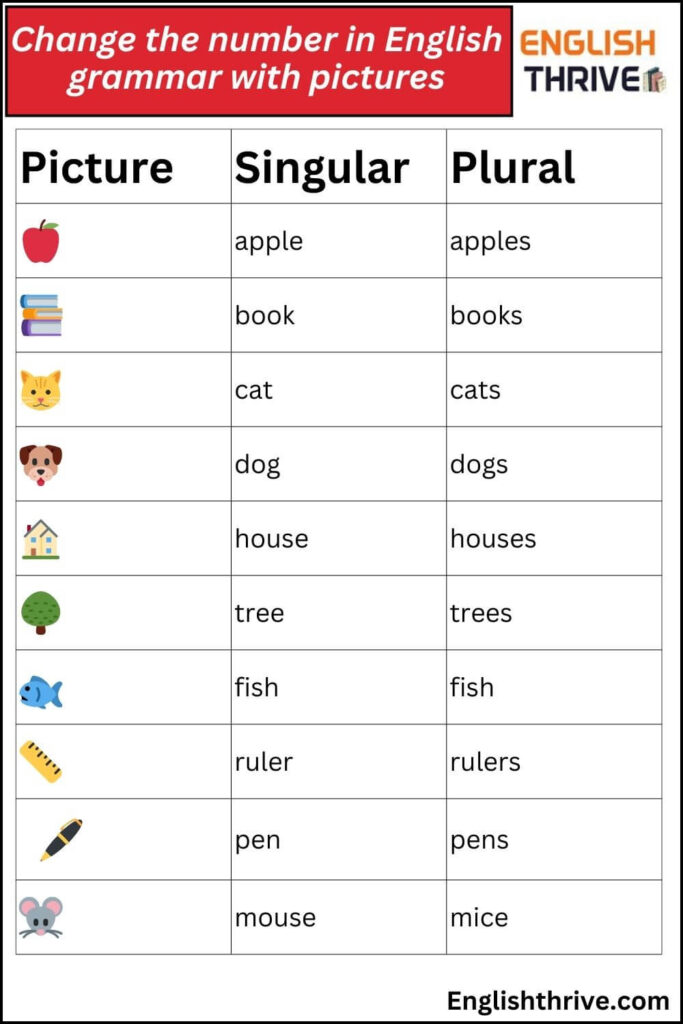
Change the number in English grammar with pictures
-
Change the number in sentences
- The dog barks loudly. → The dogs bark loudly.
- A child plays in the park. → Children play in the park.
- The leaf falls from the tree. → The leaves fall from the tree.
-
Change the number leaf
- leaf → leaves
- maple leaf → maple leaves
- leaf blower → leaf blowers
-
Change the number man
- man → men
- gentleman → gentlemen
- policeman → policemen
-
Change the number mango
- mango → mangoes/mangos
- mango tree → mango trees
- mango juice → mango juices
-
Change the number meaning
- Definition:
- Singular: indicates one
- Plural: indicates more than one
Word Singular Plural sheep one sheep many sheep person one individual people/persons data one piece of information multiple pieces of information fish one fish many fish man one man men woman one woman women child one child children mouse one mouse mice foot one foot feet tooth one tooth teeth goose one goose geese ox one ox oxen deer one deer many deer series one series many series species one species many species criterion one criterion criteria phenomenon one phenomenon phenomena analysis one analysis analyses thesis one thesis theses radius one radius radii cactus one cactus cacti/cactuses focus one focus foci/focuses fungus one fungus fungi/funguses nucleus one nucleus nuclei basis one basis bases crisis one crisis crises media one medium media curriculum one curriculum curricula/curriculums formula one formula formulae/formulas index one index indices/indexes
- Definition:
-
Change the number of
Common Examples:
- one piece of cake → two pieces of cake
- one grain of rice → many grains of rice
- one drop of water → several drops of water
-
Change the number of man
- man → men
- Compound forms:
- businessman → businessmen
- fisherman → fishermen
- chairman → chairmen Note: Modern alternatives:
- businessperson → businesspeople
- fisher → fishers
- chairperson → chairpersons
-
Change the number of the following words
Singular Plural Rule child children special plural mouse mice vowel change knife knives f → v + es cactus cacti/cactuses Latin/regular criterion criteria Greek origin -
Change the number wife
- wife → wives
- housewife → housewives
- midwife → midwives Related terms:
- ex-wife → ex-wives
- wife-to-be → wives-to-be
-
Change the number pen
- pen → pens
- ballpen → ballpens
- fountain pen → fountain pens Compound forms:
- pen holder → pen holders
- pen pal → pen pals
-
Change the number words
Common word transformations:
- book → books
- class → classes
- story → stories
- city → cities
- life → lives
-
Change the number (special cases)
Irregular plurals:
- ox → oxen
- phenomenon → phenomena
- analysis → analyses
- medium → media
- radius → radii
-
Practice Exercise: Try changing these numbers in sentences:
- “The ____ (man) went to the ____ (library).”
- “Many ____ (child) love playing with ____ (toy).”
- “The ____ (wife) of the ____ (sailor) gathered at the dock.”
- “Several ____ (leaf) fell from the ____ (tree).”
- “The ____ (baby) played with their ____ (foot).”
More Practice Exercises
Exercise Set 1: Regular Plurals
Complete the table:
| Singular | Your Answer | Correct Plural |
|---|---|---|
| desk | ______ | desks |
| teacher | ______ | teachers |
| flower | ______ | flowers |
| day | ______ | days |
| car | ______ | cars |
Exercise Set 2: Words Ending in -y
| Singular | Your Answer | Correct Plural |
|---|---|---|
| country | ______ | countries |
| toy | ______ | toys |
| family | ______ | families |
| boy | ______ | boys |
| butterfly | ______ | butterflies |
Exercise Set 3: F/Fe to V Rule
| Singular | Your Answer | Correct Plural |
|---|---|---|
| wolf | ______ | wolves |
| life | ______ | lives |
| thief | ______ | thieves |
| leaf | ______ | leaves |
| shelf | ______ | shelves |
Exercise Set 4: Special Cases
| Singular | Your Answer | Correct Plural |
|---|---|---|
| child | ______ | children |
| mouse | ______ | mice |
| person | ______ | people |
| tooth | ______ | teeth |
| foot | ______ | feet |
Exercise Set 5: Sentence Transformation
Change these sentences from singular to plural:
- “The child is reading a book.” → “The children are reading books.”
- “The mouse ate the cheese in the house.” → “The mice ate the cheese in the houses.”
- “The lady bought a dress for her baby.” → “The ladies bought dresses for their babies.”
- “The man saw a wolf near the tree.” → “The men saw wolves near the trees.”
- “The story makes the family happy.” → “The stories make the families happy.”
Transform these words correctly:
- box → ______
- potato → ______
- hero → ______
- wife → ______
- city → ______
- man → ______
- fish → ______
- deer → ______
- crisis → ______
- phenomenon → ______
[Answers: 1. boxes, 2. potatoes, 3. heroes, 4. wives, 5. cities, 6. men, 7. fish, 8. deer, 9. crises, 10. phenomena]
Mastering singular and plural numbers in English might seem challenging at first, but with regular practice and the right approach, it becomes second nature. Remember these key points:
- Most nouns simply add ‘s’ for plurals
- Special endings like ‘y’, ‘f’, and ‘o’ follow specific rules
- Some words have irregular plural forms that need to be memorized
- Practice with exercises and real-world examples helps reinforce learning
Keep these helpful tables and exercises handy as you continue your English language journey. Start with basic transformations and gradually move to more complex cases. Remember, even native speakers sometimes need to double-check irregular plurals, so don’t feel discouraged if you need to review these rules occasionally.
Whether you’re writing an email, preparing for an exam, or simply improving your English skills, understanding number changes is crucial for clear communication. Practice regularly, and you’ll see improvement in no time!
Want to test your knowledge? Return to our practice exercises and challenge yourself with different word combinations. The more you practice, the more confident you’ll become in using singular and plural numbers correctly.