

Understanding these metaphors is crucial for effective communication, negotiation, and conflict resolution. This article explores the diverse range of metaphors used to describe conflict, their underlying meanings, and how they impact our interpretation of contentious situations.
This comprehensive guide is ideal for students of English, writers, mediators, and anyone interested in improving their communication skills and gaining deeper insights into the dynamics of conflict.
Definition of Metaphor for Conflict
A metaphor for conflict is a figure of speech that uses an image, idea, or object to represent conflict in a non-literal way. It draws a comparison between conflict and something else, highlighting certain aspects of conflict while downplaying others.
These metaphors shape our understanding of conflict, influencing our emotions, attitudes, and behaviors. They are not merely decorative but are fundamental to how we conceptualize and manage disagreements.
Metaphors function by transferring qualities from the source domain (the thing used to describe the conflict) to the target domain (the conflict itself). For example, if we describe a conflict as a “battle,” we are transferring concepts like aggression, enemies, and victory from the domain of war to the domain of conflict.
This can lead to an adversarial approach to conflict resolution.
The context in which a metaphor is used is crucial. The same conflict can be described using different metaphors, each highlighting a different aspect.
Choosing the right metaphor can help frame the conflict in a more productive or constructive way.
Structural Breakdown
The structure of a metaphor involves two key elements: the tenor and the vehicle. The tenor is the subject to which metaphorical attributes are ascribed (in this case, the conflict). The vehicle is the object whose attributes are borrowed (e.g., war, game, storm). The metaphor works by implying a connection or similarity between the tenor and the vehicle.
Consider the metaphor “The argument was a minefield.” Here, the tenor is the argument, and the vehicle is the minefield. The shared attributes are danger, unpredictability, and the potential for serious harm.
The metaphor suggests that the argument is fraught with hidden dangers and could explode at any moment.
Metaphors are often embedded within larger narratives or discourses. They can be reinforced through repeated use and can become deeply ingrained in our thinking.
Recognizing the underlying structure of conflict metaphors allows us to critically evaluate their influence and consider alternative framings.
Types and Categories of Conflict Metaphors
Conflict metaphors can be broadly categorized based on the type of image or concept used to represent the conflict. Here are some common categories:
Conflict as War
This is one of the most prevalent metaphors for conflict. It frames conflict as a battle between opposing sides, with winners and losers.
It emphasizes aggression, competition, and the use of force.
Examples: “He launched an attack on her argument,” “They fought bitterly over the issue,” “She won the debate.”
Conflict as Game
This metaphor views conflict as a strategic contest with rules and objectives. It emphasizes planning, tactics, and competition, but often within a more structured framework than the “war” metaphor.
Examples: “He played his cards carefully,” “She made a strategic move,” “They were evenly matched.”
Conflict as Journey
This metaphor portrays conflict as a process of moving from one point to another, with obstacles and challenges along the way. It emphasizes progress, setbacks, and the need for perseverance.
Examples: “We’ve come a long way in resolving this issue,” “We’ve hit a roadblock,” “We need to find a new path forward.”
Conflict as Disease
This metaphor likens conflict to an illness that needs to be diagnosed and treated. It emphasizes the negative impact of conflict and the need for healing and resolution.
Examples: “The conflict has poisoned the relationship,” “We need to find a cure for this problem,” “The tension is infectious.”
Conflict as Obstacle
This metaphor sees conflict as something that blocks progress or hinders achievement. It emphasizes the need to overcome the obstacle and move forward.
Examples: “The conflict is a major hurdle,” “We need to find a way around this problem,” “We’re stuck in a rut.”
Conflict as Storm
This metaphor describes conflict as a turbulent and chaotic event, often associated with strong emotions and destructive forces. It emphasizes the intensity and unpredictability of conflict.
Examples: “The argument escalated into a raging storm,” “We need to weather this crisis,” “The atmosphere was electric.”
Conflict as Dance
This metaphor views conflict as an interactive process with coordinated movements and responses. It emphasizes the reciprocal nature of conflict and the importance of timing and balance.
Examples: “They danced around the issue,” “He led the conversation in a new direction,” “Their responses were perfectly synchronized.”
Conflict as Burden
This metaphor portrays conflict as a heavy weight or responsibility that weighs people down. It emphasizes the emotional and psychological toll of conflict.
Examples: “The conflict is a heavy burden to bear,” “He’s carrying the weight of the world on his shoulders,” “She’s overwhelmed by the situation.”
Examples of Conflict Metaphors
The following tables provide extensive examples of conflict metaphors, categorized by type. Each table includes a range of examples to illustrate the different ways in which each metaphor can be used.
The table below showcases examples of conflict described as war. Note the emphasis on aggressive language and adversarial positions.
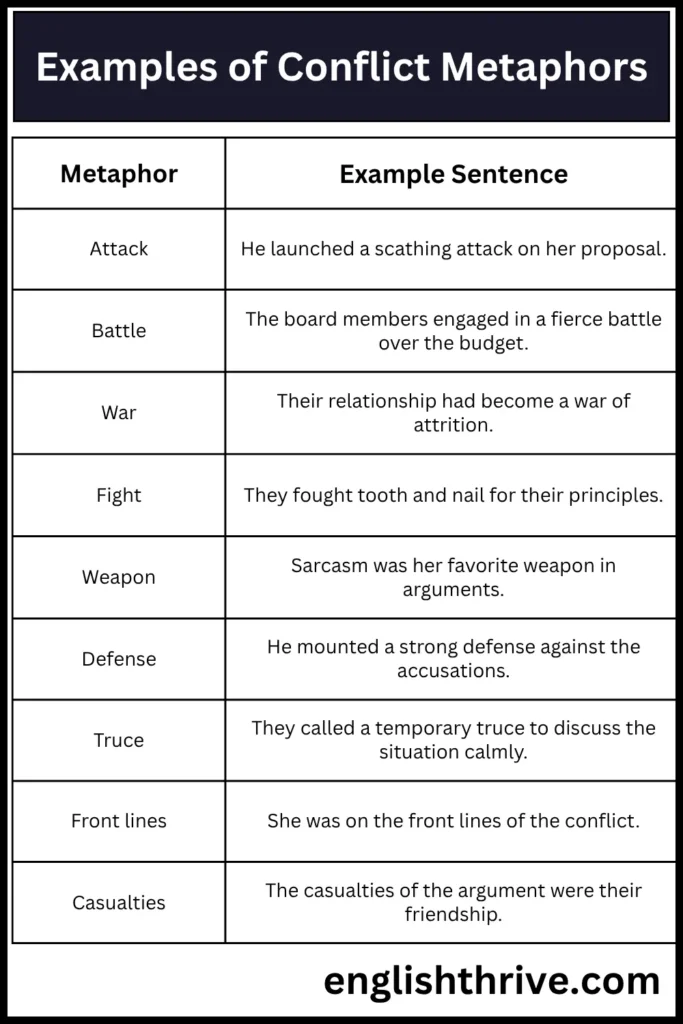
| Metaphor | Example Sentence |
|---|---|
| Attack | He launched a scathing attack on her proposal. |
| Battle | The board members engaged in a fierce battle over the budget. |
| War | Their relationship had become a war of attrition. |
| Fight | They fought tooth and nail for their principles. |
| Weapon | Sarcasm was her favorite weapon in arguments. |
| Defense | He mounted a strong defense against the accusations. |
| Truce | They called a temporary truce to discuss the situation calmly. |
| Front lines | She was on the front lines of the conflict. |
| Casualties | The casualties of the argument were their friendship. |
| Siege | The company was under siege from its competitors. |
| Ammunition | He gathered ammunition to support his claims. |
| Conquest | His goal was the conquest of the market. |
| Resistance | They met with strong resistance to their plans. |
| Victory | She claimed victory in the debate. |
| Defeat | He suffered a crushing defeat. |
| Strategy | Their strategy was to overwhelm the opposition. |
| Tactics | He employed clever tactics to win the argument. |
| Alliance | They formed an alliance to combat the threat. |
| Retreat | He decided to retreat from the discussion. |
| Offensive | They launched an offensive to regain lost ground. |
| Combat | The two sides were locked in fierce combat. |
| Guerilla Warfare | He used guerilla warfare tactics to undermine the project. |
| Battleground | The meeting room became a battleground. |
| Armistice | They signed an armistice after weeks of fighting. |
| Fortress | He built a fortress around his beliefs. |
| Blockade | The protesters set up a blockade. |
The following table illustrates conflict as a game, where strategy, rules, and winning are central themes.
| Metaphor | Example Sentence |
|---|---|
| Play | He played the situation to his advantage. |
| Game | Negotiation is often a complex game. |
| Move | She made a strategic move to gain the upper hand. |
| Cards | He kept his cards close to his chest. |
| Chess | The negotiation was like a game of chess. |
| Checkmate | He delivered a checkmate with his final argument. |
| Rules | They bent the rules to achieve their goals. |
| Score | She was keeping score of their disagreements. |
| Foul | He committed a foul by distorting the facts. |
| Referee | They needed a referee to mediate the dispute. |
| Winning | His primary focus was on winning the argument. |
| Losing | She couldn’t stand the thought of losing. |
| Competition | The meeting turned into a fierce competition. |
| Strategy | Her strategy was to remain calm and collected. |
| Tactic | He employed a clever tactic to sway the audience. |
| Gambit | His offer was a risky gambit. |
| Hand | He had a strong hand to play. |
| Level playing field | They wanted to create a level playing field. |
| Outmaneuver | She outmaneuvered her opponent with ease. |
| Advantage | He sought to gain an advantage. |
| Underdog | She was the underdog in the negotiation. |
| Game plan | They developed a detailed game plan. |
| Time-out | They called a time-out to reassess their position. |
| Endgame | His endgame was to secure the contract. |
| Opponent | He respected his opponent‘s skill. |
This table presents conflict as a journey, highlighting progress, obstacles, and the path to resolution.
| Metaphor | Example Sentence |
|---|---|
| Journey | Resolving this issue will be a long journey. |
| Road | We’ve come to a fork in the road. |
| Path | We need to find a new path forward. |
| Progress | We’ve made significant progress in the negotiations. |
| Roadblock | We’ve hit a major roadblock. |
| Obstacle | The conflict is a significant obstacle to our goals. |
| Destination | Our destination is a mutually beneficial agreement. |
| Waypoint | The meeting was an important waypoint in the process. |
| Detour | We had to take a detour to address unexpected issues. |
| Stuck | We’re stuck in a cycle of disagreement. |
| Direction | We need to change direction to find a solution. |
| Course | We need to stay the course to achieve our objectives. |
| Map | We need a map to navigate this complex situation. |
| Guide | We need a guide to help us through this process. |
| Milestone | Reaching an agreement was a major milestone. |
| Crossroads | We’ve reached a crossroads in our relationship. |
| Summit | The final meeting was the summit of the negotiations. |
| Trail | We’re blazing a new trail in conflict resolution. |
| Voyage | Their partnership was a long and challenging voyage. |
| Ascent | The ascent to a resolution was difficult but rewarding. |
| Descent | The relationship took a steep descent after the argument. |
| Route | They explored different routes to find common ground. |
| Trajectory | The conflict altered the trajectory of their project. |
| Passage | Navigating the crisis required careful passage. |
This table provides examples of conflict portrayed as a disease, emphasizing its negative impact and the need for healing.
| Metaphor | Example Sentence |
|---|---|
| Poison | The conflict has poisoned their relationship. |
| Infection | The tension is infectious. |
| Disease | The conflict is a disease spreading through the organization. |
| Sickness | Their relationship is suffering from a serious sickness. |
| Cure | We need to find a cure for this problem. |
| Diagnosis | We need a proper diagnosis of the underlying issues. |
| Symptoms | The anger is just one of the symptoms of a deeper problem. |
| Treatment | Mediation is a form of treatment for the conflict. |
| Healing | The relationship needs time to heal. |
| Contagious | The negativity is contagious. |
| Epidemic | The conflict spread like an epidemic through the team. |
| Virus | The resentment acted like a virus. |
| Inoculation | Early intervention acted like an inoculation against future conflicts. |
| Relapse | They feared a relapse into old patterns of arguing. |
| Remedy | They sought a remedy to alleviate the tension. |
| Toxic | The work environment had become toxic due to the constant conflict. |
| Wound | The argument left a deep wound. |
| Scar | The conflict left a lasting scar on their friendship. |
| Therapy | They sought therapy to address their communication issues. |
| Ailment | The underlying resentment was a serious ailment. |
This table provides examples of conflict portrayed as a storm, emphasizing its turbulent and chaotic nature.
| Metaphor | Example Sentence |
|---|---|
| Storm | The argument escalated into a raging storm. |
| Weather | We need to weather this crisis together. |
| Tempest | The disagreement turned into a tempest. |
| Turbulence | They experienced significant turbulence in their relationship. |
| Calm | There was a brief calm before the next outburst. |
| Lightning | His words struck like lightning. |
| Thunder | Her anger rumbled like thunder. |
| Clouds | Clouds of suspicion hung over the project. |
| Rain | They were caught in a rain of criticism. |
| Flood | A flood of emotions overwhelmed her. |
| Tsunami | The news hit them like a tsunami. |
| Whirlwind | Their relationship was a whirlwind of emotions. |
| Gale | A gale of laughter erupted after the tension broke. |
| Hurricane | The scandal caused a hurricane of controversy. |
| Breeze | A gentle breeze of understanding started to emerge. |
| Downpour | They faced a downpour of challenges. |
| Aftermath | In the aftermath of the argument, they tried to reconcile. |
| Clearing | There was a clearing in the tension as they began to understand each other. |
Usage Rules for Conflict Metaphors
Using conflict metaphors effectively requires sensitivity and awareness. Here are some guidelines:
- Consider the context: Choose metaphors that are appropriate for the specific situation and audience.
- Be mindful of the implications: Recognize the potential impact of different metaphors on perceptions and attitudes.
- Avoid overused metaphors: Strive for originality and creativity in your language.
- Be consistent: Maintain a consistent metaphorical framework throughout your communication.
- Balance metaphors with literal language: Use metaphors to enhance understanding, but don’t rely on them exclusively.
- Reflect on your own metaphors: Be aware of the metaphors you use to describe conflict and how they might be influencing your own thinking.
Common Mistakes
Here are some common mistakes to avoid when using conflict metaphors:
| Incorrect | Correct | Explanation |
|---|---|---|
| The negotiation was a walk in the park. | The negotiation was a grueling marathon. | “Walk in the park” trivializes the effort involved in negotiation. |
| Their relationship is a bed of roses. | Their relationship is a complex dance. | “Bed of roses” is a cliché that doesn’t capture the nuances of conflict. |
| The problem is a piece of cake. | The problem is a Gordian knot. | “Piece of cake” downplays the difficulty of the problem. |
| The discussion was sunshine and rainbows. | The discussion was a tense standoff. | “Sunshine and rainbows” inaccurately portrays a conflictual discussion. |
| The argument was a gentle breeze. | The argument was a raging fire. | “Gentle breeze” understates the intensity of the argument. |
Practice Exercises
Test your understanding of conflict metaphors with these exercises.
Exercise 1: Identify the Metaphor
Identify the dominant metaphor in each sentence.
| Question | Answer |
|---|---|
| 1. He launched a full-scale assault on her ideas. | Conflict as War |
| 2. We’ve reached a dead end in our negotiations. | Conflict as Journey |
| 3. The tension between them was palpable, like a storm brewing. | Conflict as Storm |
| 4. She masterfully played her hand during the meeting. | Conflict as Game |
| 5. The conflict has poisoned the atmosphere in the office. | Conflict as Disease |
| 6. The disagreement became a major stumbling block in the project. | Conflict as Obstacle |
| 7. They skillfully danced around the main issue. | Conflict as Dance |
| 8. The weight of the unresolved conflict was crushing him. | Conflict as Burden |
| 9. He carefully plotted his next move in the debate. | Conflict as Game |
| 10. We need to find a cure for this communication breakdown. | Conflict as Disease |
Exercise 2: Complete the Metaphor
Complete the following sentences with an appropriate conflict metaphor.
| Question | Answer |
|---|---|
| 1. The argument quickly turned into a _______. | raging storm |
| 2. We need to find a ______ to resolving this dispute. | path |
| 3. The constant negativity is _______ the team’s morale. | poisoning |
| 4. She strategically _______ her opponent in the negotiation. | outmaneuvered |
| 5. The conflict became a major _______ to their progress. | obstacle |
| 6. They tried to _______ the sensitive topic. | dance around |
| 7. The unresolved issues were a heavy _______ on his mind. | burden |
| 8. He launched a fierce _______ against the proposal. | attack |
| 9. We’ve reached a _______ in our relationship. | crossroads |
| 10. The situation is like a _______ waiting to explode. | minefield |
Exercise 3: Rewrite the Sentences
Rewrite the following sentences using a different conflict metaphor.
| Original Sentence | Rewritten Sentence |
|---|---|
| 1. He attacked her argument with relentless force. | He dissected her argument with surgical precision. |
| 2. We’ve hit a wall in our negotiations. | We’ve encountered a significant hurdle in our negotiations. |
| 3. The tension was like a volcano about to erupt. | The tension was a tightly wound spring. |
| 4. She played her cards close to her chest during the discussion. | She carefully navigated the complexities of the discussion. |
| 5. The conflict has created a toxic environment in the workplace. | The conflict has cast a dark shadow over the workplace. |
| 6. The disagreement is a major obstacle to our success. | The disagreement is a challenging puzzle to solve. |
| 7. They danced around the issue, avoiding direct confrontation. | They cautiously circled the issue, hesitant to engage directly. |
| 8. The weight of the conflict was crushing him. | The conflict was a heavy chain dragging him down. |
| 9. He carefully plotted his next move. | He meticulously charted his course of action. |
| 10. We need to find a cure for this communication breakdown. | We need to heal this communication breakdown. |
Advanced Topics
For advanced learners, consider these more complex aspects of conflict metaphors:
- Cultural variations: Different cultures may use different metaphors for conflict, reflecting their unique values and beliefs.
- The impact of metaphors on conflict resolution: Understanding the metaphors used by different parties can help mediators facilitate more effective communication.
- The use of metaphors in political discourse: Politicians often use conflict metaphors to frame issues and mobilize support.
- The role of metaphors in shaping identity: Conflict metaphors can influence how individuals and groups perceive themselves and others.
- Deconstructing and reframing metaphors: Learning to critically analyze and challenge dominant metaphors can open up new possibilities for conflict resolution.
FAQs About Metaphors for Conflict
Here are some frequently asked questions about metaphors for conflict:
What is the purpose of using metaphors for conflict?
Metaphors help us understand complex and abstract concepts like conflict by relating them to more familiar and concrete experiences. They can shape our perceptions, influence our emotions, and guide our actions.
Why is it important to be aware of the metaphors we use for conflict?
The metaphors we use can have a significant impact on how we approach conflict resolution. Some metaphors, like “conflict as war,” can promote adversarial attitudes, while others, like “conflict as journey,” can encourage collaboration and progress.
How can I identify the metaphors being used in a conflict situation?
Pay attention to the language being used. Look for words and phrases that suggest a comparison between conflict and something else. Consider the underlying image or concept being evoked.
Can I change the metaphors being used in a conflict situation?
Yes, you can actively try to reframe the conflict by introducing alternative metaphors. This can help shift perspectives and open up new possibilities for resolution.
Are some metaphors for conflict better than others?
It depends on the context and the desired outcome. Some metaphors may be more helpful in promoting constructive communication and collaboration, while others may be more appropriate for situations requiring assertiveness or competition.
How do cultural differences affect the use of conflict metaphors?
Different cultures may have different preferred metaphors for conflict, reflecting their unique values and beliefs. It’s important to be aware of these cultural differences to avoid misunderstandings and promote effective cross-cultural communication.
What are the dangers of using conflict as war metaphors?
Using “conflict as war” metaphors can escalate tensions, promote adversarial attitudes, and make it more difficult to find mutually acceptable solutions. It can also lead to a focus on winning at all costs, rather than on building relationships and resolving underlying issues.
How can I use metaphors to improve my conflict resolution skills?
By becoming more aware of the metaphors you and others use, you can gain a deeper understanding of the underlying perspectives and assumptions. You can then use this knowledge to reframe the conflict in a more productive way and facilitate more effective communication and collaboration.
Conclusion
Metaphors for conflict are powerful tools that shape our understanding and response to disagreements. By recognizing the different types of metaphors used and their potential impact, we can become more effective communicators and conflict resolvers.
Understanding these metaphors allows us to critically evaluate the language we use and the perspectives we hold, ultimately leading to more constructive and collaborative approaches to conflict resolution. By choosing our metaphors carefully, we can influence the narrative and foster a more positive and productive environment for resolving disputes.
Continue practicing identifying and reframing conflict metaphors to enhance your communication skills. Remember that the goal is not to eliminate conflict entirely, but to manage it effectively and use it as an opportunity for growth and understanding.
By mastering the art of metaphorical language, you can navigate challenging situations with greater clarity, empathy, and success.