

Spiritual words, while not a traditional grammatical category, play a crucial role in expressing beliefs, values, and inner experiences. Understanding how these words function within sentences and discourse enhances both comprehension and effective communication.
This article offers a detailed exploration of spiritual vocabulary, covering definitions, structural usage, common mistakes, and practical exercises. Whether you are a language learner, a writer, or simply interested in deepening your understanding of spiritual language, this comprehensive guide will provide you with the tools and knowledge you need.
This guide is designed for English language learners of all levels, writers seeking to enrich their prose, and anyone interested in understanding the nuances of spiritual language. By the end of this article, you will be able to identify spiritual words, understand their grammatical function, and use them effectively in your own writing and speech.
Definition of Spiritual Words
Spiritual words encompass a broad range of terms that relate to the human spirit, soul, religious beliefs, and transcendent experiences. These words can function as nouns, verbs, adjectives, or adverbs, depending on the context.
They often carry significant emotional and cultural weight, reflecting deeply held values and perspectives.
Classification: Spiritual words are not a distinct grammatical class like nouns or verbs. Instead, they are categorized by their semantic meaning and the concepts they represent. They can belong to various grammatical categories depending on their usage in a sentence.
Function: The function of spiritual words is to express abstract ideas, emotions, and beliefs related to spirituality. They help convey meaning beyond the material world, often evoking a sense of awe, reverence, or connection to something greater than oneself. They can be used to describe states of being (e.g., enlightenment), practices (e.g., meditation), or concepts (e.g., karma).
Contexts: Spiritual words are used in a variety of contexts, including religious texts, philosophical discussions, personal reflections, and artistic expressions. Their meaning and impact can vary depending on the specific cultural and linguistic background.
Structural Breakdown
The structural usage of spiritual words is diverse, mirroring their varied grammatical roles. They can be subjects, objects, verbs, modifiers, or even interjections.
Understanding their structural function helps in constructing grammatically correct and meaningful sentences.
Nouns: Spiritual nouns often represent concepts, entities, or places. They can be concrete (e.g., temple, altar) or abstract (e.g., faith, hope, peace). As nouns, they follow standard grammatical rules for number, case, and gender (although gender is less relevant in English).
Verbs: Spiritual verbs describe actions or states related to spirituality. Examples include “to pray,” “to meditate,” “to believe,” and “to worship.” These verbs conjugate according to tense, aspect, and mood, just like any other verb.
Adjectives: Spiritual adjectives modify nouns, adding descriptive details about their spiritual qualities. Examples include “sacred,” “holy,” “divine,” and “spiritual” itself. They follow the usual rules of adjective agreement and placement.
Adverbs: Spiritual adverbs modify verbs, adjectives, or other adverbs, indicating how an action is performed or to what extent a quality is present in a spiritual context. Examples include “spiritually,” “devoutly,” and “reverently.”
Types and Categories of Spiritual Words
Spiritual words can be categorized based on their specific meanings and the aspects of spirituality they represent. Here are several key categories:
Religious Terms
These words are specific to particular religions or belief systems. They include names of deities, sacred texts, rituals, and religious figures.
Examples: God, Allah, Buddha, Bible, Quran, Torah, sacrament, prayer, priest, monk.
Philosophical Concepts
These terms refer to abstract ideas and principles related to spirituality and the nature of existence. Examples: Karma, dharma, reincarnation, enlightenment, consciousness, soul, spirit.
Emotional and Experiential Terms
These words describe feelings, states of mind, and experiences that are often associated with spiritual practices or beliefs. Examples: Peace, joy, love, compassion, awe, reverence, transcendence, bliss.
Ethical and Moral Values
These terms represent virtues, principles, and behaviors that are considered spiritually significant or aligned with a higher purpose. Examples: Kindness, forgiveness, honesty, integrity, charity, selflessness.
Places and Objects
These words refer to physical locations and objects that are considered sacred or spiritually significant. Examples: Temple, church, mosque, shrine, altar, icon, relic, rosary.
Examples of Spiritual Words
This section provides numerous examples of spiritual words in context, categorized by their grammatical function. These examples will help you understand how to use these words correctly and effectively in your own writing and speech.
Nouns
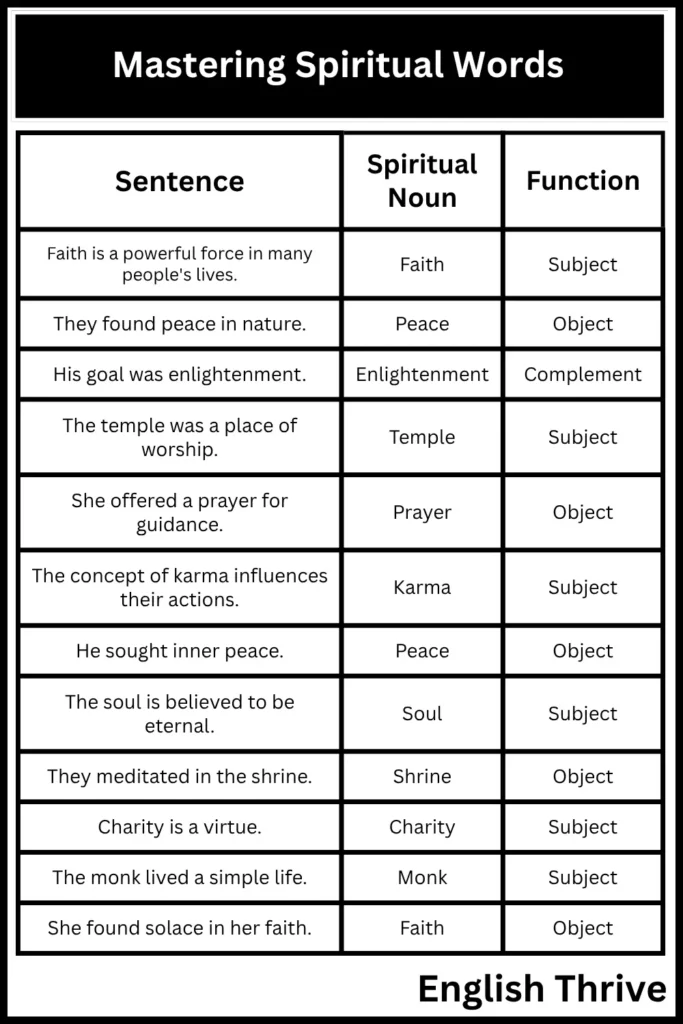
The following table provides examples of spiritual nouns used in sentences. Note how they function as subjects, objects, or complements.
| Sentence | Spiritual Noun | Function |
|---|---|---|
| Faith is a powerful force in many people’s lives. | Faith | Subject |
| They found peace in nature. | Peace | Object |
| His goal was enlightenment. | Enlightenment | Complement |
| The temple was a place of worship. | Temple | Subject |
| She offered a prayer for guidance. | Prayer | Object |
| The concept of karma influences their actions. | Karma | Subject |
| He sought inner peace. | Peace | Object |
| The soul is believed to be eternal. | Soul | Subject |
| They meditated in the shrine. | Shrine | Object |
| Charity is a virtue. | Charity | Subject |
| The monk lived a simple life. | Monk | Subject |
| She found solace in her faith. | Faith | Object |
| The Quran is a holy book. | Quran | Subject |
| They discussed dharma. | Dharma | Object |
| Reincarnation is a central belief. | Reincarnation | Subject |
| The altar was adorned with flowers. | Altar | Subject |
| He donated to charity. | Charity | Object |
| The priest offered a blessing. | Priest | Subject |
| They practiced meditation daily. | Meditation | Object |
| The icon depicted a saint. | Icon | Subject |
| The rosary was made of beads. | Rosary | Subject |
| The Torah contains ancient laws. | Torah | Subject |
| They sought guidance from their elders. | Guidance | Object |
| The Bible is a source of inspiration. | Bible | Subject |
| Her spirit was strong. | Spirit | Subject |
| They achieved a state of bliss. | Bliss | Object |
| He felt a strong sense of reverence. | Reverence | Object |
Verbs
This table illustrates the use of spiritual verbs in different tenses and forms.
| Sentence | Spiritual Verb | Tense/Form |
|---|---|---|
| They pray every day. | Pray | Present Simple |
| She meditated for an hour. | Meditated | Past Simple |
| We believe in the power of love. | Believe | Present Simple |
| He worships regularly at the temple. | Worships | Present Simple |
| They are seeking enlightenment. | Seeking | Present Continuous |
| She has devoted her life to service. | Devoted | Present Perfect |
| They will strive for inner peace. | Strive | Future Simple |
| He is contemplating the meaning of life. | Contemplating | Present Continuous |
| She repented for her actions. | Repented | Past Simple |
| They aspire to spiritual growth. | Aspire | Present Simple |
| The monk chanted sacred verses. | Chanted | Past Simple |
| She communed with nature. | Communed | Past Simple |
| They dedicate their time to helping others. | Dedicating | Present Simple |
| He envisioned a better world. | Envisioned | Past Simple |
| She exalted the virtues of patience. | Exalted | Past Simple |
| They glorified the divine. | Glorified | Past Simple |
| He hallowed the ground. | Hallowed | Past Simple |
| She invoked the spirits. | Invoked | Past Simple |
| They lamented their losses. | Lamented | Past Simple |
| He manifested his desires. | Manifested | Past Simple |
| She nurtured her spiritual growth. | Nurtured | Past Simple |
| They ordained him as a priest. | Ordained | Past Simple |
| He purified his mind. | Purified | Past Simple |
| She questioned her beliefs. | Questioned | Past Simple |
| They revered their ancestors. | Revered | Past Simple |
| He sanctified the space. | Sanctified | Past Simple |
| She transcended her limitations. | Transcended | Past Simple |
Adjectives
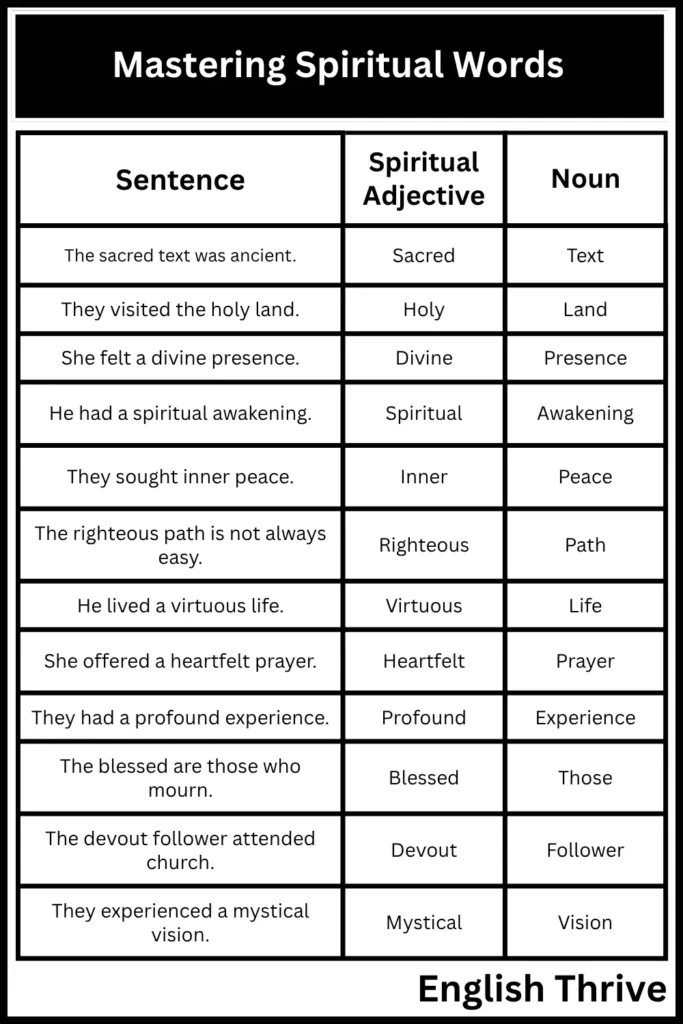
The following table shows examples of spiritual adjectives modifying nouns.
| Sentence | Spiritual Adjective | Noun |
|---|---|---|
| The sacred text was ancient. | Sacred | Text |
| They visited the holy land. | Holy | Land |
| She felt a divine presence. | Divine | Presence |
| He had a spiritual awakening. | Spiritual | Awakening |
| They sought inner peace. | Inner | Peace |
| The righteous path is not always easy. | Righteous | Path |
| He lived a virtuous life. | Virtuous | Life |
| She offered a heartfelt prayer. | Heartfelt | Prayer |
| They had a profound experience. | Profound | Experience |
| The blessed are those who mourn. | Blessed | Those |
| The devout follower attended church. | Devout | Follower |
| They experienced a mystical vision. | Mystical | Vision |
| He felt a transcendent joy. | Transcendent | Joy |
| She had a compassionate heart. | Compassionate | Heart |
| They sought enlightened guidance. | Enlightened | Guidance |
| He had a reverent attitude. | Reverent | Attitude |
| She possessed a serene spirit. | Serene | Spirit |
| They followed a sacramental ritual. | Sacramental | Ritual |
| He had a godly influence. | Godly | Influence |
| She gave a charitable donation. | Charitable | Donation |
| They felt a spiritual connection. | Spiritual | Connection |
| He showed unwavering faith. | Unwavering | Faith |
| She had a gentle soul. | Gentle | Soul |
| They sought eternal life. | Eternal | Life |
| He had a pure heart. | Pure | Heart |
Adverbs
This table demonstrates how spiritual adverbs modify verbs, adjectives, or other adverbs.
| Sentence | Spiritual Adverb | Modified Word |
|---|---|---|
| She lived spiritually. | Spiritually | Lived |
| They prayed devoutly. | Devoutly | Prayed |
| He spoke reverently. | Reverently | Spoke |
| She felt deeply connected. | Deeply | Connected |
| They acted selflessly. | Selflessly | Acted |
| He meditated peacefully. | Peacefully | Meditated |
| She forgave completely. | Completely | Forgave |
| They trusted implicitly. | Implicitly | Trusted |
| He believed wholeheartedly. | Wholeheartedly | Believed |
| She gave generously. | Generously | Gave |
| They lived righteously. | Righteously | Lived |
| He spoke truthfully. | Truthfully | Spoke |
| She acted compassionately. | Compassionately | Acted |
| They lived humbly. | Humbly | Lived |
| He served faithfully. | Faithfully | Served |
| She approached the task prayerfully. | Prayerfully | Approached |
| They contemplated the matter thoughtfully. | Thoughtfully | Contemplated |
| He listened attentively to the sermon. | Attentively | Listened |
| She reflected introspectively on her actions. | Introspectively | Reflected |
| They observed the ritual ceremonially. | Ceremonially | Observed |
| He approached the divine presence respectfully. | Respectfully | Approached |
| She viewed the world optimistically. | Optimistically | Viewed |
Usage Rules for Spiritual Words
The correct use of spiritual words involves not only grammatical accuracy but also sensitivity to their cultural and emotional connotations. Here are some key rules to follow:
Context Matters: Always consider the context in which you are using spiritual words. Their meaning can vary depending on the specific religious, philosophical, or cultural background.
Avoid Stereotypes: Be careful not to use spiritual words in a way that reinforces stereotypes or disrespects other people’s beliefs.
Precision is Key: Choose words that accurately reflect the intended meaning. Avoid vague or ambiguous language.
Respectful Tone: Maintain a respectful tone, especially when discussing sensitive or controversial topics.
Grammatical Accuracy: Ensure that spiritual words are used correctly according to the rules of English grammar. Pay attention to tense, agreement, and word order.
Common Mistakes with Spiritual Words
Here are some common mistakes people make when using spiritual words, along with corrections:
| Incorrect | Correct | Explanation |
|---|---|---|
| He is very spirit. | He is very spiritual. | “Spirit” is a noun; “spiritual” is an adjective. |
| They prayed hardly. | They prayed devoutly. | “Hardly” means “barely”; “devoutly” describes praying with devotion. |
| She felt holy. | She felt peaceful. | “Holy” implies a sacred quality; “peaceful” describes a state of mind. |
| The enlight man. | The enlightened man. | “Enlightened” is the correct past participle adjective form. |
| They are seeking innerly peace. | They are seeking inner peace. | “Inner” is the correct adjective form. “Innerly” is not a standard word. |
| He is a man of much believe. | He is a man of much belief. | “Believe” is a verb; “belief” is the noun form needed here. |
| She acted very compassion. | She acted very compassionately. | “Compassion” is a noun; “compassionately” is the adverb. |
| They are very faith. | They are very faithful. | “Faith” is a noun; “faithful” is an adjective. |
| He has a strong spirituous connection. | He has a strong spiritual connection. | “Spirituous” refers to alcohol; “spiritual” relates to the spirit. |
| The divine intervention. | The divine intervention | Correct Usage, but the context should match the word’s meaning. |
| They were in a state of blissful. | They were in a state of bliss. | “Blissful” is an adjective; “bliss” is the noun form needed after “state of”. |
Practice Exercises
Test your understanding of spiritual words with these practice exercises.
Exercise 1: Identifying Spiritual Words
Identify the spiritual words in the following sentences.
| Question | Answer |
|---|---|
| 1. The monk meditated in the temple. | monk, meditated, temple |
| 2. She found peace in her faith. | peace, faith |
| 3. They prayed for guidance and strength. | prayed, guidance, strength |
| 4. His soul was filled with compassion. | soul, compassion |
| 5. The sacred text spoke of love and forgiveness. | sacred, love, forgiveness |
| 6. The guru offered enlightenment to his disciples. | guru, enlightenment |
| 7. She sought spiritual awakening through meditation. | spiritual, awakening, meditation |
| 8. They believed in the power of karma. | karma |
| 9. He lived a righteous and virtuous life. | righteous, virtuous |
| 10. The priest blessed the congregation with holy water. | priest, blessed, holy |
Exercise 2: Using Spiritual Words in Sentences
Fill in the blanks with appropriate spiritual words.
| Question | Answer |
|---|---|
| 1. She found ______ in nature. | peace/solace |
| 2. They offered a ______ for the deceased. | prayer |
| 3. He sought ______ through selfless service. | enlightenment |
| 4. The ______ guided them on their spiritual journey. | guru/teacher |
| 5. They lived a life of ______ and integrity. | honesty |
| 6. The ______ bells rang throughout the valley. | temple |
| 7. They practiced ______ to calm their minds. | meditation |
| 8. She felt a deep sense of ______ for all beings. | compassion |
| 9. He had ______ in a higher power. | faith |
| 10. The ______ teachings inspired them. | sacred/holy |
Exercise 3: Correcting Mistakes
Correct the mistakes in the following sentences.
| Question | Answer |
|---|---|
| 1. He is a very spirit person. | He is a very spiritual person. |
| 2. They prayed hardly for forgiveness. | They prayed devoutly for forgiveness. |
| 3. She felt holy when she meditated. | She felt peaceful when she meditated. |
| 4. The enlighten monk shared his wisdom. | The enlightened monk shared his wisdom. |
| 5. They sought innerly peace and happiness. | They sought inner peace and happiness. |
| 6. He has much believe in the divine. | He has much belief in the divine. |
| 7. She acted with great compassion. | She acted very compassionately. |
| 8. They are very faith in their traditions. | They are very faithful in their traditions. |
| 9. He had a spirituous experience in the mountains. | He had a spiritual experience in the mountains. |
| 10. The divine intervention saved them. | The divine intervention saved them. (Correct) |
Advanced Topics
For advanced learners, here are some more complex aspects of spiritual language:
Figurative Language
Spiritual texts often use figurative language, such as metaphors, similes, and allegories, to convey abstract concepts. Understanding these figures of speech is crucial for interpreting the deeper meaning of the text.
Symbolism
Many spiritual words and concepts have symbolic meanings that go beyond their literal definitions. For example, the color white often symbolizes purity, while the lotus flower represents enlightenment.
Etymology
Exploring the etymology (origin and history) of spiritual words can provide valuable insights into their meaning and evolution over time. This can reveal connections between different languages and cultures.
Cultural Nuances
Spiritual language is deeply intertwined with culture. Understanding the cultural context in which a word is used is essential for accurate interpretation.
FAQs About Mastering Spiritual Words
Here are some frequently asked questions about spiritual words:
What is the difference between “spiritual” and “religious”?
While often used interchangeably, “spiritual” generally refers to a personal connection to something greater than oneself, while “religious” typically involves adherence to a specific set of beliefs and practices within an organized institution. Spirituality is a broader term that can encompass religious experiences but also includes non-religious forms of seeking meaning and purpose.
How can I improve my vocabulary of spiritual words?
Read widely in spiritual texts, philosophical works, and religious literature. Pay attention to how different authors use spiritual words and try to incorporate them into your own writing and speech. Additionally, consider keeping a vocabulary journal to record new words and their meanings.
Are spiritual words always positive?
Not necessarily. While many spiritual words evoke positive emotions and values, some can also refer to negative experiences or concepts, such as suffering, sin, or doubt. The connotation depends on the context and the specific belief system.
How do I avoid using spiritual words inappropriately?
Be mindful of the context, audience, and your own intentions. Avoid using spiritual words in a way that could be offensive, disrespectful, or insensitive. When in doubt, err on the side of caution and choose more нейтральный language.
Can spiritual words be used in secular contexts?
Yes, many spiritual words have broader meanings that can be applied in secular contexts. For example, “compassion” and “integrity” are valued virtues that can be relevant in personal relationships, professional settings, and civic life.
Conclusion
Mastering spiritual words requires a combination of grammatical knowledge, cultural sensitivity, and a deep understanding of the concepts they represent. This comprehensive guide has provided you with the tools and knowledge you need to navigate the complexities of spiritual language.
By understanding the definitions, structural usage, and common mistakes associated with these words, you can communicate more effectively and respectfully about matters of faith, belief, and inner experience.
Remember to always consider the context in which you are using spiritual words, be mindful of their cultural and emotional connotations, and strive for precision and clarity in your language. With practice and dedication, you can enrich your vocabulary, deepen your understanding, and use spiritual words to express your thoughts and feelings with greater accuracy and impact.