

Proper nouns are like the names of your favorite things — they give people, places, brands, and events their own unique identity. . As an English teacher with over a decade of experience, I’ve seen how these little words can make a big difference in understanding and writing.
In this post, we’ll break down what proper nouns are, share some fun examples, and show you how to use them in your own writing. Let’s dive in and see how easy and important they really are!
What Are Proper Nouns?
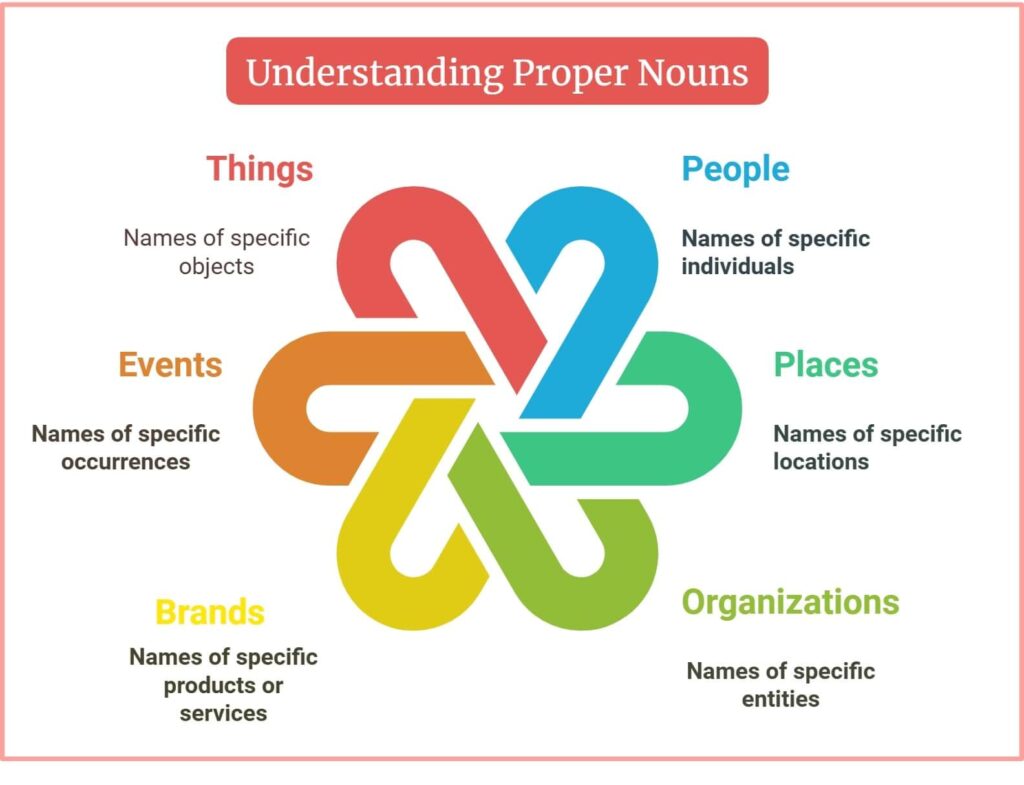
Proper nouns are specific names for particular people, places, organizations, brands, events, or things. Unlike common nouns, proper nouns are always capitalized, regardless of their position in a sentence. They give unique identities to what might otherwise be general categories.
Types of Proper Nouns with Examples
1. Personal Names
| Proper Nouns |
|---|
| Michael Jackson |
| William Shakespeare |
| Leonardo da Vinci |
| Marie Curie |
| Albert Einstein |
Example Sentences:
- Michael Jackson performed at the Super Bowl in 1993.
- William Shakespeare wrote “Romeo and Juliet.”
- Leonardo da Vinci painted the Mona Lisa.
- Marie Curie discovered radium.
- Albert Einstein developed the theory of relativity.
2. Geographic Locations
| Proper Nouns |
|---|
| Mount Everest |
| Pacific Ocean |
| New York City |
| Amazon River |
| Grand Canyon |
Example Sentences:
- Mount Everest stands as Earth’s highest peak.
- The Pacific Ocean borders many countries.
- New York City never sleeps.
- The Amazon River flows through South America.
- The Grand Canyon attracts millions of visitors yearly.
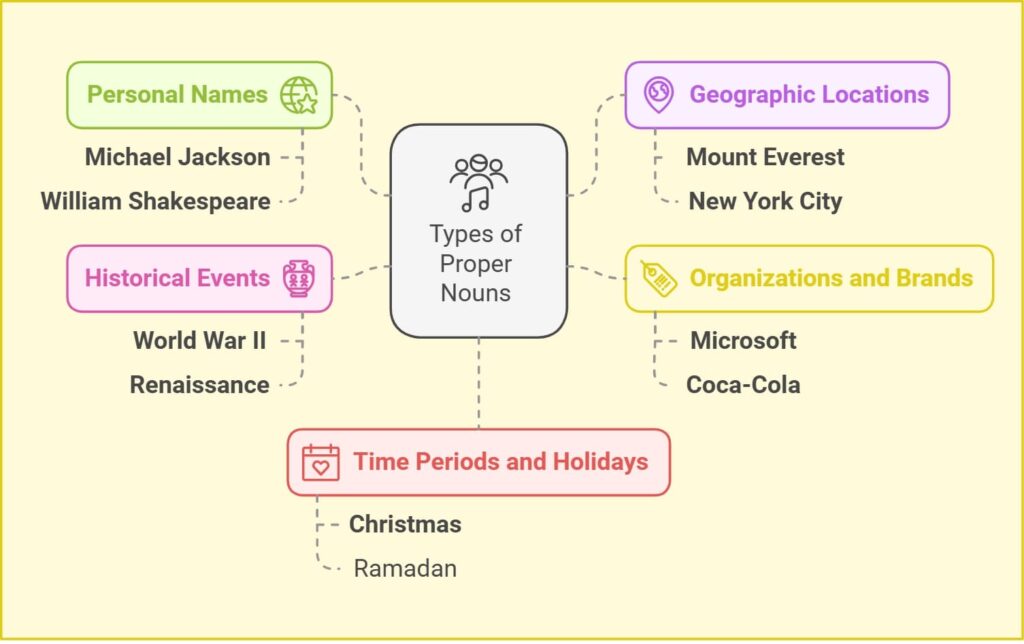
3. Organizations and Brands
| Proper Nouns |
|---|
| Microsoft |
| Coca-Cola |
| United Nations |
| McDonald’s |
| Nike |
Example Sentences:
- Microsoft released a new version of Windows.
- Coca-Cola sells beverages worldwide.
- The United Nations held its annual assembly.
- McDonald’s introduced a new menu item.
- Nike launched an innovative shoe design.
4. Historical Events
| Proper Nouns |
|---|
| World War II |
| Renaissance |
| Olympic Games |
| French Revolution |
| Industrial Revolution |
Example Sentences:
- World War II ended in 1945.
- The Renaissance changed European culture forever.
- The Olympic Games started in Ancient Greece.
- The French Revolution began in 1789.
- The Industrial Revolution transformed manufacturing.
5. Time Periods and Holidays
| Proper Nouns |
|---|
| Christmas |
| Ramadan |
| Easter |
| Monday |
| July |
Example Sentences:
- Christmas falls on December 25th.
- Muslims observe Ramadan each year.
- Easter Sunday varies by calendar.
- Monday marks the start of the work week.
- July brings summer festivities.
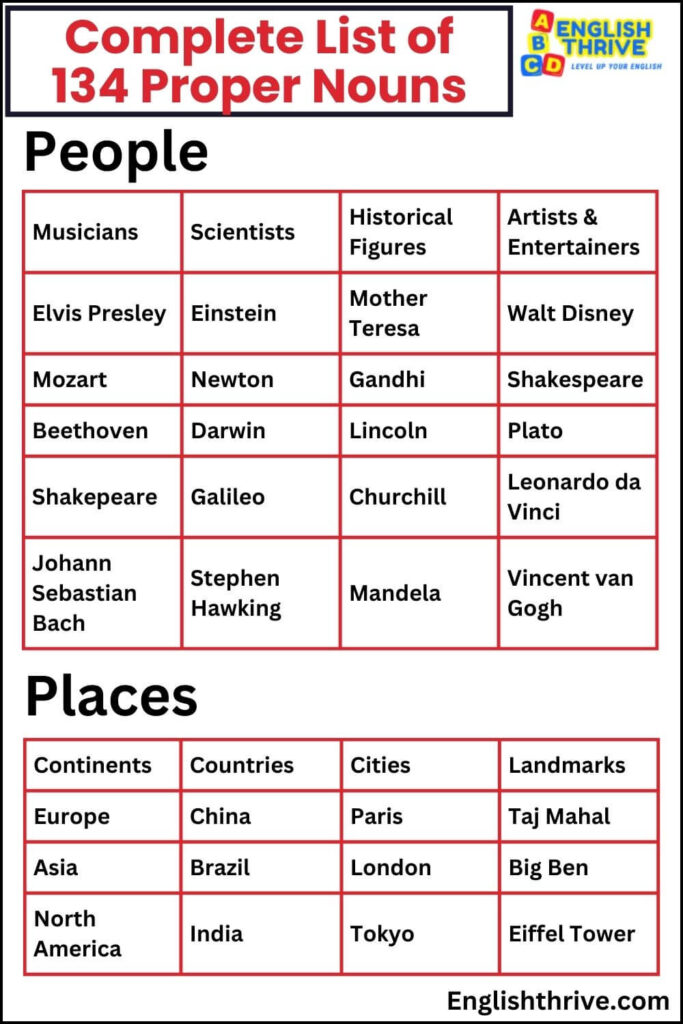
Advanced Proper noun with examples
People
| Musicians | Scientists | Historical Figures | Artists & Entertainers |
|---|---|---|---|
| Elvis Presley | Einstein | Mother Teresa | Walt Disney |
| Mozart | Newton | Gandhi | Shakespeare |
| Beethoven | Darwin | Lincoln | Plato |
| Shakepeare | Galileo | Churchill | Leonardo da Vinci |
| Johann Sebastian Bach | Stephen Hawking | Mandela | Vincent van Gogh |
Places
| Continents | Countries | Cities | Landmarks |
|---|---|---|---|
| Europe | China | Paris | Taj Mahal |
| Asia | Brazil | London | Big Ben |
| North America | India | Tokyo | Eiffel Tower |
| South America | Russia | Dubai | Stonehenge |
| Africa | Australia | Cairo | Great Wall |
Organizations
| Tech Companies | Media Companies | Sports Organizations | Scientific Institutions |
|---|---|---|---|
| Netflix | NASA | Oracle | |
| YouTube | SpaceX | Intel | |
| Amazon | FIFA | Forbes | |
| IBM | Olympic Committee | PayPal | |
| Microsoft | Spotify | World Cup Organization | Visa |
Events
| Global Sporting Events | Award Shows | Cultural Celebrations | Historical Events |
|---|---|---|---|
| Super Bowl | Grammy Awards | Diwali | D-Day |
| World Cup | Oscar Awards | Hanukkah | Independence Day |
| Olympics | Tony Awards | Chinese New Year | Labor Day |
| Paralympic Games | Emmy Awards | Eid | Memorial Day |
| World Series | Met Gala | Kwanzaa | Veterans Day |
Brands
| Automotive | Technology | Fashion | Food & Beverage |
|---|---|---|---|
| Toyota | Apple | Gucci | Pepsi |
| Honda | Samsung | Adidas | Coca-Cola |
| Ford | Sony | Puma | Shell |
| BMW | Canon | Rolex | |
| Tesla | Microsoft |
Holidays
| Cultural Holidays | Religious Holidays | National Holidays | Seasonal Celebrations |
|---|---|---|---|
| Christmas | Hanukkah | Independence Day | New Year’s Day |
| Easter | Eid | Labor Day | Valentine’s Day |
| Diwali | Ramadan | Memorial Day | Halloween |
| Kwanzaa | Passover | Veterans Day | Thanksgiving |
| Chinese New Year | Yom Kippur | Martin Luther King Jr. Day |
Landmarks
| Historical Sites | Natural Wonders | Architectural Marvels | Cultural Monuments |
|---|---|---|---|
| Taj Mahal | Grand Canyon | Eiffel Tower | Statue of Liberty |
| Stonehenge | Great Barrier Reef | Big Ben | Acropolis |
| Machu Picchu | Mount Everest | Colosseum | Petra |
| Great Wall of China | Amazon Rainforest | Vatican | Pyramids |
| Mount Rushmore | Sahara Desert | Golden Gate Bridge |
Media
| Streaming Services | Social Media | News Organizations | Entertainment Platforms |
|---|---|---|---|
| Netflix | Times | Disney+ | |
| YouTube | Forbes | HBO | |
| Spotify | BBC | Hulu | |
| Amazon Prime | CNN | ||
| TikTok | Al Jazeera |
Countries
| World Powers | Developing Nations | Island Nations | Emerging Economies |
|---|---|---|---|
| China | Brazil | Australia | Singapore |
| India | Mexico | Japan | United Arab Emirates |
| Russia | Egypt | New Zealand | Qatar |
| United States | Nigeria | Iceland | |
| Germany | Pakistan | Malta |
Cities
| Global Metropolises | Historical Cities | Cultural Centers | Economic Hubs |
|---|---|---|---|
| Paris | Rome | Venice | New York |
| London | Athens | Dublin | Tokyo |
| Tokyo | Berlin | Madrid | Shanghai |
| Dubai | Cairo | Milan | Singapore |
| Sydney | Moscow | Mumbai | Hong Kong |
FAQs on Proper Nouns
1. What’s the difference between proper nouns and common nouns?
Proper nouns are specific names for particular entities, while common nouns represent general categories. The key differences include:
- Capitalization: Proper nouns are always capitalized (Amazon, Disney, Tokyo), while common nouns aren’t (river, company, city)
- Specificity: Proper nouns name specific entities (Mount Everest), while common nouns describe general categories (mountain)
- Articles: Proper nouns usually don’t need articles (Netflix is popular), while common nouns often do (the streaming service is popular)
- Pluralization: Proper nouns rarely have plural forms, except in specific cases (the Smiths, the Americas)
2. Why do some proper nouns become common nouns?
Some proper nouns become common nouns through a process called genericization. This happens when a brand or product becomes so popular that people use its name to refer to the general category. For example:
- Kleenex (now also means any tissue)
- Google (now also means to search online)
- Xerox (now also means to make a copy)
- Band-Aid (now also means any adhesive bandage)
- Jacuzzi (now also means any hot tub)
This process demonstrates how language evolves based on popular usage, though companies often fight to prevent their trademarks from becoming generic terms.
3. How do you handle proper nouns in different languages?
When using proper nouns from different languages, follow these guidelines:
- Keep original capitalization from the source language
- Maintain special characters when possible (München, São Paulo)
- Use accepted English versions for well-known places (Munich, Rome instead of München, Roma)
- Respect cultural naming conventions (family name first in Chinese names)
- Include diacritical marks when appropriate (México, Zürich)
4. What are compound proper nouns and how do you capitalize them?
Compound proper nouns are proper nouns made up of multiple words. The capitalization rules are:
- Capitalize major words: New York City
- Lowercase articles and prepositions in the middle: Tower of London
- Capitalize first and last words regardless: The United States of America
- Capitalize both parts of hyphenated names: Winston-Salem
- Special cases may have their own rules: iPhone, MacBook
5. How do you use proper nouns in academic writing?
In academic writing, proper nouns require special attention:
- First mention: Provide full name and context (Albert Einstein, the renowned physicist)
- Subsequent mentions: Use last name only (Einstein)
- Acronyms: Define first use (World Health Organization (WHO))
- Place names: Use official current names unless discussing historical contexts
- Consistency: Maintain the same form throughout the document
6. What are the common mistakes people make with proper nouns?
Common mistakes with proper nouns include:
- Forgetting to capitalize (writing “facebook” instead of “Facebook”)
- Over-capitalizing (writing “The Internet” when “the internet” is now accepted)
- Incorrect possessive forms (writing “Jesus’s” instead of “Jesus'”)
- Misusing articles (saying “the Ukraine” instead of “Ukraine”)
- Wrong pluralization (writing “Germanys” instead of “Germans”)
Proper Noun Usage Tips
- Always capitalize the first letter
- Check official spellings for brands and organizations
- Respect cultural naming conventions
- Be consistent with chosen forms
- When in doubt, consult style guides
Conclusion
Understanding proper nouns is crucial for effective communication and writing. These 134 examples demonstrate the vast range of proper nouns we use daily, from personal names to brands, places, and events. Remember that proper nouns are more than just capitalized words – they’re the unique identifiers that give our world its rich tapestry of names and meanings. Whether you’re writing an essay, crafting a story, or simply sending an email, proper usage of proper nouns helps ensure clear, professional communication.