

Language is more than just a tool for communication; it’s a reflection of our inner world, values, and beliefs. Certain words carry a profound spiritual significance, resonating with deep-seated emotions and concepts that transcend the ordinary.
Understanding these words can enrich our vocabulary, deepen our understanding of spiritual concepts, and enhance our ability to express ourselves with greater clarity and intention. This guide explores various words with spiritual meaning, their grammatical functions, and how to use them effectively in English.
This article is designed for English language learners, writers, and anyone interested in exploring the intersection of language and spirituality. Whether you’re a beginner or an advanced learner, this guide will provide you with a comprehensive understanding of words with spiritual meaning and how to incorporate them into your writing and speech.
Definition: Words with Spiritual Meaning
Words with spiritual meaning are terms that evoke or represent concepts, emotions, or states of being associated with spirituality, religion, philosophy, or inner peace. These words often carry a weight beyond their literal definitions, tapping into deeper emotional and psychological realms. They can be nouns, verbs, adjectives, or adverbs, each contributing to the overall spiritual context of a sentence or conversation. The function of these words is to convey complex ideas about the human condition, the divine, and the search for meaning.
These words are not limited to religious contexts; they also encompass secular spirituality, focusing on personal growth, mindfulness, and connection to something larger than oneself. The context in which these words are used is crucial, as their meaning can shift depending on the speaker’s intent and the listener’s interpretation.
Structural Breakdown
The structure of words with spiritual meaning is similar to that of other English words. They follow the same grammatical rules and patterns.
However, their impact is often amplified by their connotations and associations. Consider these structural aspects:
- Nouns: Often represent concepts, entities, or states (e.g., peace, karma, enlightenment).
- Verbs: Describe actions or processes related to spiritual practices or experiences (e.g., meditate, pray, transcend).
- Adjectives: Modify nouns to describe qualities or characteristics associated with spirituality (e.g., sacred, compassionate, divine).
- Adverbs: Modify verbs, adjectives, or other adverbs to indicate how an action is performed or to what extent a quality is present (e.g., mindfully, devoutly, spiritually).
Understanding the grammatical function of these words allows for their precise and effective use in conveying nuanced spiritual ideas. For example, using the adjective “sacred” to describe a space transforms it from a mere location into a place of reverence and significance.
Types and Categories of Spiritual Words
Words with spiritual meaning can be categorized based on the concepts they represent. Here are some common categories:
Virtues
Virtues are positive qualities or traits considered morally good. They are fundamental to many spiritual traditions and philosophies.
- Examples: Compassion, patience, kindness, generosity, humility, wisdom, courage, forgiveness, integrity, gratitude.
Emotions
Certain emotions are closely linked to spiritual experiences and practices. These emotions can be both positive and challenging, but they all contribute to a deeper understanding of oneself and the world.
- Examples: Love, joy, peace, serenity, awe, reverence, hope, faith, contentment, empathy.
States of Being
States of being refer to conditions or modes of existence that are often associated with spiritual growth and awareness.
- Examples: Mindfulness, enlightenment, awakening, bliss, harmony, balance, transcendence, inner peace, connectedness, presence.
Religious Terms
These are specific to religious traditions and often have unique meanings within those contexts.
- Examples: God, soul, spirit, prayer, meditation, karma, reincarnation, nirvana, salvation, divine.
Philosophical Concepts
These are abstract ideas that explore the nature of reality, existence, and knowledge, often intersecting with spiritual themes.
- Examples: Truth, reality, consciousness, being, non-being, the Absolute, the Void, oneness, interconnectedness, ethics.
Examples of Words with Spiritual Meaning
The following tables provide examples of words with spiritual meaning, categorized by their grammatical function and spiritual category. Each table includes a word, its grammatical function, its spiritual category, and example sentences to illustrate its use.
Table 1: Examples of Nouns with Spiritual Meaning
This table shows nouns associated with spiritual meaning, their function, category and examples.
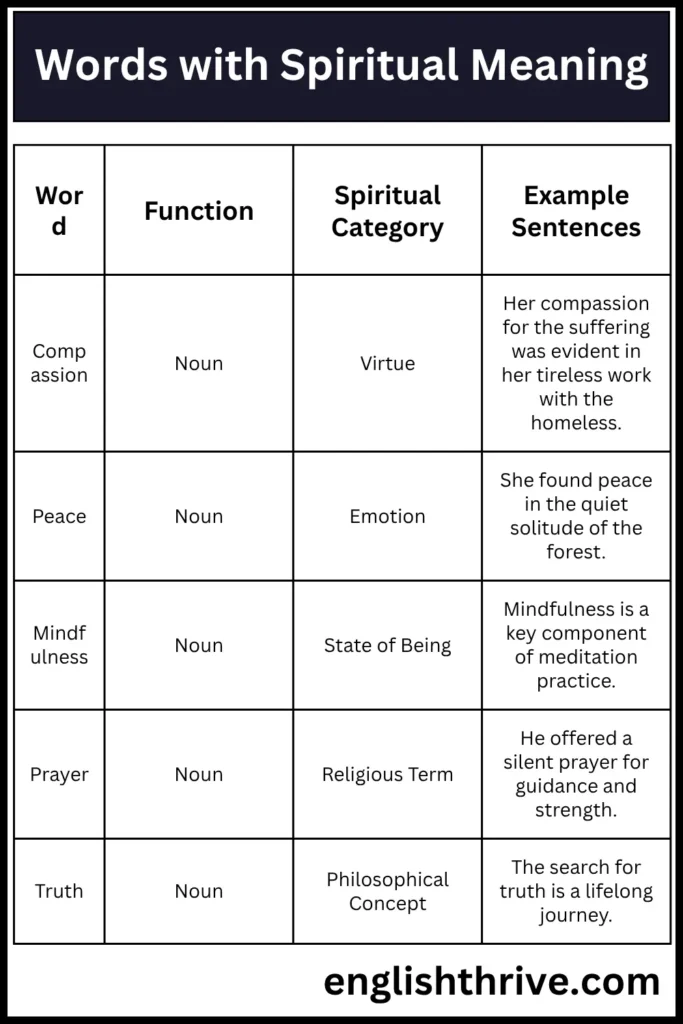
| Word | Function | Spiritual Category | Example Sentences |
|---|---|---|---|
| Compassion | Noun | Virtue | Her compassion for the suffering was evident in her tireless work with the homeless. |
| Peace | Noun | Emotion | She found peace in the quiet solitude of the forest. |
| Mindfulness | Noun | State of Being | Mindfulness is a key component of meditation practice. |
| Prayer | Noun | Religious Term | He offered a silent prayer for guidance and strength. |
| Truth | Noun | Philosophical Concept | The search for truth is a lifelong journey. |
| Serenity | Noun | Emotion | The yoga class helped her achieve a state of serenity. |
| Gratitude | Noun | Virtue | Practicing gratitude can improve your overall well-being. |
| Enlightenment | Noun | State of Being | Many spiritual traditions seek the path to enlightenment. |
| Karma | Noun | Religious Term | He believed that his actions would determine his karma. |
| Consciousness | Noun | Philosophical Concept | The nature of consciousness is a complex and fascinating subject. |
| Love | Noun | Emotion | Love is the foundation of all positive relationships. |
| Wisdom | Noun | Virtue | She sought wisdom from the ancient texts. |
| Balance | Noun | State of Being | Finding balance in life is essential for well-being. |
| Soul | Noun | Religious Term | Many believe that the soul is immortal. |
| Reality | Noun | Philosophical Concept | Our perception shapes our reality. |
| Joy | Noun | Emotion | The simple act of kindness brought her immense joy. |
| Humility | Noun | Virtue | Humility is a sign of true strength. |
| Harmony | Noun | State of Being | Living in harmony with nature is crucial for sustainability. |
| Spirit | Noun | Religious Term | The human spirit is resilient and adaptable. |
| Ethics | Noun | Philosophical Concept | A strong sense of ethics guides her decision-making. |
| Awe | Noun | Emotion | She stood in awe of the majestic mountains. |
| Generosity | Noun | Virtue | His generosity knew no bounds. |
| Presence | Noun | State of Being | Being fully in the presence of the moment is a gift. |
| Salvation | Noun | Religious Term | Some religions offer a path to salvation. |
| Oneness | Noun | Philosophical Concept | The concept of oneness emphasizes the interconnectedness of all things. |
Table 2: Examples of Verbs with Spiritual Meaning
This table shows verbs associated with spiritual meaning, their function, category and examples.
| Word | Function | Spiritual Category | Example Sentences |
|---|---|---|---|
| Meditate | Verb | Religious Term | She meditates every morning to clear her mind. |
| Pray | Verb | Religious Term | They pray for peace and healing. |
| Transcend | Verb | State of Being | He sought to transcend his limitations through spiritual practice. |
| Heal | Verb | State of Being | Time can heal even the deepest wounds. |
| Forgive | Verb | Virtue | It’s important to forgive others, and yourself. |
| Awaken | Verb | State of Being | Many seek to awaken to a higher state of consciousness. |
| Serve | Verb | Virtue | She chose to serve her community through volunteer work. |
| Reflect | Verb | Philosophical Concept | It’s important to reflect on your actions and their consequences. |
| Believe | Verb | Religious Term | They believe in the power of faith. |
| Contemplate | Verb | Philosophical Concept | He would contemplate the meaning of life for hours. |
| Devote | Verb | Religious Term | She devoted her life to helping others. |
| Practice | Verb | State of Being | He practices mindfulness throughout the day. |
| Cherish | Verb | Emotion | We should cherish every moment we have. |
| Empathize | Verb | Emotion | It’s important to empathize with the suffering of others. |
| Manifest | Verb | Philosophical Concept | She believes she can manifest her dreams into reality. |
| Inspire | Verb | Emotion | Great leaders inspire others to achieve their full potential. |
| Revere | Verb | Emotion | Many cultures revere their ancestors. |
| Seek | Verb | Philosophical Concept | We should always seek knowledge and understanding. |
| Nurture | Verb | Virtue | Parents should nurture their children’s growth and development. |
| Connect | Verb | State of Being | Yoga helps people connect with their inner selves. |
| Sacrifice | Verb | Virtue | He sacrificed his personal ambitions for the greater good. |
| Transform | Verb | State of Being | Spiritual practices can transform your perspective on life. |
| Uplift | Verb | Emotion | Kind words can uplift someone’s spirits. |
| Worship | Verb | Religious Term | They worship their deity with song and dance. |
| Embrace | Verb | Virtue | We should embrace diversity and inclusion. |
Table 3: Examples of Adjectives with Spiritual Meaning
This table shows adjectives associated with spiritual meaning, their function, category and examples.
| Word | Function | Spiritual Category | Example Sentences |
|---|---|---|---|
| Sacred | Adjective | Religious Term | This land is considered sacred by many cultures. |
| Compassionate | Adjective | Virtue | She is a compassionate and caring individual. |
| Divine | Adjective | Religious Term | They believe in the power of divine intervention. |
| Mindful | Adjective | State of Being | She tries to be mindful of her thoughts and actions. |
| Peaceful | Adjective | Emotion | The garden is a peaceful retreat from the city. |
| Wise | Adjective | Virtue | The wise old man offered valuable advice. |
| Spiritual | Adjective | General | She had a deep spiritual connection to nature. |
| Enlightened | Adjective | State of Being | An enlightened leader inspires positive change. |
| Holy | Adjective | Religious Term | The Bible is considered a holy book. |
| Ethical | Adjective | Philosophical Concept | The company follows a strict ethical code. |
| Serene | Adjective | Emotion | The lake was a serene and tranquil place. |
| Humble | Adjective | Virtue | He is a humble and unassuming person. |
| Balanced | Adjective | State of Being | A balanced diet is essential for good health. |
| Devout | Adjective | Religious Term | She is a devout follower of her faith. |
| True | Adjective | Philosophical Concept | A true friend is always there for you. |
| Joyful | Adjective | Emotion | The children were joyful and full of energy. |
| Kind | Adjective | Virtue | A kind word can make a big difference. |
| Connected | Adjective | State of Being | Feeling connected to others is important for social well-being. |
| Blessed | Adjective | Religious Term | They felt blessed to have such a wonderful family. |
| Authentic | Adjective | Philosophical Concept | It’s important to live an authentic life. |
| Reverent | Adjective | Emotion | The crowd was reverent during the ceremony. |
| Generous | Adjective | Virtue | He is a generous donor to many charities. |
| Present | Adjective | State of Being | Being fully present in the moment enhances your experience. |
| Redeemed | Adjective | Religious Term | The sinner sought to be redeemed through repentance. |
| Interconnected | Adjective | Philosophical Concept | We are all interconnected in this world. |
Table 4: Examples of Adverbs with Spiritual Meaning
This table shows adverbs associated with spiritual meaning, their function, category and examples.
| Word | Function | Spiritual Category | Example Sentences |
|---|---|---|---|
| Mindfully | Adverb | State of Being | She ate her meal mindfully, savoring each bite. |
| Devoutly | Adverb | Religious Term | He devoutly attended church every Sunday. |
| Compassionately | Adverb | Virtue | She treated everyone compassionately, regardless of their background. |
| Peacefully | Adverb | Emotion | The protesters gathered peacefully to voice their concerns. |
| Spiritually | Adverb | General | She felt spiritually connected to the land. |
| Wisely | Adverb | Virtue | He acted wisely, considering all possible outcomes. |
| Thankfully | Adverb | Emotion | She accepted the gift thankfully. |
| Humbly | Adverb | Virtue | He accepted the award humbly. |
| Reverently | Adverb | Emotion | They spoke of the deceased reverently. |
| Ethically | Adverb | Philosophical Concept | The company operates ethically in all its dealings. |
| Generously | Adverb | Virtue | They donated generously to the charity. |
| Serenely | Adverb | Emotion | The swan glided serenely across the lake. |
| Authentically | Adverb | Philosophical Concept | She lived authentically, true to herself. |
| Devotedly | Adverb | Religious Term | She cared for her family devotedly. |
| Joyfully | Adverb | Emotion | The children played joyfully in the park. |
| Kindly | Adverb | Virtue | He spoke to her kindly and with understanding. |
| Presently | Adverb | State of Being | She was presently aware of her surroundings. |
| Sacredly | Adverb | Religious Term | He treated the artifact sacredly. |
| Truthfully | Adverb | Philosophical Concept | She answered the question truthfully. |
| Harmoniously | Adverb | State of Being | The choir sang harmoniously. |
| Intuitively | Adverb | Philosophical Concept | She knew intuitively what to do next. |
| Reverentially | Adverb | Emotion | The monks bowed reverentially before the altar. |
| Holistically | Adverb | State of Being | The doctor treated the patient holistically. |
| Meditatively | Adverb | Religious Term | He sat meditatively by the river. |
| Eternally | Adverb | Religious Term | Their love would last eternally. |
Usage Rules
Using words with spiritual meaning effectively requires attention to context, tone, and audience. Here are some guidelines:
- Context is Key: The meaning of a spiritual word can vary depending on the context. Be mindful of the specific connotations you intend to convey.
- Tone Matters: Use these words with sincerity and respect. Avoid using them flippantly or sarcastically, as this can diminish their impact.
- Know Your Audience: Consider your audience’s background and beliefs when using spiritual words. Avoid jargon or terminology that may be unfamiliar or offensive.
- Be Specific: Choose words that accurately reflect the specific spiritual concept or emotion you wish to express. Avoid vague or generic terms.
- Maintain Consistency: If you’re writing about a particular spiritual tradition or philosophy, maintain consistency in your use of terminology.
For example, using the word “divine” to describe a sunset might be appropriate in a poetic context, but it could be seen as inappropriate in a scientific report. Always consider the intended purpose and audience when choosing words with spiritual meaning.
Common Mistakes
Even experienced English speakers sometimes make mistakes when using words with spiritual meaning. Here are some common errors and how to avoid them:
| Incorrect | Correct | Explanation |
|---|---|---|
| “He is very spiritualistic.” | “He is very spiritual.” | “Spiritualistic” refers to spiritualism, a specific religious movement. “Spiritual” is the correct adjective to describe someone who is connected to their spirit. |
| “She prayed to feel mindfulness.” | “She practiced mindfulness.” | “Praying” is related to religious requests, while “practicing” is about actively cultivating a state of being like mindfulness. |
| “The karma of the situation was bad luck.” | “The outcome of the situation was bad luck.” | “Karma” refers to the principle of cause and effect, not simply bad luck. |
| “He is a compassion person.” | “He is a compassionate person.” | “Compassion” is a noun, while “compassionate” is the adjective that correctly describes the person. |
| “She felt enlightenment after the course.” | “She felt enlightened after the course.” | “Enlightenment” is a noun, while “enlightened” is the adjective that describes her state. |
| “They meditated for truth.” | “They meditated to find truth.” | Meditation is a practice done to find something, not a practice done *for* a concept. |
| “He lived very spiritual.” | “He lived very spiritually.” | “Spiritual” is an adjective, while “spiritually” is the adverb that correctly modifies the verb “lived.” |
| “The divine did a miracle.” | “The divine performed a miracle.” | “Divine” is being used as a noun here, so the verb ‘performed’ is more appropriate in this context. |
| “She had a lot of ethics.” | “She had a strong sense of ethics.” | The phrase “sense of” is needed to show the strength of the ethical foundation. |
| “They felt aweful.” | “They felt awe.” | “Aweful” is incorrect spelling. “Awe” is the correct noun to use here. |
Practice Exercises
Test your understanding of words with spiritual meaning with these exercises. Choose the correct word from the options provided to complete each sentence.
Exercise 1: Fill in the Blanks (Nouns)
Select the correct noun from the choices provided to complete each sentence.
| Question | Options | Answer |
|---|---|---|
| 1. She found inner ________ through daily meditation. | a) peacefully b) peace c) peaceful | b) peace |
| 2. ________ is a key component of ethical behavior. | a) Integrity b) Integrate c) Integral | a) Integrity |
| 3. The ________ sought guidance from the ancient texts. | a) wisdom b) wise c) wisely | a) wisdom |
| 4. He offered a silent ________ for those in need. | a) pray b) prayer c) praying | b) prayer |
| 5. ________ is essential for maintaining healthy relationships. | a) Compassionate b) Compassion c) Compassionately | b) Compassion |
| 6. The yogi achieved a state of ________ during his practice. | a) serenity b) serene c) serenely | a) serenity |
| 7. Many believe in the concept of ________ and rebirth. | a) reincarnation b) reincarnate c) reincarnated | a) reincarnation |
| 8. Practicing ________ can improve your overall well-being. | a) gratitude b) grateful c) gratefully | a) gratitude |
| 9. The search for ________ is a lifelong pursuit. | a) truthful b) truth c) truly | b) truth |
| 10. She felt a sense of ________ looking at the starry night sky. | a) awe b) awful c) awed | a) awe |
Exercise 2: Fill in the Blanks (Verbs)
Select the correct verb from the choices provided to complete each sentence.
| Question | Options | Answer |
|---|---|---|
| 1. She tries to ________ on her actions before making decisions. | a) reflect b) reflection c) reflective | a) reflect |
| 2. They ________ every day to find inner peace. | a) meditate b) meditation c) meditating | a) meditate |
| 3. It’s important to ________ others, even when it’s difficult. | a) forgive b) forgiveness c) forgiving | a) forgive |
| 4. She ________ her life to helping the less fortunate. | a) devote b) devotion c) devoted | a) devote |
| 5. They ________ for guidance and strength. | a) pray b) prayer c) praying | a) pray |
| 6. The goal is to ________ beyond limitations. | a) transcend b) transcendence c) transcending | a) transcend |
| 7. We should ________ every moment with our loved ones. | a) cherish b) cherishing c) cherished | a) cherish |
| 8. They ________ to create positive change in the world. | a) inspire b) inspiration c) inspiring | a) inspire |
| 9. Many cultures ________ their ancestors. | a) revere b) reverence c) reverent | a) revere |
| 10. We must ________ diversity and inclusiveness. | a) embrace b) embracing c) embraced | a) embrace |
Exercise 3: Fill in the Blanks (Adjectives)
Select the correct adjective from the choices provided to complete each sentence.
| Question | Options | Answer | |
|---|---|---|---|
| 1. This place is considered ________ by many. | a) sacred b) secretly c) sacristy | a) sacred | |
| 2. She is a ________ and kind person. | a) compassion b) compassionate c) compassionately | b) compassionate | |
| 3. He had a ________ connection with the natural world. | a) spirit b) spiritual c) spirited | b) spiritual | |
| 4. She is a ________ follower of her faith. | a) devout b) devotion c) devotedly | a) devout | |
| 5. They live in a ________ and tranquil environment. | a) serenity b) serene c) serenely | b) serene | |
| 6. He is a ________ and unassuming person. | a) humble b) humbly c) humbleness | a) humble | |
| 7 | 7. She practiced ________ meditation. | a) mindful b) mindfully c) mindfulness | a) mindful |
| 8. It is important to make ________ decisions. | a) ethic b) ethical c) ethically | b) ethical | |
| 9. They felt ________ to have such supportive friends. | a) blessed b) bless c) blessing | a) blessed | |
| 10. He strived to live an ________ existence. | a) authentic b) authentically c) authenticity | a) authentic |
Exercise 4: Fill in the Blanks (Adverbs)
Select the correct adverb from the choices provided to complete each sentence.
| Question | Options | Answer |
|---|---|---|
| 1. She approached the task ________, giving it her full attention. | a) mindful b) mindfully c) mindfulness | b) mindfully |
| 2. He ________ attended the temple every week. | a) devout b) devotedly c) devotion | b) devotedly |
| 3. The organization operated ________, always considering the impact of its actions. | a) ethic b) ethically c) ethical | b) ethically |
| 4. She spoke of her experiences ________, with deep respect and admiration. | a) reverence b) reverently c) reverential | b) reverently |
| 5. The children played ________ in the park, their laughter filling the air. | a) joyful b) joyfully c) joyfulness | b) joyfully |
| 6. He ________ accepted the award, acknowledging the contributions of others. | a) humble b) humbly c) humbleness | b) humbly |
| 7. She ________ forgave him, understanding his past struggles. | a) compassion b) compassionately c) compassionate | b) compassionately |
| 8. They contributed ________ to the cause, making a significant difference. | a) generous b) generously c) generosity | b) generously |
| 9. The trees swayed ________ in the breeze, creating a peaceful scene. | a) serene b) serenely c) serenity | b) serenely |
| 10. He treated the artifact ________, recognizing its historical significance. | a) sacred b) sacredly c) sacristy | b) sacredly |
Advanced Topics
For those looking to deepen their understanding of words with spiritual meaning, here are some advanced topics to explore:
- Etymology and Historical Context: Investigate the origins and historical evolution of spiritual words to understand their changing meanings.
- Cross-Cultural Comparisons: Explore how different cultures and religions use similar words and concepts, noting the nuances and variations.
- Spiritual Language in Literature and Poetry: Analyze how writers and poets use spiritual words to create evocative imagery, convey complex emotions, and explore profound themes.
- The Psychology of Spiritual Words: Study the psychological impact of spiritual words on individuals and communities, examining how they influence beliefs, behaviors, and well-being.
- The Use of Spiritual Language in Modern Discourse: Examine how spiritual words are used in contemporary discussions about ethics, social justice, and environmentalism.
Delving into these advanced topics can provide a richer and more nuanced understanding of the power and significance of words with spiritual meaning.
FAQs About Words with Spiritual Meaning
What is the difference between “spiritual” and “religious”?
While the terms are often used interchangeably, “religious” typically refers to adherence to a specific set of beliefs and practices within an organized institution. “Spiritual,” on the other hand, is broader and encompasses a personal search for meaning, connection, and purpose, which may or may not involve organized religion.
Can words with spiritual meaning be used in a secular context?
Yes, many words with spiritual meaning can be used in a secular context to describe personal growth, mindfulness, and connection to something larger than oneself. For example, “compassion,” “peace,” and “mindfulness” are often used in secular settings to promote well-being and ethical behavior.
How can I improve my understanding of spiritual language?
To improve your understanding of spiritual language, read widely in spiritual and philosophical texts, practice mindfulness and meditation, engage in meaningful conversations with others, and reflect on your own experiences and beliefs.
Are there any words with spiritual meaning that should be avoided?
It’s generally best to avoid using words with spiritual meaning in a way that is disrespectful, insincere, or appropriative. Be mindful of the context, tone, and audience, and choose words that accurately reflect the specific spiritual concept or emotion you wish to express.
How do I know if I am using a spiritual word correctly?
Check the definition and usage examples in a reputable dictionary or thesaurus, and consider the context in which you are using the word. If possible, ask a knowledgeable friend or colleague for feedback.
Conclusion
Words with spiritual meaning are powerful tools for expressing profound ideas, emotions, and experiences. By understanding their grammatical functions, spiritual categories, and usage rules, you can enhance your ability to communicate effectively and connect with others on a deeper level.
Whether you’re a writer, a language learner, or simply someone interested in exploring the intersection of language and spirituality, this guide provides a foundation for continued growth and discovery. Embrace the richness and depth of spiritual language, and let it inspire you to live a more meaningful and fulfilling life.