

Words that end with the letter L have a unique ring to them. They flow off the tongue with a lingering sound that adds musicality to our language. From simple everyday terms to more complex vocabulary, L-ending words appear throughout English in various contexts. Whether you’re expanding your vocabulary, preparing for word games, or simply curious about language patterns, this comprehensive guide will help you explore and understand the fascinating world of words ending with L.
The English language is a rich tapestry of words with diverse origins and endings. Among these, words ending with the letter L hold a special place. They range from short, everyday terms to longer, more specialized vocabulary. The letter L creates a flowing, liquid sound when spoken, giving these words a distinct phonetic quality that enhances their impact in both written and spoken communication.
Words ending with L appear in virtually every aspect of English usage—from simple daily conversations to academic writing, poetry, and technical documents. They form an integral part of our verbal and written expression, serving various grammatical functions as nouns, verbs, adjectives, and adverbs.
This article delves into the fascinating world of L-ending words, exploring their characteristics, origins, and usage patterns. We’ll examine words of different lengths, from three-letter basics to ten-letter complexities, providing clear definitions and examples along the way. By the end, you’ll have a deeper understanding of how these words function in our language and how you can use them effectively in your own communication.
What Are Words That End With L?
Words ending with L are terms that conclude with the consonant sound /l/, a liquid consonant produced by allowing air to flow around the sides of the tongue while it touches the roof of the mouth. This sound has a distinctive quality in English, creating a gentle, flowing endpoint to words that can linger in the listener’s ear.
In linguistic terms, the letter L is classified as an alveolar lateral approximant—a sound made when the tongue approaches the alveolar ridge (the ridge behind your upper teeth) but allows air to escape around its sides. This unique articulation gives L-ending words their characteristic resonance.
Several patterns emerge when examining words that end with L:
- Grammatical Function: Words ending with L can serve as nouns (ball, skill), verbs (call, smell), adjectives (tall, final), or adverbs (well, still).
- Etymology: Many L-ending words have roots in Old English and Germanic languages, though others derive from Latin, Greek, French, and other sources.
- Phonetic Patterns: The L ending often follows vowels or consonants in predictable patterns, creating distinctive sound combinations (vowel + L: mail, fuel; consonant + L: world, curl).
- Word Formation: The letter L frequently appears in suffixes that form new words (-al, -ful, -ical), making it a productive ending in English word formation.
Understanding these patterns helps us recognize how L-ending words function in the language and why they sound the way they do.
Common Words That End With L
Let’s explore words ending with L organized by length, beginning with the shortest three-letter words and progressing to longer, more complex terms. This systematic approach will help you build your vocabulary from fundamental terms to more specialized language.
3-Letter Words Ending in L
Three-letter words ending in L form some of the most basic and frequently used terms in English. These short words often serve essential functions in everyday communication.
| Word | Meaning |
|---|---|
| all | The entire amount or quantity |
| bal | A large, round dance party |
| cal | A unit of heat energy |
| dal | A lentil dish in Indian cuisine |
| eel | A snake-like fish |
| fel | A medieval term for cruel or fierce |
| gal | Informal term for a woman |
| hal | A shortened form of the name Harold |
| pal | A friend or companion |
| val | A shortened form of the name Valentine |
| wil | An archaic term meaning “will” |
| mil | One-thousandth of an inch |
| nil | Nothing or zero |
| oil | A viscous liquid derived from plants or petroleum |
| ral | A rare word meaning “to flow” |
| sol | The sun or a musical note |
| tel | A human-made hill or mound |
| gel | A semi-solid jelly-like substance |
| hel | An archaic spelling of “hell” |
| jel | Alternative spelling of “gel” |
4-Letter Words Ending in L
Four-letter words ending in L include many common terms used frequently in everyday language. These words form the backbone of basic English vocabulary.
| Word | Meaning |
|---|---|
| ball | A round object used in games |
| bell | A hollow metal object that makes a ringing sound |
| call | To speak to someone over distance or by phone |
| doll | A toy in human form |
| fall | To drop from a higher position |
| gall | Bitter feeling or impudence |
| hall | A corridor or large room |
| jail | A place for confining prisoners |
| kill | To cause death |
| mall | A shopping center |
| nail | A thin metal spike or the hard covering at fingertips |
| pall | A dark cloud or covering |
| quell | To subdue or put an end to |
| reel | A cylinder on which film, wire, or thread is wound |
| seal | A marine mammal or a device for closing an opening |
| tall | Having great height |
| veil | A piece of fabric worn to conceal the face |
| wail | A prolonged high-pitched cry |
| yell | To shout or cry out loudly |
| zeal | Great energy or enthusiasm |
5-Letter Words Ending in L
Five-letter words ending in L introduce more specific concepts and begin to include more specialized terminology.
| Word | Meaning |
|---|---|
| angel | A spiritual being or an extremely kind person |
| bagel | A ring-shaped bread roll |
| camel | A large desert animal with humps |
| dwell | To live in a place |
| equal | Having the same value or amount |
| frail | Weak and delicate |
| gruel | A thin liquid food made by boiling cereal in water or milk |
| hotel | An establishment providing accommodation |
| ideal | Perfect or most suitable |
| jewel | A precious stone |
| kernel | The central or essential part of something |
| level | A position on a scale or a flat surface |
| model | A representation of something or someone |
| naval | Relating to ships or the navy |
| peril | Serious and immediate danger |
6-Letter Words Ending in L
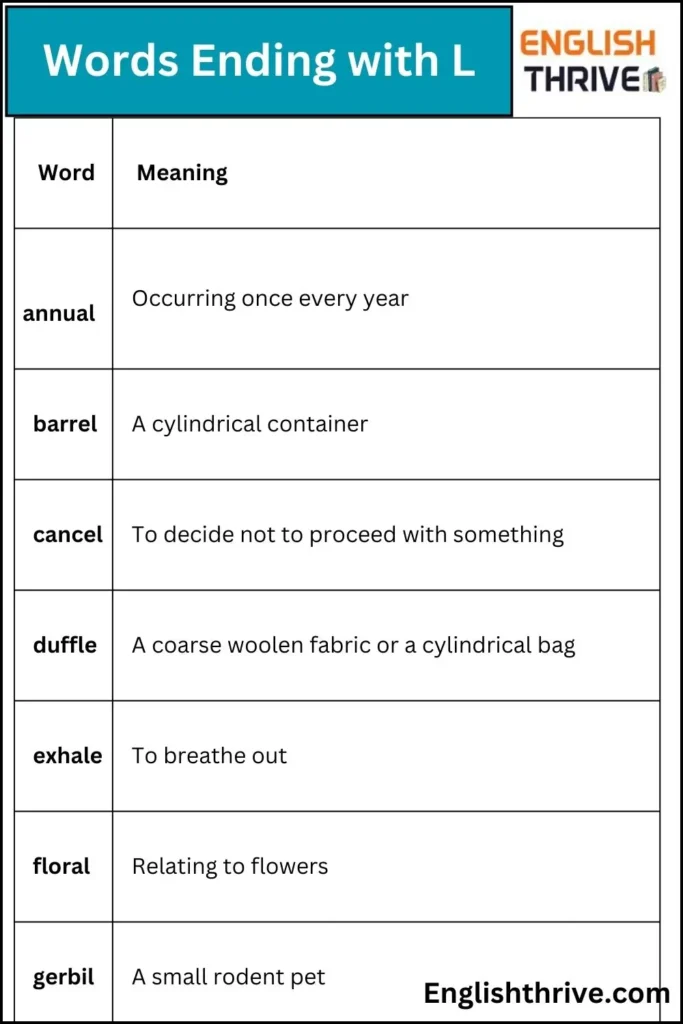
Six-letter words ending in L introduce more complex concepts and specialized terminology. These words add depth and precision to your vocabulary.
| Word | Meaning |
|---|---|
| annual | Occurring once every year |
| barrel | A cylindrical container |
| cancel | To decide not to proceed with something |
| duffle | A coarse woolen fabric or a cylindrical bag |
| exhale | To breathe out |
| floral | Relating to flowers |
| gerbil | A small rodent pet |
| hostel | Budget accommodation for travelers |
| inhale | To breathe in |
| jovial | Cheerful and friendly |
7-Letter Words Ending in L
Seven-letter words ending in L often represent more specific concepts or technical terms. These words help express complex ideas with precision.
| Word | Meaning |
|---|---|
| arsenal | A collection of weapons or a football club |
| betrayal | The act of betraying someone’s trust |
| central | Located at or forming the center |
| daffodil | A yellow spring flower |
| eternal | Lasting or existing forever |
| flannel | A soft woven fabric |
| gradual | Taking place slowly over a period of time |
| handful | A quantity that fills the hand |
8-Letter Words Ending in L
Eight-letter words ending in L typically represent more specialized concepts or technical terms. These words often appear in academic or professional contexts.
| Word | Meaning |
|---|---|
| approval | The belief that someone or something is good or acceptable |
| betrayal | The action of betraying someone’s trust |
| carnival | A traveling amusement show or a festive occasion |
| disposal | The action of getting rid of something |
| ethereal | Extremely delicate and light in a way that seems not of this world |
9-Letter Words Ending in L
Nine-letter words ending in L often represent specific concepts, technical terms, or complex ideas. These words add sophistication to your vocabulary.
| Word | Meaning |
|---|---|
| appraisal | A formal assessment of something’s value |
| bacterial | Relating to or caused by bacteria |
| charcoal | A lightweight black carbon residue from burning wood |
| dismissal | The act of ordering someone to leave |
| ethereal | Extremely delicate and light in a way that seems not of this world |
10-Letter Words Ending in L
Ten-letter words ending in L typically represent more specialized or technical concepts. These words demonstrate advanced vocabulary and often appear in academic or professional writing.
| Word | Meaning |
|---|---|
| analytical | Relating to or using analysis |
| biological | Relating to biology or living organisms |
| contextual | Depending on or relating to the context |
| dialectical | Relating to the logical discussion of ideas and opinions |
How Words That End With L Are Used in Sentences
Words ending with L serve various grammatical functions in sentences. Understanding how these words operate in context helps improve both written and spoken communication. Let’s explore their diverse uses:
Nouns Ending in L
Nouns ending in L name people, places, objects, or concepts. They function as subjects, objects, or complements in sentences:
- “The school offers excellent educational programs.” (subject)
- “She graduated from medical school last year.” (object of preposition)
- “The towel was still damp from the morning shower.” (subject)
- “Hand me that towel, please.” (direct object)
Verbs Ending in L
Verbs ending in L describe actions, states, or occurrences. They serve as the main predicates in sentences:
- “The children crawl through the playground tunnel.” (present tense)
- “She crawled under the fence to retrieve the ball.” (past tense)
- “Please mail this letter by tomorrow.” (imperative)
- “The hikers trail behind the experienced guide.” (present tense)
Adjectives Ending in L
Adjectives ending in L modify nouns by describing their qualities or attributes:
- “The final exam will cover all course material.”
- “Her loyal friend stood by her through difficult times.”
- “The small details make a big difference.”
- “A formal invitation arrived in yesterday’s mail.”
Adverbs Ending in L
Some words ending in L function as adverbs, modifying verbs, adjectives, or other adverbs:
- “He performed the task well.”
- “She spoke softly yet well.”
- “The team played exceptionally well in the championship game.”
Compound Words Ending in L
Many compound words in English end with L, combining two or more words to create a new meaning:
- “The downhill ski competition was postponed due to weather.”
- “The treadmill helps improve cardiovascular health.”
- “She has a strongwill that helps her overcome challenges.”
- “The windmill generated sustainable energy for the farm.”
Common Phrases and Expressions with L-Ending Words
Words ending with L appear in many common phrases and expressions:
- “Level the playing field” (to make conditions fair for everyone)
- “Ring a bell” (to sound familiar)
- “Spill the beans” (to reveal a secret)
- “Take a toll” (to have a negative effect)
- “Fit the bill” (to be suitable for a purpose)
Technical and Professional Uses
In specialized fields, L-ending words often carry specific technical meanings:
- Medical: “The surgical scalpel requires precise handling.”
- Legal: “The legal counsel advised against the proposed action.”
- Scientific: “The chemical alcohol has various industrial applications.”
- Educational: “The school principal announced new safety protocols.”
Understanding how words ending with L function in different contexts enhances your ability to use them effectively in your own communication. Whether you’re writing an academic paper, composing a business email, or engaging in casual conversation, mastering these words adds precision and clarity to your expression.
Pronunciation Patterns of Words Ending with L
Words ending with L follow distinctive pronunciation patterns that contribute to their unique sound in English. Understanding these patterns can help with proper pronunciation and enhance your speaking skills.
Basic Pronunciation Rules
The letter L at the end of words creates several common pronunciation patterns:
- Clear L: When L appears at the end of a word and follows a vowel, it often produces a “clear L” sound where the tongue tip touches the alveolar ridge (mail, seal, hotel)
- Dark L: When L concludes a word after a consonant or when followed by another consonant, it typically produces a “dark L” or “velarized L” where the back of the tongue raises toward the soft palate (milk, world, help)
- Silent L: In certain words, especially those borrowed from French, the L may be silent (could, should, would)
- Syllabic L: Sometimes the L creates its own syllable, particularly when following certain consonants (bottle, middle, puzzle)
Stress Patterns
Words ending with L feature various stress patterns depending on their length and origin:
- One-syllable words: Naturally stressed on the single syllable (tall, well, seal)
- Two-syllable words: Often stressed on the first syllable (MO-del, LE-vel) though exceptions exist (ho-TEL, ex-CEL)
- Multi-syllable words: Follow more complex patterns:
- Words ending in -al typically stress the third-to-last syllable (LOG-i-cal, MU-si-cal)
- Words ending in -ial often stress the second-to-last syllable (par-TIAL, spe-CIAL)
Regional Variations
Pronunciation of L-ending words can vary across English dialects:
- British English: Often features a more distinct pronunciation of the final L
- American English: Sometimes reduces the final L sound, particularly in casual speech
- Australian English: May slightly soften the final L in certain words
Mastering the pronunciation of words ending with L adds fluency and naturalness to your spoken English, making your communication more effective across different contexts.
The Etymology of Words Ending with L
The history and origins of words ending with L reveal fascinating insights into language development. These etymological patterns help explain why certain words have this distinctive ending.
Latin Influences
Many L-ending words have Latin origins, particularly those ending with suffixes like:
- -al (from Latin -alis): logical, musical, legal
- -ial (from Latin -ialis): facial, special, partial
- -ual (from Latin -ualis): gradual, annual, individual
Germanic Origins
Several common L-ending words derive from Germanic language roots:
- Old English: fall (feallan), tell (tellan), sell (sellan)
- Old Norse: skill (skil), ill (illr)
- Proto-Germanic: well (wella), hill (hyll)
French Contributions
Norman French and Middle French contributed numerous L-ending words to English:
- barrel (baril), castle (chastel), jewel (jouel)
Greek Derivatives
Some L-ending words have Greek origins, especially scientific and academic terms:
- symbol (symbolon), idol (eidolon), crystal (krystallos)
Understanding these etymological connections enriches our appreciation of L-ending words and provides insights into their meaning and usage in modern English.
Conclusion & Final Tips
Words ending with L represent a diverse and valuable subset of English vocabulary that appears across all contexts of language use. From simple three-letter terms used in everyday conversation to specialized technical vocabulary, L-ending words offer rich opportunities for precise and effective communication.
Through our exploration, we’ve seen how these words:
- Create distinctive sounds that add musicality and flow to spoken English
- Serve various grammatical functions as nouns, verbs, adjectives, and adverbs
- Form important components of compound words and idiomatic expressions
- Follow specific pronunciation patterns that vary across dialects
- Reflect diverse etymological roots that reveal language history
To effectively incorporate words ending with L into your vocabulary:
- Practice pronunciation: Pay special attention to the difference between “clear” and “dark” L sounds at word endings
- Study word families: Notice patterns among related words (equal, equality, equalize)
- Explore specialized vocabularies: Different professional domains feature unique L-ending terminology
- Read widely: Exposure to varied texts will naturally increase your familiarity with diverse L-ending words
- Use contextually: Understanding the precise meaning and connotation of each word ensures appropriate usage
Whether you’re a language learner, a word enthusiast, or someone looking to improve your communication skills, words ending with L offer rich opportunities for expanding your vocabulary and enhancing your expression. Their distinctive sound qualities and diverse origins contribute significantly to the richness and precision of English.
By incorporating these words thoughtfully into your written and spoken communication, you can add clarity, create emphasis, and express ideas with greater accuracy. The flowing quality of L-ending words makes them particularly effective in creating smooth, engaging prose and speech.
Common Questions About Words Ending with L
Q: Why do some words ending with L double the L when adding suffixes?
A: This typically occurs with one-syllable words ending in a single L preceded by a single vowel (hill → hilly, skill → skilled). The doubling maintains the short vowel sound in the original word.
Q: Are there patterns to help remember which words end with LE versus just L?
A: Words ending in -le typically have the L sound forming its own syllable (bubble, handle, middle), while words ending in just L often have the L as part of the final syllable (small, equal, until).
Q: Which languages contributed the most L-ending words to English?
A: Latin has contributed the most L-ending words to English, particularly through suffixes like -al, -ial, and -ual. Germanic languages (including Old English) and French have also provided significant numbers of L-ending words.
Q: Can word endings with L help identify parts of speech?
A: Yes, many suffixes ending in L indicate specific parts of speech. For example, -al, -ial, and -ful typically form adjectives (logical, partial, beautiful), while -ol often appears in chemical terms (ethanol, methanol).
By understanding these patterns and origins, you’ll develop a deeper appreciation for the rich tapestry of L-ending words in the English language and use them more effectively in your own communication.