

Prepositions may be short words, but they are essential for making English sentences clear and meaningful. Words like “in,” “on,” “at,” “to,” “for,” and “with” help us explain place, time, direction, reason, and relationships in a sentence. Sentences often lose clarity and meaning when prepositions are not used.
That is why learning preposition words and their uses in sentences is essential for students, teachers, and English learners. Many people also prefer studying using a PDF, as it is easy to download, print, and revise anytime.
In this guide, you will find:
-
A clear list of common and additional prepositions
-
Simple example sentences for each preposition
- PDF Files
What Are Prepositions?
A preposition is a grammar word used to show the connection between a noun or pronoun and other parts of a sentence.
Prepositions usually tell us about:
-
Place (where something is)
-
Time (when something happens)
-
Direction (movement)
-
Cause or reason
-
Manner or method
Formula:
Preposition + Noun / Pronoun = Prepositional Phrase
List of Common Preposition Words
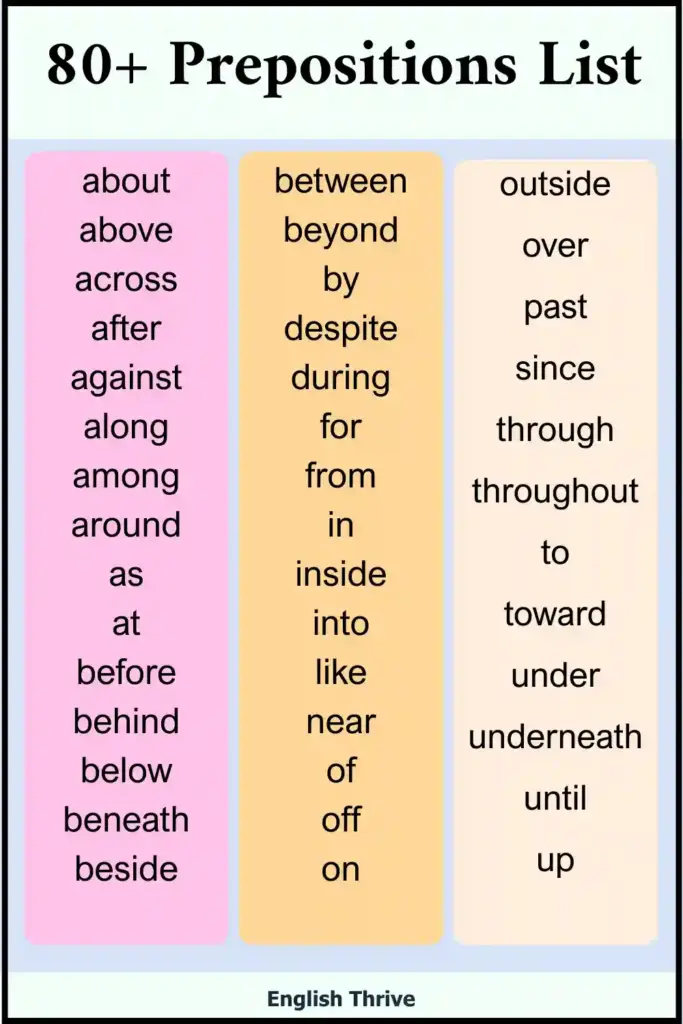
50 Most Common Prepositions
-
about
-
above
-
across
-
after
-
against
-
along
-
among
-
around
-
as
-
at
-
before
-
behind
-
below
-
beneath
-
beside
-
between
-
beyond
-
by
-
despite
-
during
-
for
-
from
-
in
-
inside
-
into
-
like
-
near
-
of
-
off
-
on
-
onto
-
out
-
outside
-
over
-
past
-
since
-
through
-
throughout
-
to
-
toward
-
under
-
underneath
-
until
-
up
-
upon
-
with
-
within
-
without
-
worth
-
via
Additional Preposition Words
-
according to
-
across from
-
ahead of
-
apart from
-
as for
-
as of
-
because of
-
close to
-
due to
-
in addition to
-
in front of
-
in spite of
-
instead of
-
next to
-
on account of
-
on behalf of
-
on top of
-
out of
-
prior to
-
regardless of
-
up to
-
with respect to
-
with regard to
-
in accordance with
-
in case of
-
in line with
-
in place of
-
in reference to
-
in view of
-
as per
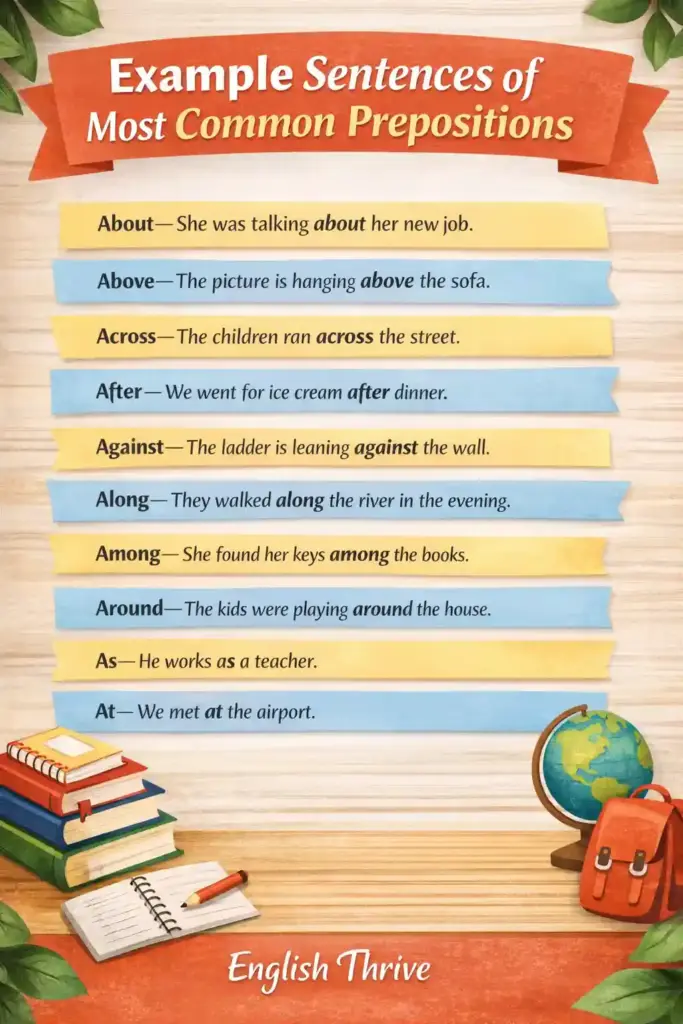
Example Sentences of Most Common Prepositions
-
About—she was talking about her new job.
-
Above—The picture is hanging above the sofa.
-
Across—The children ran across the street.
-
After—we went for ice cream after dinner.
-
Against—The ladder is leaning against the wall.
-
Along—They walked along the river in the evening.
-
Among—She found her keys among the books.
-
Around—The kids were playing around the house.
-
As—He works as a teacher.
-
At—We met at the airport.
-
Before—Please finish your work before sunset.
-
Behind—The cat is hiding behind the curtain.
-
Below—The temperature dropped below zero.
-
Beneath—The treasure was buried beneath the tree.
-
Beside—She sat beside her best friend.
-
Between—The shop is between the bank and the café.
-
Beyond—The road continues beyond the village.
-
By—The letter was written by my brother.
-
Despite the rain, they played outside.
-
During—He fell asleep during the movie.
-
For—this gift is for you.
-
From—She moved from Texas to California.
-
In—The milk is in the fridge.
-
Inside—The dog stayed inside the house.
-
Into—He jumped into the pool.
-
Like—she sings like a professional.
-
Near—The school is near my home.
-
Of—a cup of coffee sounds great.
-
Off—Please take your shoes off the couch.
-
On—The book is on the desk.
-
Onto—The cat jumped onto the table.
-
Out—He ran out of the room.
-
Outside—The kids are playing outside.
-
Over—The plane flew over the city.
-
Past – She walked past the store.
-
Since—I have lived here since 2015.
-
Through—We drove through the tunnel.
-
Throughout—She stayed calm throughout the test.
-
To—He went to the office early.
-
Toward—The dog ran toward its owner.
-
Under—The shoes are under the bed.
-
Underneath—The cat slept underneath the chair.
-
Until—Please wait until I return.
-
Up—The balloons floated up into the sky.
-
Upon arrival, we checked in at the hotel.
-
With—she came with her friends.
-
Within—Finish the task within an hour.
-
Without—He left without his wallet.
-
Worth—This book is worth reading.
-
Via – He sent the file via email.
Additional Preposition Examples in Sentences
-
According to the teacher’s explanation, the questions will be simple
-
Across from—The café is across from the library.
-
Ahead of—She arrived ahead of the scheduled time.
-
Apart from math, he enjoys science.
-
As for—as for the project, it is almost finished.
-
As of today, new rules are effective.
-
Because of—The flight was delayed because of fog.
-
Close to—The hotel is close to the airport.
-
Due to—The exam was canceled due to heavy rain.
-
In addition to—In addition to English, she studies French.
-
In front of—The car is parked in front of the house.
-
In spite of—In spite of the pain, he kept running.
-
Instead of—She drank tea instead of coffee.
-
Next to—He sat next to his sister.
-
On account of—The office was closed on account of the holiday.
-
On behalf of—On behalf of the group, she shared their decision.
-
On top of—The keys are on top of the shelf.
-
Out of—He stepped out of the car.
-
Prior to—prior to the exam, revise your notes.
-
Regardless of the result, try your best.
-
Up to—Children can play up to sunset.
-
With respect to—With respect to your request, we agree.
-
With regard to the complaint, action was taken.
-
In accordance with—The policy was changed in accordance with the law.
-
In case of—In case of fire, use the stairs.
-
In line with—His actions were in line with company rules.
-
In place of—She attended the meeting in place of her manager.
-
In reference to— In reference to your email, we have replied.
-
In view of—In view of the weather, the trip was canceled.
-
As per instructions, submit the form today.
FAQs on Preposition Words and Their Uses in Sentences
What are prepositions in simple words?
Prepositions are words that show the relationship between a noun or pronoun and another word in a sentence. They usually tell us where, when, or how something happens.
Example:
-
The book is on the table.
What are 20 examples of prepositions in sentences?
Some common prepositions used in sentences are
in, on, at, to, for, from, with, by, under, over, after, before, between, among, near, inside, outside, during, since, until.
Each of these helps explain time, place, or movement.
What are the most common prepositions in English?
The most common prepositions in English include in, on, at, to, for, of, from, with, by, and about. These are used daily in speaking and writing.
What are the 8 types of prepositions?
The main types of prepositions are
-
Prepositions of place
-
Prepositions of time
-
Prepositions of direction
-
Prepositions of manner
-
Prepositions of cause or reason
-
Prepositions of agent
-
Compound prepositions
-
Phrase prepositions
Each type serves a different purpose in a sentence.
Can a sentence end with a preposition?
Yes. In modern English, especially in conversation and informal writing, it is completely acceptable to end a sentence with a preposition.
Example:
-
That’s the topic I was talking about.
Why should I learn prepositions with example sentences?
Learning prepositions with sentences helps you understand how they are actually used, not just their meanings. This makes it easier to speak and write English correctly and confidently.
Conclusion
Prepositions may seem simple, but they are a key part of clear and correct English. By learning preposition words and their uses in sentences, you improve your ability to describe time, place, movement, and reasons accurately.