

Math vocabulary is the foundation of understanding mathematics. You can solve simple addition problems. You can also work with shapes, algebra, or data. In all cases, math words are important.
Math vocabulary can be harder to understand than math itself. This is true for students, English learners, parents, and teachers. Many math problems stem from language issues, not numerical ones. You will learn the most important math vocabulary words, their meanings, and how to use them in real examples with this guide.
By the end of this article, you will understand common math terms. You will also avoid common mistakes. This will help you feel more confident when reading and solving math problems.
What Is Math Vocabulary?
Definition of Math Vocabulary
Math vocabulary refers to the specific words, phrases, and symbols used in mathematics. These words explain operations, numbers, shapes, relationships, and processes in math.
Math vocabulary includes:
- Words that show actions (add, subtract, divide)
- Words that describe results (sum, product, quotient)
- Words that name shapes and measurements (triangle, area, volume)
- Words that explain math thinking (estimate, simplify, algorithm)
In simple terms, math vocabulary is the language of math.
Why Math Vocabulary Matters for Students and English Learners
Understanding math vocabulary is essential because:
- Math problems are written in words, not just numbers
- One word can completely change the meaning of a problem
- Many math mistakes happen because of misunderstood vocabulary
For English learners, math vocabulary is especially important because:
- Some words have different meanings in everyday English and math
- Phrases like “less than” or “shared equally” can be confusing
- Learning math vocabulary improves both math skills and academic English
Strong math vocabulary helps students:
- Read word problems correctly
- Choose the right math operation
- Explain their answers clearly
Basic Math Vocabulary for Numbers and Operations
Basic operations are the first place where students encounter math vocabulary. These words tell you what to do with numbers.
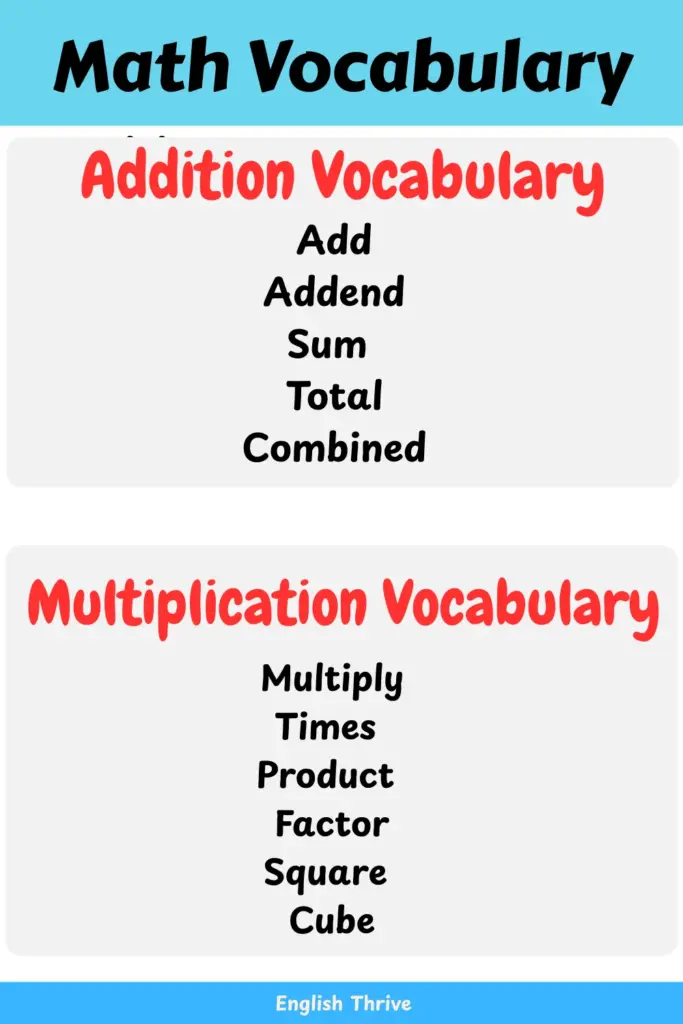
Addition Vocabulary
Addition means putting numbers together.
Common addition words include:
- Add – to combine numbers
- Addend – a number being added
- Sum – the result of addition
- Total – the whole amount
- More / Increased / Combined – signal addition in word problems
Example:
6 + 3 = 9
6 and 3 are addends
9 is the sum
Word problem example:
I have 5 apples. I buy 4 more. How many apples do I have in total?
The word “more” tells you to add.
Subtraction Vocabulary
Subtraction means taking away or finding the difference.
Common subtraction words include:
- Subtract – to take away
- Difference – the result of subtraction
- Less / Fewer – smaller amount
- Decreased – made smaller
- Remaining / Leftover – what is still there
Example:
10 − 4 = 6
The difference is 6
Important ESL note:
- 10 minus 4 = 6
- 10 less than 4 = 4 − 10 = −6
These phrases do not mean the same thing.
Multiplication Vocabulary
Multiplication means repeated addition or groups of equal size.
Common multiplication words include:
- Multiply – to find a product
- Times – another word for multiply
- Product – the result of multiplication
- Factor – numbers multiplied together
- Square – multiply a number by itself
- Cube – multiply a number by itself three times
Example:
6 × 3 = 18
6 and 3 are factors
18 is the product
Division Vocabulary
Division means splitting into equal parts.
Common division words include:
- Divide – to separate into equal groups
- Quotient – the result of division
- Dividend – the number being divided
- Divisor – the number dividing
- Half – divide by 2
- Quarter – divide by 4
- Shared equally / Split – signals division
Example:
12 ÷ 3 = 4
12 is the dividend
3 is the divisor
4 is the quotient

Key Takeaway from Basic Operations
Many math problems do not say add, subtract, multiply, or divide directly. Instead, they use math vocabulary words as clues. Learning these words helps you choose the correct operation every time.
Math Vocabulary for Fractions and Numbers
Understanding fractions and number types is essential for higher-level math. These terms appear often in word problems, tests, and real-life situations.
Fraction Vocabulary
A fraction represents part of a whole and is also a division problem.
Important fraction terms:
- Fraction – the quotient of two numbers
- Numerator – the top number of a fraction (the dividend)
- Denominator – the bottom number of a fraction (the divisor)
Example:
3/4
3 is the numerator
4 is the denominator
Helpful tip for learners:
A fraction always means division.
3/4 = 3 ÷ 4
Integer and Number Vocabulary
Different math problems use different types of numbers.
Common number terms include:
- Integer – positive and negative whole numbers, including zero
(…, −3, −2, −1, 0, 1, 2, 3 …) - Whole number – 0 and positive numbers
- Prime number – a number with only two factors: 1 and itself
(2, 3, 5, 7, 11, 13 …)
Knowing these terms helps students understand instructions like:
“Solve using integers only.”
Geometry Math Vocabulary (Shapes & Angles)

Geometry focuses on shapes, sizes, angles, and space. Geometry vocabulary is very visual and often used in school exams.
Basic Geometry Terms
- Point – an exact position in space
- Line – a straight path with no end
- Line segment – part of a line with two endpoints
- Ray – a line that starts at one point and goes on forever in one direction
Angle Vocabulary
An angle is formed when two lines meet at a point called a vertex.
Common angle types:
- Acute angle – less than 90°
- Right angle – exactly 90°
- Obtuse angle – more than 90° but less than 180°
- Straight angle – exactly 180°
Memory tip:
- Acute = small
- Obtuse = wide or “fat”
Shape Vocabulary (2D Shapes)
A polygon is a closed shape with straight sides.
Common polygons:
- Triangle – 3 sides
- Equilateral – all sides equal
- Isosceles – two sides equal
- Scalene – all sides different
- Quadrilateral – 4 sides
- Pentagon – 5 sides
- Hexagon – 6 sides
- Octagon – 8 sides
Special Quadrilaterals
- Square – 4 equal sides and 4 right angles
- Rectangle – 4 right angles
- Parallelogram – opposite sides are parallel and equal
- Rhombus – 4 equal sides, looks like a “tilted square”
Circle Vocabulary
A circle is a shape with an infinite number of points the same distance from the center.
- Circle – round shape
- Circumference – distance around a circle
- Radius – distance from the center to the edge
- Diameter – distance across the circle through the center
Measurement Vocabulary
Measurement terms describe space and size.
- Perimeter – distance around a shape
- Area – space inside a 2D shape
- Volume – space inside a 3D shape
- Unit – standard measurement (inch, meter, gram, liter)
Example:
- Area is measured in square units
- Volume is measured in cubic units
Algebra Math Vocabulary Made Simple
Algebra uses letters and symbols to represent numbers and relationships.
Algebra Basics
- Variable – a letter that represents an unknown value (x, y)
- Expression – numbers and variables without an equals sign
2x + 3
- Equation – two expressions that are equal
2x + 3 = 7
- Coefficient – the number in front of a variable
In 5x, 5 is the coefficient
Formulas and Patterns
- Formula – a rule used to calculate something
Area = length × width
- Pattern – a repeated or predictable sequence
- Algorithm – step-by-step procedure to solve a problem
- Simplify – make an expression easier to understand
Data, Graphs, and Statistics Vocabulary
Data vocabulary helps students understand charts, averages, and real-life information such as surveys, scores, and measurements.
Data and Measurement Terms
- Data – information, often numbers
- Table – information organized in rows and columns
- Graph – a visual display of data
- Coordinate – a pair of numbers (x, y) that shows a position on a graph
Example:
The point (3, 5) is a coordinate on a graph.
Averages and Probability Vocabulary
These terms are common in school math and standardized tests.
- Mean (Average) – add all values, then divide by how many values there are
- Median – the middle number when values are in order
- Mode – the number that appears most often
- Probability – how likely something is to happen
- Estimate – an approximate answer, not exact
Math Vocabulary List (A–Z)

- Addend – a number being added
- Area – space inside a 2D shape
- Coefficient – number multiplied by a variable
- Denominator – bottom number of a fraction
- Equation – math statement with an equals sign
- Expression – math symbols without an equals sign
- Factor – numbers multiplied together
- Fraction – part of a whole
- Integer – positive, negative, or zero whole number
- Mean – average
- Numerator – top number of a fraction
- Perimeter – distance around a shape
- Polygon – closed shape with straight sides
- Product – result of multiplication
- Quotient – result of division
- Sum – result of addition
- Volume – space inside a 3D shape
Math Vocabulary Examples in Sentences
Using math vocabulary in sentences helps learners understand how words work in context.
Examples:
- The sum of 6 and 4 is 10.
- The product of 5 and 3 is 15.
- The difference between 12 and 7 is 5.
- The area of the rectangle is 24 square units.
- The variable x represents an unknown number.
Common Math Vocabulary Mistakes for English Learners
Many learners struggle with these confusing terms:
- Less vs. fewer
- Less = amount
- Fewer = number of items
- Minus vs. less than
- 10 − 4 ≠ 10 less than 4
- Expression vs. equation
- Expressions have no equals sign
- Product vs. sum
- Product = multiplication
- Sum = addition
Understanding these differences prevents common exam mistakes.
Math Vocabulary for ESL and ELL Students
Tips to Learn Math Vocabulary Faster
- Use visual aids (charts, diagrams, shapes)
- Practice with real-life examples
- Read math problems out loud
- Learn math words in context, not alone
FAQs About Math Vocabulary
What are 10 common math vocabulary words with examples?
Examples include add, subtract, sum, product, fraction, area, volume, variable, equation, and mean.
What is math vocabulary in English?
Math vocabulary in English includes the words and phrases used to describe numbers, operations, shapes, and math processes.
What is 24 in words in math?
24 in words is twenty-four.
What are the most important math words for students?
Basic operation words (add, subtract, multiply, divide), number terms (fraction, integer), and geometry terms (area, perimeter) are essential.
Where can I find a math vocabulary list A–Z?
This article provides a simplified A–Z math vocabulary reference suitable for students and English learners.
Final Thoughts: Mastering Math Vocabulary for Academic Success
Math is not only about numbers. It is also about words. When students know math words, they understand math better.
Math vocabulary helps students read problems carefully. It helps them choose the right math operation. It helps them explain answers with confidence. Anyone can learn math vocabulary. Students, teachers, parents, and English learners all benefit.
Learning step by step makes math easier. Keep practicing every day. Review math words often. Remember this simple rule: when you understand the words, you understand the math.