

Relationships are a cornerstone of the human experience, and understanding how to talk about them effectively is crucial. English offers a rich tapestry of idioms that can add color, depth, and nuance to our conversations about love, friendship, and family.
Mastering these idioms not only enhances your vocabulary but also provides insight into the cultural perspectives on relationships. This article is designed for English language learners of all levels who wish to express themselves more fluently and accurately when discussing relationships.
By exploring the definitions, structures, and usage of common idioms, you’ll gain the confidence to navigate relationship-related conversations with ease.
Whether you’re a beginner looking to grasp the basics or an advanced learner aiming to refine your communication skills, this comprehensive guide will equip you with the knowledge and practice needed to use relationship idioms correctly and confidently. Get ready to delve into the fascinating world of English idioms and unlock a new level of expressive power!
What are Idioms for Relationships?
Idioms are phrases or expressions whose meanings cannot be understood from the literal definitions of the individual words. Instead, they carry a figurative meaning that is culturally specific.
Relationship idioms are idioms that relate to the various types of connections people form, including romantic relationships, friendships, and family bonds. Understanding these idioms is essential for comprehending nuanced conversations and cultural contexts in English.
These idioms often reflect cultural values and beliefs about relationships. For example, an idiom like “tie the knot” (to get married) provides a metaphorical image of binding two lives together.
Similarly, “thick as thieves” (very close friends) conveys a sense of unwavering loyalty and camaraderie. The function of relationship idioms is to add color and depth to our language, allowing us to express complex emotions and dynamics in a concise and engaging manner.
They enable speakers and writers to convey feelings and situations more vividly than literal language might allow.
In essence, relationship idioms are a type of figurative language used to describe the dynamics, emotions, and stages of interpersonal connections. They are deeply embedded in the English language and are frequently used in everyday conversation, literature, and media.
The contexts in which they appear are diverse, ranging from casual chats to formal speeches, making their understanding crucial for effective communication.
Structural Breakdown of Relationship Idioms
Relationship idioms come in various structural forms, making it important to understand their patterns to use them correctly. Some common structures include:
- Phrasal Verbs: Many idioms involve phrasal verbs, which consist of a verb and a preposition or adverb. For instance, “fall for” (to become romantically attracted to someone) is a phrasal verb idiom.
- Noun Phrases: Some idioms are expressed as noun phrases, such as “a match made in heaven” (a perfectly compatible couple).
- Similes and Metaphors: Idioms often employ similes (using “like” or “as”) or metaphors (directly comparing two unlike things) to convey meaning. For example, “like two peas in a pod” (very similar and close) is a simile-based idiom.
- Fixed Expressions: Certain idioms are fixed expressions, meaning their wording cannot be changed without altering the meaning. Examples include “wear your heart on your sleeve” (to openly display your emotions).
Understanding the grammatical structure of an idiom is important because it dictates how the idiom can be used in a sentence. For example, phrasal verb idioms often require specific word order, whereas noun phrase idioms can function as subjects or objects within a sentence.
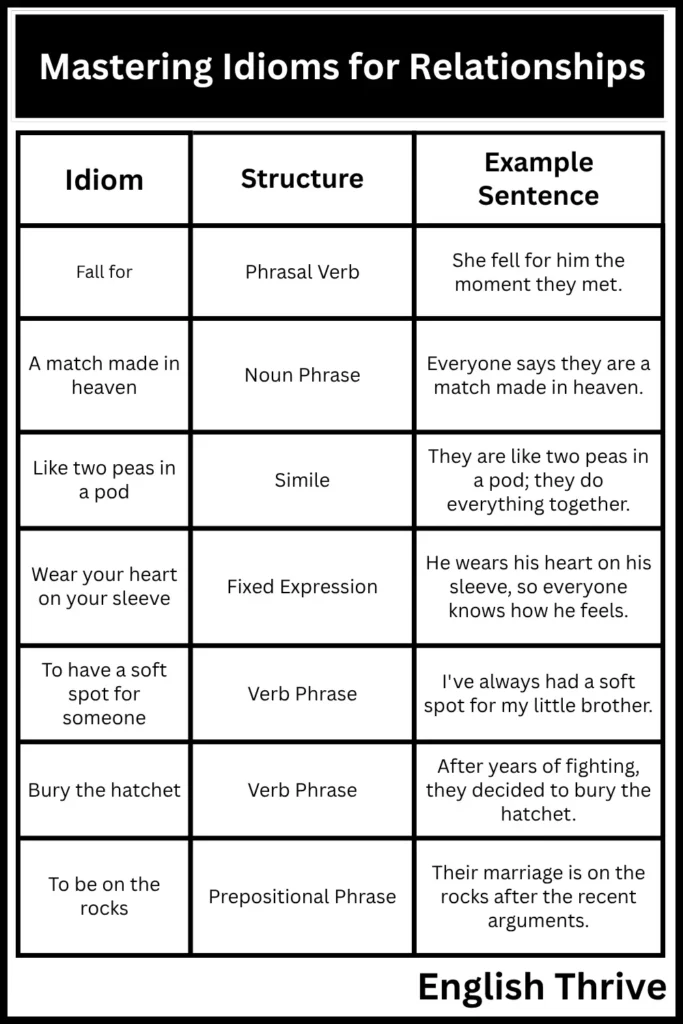
Recognizing these patterns can help learners avoid making grammatical errors when incorporating idioms into their speech and writing. The table below illustrates the structural breakdown of some relationship idioms:
| Idiom | Structure | Example Sentence |
|---|---|---|
| Fall for | Phrasal Verb | She fell for him the moment they met. |
| A match made in heaven | Noun Phrase | Everyone says they are a match made in heaven. |
| Like two peas in a pod | Simile | They are like two peas in a pod; they do everything together. |
| Wear your heart on your sleeve | Fixed Expression | He wears his heart on his sleeve, so everyone knows how he feels. |
| To have a soft spot for someone | Verb Phrase | I’ve always had a soft spot for my little brother. |
| Bury the hatchet | Verb Phrase | After years of fighting, they decided to bury the hatchet. |
| To be on the rocks | Prepositional Phrase | Their marriage is on the rocks after the recent arguments. |
| To pop the question | Verb Phrase | He’s planning to pop the question on their anniversary. |
| To tie the knot | Verb Phrase | They are finally going to tie the knot next summer. |
| To be joined at the hip | Adjective Phrase | Those two are joined at the hip; they’re always together. |
| To keep someone at arm’s length | Verb Phrase | After the betrayal, she decided to keep him at arm’s length. |
| To be through thick and thin | Prepositional Phrase | They have been friends through thick and thin. |
| To build bridges | Verb Phrase | The diplomat worked hard to build bridges between the countries. |
| To be in someone’s good books | Prepositional Phrase | He tried to get in her good books by helping with the project. |
| To let someone down | Phrasal Verb | He didn’t want to let her down by canceling their plans. |
| To pick up the pieces | Verb Phrase | After the breakup, she had to pick up the pieces and move on. |
| To have a falling out | Noun Phrase | They had a falling out over a misunderstanding. |
| To turn one’s back on someone | Verb Phrase | I can’t believe he would turn his back on his own family. |
| To be two-faced | Adjective | I don’t trust her because she’s two-faced. |
| To make amends | Verb Phrase | He tried to make amends for his past mistakes. |
| To get on like a house on fire | Verb Phrase | They get on like a house on fire whenever they meet. |
| To be a shoulder to cry on | Noun Phrase | She’s always been a shoulder to cry on for her friends. |
| To be there for someone | Verb Phrase | I’ll always be there for you, no matter what. |
| To have each other’s backs | Verb Phrase | They always have each other’s backs in difficult situations. |
| To stand by someone | Phrasal Verb | I will stand by you through thick and thin. |
Types and Categories of Relationship Idioms
Relationship idioms can be categorized based on the type of relationship they describe. Here are some major categories:
Idioms About Love and Romance
These idioms describe the feelings, stages, and dynamics of romantic relationships. They encompass everything from initial attraction to long-term commitment.
Idioms About Friendship
Friendship idioms capture the essence of platonic relationships, including closeness, loyalty, and shared experiences.
Idioms About Family
Family idioms reflect the unique bonds and dynamics within families, including blood relations and chosen families.
Idioms About Conflict in Relationships
These idioms describe disagreements, tensions, and resolutions within various types of relationships.
Idioms About Support in Relationships
Support idioms highlight the ways people help and encourage each other in times of need, strengthening their bonds.
Examples of Relationship Idioms
To further illustrate the use of relationship idioms, here are several examples categorized by the type of relationship they describe:
Love and Romance Examples
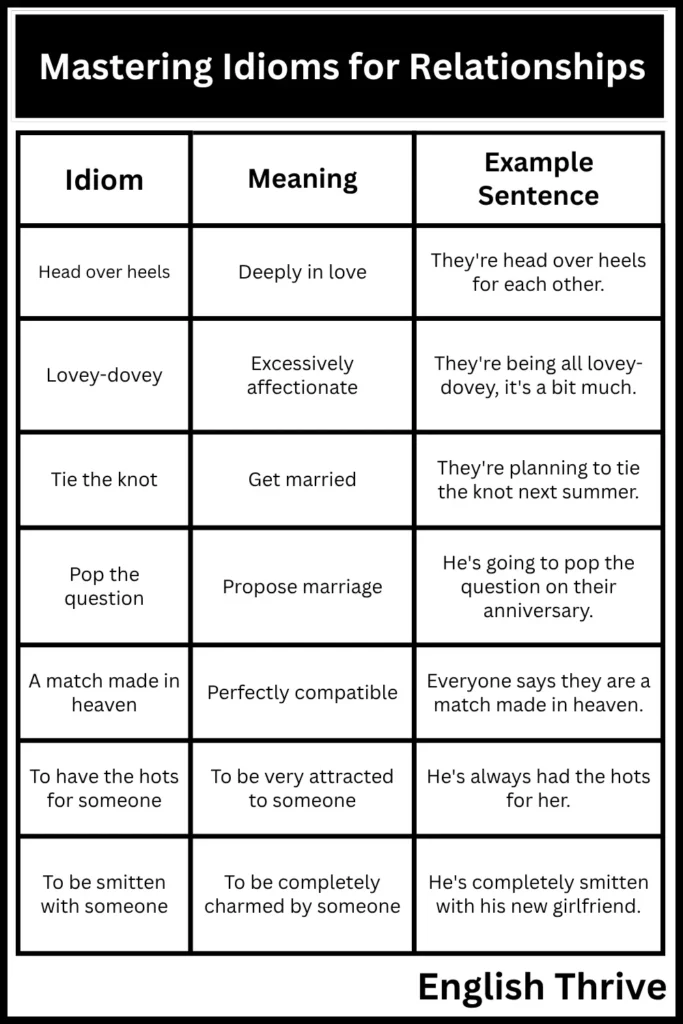
These idioms are commonly used to describe the various stages and aspects of romantic relationships. Understanding these idioms can help you better express and understand conversations about love.
| Idiom | Meaning | Example Sentence |
|---|---|---|
| Head over heels | Deeply in love | They’re head over heels for each other. |
| Lovey-dovey | Excessively affectionate | They’re being all lovey-dovey, it’s a bit much. |
| Tie the knot | Get married | They’re planning to tie the knot next summer. |
| Pop the question | Propose marriage | He’s going to pop the question on their anniversary. |
| A match made in heaven | Perfectly compatible | Everyone says they are a match made in heaven. |
| To have the hots for someone | To be very attracted to someone | He’s always had the hots for her. |
| To be smitten with someone | To be completely charmed by someone | He’s completely smitten with his new girlfriend. |
| To click with someone | To immediately connect with someone | They clicked right away and became good friends. |
| To sweep someone off their feet | To charm someone instantly | He swept her off her feet with his charm and wit. |
| To be an item | To be in a romantic relationship | They’ve been an item for over a year now. |
| To two-time someone | To cheat on someone | She found out he was two-timing her with her best friend. |
| To have a crush on someone | To have a brief but intense infatuation | She has a crush on the new guy at work. |
| To be the apple of one’s eye | To be cherished above all others | His granddaughter is the apple of his eye. |
| To be wrapped around someone’s finger | To be easily controlled by someone | He’s completely wrapped around her finger. |
| To go steady | To have a regular boyfriend or girlfriend | They decided to go steady after dating for a few months. |
| To be on the same wavelength | To understand each other perfectly | They’re always on the same wavelength. |
| To get hitched | To get married (informal) | They decided to get hitched in Las Vegas. |
| To walk down the aisle | To get married | She’s excited to walk down the aisle next spring. |
| To be a blushing bride | A bride who is shy and happy | She made a blushing bride on her wedding day. |
| To be a cradle snatcher | Someone who dates someone much younger | People call him a cradle snatcher because his girlfriend is much younger than him. |
| To lead someone on | To give someone false hope | He was leading her on, but he never intended to commit. |
| To string someone along | To keep someone interested without committing | She’s been stringing him along for months. |
| To play the field | To date multiple people at once | He decided to play the field before settling down. |
| To pop the cork | To celebrate a romantic event | They popped the cork on a bottle of champagne after getting engaged. |
| To be lovey-dovey | To show a lot of affection in public | They were being all lovey-dovey at the restaurant. |
Friendship Examples
These idioms are used to describe the qualities, dynamics, and experiences of friendships. They capture the importance of loyalty, support, and shared history.
| Idiom | Meaning | Example Sentence |
|---|---|---|
| Thick as thieves | Very close friends | They’re as thick as thieves; they do everything together. |
| Like two peas in a pod | Very similar and close | They are like two peas in a pod; they share the same interests. |
| A shoulder to cry on | Someone who offers support | She’s always been a shoulder to cry on for her friends. |
| To be there for someone | To offer support | I’ll always be there for you, no matter what. |
| To have each other’s backs | To support each other | They always have each other’s backs in difficult situations. |
| To get on like a house on fire | To become friends quickly | They get on like a house on fire whenever they meet. |
| To be joined at the hip | To be inseparable | Those two are joined at the hip; they’re always together. |
| To bury the hatchet | To end a conflict | After years of fighting, they decided to bury the hatchet. |
| To patch things up | To resolve a disagreement | They managed to patch things up after their argument. |
| To stand by someone | To support someone through difficult times | I will stand by you through thick and thin. |
| To be through thick and thin | To endure good and bad times together | They have been friends through thick and thin. |
| To be a fair-weather friend | Someone who is only there in good times | He turned out to be a fair-weather friend when I needed him most. |
| To keep someone at arm’s length | To avoid becoming too close | After the betrayal, she decided to keep him at arm’s length. |
| To build bridges | To improve relationships | The diplomat worked hard to build bridges between the countries. |
| To be in someone’s good books | To be favored by someone | He tried to get in her good books by helping with the project. |
| To let someone down | To disappoint someone | He didn’t want to let her down by canceling their plans. |
| To pick up the pieces | To recover after a difficult time | After the breakup, she had to pick up the pieces and move on. |
| To have a falling out | To have a serious disagreement | They had a falling out over a misunderstanding. |
| To turn one’s back on someone | To abandon someone | I can’t believe he would turn his back on his own family. |
| To be two-faced | To be deceitful | I don’t trust her because she’s two-faced. |
| To make amends | To make up for past mistakes | He tried to make amends for his past mistakes. |
| To get off on the wrong foot | To start a relationship badly | They got off on the wrong foot during their first meeting. |
| Birds of a feather flock together | People with similar interests tend to gather | Birds of a feather flock together; that’s why they became friends. |
| A friend in need is a friend indeed | A true friend helps in difficult times | He proved to be a friend in need is a friend indeed when he helped me move. |
| To be bosom buddies | Extremely close friends | They’ve been bosom buddies since kindergarten. |
Family Examples
These idioms describe the unique dynamics, relationships, and roles within a family. They capture the complex bonds and shared history that define familial connections.
| Idiom | Meaning | Example Sentence |
|---|---|---|
| Blood is thicker than water | Family bonds are stronger than other relationships | Despite their disagreements, blood is thicker than water. |
| Like father, like son | Sons tend to resemble their fathers | He’s a great musician, like father, like son. |
| To run in the family | To be a common trait in a family | A talent for art seems to run in the family. |
| To be the black sheep of the family | To be the odd one out | He’s always been the black sheep of the family. |
| To wear the pants in the family | To be the dominant one | She wears the pants in the family. |
| To be born with a silver spoon in one’s mouth | To be born into wealth | He was born with a silver spoon in his mouth and never had to work a day in his life. |
| To follow in someone’s footsteps | To pursue the same career or path | She decided to follow in her mother’s footsteps and become a doctor. |
| To be the spitting image of someone | To look exactly like someone | She’s the spitting image of her grandmother. |
| To be an old head on young shoulders | To be wise beyond one’s years | He’s an old head on young shoulders; he gives great advice. |
| To keep it in the family | To keep something private | Let’s keep it in the family and not tell anyone else. |
| To air dirty laundry in public | To reveal embarrassing family secrets | They shouldn’t air their dirty laundry in public. |
| To have a bun in the oven | To be pregnant | She has a bun in the oven and is expecting a baby. |
| To be tied to one’s mother’s apron strings | To be overly dependent on one’s mother | He’s still tied to his mother’s apron strings. |
| To be a chip off the old block | To resemble one’s parents | He’s a chip off the old block; he’s just like his father. |
| To rule the roost | To be in charge | Grandma rules the roost in their family. |
| To not see eye to eye | To disagree | They often don’t see eye to eye on political issues. |
| To leave the nest | To move out of one’s parents’ home | It’s time for him to leave the nest and become independent. |
| To be the baby of the family | To be the youngest child | She’s the baby of the family and gets a lot of attention. |
| To be a family man/woman | Someone who values family | He’s a real family man and loves spending time with his kids. |
| To have one’s hands full | To be very busy | She has her hands full with three young children. |
| To keep up with the Joneses | To try to match one’s neighbors in possessions | They’re always trying to keep up with the Joneses. |
| To be a deadbeat dad | A father who doesn’t support his children | He’s considered a deadbeat dad because he doesn’t pay child support. |
| To have a skeleton in the closet | To have a hidden secret | Every family has a skeleton in the closet. |
| To be the breadwinner | The person who earns the most money in the family | She’s the breadwinner in their family. |
| To be a couch potato | Someone who spends a lot of time sitting and watching TV | He’s become a real couch potato since he retired. |
Conflict Examples
These idioms describe disagreements, tensions, and resolutions within relationships. They are useful for understanding and discussing conflict scenarios.
| Idiom | Meaning | Example Sentence |
|---|---|---|
| To be on the rocks | Experiencing difficulties | Their marriage is on the rocks after the recent arguments. |
| To have a falling out | To have a serious disagreement | They had a falling out over a misunderstanding. |
| To bury the hatchet | To end a conflict | After years of fighting, they decided to bury the hatchet. |
| To patch things up | To resolve a disagreement | They managed to patch things up after their argument. |
| To be at loggerheads | To be in strong disagreement | They’re at loggerheads over the new project. |
| To lock horns | To engage in a conflict | The two politicians often lock horns during debates. |
| To agree to disagree | To accept a difference of opinion | We’ll just have to agree to disagree on this issue. |
| To sweep something under the rug | To ignore or hide a problem | They tried to sweep the scandal under the rug. |
| To be at each other’s throats | To be in constant conflict | They’re always at each other’s throats. |
| To have a bone to pick with someone | To have a grievance to discuss | I have a bone to pick with you about what you said yesterday. |
| To cross swords with someone | To argue or disagree with someone | The manager crossed swords with the employee over the new policy. |
| To fight like cats and dogs | To argue frequently and intensely | They fight like cats and dogs. |
| To be a thorn in someone’s side | To be a constant source of annoyance | He’s always been a thorn in her side. |
| To pour oil on troubled waters | To calm a situation | He tried to pour oil on troubled waters during the argument. |
| To clear the air | To resolve misunderstandings | We need to clear the air and discuss what happened. |
| To let sleeping dogs lie | To avoid stirring up old conflicts | It’s best to let sleeping dogs lie and not bring up the past. |
| To be on bad terms | To have a strained relationship | They’re on bad terms after their argument. |
| To drive a wedge between | To create conflict | The misunderstanding drove a wedge between them. |
| To be at daggers drawn | To be in a state of hostility | They’ve been at daggers drawn ever since the business deal fell through. |
| To add fuel to the fire | To make a situation worse | His comments only added fuel to the fire. |
| To call a truce | To temporarily stop fighting | They decided to call a truce for the holidays. |
| To kiss and make up | To reconcile after a fight | They always kiss and make up after their arguments. |
| To hold a grudge | To maintain resentment | She tends to hold a grudge for a long time. |
| To rub salt in the wound | To make a bad situation worse | His comments only rubbed salt in the wound. |
| To be at odds with someone | To disagree with someone | They’re often at odds with each other on political issues. |
Support Examples
These idioms describe the ways people help, encourage, and support each other, strengthening their relationships and providing comfort during difficult times.
| Idiom | Meaning | Example Sentence |
|---|---|---|
| To be a shoulder to cry on | To offer emotional support | She’s always been a shoulder to cry on for her friends. |
| To be there for someone | To offer support and assistance | I’ll always be there for you, no matter what. |
| To have each other’s backs | To support and defend each other | They always have each other’s backs in difficult situations. |
| To stand by someone | To support someone through difficult times | I will stand by you through thick and thin. |
| To lend a helping hand | To offer assistance | He’s always willing to lend a helping hand. |
| To go the extra mile | To do more than is expected | She always goes the extra mile for her friends. |
| To pick someone up | To cheer someone up | I tried to pick her up after she failed her exam. |
| To be a pillar of strength | To provide unwavering support | She’s been a pillar of strength for her family. |
| To give someone a pep talk | To offer encouragement | He gave me a pep talk before my presentation. |
| To look out for someone | To protect someone | He always looks out for his younger brother. |
| To go out on a limb for someone | To take a risk to support someone | He went out on a limb for her by vouching for her at work. |
| To carry someone through | To help someone through a difficult time | Her support carried him through the loss of his job. |
| To give someone a boost | To help someone improve | The scholarship gave her a boost in her education. |
| To lift someone’s spirits | To make someone happier | The good news really lifted her spirits. |
| To rally around someone | To come together to support someone | The community rallied around the family after the fire. |
| To take someone under one’s wing | To mentor someone | She took him under her wing and taught him everything she knew. |
| To be in one’s corner | To support someone | I know I can always count on you to be in my corner. |
| To be a rock for someone | To provide stability and support | He’s been a rock for her during this difficult time
. |
Usage Rules for Relationship Idioms
Using idioms correctly requires attention to context, grammar, and cultural understanding. Here are some key rules to follow:
- Understand the Meaning: Always ensure you fully understand the figurative meaning of the idiom before using it. Misusing an idiom can lead to confusion or miscommunication.
- Consider the Context: Idioms are often informal and may not be appropriate for all situations. Use them in contexts where figurative language is acceptable.
- Use Correct Grammar: Ensure the idiom fits grammatically into your sentence. Pay attention to verb tenses, subject-verb agreement, and word order.
- Be Mindful of Cultural Differences: Some idioms are culture-specific and may not translate well or be understood by people from different backgrounds.
- Avoid Overuse: While idioms can enrich your language, overuse can make your speech sound unnatural or forced. Use them sparingly and appropriately.
By following these guidelines, you can confidently incorporate relationship idioms into your conversations and writing, enhancing your communication skills and adding depth to your expressions.
Common Mistakes with Relationship Idioms
Even advanced learners sometimes make mistakes when using idioms. Here are some common pitfalls to avoid:
- Literal Interpretation: Interpreting an idiom literally instead of understanding its figurative meaning.
- Incorrect Wording: Changing the words of a fixed idiom, which can alter or negate its meaning.
- Misapplication: Using an idiom in an inappropriate context or situation.
- Grammatical Errors: Failing to integrate the idiom correctly into the sentence structure.
- Overuse: Using too many idioms, making the language sound unnatural or confusing.
To avoid these mistakes, practice using idioms in various contexts, seek feedback from native speakers, and continually expand your understanding of idiomatic expressions. Here are some examples of common mistakes and their corrections:
Incorrect: They are thick as water.
Correct: They are thick as thieves.
Explanation: The correct idiom is “thick as thieves,” meaning very close friends.
Incorrect: He has a bone to fight with you.
Correct: He has a bone to pick with you.
Explanation: The correct idiom is “a bone to pick,” meaning to have a grievance to discuss.
Incorrect: She is always a shoulder to shout on.
Correct: She is always a shoulder to cry on.
Explanation: The correct idiom is “a shoulder to cry on,” meaning someone who offers emotional support.
Practice Exercises
To solidify your understanding of relationship idioms, try the following exercises. These activities will help you practice using idioms in context and reinforce their meanings.
Exercise 1: Multiple Choice
Choose the correct idiom to complete each sentence.
1. After their argument, they decided to _______ and move on.
- bury the hatchet
- add fuel to the fire
- sweep it under the rug
Answer: a. bury the hatchet
2. They _______ when they realized they shared the same interests.
- had a falling out
- got on like a house on fire
- were at loggerheads
Answer: b. got on like a house on fire
3. She’s always been _______ for her friends.
- a thorn in their side
- a shoulder to cry on
- at daggers drawn
Answer: b. a shoulder to cry on
Exercise 2: Fill in the Blanks
Complete the sentences with the appropriate idiom from the list below.
Idiom List:
- Blood is thicker than water
- Like father, like son
- On the rocks
- Two-faced
- Joined at the hip
1. Their marriage is _______ after the recent disagreements.
Answer: On the rocks
2. They are _______; they do everything together.
Answer: Joined at the hip
3. Despite their differences, _______.
Answer: Blood is thicker than water
Sentence Completion
Finish the following sentences using an appropriate relationship idiom.
1. After years of disagreements, they decided to…
Answer: …bury the hatchet.
2. She knew she could always count on him because he would…
Answer: …be there for her.
3. They were so much alike that everyone said they were…
Answer: …like two peas in a pod.
Error Correction
Identify and correct the misused idiom in each sentence.
1. Incorrect: They are as different as night and day, but they get on like a house on fire.
Correct: They are very similar and get on like a house on fire.
2. Incorrect: He’s always been a stone in her shoe.
Correct: He’s always been a thorn in her side.
3. Incorrect: She wears her heart on her arm.
Correct: She wears her heart on her sleeve.
Advanced Topics: Nuances and Regional Variations
As you become more proficient in using relationship idioms, it’s important to understand the nuances and regional variations that can affect their usage. Some idioms may have slightly different meanings or connotations depending on the cultural context.
- Regional Variations: Certain idioms are more common in specific regions or countries. For example, an idiom used frequently in British English may not be as common or understood in American English.
- Historical Context: The origins and historical context of idioms can influence their usage and meaning. Understanding the history can provide deeper insight into the idiom’s significance.
- Connotations: Some idioms carry positive or negative connotations. Be aware of these connotations to use idioms appropriately and avoid unintended implications.
By exploring these advanced topics, you can refine your understanding of relationship idioms and use them with greater precision and cultural sensitivity.
FAQs on Idioms for Relationships
What is the best way to learn relationship idioms?
The best way to learn relationship idioms is through consistent exposure and practice. Read books, watch movies, listen to podcasts, and engage in conversations with native English speakers.
Keep a notebook of new idioms you encounter and practice using them in context.
Are relationship idioms used in formal writing?
Relationship idioms are generally more common in informal speech and writing. In formal contexts, it’s often better to use more direct and literal language to ensure clarity and avoid ambiguity.
However, when used sparingly and appropriately, idioms can add color and depth to formal writing as well.
How can I avoid misusing relationship idioms?
To avoid misusing relationship idioms, always double-check their meanings and usage in a reliable dictionary or idiom resource. Pay attention to the context in which you use them, and ask for feedback from native English speakers to ensure you’re using them correctly.
Conclusion
Mastering idioms for relationships is a valuable skill for English language learners. By understanding the definitions, structures, and usage of these idioms, you can express yourself more fluently and accurately when discussing love, friendship, and family.
Remember to practice consistently, pay attention to context, and be mindful of cultural nuances. With dedication and effort, you’ll be well-equipped to navigate relationship-related conversations with confidence and ease.
Keep exploring, keep practicing, and continue to enrich your language skills!