

Idioms are phrases or expressions whose meanings cannot be understood from the literal definitions of the individual words. They are a vital part of the English language, adding richness and color to communication.
When it comes to expressing emotions, idioms offer a particularly powerful tool, allowing speakers to convey feelings with greater nuance and impact. Understanding and using emotional idioms effectively can significantly improve your fluency and comprehension, making your interactions more engaging and authentic.
This article aims to provide a comprehensive guide to idioms for emotions, covering various emotional states and offering practical examples and exercises to help you master their use.
What are Idioms for Emotions?
Idioms for emotions are expressions used to describe feelings or emotional states in a non-literal way. These idioms often use figurative language, metaphors, or similes to convey the intensity and nature of the emotion being expressed.
They differ from literal descriptions by relying on shared cultural understanding and context to communicate their meaning. For example, saying someone is “over the moon” doesn’t literally mean they are floating above the earth; it signifies that they are extremely happy.
Understanding these idioms is essential for both comprehending and expressing emotions effectively in English.
Idioms related to emotions can be classified based on the specific emotion they convey. They function to add emphasis, color, and cultural context to conversations.
The context in which they are used provides clues to their meaning, but familiarity is crucial for accurate interpretation. Emotional idioms are frequently used in everyday conversations, literature, and media, making their understanding vital for effective communication.
Structural Breakdown of Emotional Idioms
Emotional idioms, like all idioms, rarely follow standard grammatical rules when interpreted literally. Their structure typically involves a combination of words that, when considered individually, do not directly relate to the emotion being described.
Instead, the meaning arises from the established usage and cultural understanding of the phrase. Common structural elements include:
- Metaphors: Using one thing to represent another (e.g., “feeling blue” uses color to represent sadness).
- Similes: Comparing one thing to another using “like” or “as” (e.g., “as happy as a clam”).
- Hyperbole: Exaggeration for emphasis (e.g., “scared to death”).
- Personification: Giving human qualities to inanimate objects or abstract concepts (e.g., “my heart sank”).
The structure of emotional idioms often deviates from standard sentence construction. They may contain unusual word combinations or grammatical arrangements that make sense only within the specific idiomatic context.
Recognizing these structural patterns can help learners identify and understand new idioms more easily. The key is to focus on the overall meaning of the phrase rather than analyzing each word individually.
Types of Emotional Idioms
Idioms for emotions can be categorized according to the specific emotion they represent. Here are some of the most common categories:
Idioms for Happiness
Happiness idioms express joy, contentment, and satisfaction. These idioms often use bright imagery and positive associations to convey a sense of well-being and cheerfulness.
They can range from mild contentment to extreme elation, depending on the specific idiom used.
Idioms for Sadness
Sadness idioms describe feelings of sorrow, grief, and unhappiness. These idioms often use dark or heavy imagery to convey the weight and intensity of the emotion.
They can range from mild disappointment to deep despair, depending on the specific idiom used.
Idioms for Anger
Anger idioms express feelings of rage, frustration, and annoyance. These idioms often use fiery or explosive imagery to convey the intensity of the emotion.
They can range from mild irritation to uncontrollable fury, depending on the specific idiom used.
Idioms for Fear
Fear idioms describe feelings of fright, anxiety, and apprehension. These idioms often use dark or suspenseful imagery to convey the intensity of the emotion.
They can range from mild nervousness to paralyzing terror, depending on the specific idiom used.
Idioms for Surprise
Surprise idioms express feelings of astonishment, amazement, and shock. These idioms often use sudden or unexpected imagery to convey the intensity of the emotion.
They can range from mild surprise to utter disbelief, depending on the specific idiom used.
Idioms for Anxiety
Anxiety idioms describe feelings of worry, unease, and nervousness. These idioms often use restless or agitated imagery to convey the intensity of the emotion.
They can range from mild apprehension to overwhelming panic, depending on the specific idiom used.
Idioms for Excitement
Excitement idioms express feelings of enthusiasm, anticipation, and eagerness. These idioms often use energetic or vibrant imagery to convey the intensity of the emotion.
They can range from mild interest to fervent anticipation, depending on the specific idiom used.
Idioms for Disappointment
Disappointment idioms describe feelings of letdown, discouragement, and disillusionment. These idioms often use deflated or downcast imagery to convey the intensity of the emotion.
They can range from mild dissatisfaction to profound disillusionment, depending on the specific idiom used.
Examples of Idioms for Emotions
This section provides extensive examples of idioms for various emotions, organized by category. Each example includes a definition and a sentence illustrating its usage.
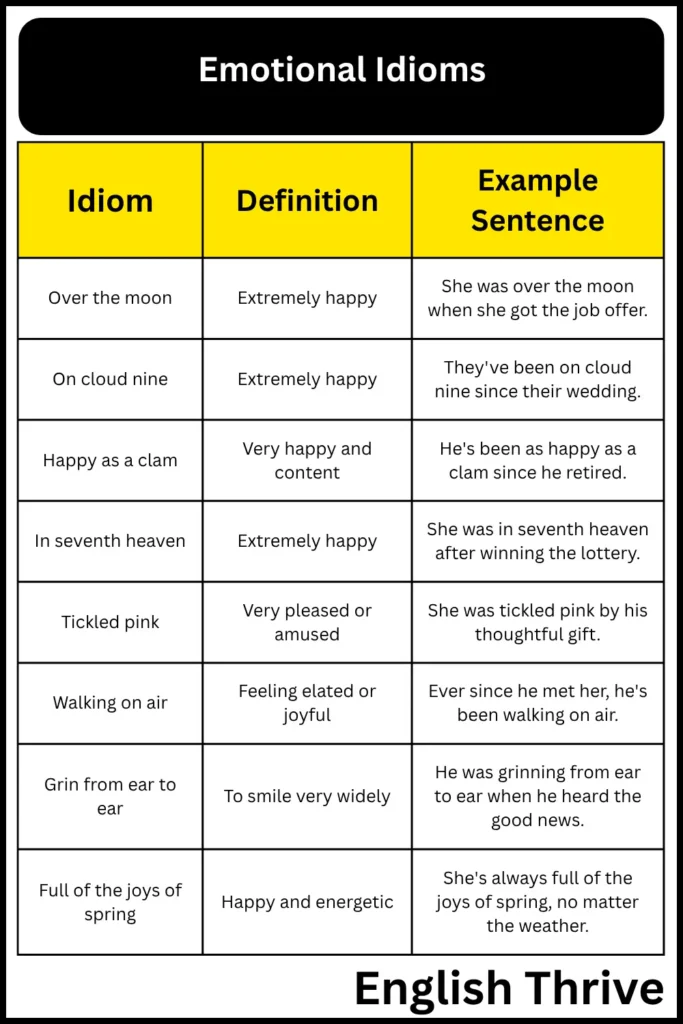
Here’s a table showcasing idioms related to happiness. Understanding these idioms allows you to express joy in a more colorful and nuanced way.
| Idiom | Definition | Example Sentence |
|---|---|---|
| Over the moon | Extremely happy | She was over the moon when she got the job offer. |
| On cloud nine | Extremely happy | They’ve been on cloud nine since their wedding. |
| Happy as a clam | Very happy and content | He’s been as happy as a clam since he retired. |
| In seventh heaven | Extremely happy | She was in seventh heaven after winning the lottery. |
| Tickled pink | Very pleased or amused | She was tickled pink by his thoughtful gift. |
| Walking on air | Feeling elated or joyful | Ever since he met her, he’s been walking on air. |
| Grin from ear to ear | To smile very widely | He was grinning from ear to ear when he heard the good news. |
| Full of the joys of spring | Happy and energetic | She’s always full of the joys of spring, no matter the weather. |
| Like a dog with two tails | Extremely happy and excited | The kids were like dogs with two tails when they saw the presents. |
| Have a whale of a time | To have a very enjoyable time | We had a whale of a time at the beach yesterday. |
| Be on top of the world | Feeling extremely happy and successful | After acing the exam, he felt like he was on top of the world. |
| Jump for joy | To express great happiness by jumping | She jumped for joy when she heard she got accepted into her dream college. |
| Laugh your head off | To laugh very loudly and heartily | We laughed our heads off watching the comedy show. |
| Be in good spirits | To be in a happy and cheerful mood | Despite the challenges, she tried to be in good spirits. |
| Have a blast | To have a lot of fun | We had a blast at the party last night. |
| Be as pleased as Punch | To be very pleased and satisfied | He was as pleased as Punch with his performance. |
| Sing someone’s praises | To praise someone enthusiastically | The teacher sang her praises for her outstanding work. |
| Paint the town red | To go out and celebrate in a lively way | They decided to paint the town red after their victory. |
| Get a kick out of something | To find something very enjoyable or amusing | He gets a kick out of watching old movies. |
| Be in raptures | To be filled with intense joy or delight | She was in raptures over the beautiful sunset. |
| Be sitting pretty | To be in a favorable situation | With his new job and apartment, he’s sitting pretty. |
| Be floating on air | To feel extremely happy | Ever since he met her, he’s been floating on air. |
| Be on a high | To be in a state of great excitement or happiness | She’s been on a high since winning the competition. |
| Be in a good place | To be in a happy and content state of mind | After overcoming her challenges, she’s finally in a good place. |
| Be thrilled to bits | To be extremely happy and excited | They were thrilled to bits when they found out they were expecting. |
 Idioms for Emotions
The following table presents idioms related to sadness. Understanding these idioms can help you express and understand feelings of sorrow and disappointment.
| Idiom | Definition | Example Sentence |
|---|---|---|
| Feeling blue | Feeling sad or depressed | She’s been feeling blue since her vacation ended. |
| Down in the dumps | Feeling sad or depressed | He’s been down in the dumps since he lost his job. |
| Have a long face | To look sad or unhappy | She had a long face after failing the exam. |
| A broken heart | Feeling extreme sadness due to a failed relationship | He’s been nursing a broken heart since his girlfriend left him. |
| Tears streaming down one’s face | Crying uncontrollably | She had tears streaming down her face when she heard the news. |
| Cry one’s heart out | To cry intensely | She cried her heart out after the movie ended. |
| A lump in one’s throat | A feeling of sadness that makes it difficult to speak | He had a lump in his throat as he said goodbye. |
| Down in the mouth | Looking depressed or unhappy | He’s been down in the mouth ever since his team lost. |
| Sad as a funeral | Very sad | The atmosphere was as sad as a funeral after the announcement. |
| Have the blues | To feel sad or depressed | She has the blues every winter. |
| Be at rock bottom | To be in the worst possible situation | After losing everything, he felt like he was at rock bottom. |
| Be in the doldrums | To be in a state of inactivity or sadness | The project was in the doldrums due to lack of funding. |
| Be a basket case | To be emotionally overwhelmed or distraught | She was a basket case after the stressful week. |
| Be crestfallen | To be disappointed and dejected | He was crestfallen when he didn’t get the promotion. |
| Be gutted | To be extremely disappointed | She was gutted when she missed the flight. |
| Be choked up | To feel emotional and unable to speak | He was choked up during his farewell speech. |
| Feel like a wet blanket | To feel dispirited and unable to enjoy things | I felt like a wet blanket when I couldn’t celebrate with my friends. |
| Feel low | To feel sad or depressed | She’s been feeling low lately. |
| Be downhearted | To feel discouraged or sad | He was downhearted after the rejection. |
| Be in despair | To feel a complete loss of hope | They were in despair after the natural disaster. |
| Be on the verge of tears | To be about to cry | She was on the verge of tears after hearing the news. |
| Be down in the mouth | To look sad or unhappy | He’s been down in the mouth ever since his team lost. |
| Be a shadow of your former self | To be much weaker or unhealthier than before | After his illness, he was a mere shadow of his former self. |
| Have a heavy heart | To feel sad or burdened by worries | She left with a heavy heart. |
| Be singing the blues | To feel sad or depressed | He’s been singing the blues since his girlfriend moved away. |
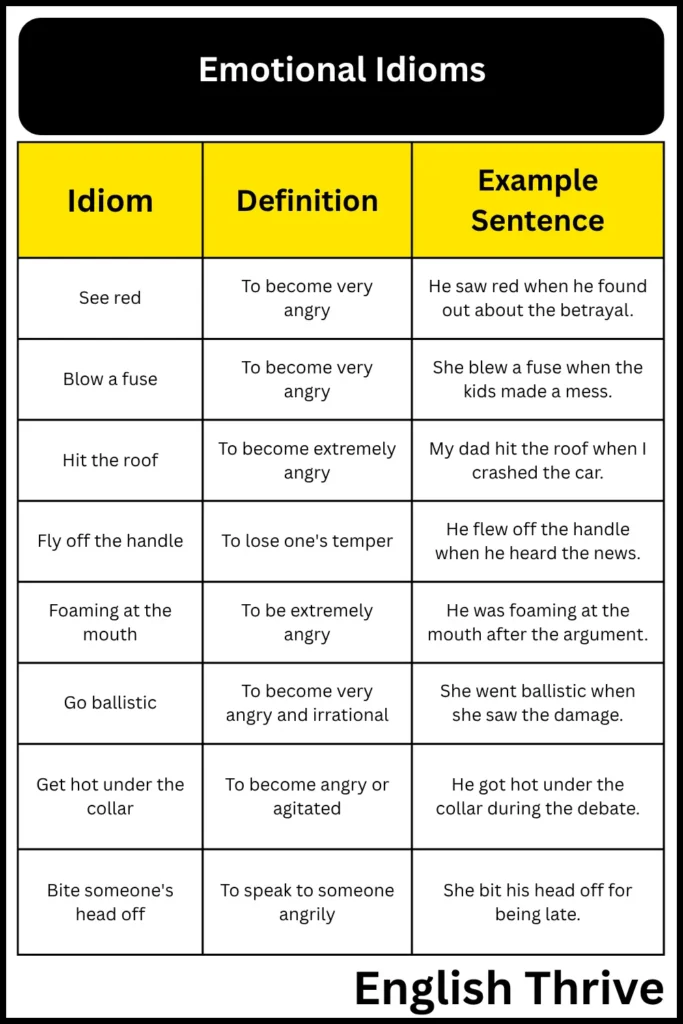
This table illustrates idioms related to anger. Learning these expressions can help you articulate feelings of frustration and rage more vividly.
| Idiom | Definition | Example Sentence |
|---|---|---|
| See red | To become very angry | He saw red when he found out about the betrayal. |
| Blow a fuse | To become very angry | She blew a fuse when the kids made a mess. |
| Hit the roof | To become extremely angry | My dad hit the roof when I crashed the car. |
| Fly off the handle | To lose one’s temper | He flew off the handle when he heard the news. |
| Foaming at the mouth | To be extremely angry | He was foaming at the mouth after the argument. |
| Go ballistic | To become very angry and irrational | She went ballistic when she saw the damage. |
| Get hot under the collar | To become angry or agitated | He got hot under the collar during the debate. |
| Bite someone’s head off | To speak to someone angrily | She bit his head off for being late. |
| Chew someone out | To scold someone severely | The boss chewed him out for his mistakes. |
| Drive someone up the wall | To irritate or annoy someone greatly | His constant complaining is driving me up the wall. |
| Be at the end of your rope | To be at the limit of your patience | She was at the end of her rope with the constant demands. |
| Be fed up with something | To be annoyed or bored with something | I’m fed up with his excuses. |
| Be hopping mad | To be extremely angry | He was hopping mad when he found out the truth. |
| Be in a rage | To be filled with intense anger | She was in a rage after the betrayal. |
| Be livid | To be extremely angry | He was livid when he saw the damage. |
| Have a short fuse | To be easily angered | He has a short fuse and gets angry easily. |
| Make someone’s blood boil | To make someone extremely angry | His arrogance makes my blood boil. |
| Rub someone the wrong way | To irritate or annoy someone | His comments always rub me the wrong way. |
| Take something out on someone | To express anger towards someone who is not responsible for the problem | He took his anger out on his family after a bad day at work. |
| Be up in arms about something | To be very angry and protesting about something | The neighbors are up in arms about the new construction. |
| Look daggers at someone | To give someone an angry look | She looked daggers at him after his rude remark. |
| Be breathing fire | To be very angry and threatening | The boss was breathing fire after the project failure. |
| Be like a bear with a sore head | To be in a bad mood and easily angered | He’s been like a bear with a sore head all morning. |
| Be on the warpath | To be in a state of anger and ready to confront someone | She’s on the warpath after finding out about the lies. |
| Be seeing red | To become very angry | He was seeing red when he found out about the betrayal. |
 Idioms for Emotions
Here’s a table presenting idioms related to fear. These expressions help you convey feelings of anxiety and fright in a more impactful manner.
| Idiom | Definition | Example Sentence |
|---|---|---|
| Scared stiff | Extremely frightened | She was scared stiff during the horror movie. |
| Afraid of one’s own shadow | Very easily frightened | He’s so nervous; he’s afraid of his own shadow. |
| Have butterflies in one’s stomach | To feel nervous or anxious | I have butterflies in my stomach before my presentation. |
| Jump out of one’s skin | To be startled | She jumped out of her skin when the door slammed. |
| Be petrified | To be extremely scared | He was petrified of public speaking. |
| Be scared to death | To be extremely frightened | She was scared to death when she heard the noise. |
| Be shaking in one’s boots | To be very afraid | He was shaking in his boots before the interview. |
| Be white as a ghost | To look very pale due to fear | She turned as white as a ghost when she saw the accident. |
| Have the jitters | To feel nervous or uneasy | I always have the jitters before a big event. |
| Be on edge | To be nervous and irritable | She’s been on edge all day waiting for the results. |
| Be frozen with fear | To be unable to move due to intense fear | He was frozen with fear when he saw the snake. |
| Be in a cold sweat | To be very nervous and sweating | He woke up in a cold sweat after the nightmare. |
| Be like a deer caught in headlights | To be startled and unable to react | She was like a deer caught in headlights when she was asked the question. |
| Be a bundle of nerves | To be very nervous and anxious | He’s always a bundle of nerves before a performance. |
| Have a frog in your throat | To have difficulty speaking due to nervousness | He had a frog in his throat when he started his speech. |
| Be trembling like a leaf | To be shaking uncontrollably due to fear | She was trembling like a leaf when she walked into the haunted house. |
| Be quaking in one’s shoes | To be very afraid | He was quaking in his shoes before the presentation. |
| Be a nervous wreck | To be extremely nervous and anxious | She was a nervous wreck waiting for the results. |
| Be on pins and needles | To be very anxious and tense | We were on pins and needles waiting for the announcement. |
| Be scared out of one’s wits | To be extremely frightened | She was scared out of her wits by the sudden noise. |
| Be like a cat on a hot tin roof | To be very nervous and restless | He was like a cat on a hot tin roof waiting for the call. |
| Be a chicken | To be afraid to do something | He was too much of a chicken to ask her out. |
| Be faint of heart | To be easily frightened or discouraged | This movie isn’t for the faint of heart. |
| Get cold feet | To become nervous and withdraw from something | He got cold feet before the wedding. |
| Be a nervous Nellie | To be a person who worries excessively | She’s such a nervous Nellie, always worrying about everything. |
This table offers examples of idioms related to surprise. These phrases allow you to express astonishment and amazement in a more vivid way.
| Idiom | Definition | Example Sentence |
|---|---|---|
| Knock someone’s socks off | To greatly surprise or impress someone | The performance knocked my socks off. |
| Take someone’s breath away | To surprise someone in a delightful way | The view took my breath away. |
| Be floored | To be greatly surprised or astonished | I was floored by the news. |
| Be thunderstruck | To be extremely surprised or shocked | He was thunderstruck when he heard the announcement. |
| Eyes popping out of their head | To be extremely surprised | Their eyes popped out of their head when they saw the car. |
| Be gobsmacked | To be utterly astonished | She was gobsmacked when she won the prize. |
| Be taken aback | To be surprised and slightly shocked | I was taken aback by his rude comment. |
| Not believe one’s ears | To be unable to believe what one is hearing | I couldn’t believe my ears when I heard the news. |
| Be in disbelief | To be unable to believe something | She was in disbelief when she won the lottery. |
| Be speechless | To be unable to speak due to surprise | He was speechless when he saw the gift. |
| Be caught off guard | To be surprised and unprepared | I was caught off guard by the sudden question. |
| Be bowled over | To be overwhelmed with surprise | I was bowled over by their generosity. |
| Be in a daze | To be in a state of shock or bewilderment | She was in a daze after the accident. |
| Be dumbfounded | To be greatly astonished or amazed | He was dumbfounded by the magician’s trick. |
| Be knocked for six | To be greatly surprised or shocked | I was knocked for six when I heard the news. |
| Be stopped in your tracks | To be so surprised you stop moving | I was stopped in my tracks when I saw him. |
| Be thunderstruck | To be extremely surprised or shocked | He was thunderstruck when he heard the announcement. |
| Drop a bombshell | To reveal surprising or shocking news | She dropped a bombshell when she announced her resignation. |
| Make your jaw drop | To cause someone to be very surprised | The news made my jaw drop. |
| Out of the blue | Unexpectedly | He called me out of the blue after many years. |
| Come as a bolt from the blue | To be a sudden and unexpected surprise | The news of his resignation came as a bolt from the blue. |
| Not see something coming | To not anticipate something | I did not see that coming at all. |
| Take someone by surprise | To surprise someone | The party took her by surprise. |
| Catch someone unawares | To surprise someone when they are not expecting it | The question caught him unawares. |
| Be like a rabbit in the headlights | To be so surprised that you are unable to move or think | She was like a rabbit in the headlights when she was asked the question. |
Usage Rules for Idioms
Using idioms correctly requires understanding their specific meanings and contexts. Idioms are not meant to be taken literally, so it’s crucial to grasp the figurative sense behind the words.
Here are some key usage rules:
- Context is Key: Pay attention to the context in which the idiom is used. The surrounding words and situation will provide clues to its meaning.
- Word Order: Do not change the word order of an idiom. Idioms have fixed structures, and altering them can change or negate their meaning.
- Tense and Agreement: Adjust the tense and verb agreement to match the sentence. For example, “He is feeling blue” can be changed to “He was feeling blue” or “He has been feeling blue.”
- Audience Awareness: Be mindful of your audience. Some idioms may not be universally understood, especially by non-native speakers or people from different cultural backgrounds.
- Avoid Overuse: Use idioms sparingly. Overusing them can make your speech sound unnatural or forced.
Idioms often have cultural origins, so understanding their historical or cultural context can enhance your comprehension and usage. When in doubt, consult a dictionary or online resource to confirm the meaning and usage of an idiom.
Common Mistakes with Emotional Idioms
Learners often make mistakes when using idioms due to their non-literal nature. Here are some common errors and how to avoid them:
- Literal Interpretation: Interpreting idioms literally instead of understanding their figurative meaning. Incorrect: “He was really over the moon, floating above us.” Correct: “He was over the moon when he got the promotion.”
- Incorrect Word Order: Changing the word order of an idiom. Incorrect: “Blue feeling.” Correct: “Feeling blue.”
- Misunderstanding Context: Using an idiom in an inappropriate context. Incorrect: “She was happy as a clam to hear about the bad news.” Correct: “She was sad as a funeral to hear about the bad news.”
- Overusing Idioms: Using too many idioms in a single conversation, making it sound unnatural.
- Incorrect Tense: Using the wrong tense of the idiom. Incorrect: “He will be feeling blue yesterday.” Correct: “He was feeling blue yesterday.”
To avoid these mistakes, practice using idioms in different contexts and pay attention to how native speakers use them. Regularly review and expand your knowledge of idioms to improve your accuracy and fluency.
Practice Exercises: Idioms for Emotions
Test your understanding of idioms for emotions with the following exercises:
Exercise 1: Choose the correct idiom to complete each sentence.
| Question | Options | Answer |
|---|---|---|
| 1. She was ________ when she won the lottery. | a) feeling blue b) over the moon c) seeing red | b) over the moon |
| 2. He ________ when he found out about the betrayal. | a) saw red b) felt blue c) had butterflies | a) saw red |
| 3. I ________ before my presentation. | a) saw red b) felt blue c) had butterflies | c) had butterflies |
| 4. After a long day, she was ________. | a) on cloud nine b) down in the dumps c) full of beans | b) down in the dumps |
| 5. The surprise party ________. | a) blew a fuse b) knocked my socks off c) hit the roof | b) knocked my socks off |
Exercise 2: Match the idiom with its correct meaning.
| Idiom | Meaning |
|---|---|
| 1. Feeling blue | a) To be very angry |
| 2. See red | b) To be very happy |
| 3. Over the moon | c) To feel nervous |
| 4. Have butterflies in your stomach | d) To feel sad |
Answers: 1-d, 2-a, 3-b, 4-c
Exercise 3: Write a sentence using each of the following idioms:
- Scared stiff
- Happy as a clam
- Down in the dumps
Advanced Topics: Cultural Nuances
Idioms are deeply rooted in culture, and their meanings can vary across different regions and languages. Understanding the cultural nuances of emotional idioms is essential for effective communication and avoiding misunderstandings.
Here are some advanced topics to consider:
- Regional Variations: Some idioms are specific to certain regions or dialects. For example, an idiom commonly used in British English may not be understood in American English, and vice versa.
- Historical Context: The origins of many idioms are tied to historical events, customs, or folklore. Understanding the historical context can provide deeper insight into their meanings.
- Cultural Sensitivity: Be mindful of the cultural connotations of idioms. Some idioms may be offensive or inappropriate in certain cultural contexts.
- Translation Challenges: Idioms often do not have direct equivalents in other languages. Translating them literally can result in nonsensical or inaccurate meanings.
- Non-Verbal Communication: The use of emotional idioms can be complemented by non-verbal cues, such as facial expressions and body language, to enhance their impact.
Exploring the cultural nuances of emotional idioms can enrich your understanding of language and culture, making you a more effective and culturally sensitive communicator.
FAQs About Express Yourself
Why is it important to learn idioms for emotions?
Learning idioms for emotions allows you to express feelings more vividly and accurately. It also enhances your understanding of spoken and written English, making your communication more effective and engaging.
How can I improve my understanding of emotional idioms?
To improve your understanding of emotional idioms, read widely, listen to native speakers, and practice using idioms in different contexts. Regularly review and expand your knowledge of idioms to increase your accuracy and fluency.
Are there any resources for learning more about idioms?
Yes, there are numerous resources available for learning about idioms, including dictionaries, online resources, language learning apps, and textbooks. Additionally, watching English-language movies and TV shows can expose you to idioms in context.
Can I use idioms in formal writing?
While idioms are generally more common in spoken English, they can be used in formal writing if appropriate for the context and audience. However, it’s important to use them judiciously and avoid overusing them, as this can make your writing sound unnatural.
How can I avoid making mistakes when using idioms?
To avoid making mistakes when using idioms, pay attention to the context in which they are used, understand their figurative meanings, and avoid changing their word order. Practice using idioms in different contexts and seek feedback from native speakers to improve your accuracy.
Conclusion: Idioms for Emotions
Mastering idioms for emotions is a valuable skill that can significantly enhance your ability to communicate effectively in English. By understanding the meanings, usage rules, and cultural nuances of these expressions, you can express your feelings with greater nuance and impact.
This article has provided a comprehensive guide to idioms for emotions, covering various emotional states and offering practical examples and exercises to help you master their use. Continue practicing and expanding your knowledge of idioms to become a more confident and fluent English speaker.