

Have you ever heard your teacher say “open your textbook,” “raise your hand,” or “work in pairs” and wondered what it meant? Knowing the right classroom words can make lessons much easier to understand—and help you feel more confident speaking English at school.
Learning English classroom vocabulary is not just about memorizing the names of objects. It also includes the actions you do, the people you meet, the instructions you hear, and the phrases you use every day in class.
In this guide, you’ll learn common classroom objects, actions, commands, people, and rules with simple meanings. You’ll also find easy practice exercises to help you remember and use these words naturally.
Ready to make classroom English easier? Let’s start with the words you see and use every day.
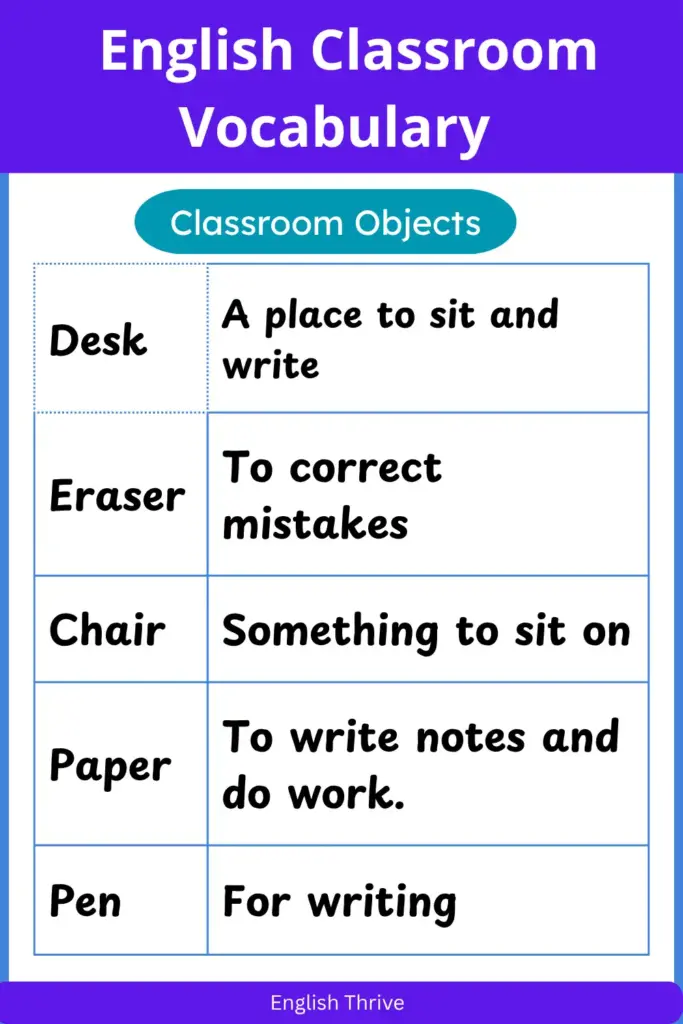
Classroom Objects
Here are the main things you will see in a classroom.
- Desk—A place to sit and write.
- Chair—Something to sit on.
- Book / Textbook – For reading and learning.
- Notebook / Paper – To write notes and do work.
- Pen / Pencil – For writing.
- Eraser – To correct mistakes.
- Ruler – To measure or draw straight lines.
- Scissors/Glue – For cutting and sticking in projects.
- Backpack / School Bag – To carry your stuff.
- Clock—Shows the time.
- Whiteboard / Blackboard – Where the teacher writes.
- Marker/Chalk—To write on the board.
- Computer/Laptop—For research or schoolwork.
- Pencil Sharpener – Keeps pencils sharp.
- Calculator—for math problems.
- Highlighter – To mark important points.
- Binder/Folder—To organize papers.
- Crayons / Paints / Brush – For coloring and art.
- Globe/Map—To learn about the world.
- Flashcards—to remember words or facts.
Classroom Actions
These are common things you do in class:
- Raise your hand—to ask or answer questions.
- Listen—pay attention to the teacher or classmates.
- Write/Draw—Put your ideas on paper.
- Read—Understand words in books or notes.
- Clean up—put things back where they belong.
- Follow directions—do what the teacher asks.
- Speak—answer questions or share ideas.
- Work in groups—learn with classmates.
People in the Classroom
Know the main people around you:
- Teacher – Leads the class and teaches.
- Student – Learns in the class.
- Classmates—Other students in your class.
- Principal/Staff—Help the school run smoothly.
Classroom Rules
These words help you understand what to do in class:
- Raise your hand—don’t shout; wait for your turn.
- Be quiet—listen and avoid disturbing others.
- Complete homework—finish your tasks at home.
- Respect classmates – Be kind and polite.
- Follow instructions—do what the teacher asks.
English Classroom Vocabulary Practice Exercise
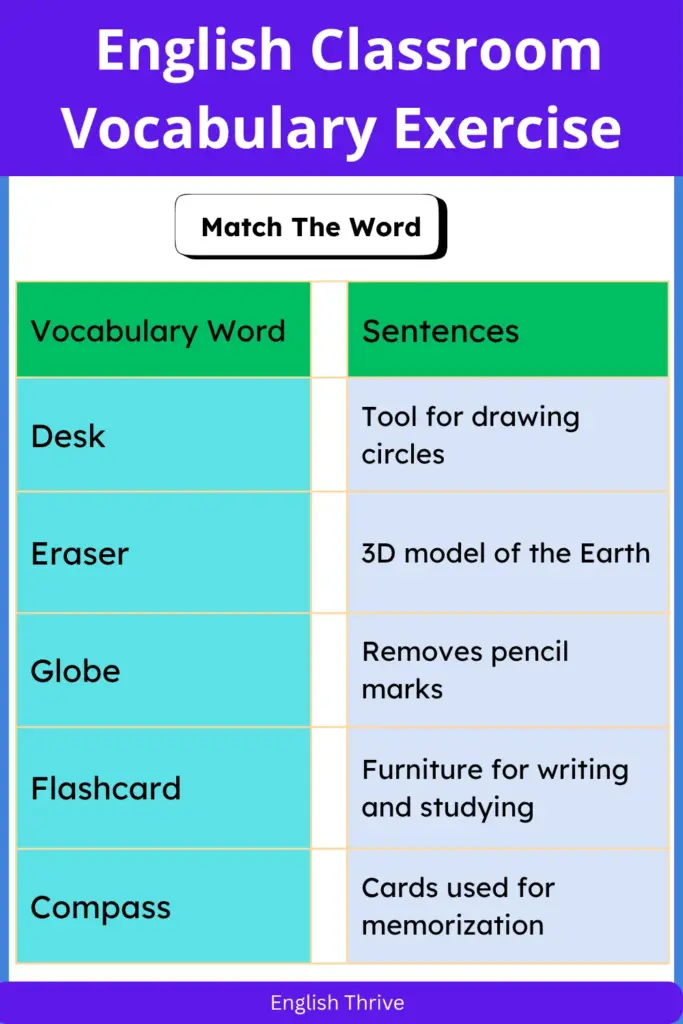
Exercise 1 – Match the Word
| Desk | Tool for drawing circles |
| Eraser | 3D model of the Earth |
| Globe | Removes pencil marks |
| Flashcard | Furniture for writing and studying |
| Compass | Cards used for memorization |
Answers:
-
Desk → Furniture for writing and studying
-
Eraser → Removes pencil marks
-
Globe → 3D model of the Earth
-
Flashcards → Cards used for memorization
-
Compass → Tool for drawing circles
Exercise 2 – Fill in the Blanks
Use words from teacher, notebook, scissors, ruler, backpack
-
I wrote all my notes in my _______
-
The _______ explained the lesson clearly
-
I cut the paper with my _______
-
Measure the line using a _______
-
I carry my books in my _______
Answers:
-
Notebook
-
Teacher
-
Scissors
-
Ruler
-
Backpack
Exercise 3 – Make Sentences
Pick any five classroom words and create sentences. Example:
-
Pencil → I sharpened my pencil before starting the test.
-
Whiteboard: The teacher wrote the homework on the whiteboard.
-
Sticky Notes: I used sticky notes to mark important pages.
How to Learn Classroom Vocabulary Easily
Ever learned a new classroom word and forgotten it the next day? Instead of trying to memorize a long list, connect each word to something you can see, touch, hear, or do at school.
Here are some simple ways to learn classroom vocabulary faster:
- Label real objects: Put small labels on a desk, chair, door, whiteboard, ruler, or bookshelf. Seeing the word and object together helps you remember it.
- Use flashcards: Write a word on one side and its meaning or picture on the other. Practice a few words each day.
- Say the words aloud: Pronounce new words several times. For example, point to your notebook and say, “This is my notebook.”
- Practice classroom commands: Act out phrases such as “stand up,” “sit down,” “open your book,” and “raise your hand.”
- Make simple sentences: Don’t learn words alone. Use them in context: “I write with a pencil” or “The teacher writes on the whiteboard.”
- Play word games: Try matching games, Pictionary, “I Spy,” or classroom word bingo to make practice more enjoyable.
- Review a little every day: Learning five words well is often more useful than trying to memorize 30 at once.
Quick tip: Look around your classroom and name as many things as you can in English. If you don’t know the name of something, write it down and learn it later. This turns your classroom into a simple vocabulary practice space.
FAQs About English Classroom Vocabulary
1. What is classroom vocabulary for students?
Classroom vocabulary includes words used in the school environment, such as objects, people, actions, and rules. These words help students communicate and learn efficiently.
2. How can students learn classroom vocabulary faster?
-
Label classroom objects
-
Use flashcards
-
Practice in real situations
-
Play matching and memory games
-
Review words regularly
3. What are some examples of classroom vocabulary words?
Some examples include desk, chair, pencil, notebook, glue, teacher, student, raise your hand, listen, and read.
4. How can teachers teach classroom vocabulary effectively?
-
Display words with pictures
-
Use word walls or posters
-
Introduce a “Word of the Day.”
-
Encourage students to use words in sentences
-
Conduct interactive games
Conclusion
Learn classroom words to make studying easy. They help you talk in class and feel confident. Start with simple objects, actions, people, and rules. Then practice by matching words, filling blanks, or making short sentences.
Get our free Classroom Vocabulary PDF to practice. You can also make flashcards to learn fast.