

The “community words list” is a vital concept in English language learning, particularly for those focusing on practical, everyday communication. It encompasses vocabulary related to community environments, social interactions, and local resources.
Mastering these words allows learners to navigate daily life more effectively, engage in meaningful conversations, and build stronger connections within their communities. This article provides a detailed exploration of community words, their usage, and practical exercises to enhance your understanding and fluency.
It is designed for English language learners of all levels, from beginners seeking foundational vocabulary to advanced speakers aiming to refine their communication skills.
Definition of Community Words List
A community words list is a collection of vocabulary specifically related to places, people, activities, and services commonly found within a local community. These words are essential for understanding and participating effectively in daily life. The list often includes nouns, verbs, adjectives, and adverbs that describe various aspects of the community, such as its infrastructure, social interactions, local government, and cultural events. The function of a community words list is to equip individuals with the necessary language skills to navigate and interact with their surroundings confidently.
Community words are used in a variety of contexts, including:
- Everyday conversations: Talking about local events, directions, or community issues.
- Reading local news: Understanding articles about community developments, politics, or social events.
- Interacting with service providers: Communicating with doctors, teachers, librarians, and other professionals.
- Participating in community activities: Engaging in volunteer work, attending community meetings, or joining local clubs.
Structural Breakdown
Understanding the structural components of community words involves recognizing the different parts of speech and how they combine to form meaningful sentences. Here’s a breakdown:
- Nouns: These are words that name people, places, things, or ideas within the community. Examples include neighbor, park, library, school, city hall.
- Verbs: These are action words related to activities within the community. Examples include volunteer, participate, donate, attend, organize.
- Adjectives: These words describe the qualities or characteristics of community elements. Examples include local, public, community, safe, clean.
- Adverbs: These words modify verbs, adjectives, or other adverbs and provide information about how, when, where, or to what extent actions occur in the community. Examples include locally, publicly, safely, regularly, actively.
Community words often appear in various grammatical structures, such as simple sentences, compound sentences, and complex sentences. Understanding these structures helps in constructing clear and effective communication.
For example:
- Simple Sentence: “The park is clean.” (Noun and Adjective)
- Compound Sentence: “We volunteer at the shelter, and we also donate to the food bank.” (Verbs and Nouns)
- Complex Sentence: “Because the community is safe, families choose to live here.” (Adjective, Noun and Verb)
Types and Categories of Community Words
Community words can be categorized based on various aspects of community life. Here are some key categories:
1. Places
These words refer to specific locations within the community.
- Park
- School
- Library
- Hospital
- Post office
- City hall
- Community center
- Fire station
- Police station
- Grocery store
2. People
These words refer to individuals or groups within the community.
- Neighbor
- Teacher
- Doctor
- Librarian
- Police officer
- Firefighter
- Mayor
- Council member
- Volunteer
- Resident
3. Activities
These words describe actions or events that occur within the community.
- Volunteer
- Participate
- Donate
- Attend
- Organize
- Clean up
- Vote
- Celebrate
- Meet
- Discuss
4. Services
These words refer to the resources and assistance available within the community.
- Healthcare
- Education
- Transportation
- Public safety
- Social services
- Waste management
- Utilities
- Recreation
- Legal aid
- Financial assistance
5. Community Issues
These words relate to challenges and concerns within the community.
- Poverty
- Homelessness
- Pollution
- Crime
- Traffic congestion
- Unemployment
- Healthcare access
- Education funding
- Affordable housing
- Climate change
Examples of Community Words
Here are several examples of community words organized by category.
Table 1: Examples of Community Place Words
This table showcases words related to places within a community, helping you understand the physical environment and key locations.
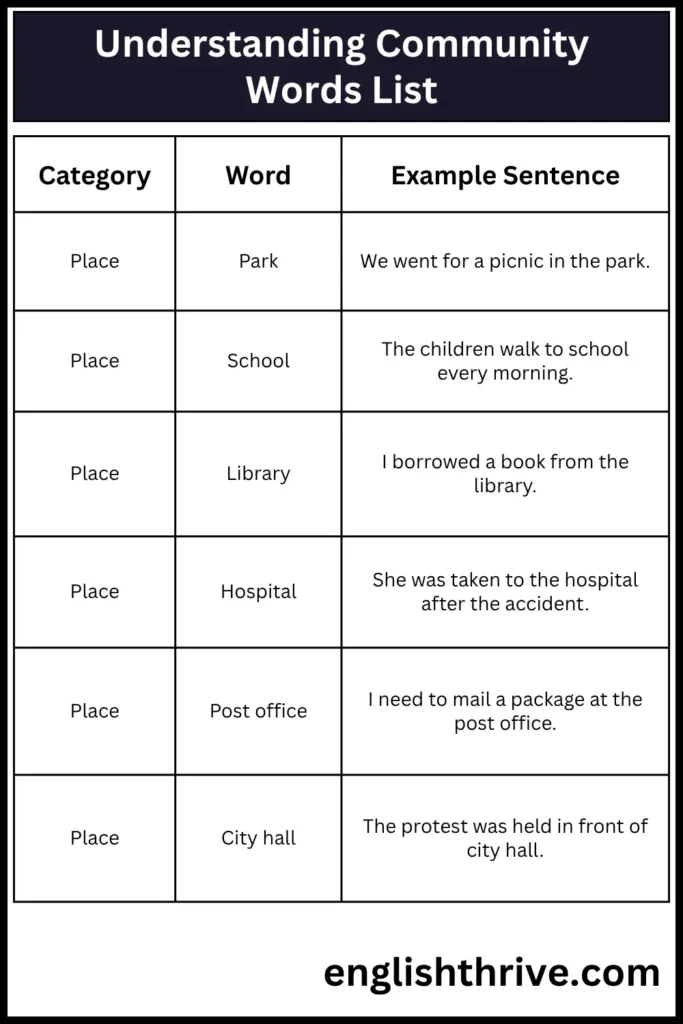
| Category | Word | Example Sentence |
|---|---|---|
| Place | Park | We went for a picnic in the park. |
| Place | School | The children walk to school every morning. |
| Place | Library | I borrowed a book from the library. |
| Place | Hospital | She was taken to the hospital after the accident. |
| Place | Post office | I need to mail a package at the post office. |
| Place | City hall | The protest was held in front of city hall. |
| Place | Community center | The community center offers many programs for seniors. |
| Place | Fire station | The fire station is located near the main street. |
| Place | Police station | We reported the incident at the police station. |
| Place | Grocery store | I went to the grocery store to buy some milk. |
| Place | Recreation Center | The recreation center has a swimming pool and gym. |
| Place | Town Square | The annual festival is held in the town square. |
| Place | Bus Stop | I wait for the bus at the bus stop every day. |
| Place | Train Station | The train station is undergoing renovations. |
| Place | Local Market | Fresh produce is available at the local market. |
| Place | Theater | We watched a play at the theater last night. |
| Place | Museum | The museum has many interesting exhibits. |
| Place | Art Gallery | The art gallery showcases local artists. |
| Place | Church | We attend services at the church every Sunday. |
| Place | Mosque | The mosque is a beautiful building. |
| Place | Synagogue | The synagogue hosts many community events. |
| Place | Temple | The temple is a place of worship and reflection. |
| Place | Cemetery | The cemetery is a peaceful resting place. |
| Place | Recycling Center | We take our recyclables to the recycling center. |
| Place | Water Treatment Plant | The water treatment plant ensures clean drinking water. |
| Place | Power Plant | The power plant provides electricity to the city. |
| Place | Sewage Treatment Plant | The sewage treatment plant processes wastewater. |
| Place | Landfill | The landfill is where the city’s waste is disposed of. |
Table 2: Examples of Community People Words
This table provides examples of words related to people in a community, helping you understand the roles and relationships within a local setting.
| Category | Word | Example Sentence |
|---|---|---|
| People | Neighbor | My neighbor is very friendly and helpful. |
| People | Teacher | The teacher is dedicated to her students. |
| People | Doctor | I have an appointment with the doctor tomorrow. |
| People | Librarian | The librarian helped me find a good book. |
| People | Police officer | The police officer is patrolling the neighborhood. |
| People | Firefighter | The firefighter rescued the cat from the tree. |
| People | Mayor | The mayor addressed the community at the meeting. |
| People | Council member | The council member listened to the residents’ concerns. |
| People | Volunteer | She is a volunteer at the local soup kitchen. |
| People | Resident | He has been a resident of this town for 20 years. |
| People | Principal | The principal announced new school policies. |
| People | Nurse | The nurse took my temperature and blood pressure. |
| People | Janitor | The janitor keeps the school clean and tidy. |
| People | Crossing Guard | The crossing guard helps children cross the street safely. |
| People | Mail Carrier | The mail carrier delivers our mail every day. |
| People | Garbage Collector | The garbage collector empties our trash cans weekly. |
| People | Bus Driver | The bus driver is responsible for the safety of the passengers. |
| People | Chef | The chef prepares delicious meals at the restaurant. |
| People | Waiter/Waitress | The waitress took our order at the cafe. |
| People | Cashier | The cashier scanned my groceries at the supermarket. |
| People | Pharmacist | The pharmacist dispensed my medication. |
| People | Accountant | The accountant helped me with my taxes. |
| People | Lawyer | I consulted a lawyer for legal advice. |
| People | Real Estate Agent | The real estate agent showed us several houses. |
| People | Construction Worker | The construction worker is building a new house. |
| People | Electrician | The electrician fixed the wiring in our house. |
| People | Plumber | The plumber repaired the leaky faucet. |
| People | Gardener | The gardener maintains the beautiful flower beds. |
| People | Therapist | The therapist provides mental health support. |
Table 3: Examples of Community Activity Words
This table presents words related to activities that take place within a community, enhancing your ability to describe and discuss community events and actions.
| Category | Word | Example Sentence |
|---|---|---|
| Activity | Volunteer | We volunteer at the local animal shelter every Saturday. |
| Activity | Participate | I want to participate in the community cleanup event. |
| Activity | Donate | Please donate to the food bank to help those in need. |
| Activity | Attend | We will attend the town hall meeting tonight. |
| Activity | Organize | They are going to organize a fundraising event for the school. |
| Activity | Clean up | The community decided to clean up the park. |
| Activity | Vote | It is important to vote in local elections. |
| Activity | Celebrate | We will celebrate the town’s anniversary with a parade. |
| Activity | Meet | The neighborhood association will meet next week. |
| Activity | Discuss | We need to discuss the new zoning regulations. |
| Activity | Shop | I like to shop at the local farmers market. |
| Activity | Exercise | Many people exercise in the park every morning. |
| Activity | Learn | We can learn new skills at the community center. |
| Activity | Play | Children play in the playground after school. |
| Activity | Work | Many residents work in the local businesses. |
| Activity | Visit | Tourists visit the historical sites in the town. |
| Activity | Support | We should support local artists and businesses. |
| Activity | Protect | We need to protect our natural resources. |
| Activity | Maintain | The city works to maintain the roads and infrastructure. |
| Activity | Improve | We are always looking for ways to improve our community. |
| Activity | Fundraise | We fundraise for new equipment at the school. |
| Activity | Advocate | We advocate for better public transportation. |
| Activity | Petition | We petition the city council to address local concerns. |
| Activity | Demonstrate | People demonstrate peacefully for social change. |
| Activity | Collaborate | We collaborate with other organizations to achieve our goals. |
| Activity | Empower | We empower residents to take action in their community. |
| Activity | Engage | We engage with local businesses to promote community growth. |
| Activity | Nurture | We nurture a sense of belonging and pride in our community. |
| Activity | Connect | We connect people with the resources they need. |
Table 4: Examples of Community Issue Words
This table provides examples of words related to issues that communities face, helping you understand the challenges and concerns within a local setting.
| Category | Word | Example Sentence |
|---|---|---|
| Issue | Poverty | Poverty is a significant issue in many communities. |
| Issue | Homelessness | Homelessness is a visible problem in the city center. |
| Issue | Pollution | Pollution from factories affects the air quality. |
| Issue | Crime | The community is working to reduce crime rates. |
| Issue | Traffic congestion | Traffic congestion makes commuting difficult. |
| Issue | Unemployment | Unemployment is a major concern for many residents. |
| Issue | Healthcare access | Improving healthcare access is a priority. |
| Issue | Education funding | Adequate education funding is essential for schools. |
| Issue | Affordable housing | The lack of affordable housing is a pressing problem. |
| Issue | Climate change | Climate change is impacting our local environment. |
| Issue | Discrimination | Discrimination based on race, gender, or religion is unacceptable. |
| Issue | Inequality | Economic inequality is widening the gap between rich and poor. |
| Issue | Food insecurity | Food insecurity affects many families in our community. |
| Issue | Drug abuse | Drug abuse is a serious public health problem. |
| Issue | Mental health | Addressing mental health issues is crucial. |
| Issue | Aging population | The aging population requires more senior services. |
| Issue | Infrastructure decay | Infrastructure decay is a growing problem in older cities. |
| Issue | Water scarcity | Water scarcity is a concern during dry seasons. |
| Issue | Air quality | Poor air quality can lead to respiratory problems. |
| Issue | Noise pollution | Noise pollution can disrupt daily life. |
| Issue | Waste management | Effective waste management is essential for a clean environment. |
| Issue | Urban sprawl | Urban sprawl is consuming valuable farmland. |
| Issue | Gentrification | Gentrification can displace long-time residents. |
| Issue | Lack of green space | The lack of green space is a concern in urban areas. |
| Issue | Social isolation | Social isolation can affect the elderly and those with disabilities. |
| Issue | Digital divide | The digital divide prevents some residents from accessing online services. |
| Issue | Public safety | Ensuring public safety is a top priority for the city. |
| Issue | Underfunded schools | Underfunded schools struggle to provide quality education. |
Usage Rules for Community Words
Using community words correctly involves understanding their specific meanings and applying them in appropriate contexts. Here are some general rules:
- Use nouns to name specific places, people, or things: “The library offers free computer classes.”
- Use verbs to describe actions or activities: “Residents participate in the annual community fair.”
- Use adjectives to describe the qualities of community elements: “The local park is a great place to relax.”
- Use adverbs to modify verbs, adjectives, or other adverbs: “The community actively supports its schools.”
Agreement: Ensure that verbs agree with their subjects in number and person. For example, “The teacher helps students” (singular subject) versus “Teachers help students” (plural subject).
Prepositions: Pay attention to the prepositions that often accompany certain community words. For example, “volunteer at the hospital,” “participate in community events,” “donate to the food bank.”
Context: Consider the context in which you are using the words. Some words may have multiple meanings, and the context will determine the appropriate usage. For example, “The bank is on Main Street” (financial institution) versus “The river bank is eroding” (edge of a river).
Formal vs. Informal: Be aware of the level of formality required in different situations. Some community words may be more appropriate for formal settings (e.g., “municipal government”) while others are suitable for informal conversations (e.g., “town hall”).
Common Mistakes with Community Words
Here are some common mistakes that learners make when using community words, along with corrections:
| Incorrect | Correct | Explanation |
|---|---|---|
| I volunteer on the park. | I volunteer at the park. | Use “at” to indicate a specific location where you volunteer. |
| She participate to the event. | She participates in the event. | The verb “participate” requires the preposition “in” and the verb needs to agree with the subject (“she”). |
| They donate for the charity. | They donate to the charity. | Use “to” to indicate the recipient of the donation. |
| The mayor speaked at the meeting. | The mayor spoke at the meeting. | “Spoke” is the correct past tense form of “speak.” |
| We are interesting in the local history. | We are interested in the local history. | Use “interested” to describe how someone feels. |
| The library is near from the school. | The library is near the school. | “Near” does not require the preposition “from”. |
| I live in the neighbor of the park. | I live near the park. | Use “near” to indicate proximity. “Neighbor” refers to a person. |
| The police is here. | The police are here. | “Police” is a plural noun and requires a plural verb. |
| The firemans arrived quickly. | The firefighters arrived quickly. | The plural form of “fireman” is “firefighters.” |
| The city have many parks. | The city has many parks. | The singular noun “city” requires the singular verb “has.” |
Practice Exercises
Test your understanding of community words with these exercises.
Exercise 1: Fill in the Blanks
Complete the following sentences with appropriate community words from the list below.
(park, teacher, volunteer, library, hospital, mayor, participate, donate, school, neighbor)
| Question | Answer |
|---|---|
| 1. The __________ is a great place to read books. | library |
| 2. My __________ is very friendly and always helps me. | neighbor |
| 3. The __________ is working to improve the city. | mayor |
| 4. I __________ at the local soup kitchen every week. | volunteer |
| 5. The __________ is where children go to learn. | school |
| 6. We went for a walk in the __________. | park |
| 7. I had to go to the __________ for a check-up. | hospital |
| 8. The __________ is dedicated to helping students succeed. | teacher |
| 9. I want to __________ in the community event. | participate |
| 10. We decided to __________ to the animal shelter. | donate |
Exercise 2: Multiple Choice
Choose the correct community word to complete each sentence.
| Question | Options | Answer |
|---|---|---|
| 1. The __________ helped me find a book. | (a) doctor (b) librarian (c) police officer | (b) librarian |
| 2. The __________ put out the fire. | (a) firefighter (b) teacher (c) mayor | (a) firefighter |
| 3. We __________ in the community garden every Saturday. | (a) vote (b) volunteer (c) attend | (b) volunteer |
| 4. The __________ is responsible for enforcing the law. | (a) librarian (b) firefighter (c) police officer | (c) police officer |
| 5. The __________ addressed the town at the meeting. | (a) mayor (b) teacher (c) doctor | (a) mayor |
| 6. The local __________ provides healthcare services. | (a) park (b) hospital (c) library | (b) hospital |
| 7. Children learn in the __________. | (a) park (b) school (c) post office | (b) school |
| 8. We mailed the letter at the __________. | (a) city hall (b) grocery store (c) post office | (c) post office |
| 9. The __________ offers various programs for all ages. | (a) community center (b) fire station (c) police station | (a) community center |
| 10. You can buy fresh produce at the __________. | (a) grocery store (b) library (c) hospital | (a) grocery store |
Exercise 3: Sentence Construction
Create sentences using the following community words.
| Word | Example Sentence |
|---|---|
| Community | Our community is very supportive and welcoming. |
| Public | The public library offers many free services. |
| Local | We support local businesses whenever possible. |
| Resident | Every resident is encouraged to participate in town meetings. |
| Service | The city provides essential services to its citizens. |
| Issue | Traffic congestion is a major issue in our town. |
| Organize | They are going to organize a fundraiser for the local school. |
| Attend | We plan to attend the community festival this weekend. |
| Discuss | The city council will discuss the new zoning regulations. |
| Improve | We are working to improve the quality of life in our community. |
Advanced Topics
For advanced learners, understanding the nuances of community words can involve exploring more complex aspects:
- Collocations: Learn common word pairings or phrases that frequently occur with community words. For example, “community involvement,” “public safety,” “local economy.”
- Idioms: Explore idiomatic expressions that use community words. For example, “grassroots movement” (a community-based initiative).
- Formal vs. Informal Language: Differentiate between formal and informal vocabulary related to community matters. For example, “municipal government” (formal) versus “city hall” (informal).
- Regional Variations: Be aware of regional differences in vocabulary use. Some words may be more common in certain areas than others.
- Social and Political Context: Understand how community words are used in social and political discussions. For example, “gentrification,” “social justice,” “community development.”
FAQs About Community Words List
Here are some frequently asked questions about community words:
What is the importance of learning community words?
Learning community words is crucial for effective communication and participation in daily life. It allows you to understand and engage with your surroundings, interact with service providers, and participate in community activities.
How can I expand my vocabulary of community words?
You can expand your vocabulary by reading local news, listening to community radio, attending local events, and using online resources and language learning apps that focus on community-related topics. Actively use new words in conversations to reinforce your learning.
Are community words different in different regions?
Yes, community words can vary depending on the region. Different areas may have unique terms for local places, people, and activities. Pay attention to the specific vocabulary used in your community.
How can I use community words in my writing?
When writing about community-related topics, use specific and descriptive community words to provide detail and context. Ensure that your language is appropriate for your audience and purpose.
What are some common mistakes to avoid when using community words?
Avoid using incorrect prepositions, verb tenses, or word forms. Pay attention to subject-verb agreement and use words in their proper context. Review common mistakes and practicecorrect usage.
Conclusion
Mastering community words is essential for effective communication and integration into any English-speaking community. By understanding the definitions, structural breakdown, types, and usage rules of these words, learners can enhance their ability to navigate daily life, participate in community activities, and build meaningful relationships.
Regular practice, attention to common mistakes, and exploration of advanced topics will further strengthen your vocabulary and fluency. Embrace the opportunity to learn and use community words to become a more confident and engaged member of your community.