

Idioms are an integral part of the English language, adding color and nuance to everyday conversations. Among the vast array of idioms, those related to laughter are particularly expressive and versatile.
They allow us to convey different types of amusement, from genuine joy to sarcastic mockery. Understanding and using these idioms effectively can significantly enhance your communication skills, making your speech more engaging and relatable.
This article aims to provide a comprehensive guide to idioms for laughing, catering to learners of all levels. By exploring their definitions, structures, usage rules, and examples, you will gain a deeper appreciation for these expressions and learn how to incorporate them into your everyday language.
Definition of Idioms for Laughing
An idiom is a phrase or expression whose meaning cannot be understood from the ordinary meanings of the words it contains. In other words, the phrase has a figurative meaning that is different from its literal meaning.
Idioms for laughing are expressions that describe various types of laughter or reactions to humorous situations. They often involve figurative language, such as metaphors and similes, to convey the intensity or nature of the laughter.
These idioms can describe everything from a polite chuckle to an uproarious burst of laughter.
Idioms related to laughter can be classified based on the emotion or context they convey. Some idioms express genuine amusement, while others may indicate sarcasm, ridicule, or even nervous laughter.
Understanding the nuances of these idioms is crucial for using them appropriately and effectively.
Structural Breakdown
The structure of idioms for laughing can vary widely. Some idioms are simple phrases consisting of a verb and a noun, while others are more complex sentences.
The key is that the meaning of the idiom is not derived from the individual words but rather from the phrase as a whole.
Many laughing idioms involve verbs like laugh, chuckle, giggle, or roar, combined with prepositions or adverbs to modify the action. For example, “laugh your head off” combines the verb “laugh” with the possessive pronoun “your” and the noun “head,” followed by the preposition “off.” The structure emphasizes the intensity of the laughter.
Other idioms may use metaphorical language to describe laughter. For instance, “crack up” uses the verb “crack” metaphorically to suggest breaking into laughter.
The structure is simple, but the meaning is figurative.
Types and Categories of Laughing Idioms
Laughing idioms can be categorized based on the type of laughter or emotion they express. Understanding these categories can help you choose the most appropriate idiom for a given situation.
Expressions of Amusement
These idioms describe genuine amusement and joy. They often convey a sense of lightheartedness and happiness.
Expressions of Ridicule
These idioms express laughter that is used to mock or belittle someone. They often carry a negative connotation and should be used with caution.
Expressions of Nervousness
These idioms describe laughter that is caused by anxiety or discomfort. They often indicate that someone is trying to hide their true feelings.
Examples of Idioms for Laughing
Here are some examples of idioms for laughing, categorized by the type of emotion they express. Each category includes a table with examples, their meanings, and example sentences.
Examples of Amusement Idioms
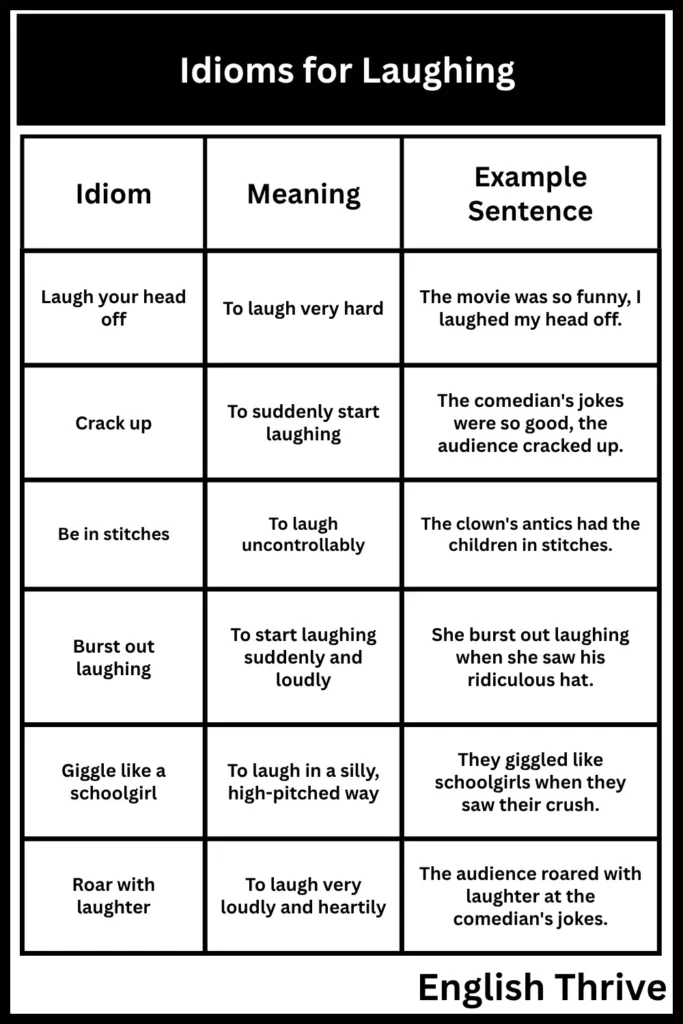
This table provides examples of idioms that express genuine amusement and joy.
| Idiom | Meaning | Example Sentence |
|---|---|---|
| Laugh your head off | To laugh very hard | The movie was so funny, I laughed my head off. |
| Crack up | To suddenly start laughing | The comedian’s jokes were so good, the audience cracked up. |
| Be in stitches | To laugh uncontrollably | The clown’s antics had the children in stitches. |
| Burst out laughing | To start laughing suddenly and loudly | She burst out laughing when she saw his ridiculous hat. |
| Giggle like a schoolgirl | To laugh in a silly, high-pitched way | They giggled like schoolgirls when they saw their crush. |
| Roar with laughter | To laugh very loudly and heartily | The audience roared with laughter at the comedian’s jokes. |
| Chuckle to oneself | To laugh quietly to oneself | He chuckled to himself as he remembered the funny incident. |
| Have a good laugh | To enjoy laughing | We had a good laugh over the old photos. |
| Die laughing | To laugh so much that you can’t breathe | The show was so hilarious, I almost died laughing. |
| Tee-hee | A suppressed giggle, often used to express amusement or embarrassment | She said tee-hee when he told her the joke. |
| Rolling in the aisles | Laughing uncontrollably and excessively | The stand-up comedian had the audience rolling in the aisles. |
| Splitting your sides | Laughing extremely hard | That joke was so funny; I was splitting my sides. |
| Belly laugh | A deep, hearty laugh | He let out a big belly laugh at the unexpected punchline. |
| Fit of laughter | A sudden, uncontrollable episode of laughing | She suddenly had a fit of laughter during the serious meeting. |
| Laugh fit to burst | Laughing so much that you are out of breath | The slapstick comedy had us laughing fit to burst. |
| To be tickled pink | To be very amused or pleased | She was tickled pink by the surprise party. |
| Grin from ear to ear | To smile widely, showing great happiness | He was grinning from ear to ear when he received the good news. |
| Beam with joy | To show radiant happiness | She was beaming with joy after winning the award. |
| Amused to bits | Extremely amused | We were amused to bits by the children’s performance. |
| Get a kick out of something | To find something very enjoyable or amusing | I get a kick out of watching old cartoons. |
| Find something hilarious | To consider something extremely funny | He found the situation absolutely hilarious. |
| Laugh until you cry | Laughing so much that tears come to your eyes | The comedy show was so good, we laughed until we cried. |
| Have a whale of a time | To have a very enjoyable and fun experience | We had a whale of a time at the beach yesterday. |
| Be in high spirits | To be cheerful and happy | Everyone was in high spirits at the wedding. |
| On cloud nine | Extremely happy and elated | She was on cloud nine after getting the job offer. |
Examples of Ridicule Idioms
This table provides examples of idioms that express laughter used to mock or belittle someone.
| Idiom | Meaning | Example Sentence |
|---|---|---|
| Laugh in someone’s face | To laugh directly at someone in a mocking way | They laughed in his face when he told them his plan. |
| Laugh someone out of the room | To make someone leave by laughing at them | His colleagues laughed him out of the room with their constant mockery. |
| Snicker | To laugh quietly in a disrespectful way | The students snickered when the teacher made a mistake. |
| Guffaw | To laugh loudly and coarsely | He let out a loud guffaw at the inappropriate joke. |
| Sneer | To smile or laugh with contempt | She sneered at his attempt to impress her. |
| Take the mickey (out of someone) | To make fun of someone | They were taking the mickey out of him for his strange haircut. |
| Poke fun at | To make jokes about someone or something | The comedian poked fun at the politician’s policies. |
| Roast | To humorously mock or satirize someone in a public setting | They roasted the guest of honor at the comedy show. |
| Chuckle with derision | To laugh quietly with contempt | He chuckled with derision at her naive suggestion. |
| Scornful laughter | Laughter that expresses contempt or disdain | Her suggestion was met with scornful laughter. |
| To make a laughingstock of | To cause someone to be ridiculed | His foolish behavior made a laughingstock of him. |
| To have a good laugh at someone’s expense | To enjoy laughing at someone’s misfortune | They had a good laugh at his expense when he tripped and fell. |
| Derisive snort | A snort that expresses contempt or mockery | She responded to his boast with a derisive snort. |
| Mocking laughter | Laughter that is intended to ridicule or make fun of someone | His clumsy attempt to dance was met with mocking laughter. |
| To laugh up one’s sleeve | To laugh secretly at someone | He was laughing up his sleeve at their ignorance. |
| To laugh something off | To dismiss something by laughing at it | She tried to laugh off his rude comment. |
| To laugh out of court | To dismiss something as ridiculous or unworthy of consideration | His argument was laughed out of court. |
| To give someone the last laugh | To ultimately triumph over someone who has mocked you | Despite their initial ridicule, he had the last laugh when his invention succeeded. |
| To be the butt of the joke | To be the person who is being laughed at | He didn’t appreciate being the butt of the joke. |
| To be a figure of fun | To be someone who is often laughed at | He became a figure of fun after his embarrassing mistake. |
| To make light of something | To treat something serious as if it is not important or funny | He made light of the situation, which upset some people. |
| To pour scorn on something | To express strong disapproval or contempt | She poured scorn on his efforts to improve their situation. |
| To look down one’s nose at someone | To regard someone with contempt or disdain | She looked down her nose at anyone who didn’t share her privileged background. |
| To turn up one’s nose at something | To reject something disdainfully | He turned up his nose at the offer of a part-time job. |
Examples of Nervousness Idioms
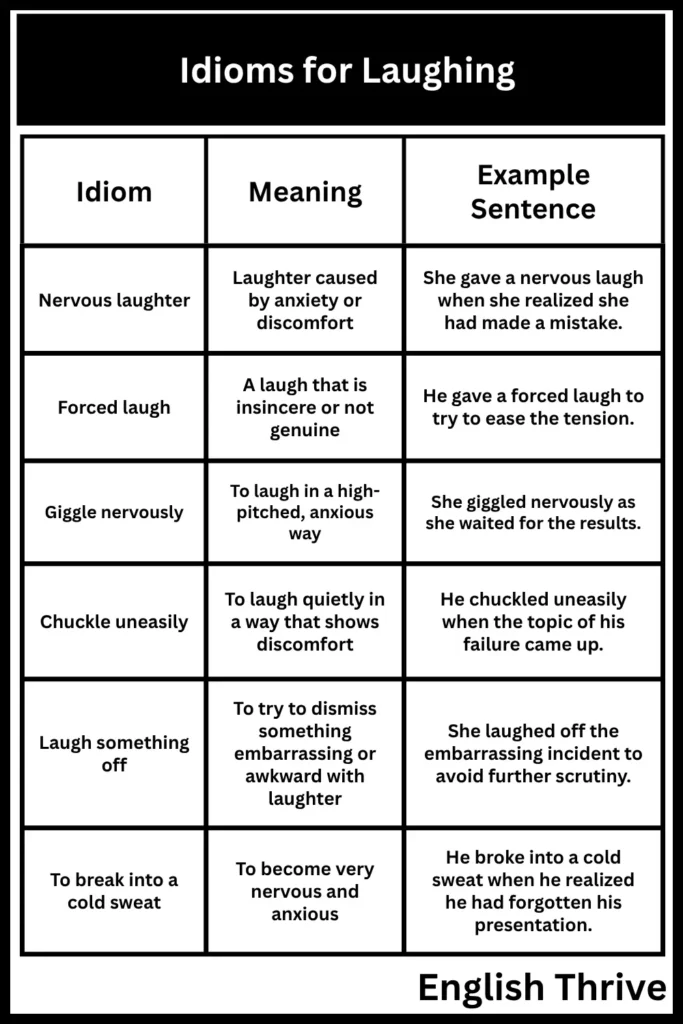
This table provides examples of idioms that express laughter caused by anxiety or discomfort.
| Idiom | Meaning | Example Sentence |
|---|---|---|
| Nervous laughter | Laughter caused by anxiety or discomfort | She gave a nervous laugh when she realized she had made a mistake. |
| Forced laugh | A laugh that is insincere or not genuine | He gave a forced laugh to try to ease the tension. |
| Giggle nervously | To laugh in a high-pitched, anxious way | She giggled nervously as she waited for the results. |
| Chuckle uneasily | To laugh quietly in a way that shows discomfort | He chuckled uneasily when the topic of his failure came up. |
| Laugh something off | To try to dismiss something embarrassing or awkward with laughter | She laughed off the embarrassing incident to avoid further scrutiny. |
| To break into a cold sweat | To become very nervous and anxious | He broke into a cold sweat when he realized he had forgotten his presentation. |
| To have butterflies in one’s stomach | To feel nervous and anxious, especially before an event | She had butterflies in her stomach before going on stage. |
| To be on pins and needles | To be very anxious or nervous about something | They were on pins and needles waiting for the doctor’s call. |
| To laugh to keep from crying | To laugh as a way to cope with sadness or pain | She laughed to keep from crying after receiving the bad news. |
| Crooked smile | A smile that is not genuine, often expressing nervousness or insincerity | He gave a crooked smile when he was caught in the lie. |
| To grin and bear it | To endure something unpleasant with a smile | She had to grin and bear it during the long and tedious meeting. |
| Weak smile | A smile that lacks sincerity or energy | He offered a weak smile, trying to hide his disappointment. |
| To chuckle wryly | To laugh in a way that shows both amusement and bitterness | He chuckled wryly at the irony of the situation. |
| To force a smile | To make oneself smile even when not feeling happy | She forced a smile for the camera, despite feeling upset. |
| To try to smile it away | To attempt to hide negative feelings by smiling | She tried to smile it away, but everyone could see she was hurt. |
| To wear a nervous grin | To have a smile that indicates nervousness or anxiety | He wore a nervous grin as he waited for his turn to speak. |
| To fake a laugh | To pretend to laugh when not genuinely amused | She faked a laugh to be polite, even though the joke wasn’t funny. |
| To laugh something off as a joke | To dismiss something serious by treating it as a joke | He laughed off the mistake as a joke to avoid taking responsibility. |
| To make light of one’s anxiety | To downplay one’s own anxiety by using humor | She made light of her anxiety to make others feel more comfortable. |
| To use humor as a defense mechanism | To use humor to protect oneself from uncomfortable emotions | He used humor as a defense mechanism to avoid addressing his true feelings. |
| To deflect attention with a joke | To redirect focus away from oneself by telling a joke | He deflected attention with a joke to avoid answering the difficult question. |
| To chuckle in disbelief | To laugh in a way that expresses doubt or incredulity | She chuckled in disbelief when she heard the outlandish story. |
| To laugh in resignation | To laugh because one has accepted an unpleasant situation | He laughed in resignation when he realized there was nothing he could do to change things. |
| To mask one’s discomfort with a smile | To hide one’s feelings of unease by smiling | She masked her discomfort with a smile during the awkward encounter. |
| To try to smile through the pain | To attempt to maintain a positive attitude despite experiencing distress | She tried to smile through the pain after the breakup. |
Usage Rules for Laughing Idioms
Using idioms correctly requires understanding their specific meanings and contexts. Here are some general rules to follow when using laughing idioms:
- Consider the Tone: Be mindful of the tone you want to convey. Some idioms are lighthearted and humorous, while others can be sarcastic or even offensive.
- Understand the Context: Make sure the idiom fits the situation. Using an idiom inappropriately can confuse or offend your audience.
- Know Your Audience: Some idioms are more common in certain regions or age groups. Consider your audience when choosing an idiom.
- Don’t Overuse Idioms: Using too many idioms can make your speech sound unnatural or forced. Use them sparingly to add color and emphasis.
- Pay Attention to Grammar: Ensure that the idiom is grammatically correct within the sentence. For example, use the correct verb tense and subject-verb agreement.
Common Mistakes When Using Laughing Idioms
Here are some common mistakes that learners make when using laughing idioms:
| Incorrect | Correct | Explanation |
|---|---|---|
| I laughed my stomach off. | I laughed my head off. | The correct idiom is “laugh your head off,” not “laugh your stomach off.” |
| He cracked with laughter. | He cracked up. | The correct idiom is “crack up,” not “crack with laughter.” |
| They were in stitches of laughter. | They were in stitches. | The correct idiom is “be in stitches,” not “be in stitches of laughter.” |
| She bursted out laughing. | She burst out laughing. | The correct verb form is “burst,” not “bursted.” |
| He giggled as a schoolgirl. | He giggled like a schoolgirl. | The correct idiom is “giggle like a schoolgirl,” which requires the word “like.” |
| We had a good laugh on it. | We had a good laugh about it. | The correct preposition is “about,” not “on.” |
| I am dying from laughing. | I am dying laughing. | The correct idiom is “die laughing,” not “die from laughing.” |
| They took the micky from him. | They took the mickey out of him. | The correct idiom is “take the mickey out of,” not “take the micky from.” |
| He poked fun on her. | He poked fun at her. | The correct idiom is “poke fun at,” not “poke fun on.” |
| She laughed to keep from cry. | She laughed to keep from crying. | The correct form is the gerund “crying,” not the base verb “cry.” |
Practice Exercises
Test your understanding of idioms for laughing with these practice exercises.
Exercise 1: Fill in the Blanks
Fill in the blanks with the appropriate idiom from the list below.
Idiom List: laugh your head off, crack up, be in stitches, burst out laughing, chuckle to oneself
| Question | Answer |
|---|---|
| 1. The movie was so hilarious that I couldn’t stop laughing. I nearly __________. | laugh my head off |
| 2. The comedian’s jokes were so unexpected that the entire audience started to __________. | crack up |
| 3. The clown’s silly antics had all the children __________. | in stitches |
| 4. When she saw his ridiculous costume, she couldn’t help but __________. | burst out laughing |
| 5. He remembered the funny incident from his childhood and began to __________. | chuckle to oneself |
| 6. After hearing the comedian’s routine, I was ____________. | in stitches |
| 7. The surprise party was so well-planned that everyone ____________ when they saw it. | burst out laughing |
| 8. I ____________ when I remembered the embarrassing moment from the other day. | chuckled to myself |
| 9. The stand-up comedian was so funny that the audience began to ____________. | crack up |
| 10. The film was so funny, I thought I was going to ____________. | laugh my head off |
Exercise 2: Multiple Choice
Choose the correct idiom to complete each sentence.
| Question | Choices | Answer |
|---|---|---|
| 1. The joke was so funny that everyone was __________. | (a) in tears (b) in stitches (c) in pain | (b) in stitches |
| 2. He __________ when he heard the unexpected news. | (a) cracked up (b) broke down (c) fell apart | (a) cracked up |
| 3. She __________ when she saw the surprise gift. | (a) laughed her feet off (b) laughed her head off (c) laughed her socks off | (b) laughed her head off |
| 4. He couldn’t help but __________ when he remembered the silly mistake. | (a) chuckle to others (b) chuckle to himself (c) chuckle to everyone | (b) chuckle to himself |
| 5. The movie was so funny that we __________ the entire time. | (a) bursted with laughter (b) burst out laughing (c) exploded with laughter | (b) burst out laughing |
| 6. After hearing the joke, the audience began to __________. | (a) split a gut (b) split the sides (c) split their sides | (c) split their sides |
| 7. The story was so amusing that he couldn’t help but ____________. | (a) grin from mouth to mouth (b) grin from ear to ear (c) grin from nose to chin | (b) grin from ear to ear |
| 8. The kids ____________ at the clown’s silly antics. | (a) giggled as adults (b) giggled as teenagers (c) giggled like schoolgirls | (c) giggled like schoolgirls |
| 9. The comedian’s performance had everyone ____________. | (a) rolling on the floor (b) rolling in the aisles (c) rolling on the seats | (b) rolling in the aisles |
| 10. He had a ____________ after the good news. | (a) whale of a day (b) whale of a moment (c) whale of a time | (c) whale of a time |
Exercise 3: Sentence Completion
Complete the following sentences using an appropriate idiom related to laughter.
| Question | Answer |
|---|---|
| 1. The comedian’s jokes were so funny that the audience began to ____________. | roar with laughter |
| 2. After hearing the hilarious story, I ____________ and couldn’t stop. | cracked up |
| 3. The children were ____________ at the clown’s performance. | in stitches |
| 4. She ____________ when she realized the extent of her mistake. | gave a nervous laugh |
| 5. They ____________ when he told them his ridiculous plan. | laughed in his face |
| 6. The movie was so funny that I thought I would ____________. | die laughing |
| 7. He ____________ as he remembered the funny incident from his childhood. | chuckled to himself |
| 8. After the surprising announcement, the crowd ____________. | burst out laughing |
| 9. The comedian’s jokes were so unexpected that everyone began to ____________. | crack up |
| 10. The children ____________ at the funny faces she made. | giggled like schoolgirls |
Advanced Topics
For advanced learners, it’s beneficial to explore the etymology and cultural variations of laughing idioms. The origin of an idiom can provide insight into its meaning and usage.
For example, “laugh your head off” is believed to have originated from the idea of being so amused that one’s head might detach from one’s body. Understanding such origins can deepen your appreciation for the idiom.
Cultural variations in idioms can also be significant. While some idioms are universally understood, others may be specific to certain regions or cultures.
Being aware of these variations can help you avoid misunderstandings and communicate more effectively with people from different backgrounds. For instance, the idiom “take the mickey” is more commonly used in British English than in American English.
FAQs About Idioms for Laughing
What is the difference between an idiom and a proverb?
An idiom is a phrase whose meaning is different from the literal meaning of its words, while a proverb is a short, well-known saying that expresses a general truth or piece of advice. Idioms are more figurative and context-dependent, whereas proverbs are straightforward and universally applicable.
How can I learn more idioms?
Read widely, listen to native speakers, and use online resources and idiom dictionaries. Pay attention to how idioms are used in context and try to incorporate them into your own speech and writing. Consistent practice is key to mastering idioms.
Is it okay to use idioms in formal writing?
It depends on the context and audience. In general, idioms are more appropriate for informal writing and conversation. In formal writing, it’s best to use more direct and precise language unless the idiom is widely recognized and appropriate for the tone.
How do I know when to use a particular idiom?
Consider the context, tone, and audience. Make sure the idiom fits the situation and conveys the intended meaning. If you’re unsure, it’s better to err on the side of caution and use more direct language.
Can idioms have multiple meanings?
Yes, some idioms can have multiple meanings depending on the context. It’s important to understand all the possible meanings and choose the one that is most appropriate for the situation.
Conclusion
Idioms for laughing are a rich and expressive part of the English language. By understanding their definitions, structures, usage rules, and common mistakes, you can effectively incorporate them into your everyday communication.
Whether you’re expressing genuine amusement, sarcastic mockery, or nervous laughter, these idioms can add color and depth to your conversations. Remember to consider the context, tone, and audience when using idioms, and practice consistently to improve your fluency and confidence.
With a little effort, you can master these expressions and enhance your ability to communicate humor and emotion in English.