
What Is Figurative Language?
Figurative language is the use of words or phrases that go beyond their literal meaning to express ideas more clearly, creatively, or emotionally. Instead of stating facts directly, figurative language helps readers and listeners imagine situations, feel emotions, and understand ideas in a deeper way.
Figurative language is commonly used in stories, poems, speeches, songs, and everyday conversations. It allows speakers and writers to describe feelings, explain complex ideas, and make communication more interesting and memorable.
Example:
When someone says, “The classroom was a zoo,” they do not mean animals were inside the room. They mean the classroom was noisy or chaotic. This is a clear example of figurative language.
Why Figurative Language Is Important
Figurative language plays a key role in both written and spoken English. It helps people communicate ideas that may be difficult to express using literal language alone.
Figurative language is important because it:
- Makes writing more vivid and engaging
- Helps readers visualize ideas
- Expresses emotions more clearly
- Adds depth and creativity to language
- Improves storytelling and persuasion
Without figurative language, communication can sound flat or mechanical. With it, language becomes expressive, meaningful, and memorable.
Definition of Figurative Language
Figurative language refers to language that uses words in a non-literal way to create meaning, emphasis, or imagery. The words do not mean exactly what they say, but they help convey a message more effectively.
Literal language states facts directly. Figurative language, on the other hand, uses comparison, exaggeration, sound, and symbolism to express ideas.
Example:
- Literal: He is very tired.
- Figurative: He is running on empty.
Both sentences communicate tiredness, but the figurative sentence creates a stronger image.
Figurative language helps writers and speakers explain abstract ideas, emotions, and experiences in a clear and memorable way.
How Figurative Language Works
Figurative language works by creating connections between ideas. These connections may be based on similarity, exaggeration, sound, or association.
Some figures of speech compare two unlike things. Others exaggerate or minimize reality. Some imitate sounds, while others substitute one word for another closely related idea.
Understanding how figurative language works helps readers:
- Identify figures of speech
- Interpret meaning correctly
- Appreciate creative writing
It also helps writers use figurative language clearly and effectively.
Structural Breakdown of Figurative Language
The structure of figurative language depends on the type being used, but many figures of speech follow common patterns.
Comparison-Based Structures
Many figures of speech compare two unlike things to highlight a shared quality. Similes and metaphors fall into this group.
Examples:
- Her voice was like music.
- Her voice was music.
Exaggeration and Understatement
Some figures of speech rely on exaggeration or understatement.
- Hyperbole exaggerates for emphasis
- Understatement minimizes for effect
These are often used for humor, drama, or irony.
Sound-Based Structures
Some figures of speech focus on sound.
- Alliteration repeats beginning sounds
- Onomatopoeia imitates real sounds
These are common in poetry and storytelling.
Association-Based Structures
Other figures of speech express meaning through association.
- Synecdoche uses a part to represent the whole
- Metonymy uses something closely related
Types of Figurative Language
There are many types of figurative language. Each type adds meaning in a different way.
Simile
A simile compares two different things using the words like or as.
Simile Examples
- Her smile was as bright as the sun.
- He ran like a cheetah.
- The snow was like a white blanket.
Similes help readers visualize ideas clearly.
Metaphor
A metaphor compares two things directly without using like or as.
Metaphor Examples
- Time is a thief.
- The classroom was a zoo.
- Life is a rollercoaster.
Metaphors create strong images and deeper meaning.
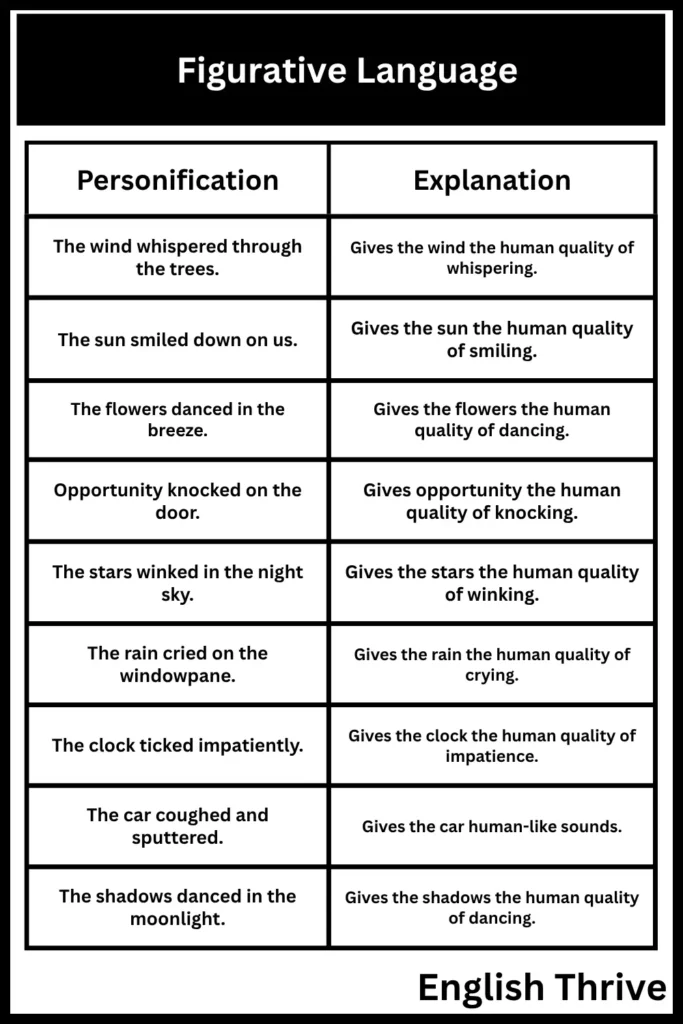
Personification
Personification gives human qualities to objects, animals, or ideas.
Personification Examples
- The wind whispered through the trees.
- The sun smiled down on us.
- The alarm clock refused to stop ringing.
Hyperbole
Hyperbole uses extreme exaggeration to emphasize a point.
Hyperbole Examples
- I’ve told you a million times.
- I’m so hungry I could eat a horse.
Understatement
An understatement makes something seem less important than it really is.
Understatement Example
- Saying “It’s a bit cold” when it is freezing.
Idiom
An idiom is a phrase whose meaning cannot be understood from the literal words.
Idiom Examples
- Piece of cake (very easy)
- Kick the bucket (to die)
- Break the ice (start a conversation)
Oxymoron
An oxymoron combines two opposite words.
Oxymoron Examples
- Bittersweet
- Jumbo shrimp
- Deafening silence
Pun
A pun uses wordplay for humor.
Pun Example
- I’m reading a book about anti-gravity. It’s impossible to put down!
Irony
Irony occurs when there is a contrast between expectation and reality.
Verbal Irony
Saying one thing but meaning another.
Example: “Great job!” after a mistake.
Situational Irony
When the outcome is the opposite of what is expected.
Example: A fire station catching fire.
Dramatic Irony
When the audience knows something the character does not.
Alliteration
Alliteration repeats the same beginning sound.
Example
- Peter Piper picked a peck of pickled peppers.
Onomatopoeia
Onomatopoeia uses words that imitate sounds.
Examples
- Buzz
- Bang
- Splash
- Hiss
Euphemism
A euphemism replaces harsh words with softer ones.
Examples
- Passed away (instead of died)
- Let go (instead of fired)
Synecdoche
Synecdoche uses a part to represent the whole.
Example
- All hands on deck
Metonymy
Metonymy replaces something with a closely related term.
Example
- The crown represents the monarchy.
Paradox
A paradox seems contradictory but contains truth.
Examples
- Less is more
- The more you learn, the less you know
Examples of Figurative Language
Simile Examples
- Her tears flowed like a river.
- The night was as dark as ink.
Metaphor Examples
- The test was a breeze.
- The city is a jungle.
Personification Examples
- The stars danced in the sky.
- The rain cried on the window.
Rules for Using Figurative Language
To use figurative language effectively:
- Know your audience
- Do not overuse it
- Avoid mixed metaphors
- Keep meanings clear
- Match the tone of your writing
Common Mistakes with Figurative Language
Mixed Metaphors
Incorrect:
We need to nip it in the bud before it snowballs.
Correct:
We need to address the issue early.
Clichés
Avoid overused expressions.
Unclear Comparisons
Make sure comparisons make sense.
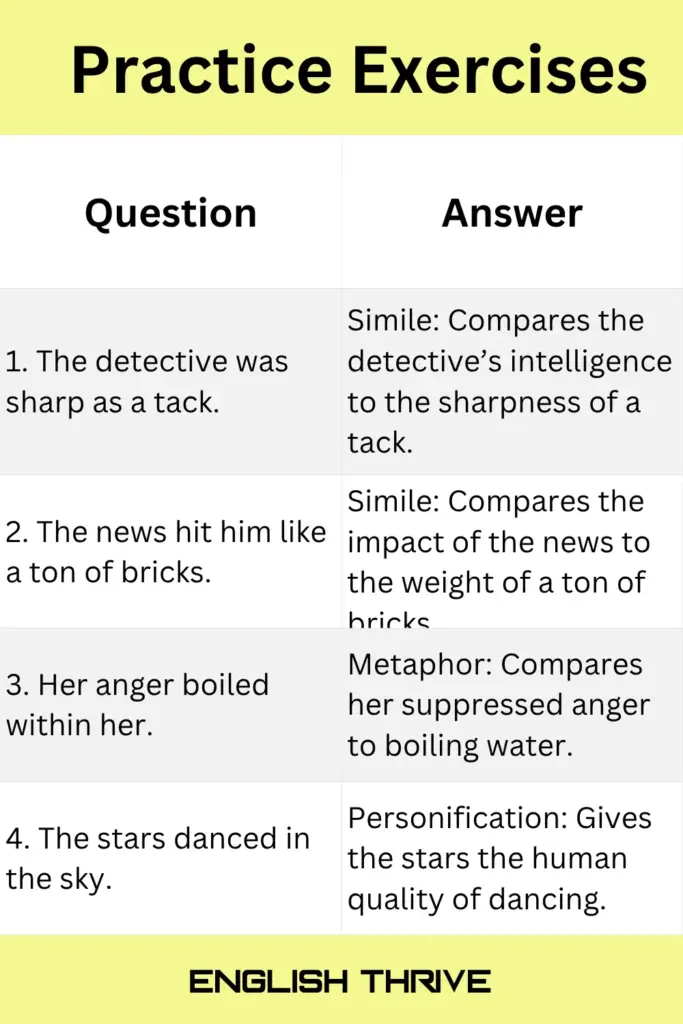
Practice Exercises
Identify the type of figurative language used:
- He was sharp as a tack.
- The stars winked at us.
- I’m so hungry I could eat a horse.
- The classroom was a zoo.
FAQs About Figurative Language
What is figurative language?
It is language that uses non-literal expressions to add meaning.
Why is figurative language important?
It makes writing clearer, more expressive, and engaging.
Can figurative language be overused?
Yes. Too much can confuse readers.
How can I improve my use of figurative language?
Read widely and practice writing examples.
Conclusion
Figurative language makes English richer and more expressive. By learning its types and practicing examples, you can improve reading, writing, and speaking skills. With regular practice, figurative language becomes natural and effective.