

Idioms are figurative expressions whose meanings differ from the literal interpretation of the words. In the world of learning, idioms are often used to describe experiences, challenges, and accomplishments, making Idioms for Education a valuable tool for enriching communication.
Understanding these idioms is vital for effectively communicating in academic settings and comprehending educational contexts described in various forms of media. This article aims to provide a thorough overview of common education-related idioms, equipping learners with the knowledge and skills to use them correctly and confidently.
By mastering these idioms, you will not only improve your English proficiency but also gain a deeper understanding of the cultural nuances embedded in the language.
Definition of Idioms
An idiom is a phrase or expression whose meaning cannot be understood from the literal meanings of its individual words. Instead, an idiom has a figurative meaning that is known through common usage.
Idioms are culturally specific and often evolve over time. They add color and expressiveness to language, making it more engaging and relatable.
In the context of education, idioms can describe various aspects of the learning process, teaching methods, and academic achievements. Recognizing and understanding idioms is a key component of advanced language proficiency.
Idioms can be classified based on their structure or function. Some idioms are metaphorical, using comparisons to convey meaning (e.g., “a piece of cake”).
Others are based on historical or cultural references (e.g., “burning the midnight oil”). Understanding the etymology of an idiom can sometimes shed light on its meaning, but ultimately, familiarity through exposure and practice is the most effective way to learn them.
The function of an idiom is to provide a more vivid or concise way of expressing a concept or idea. They often replace more formal or literal language with a more colloquial or expressive alternative.
Structural Breakdown
Idioms do not adhere to standard grammatical rules, which is part of what makes them challenging for language learners. The structure of an idiom is fixed; the words cannot be changed or rearranged without altering or destroying its meaning.
For example, “hit the books” cannot be changed to “strike the books” or “hit the notebooks” without losing its idiomatic meaning. The grammatical structure of an idiom can vary.
Some idioms are phrases, while others are clauses or even complete sentences. Regardless of the grammatical structure, the key characteristic of an idiom is its non-literal meaning.
The components of an idiom work together as a single unit of meaning. The individual words contribute to the overall figurative sense, rather than their literal definitions.
Recognizing the structural integrity of an idiom is crucial for understanding and using it correctly. Attempting to analyze an idiom based on the individual meanings of its words will lead to misinterpretation.
Instead, it is essential to learn the idiom as a whole and understand its conventional usage. The fixed nature of idiomatic expressions highlights the importance of memorization and contextual understanding in language acquisition.
Types and Categories
Idioms related to education can be categorized based on various aspects of the educational experience. Here are some common categories:
Learning and Studying
These idioms describe the process of acquiring knowledge and skills.
Teaching and Instruction
These idioms relate to the act of imparting knowledge and guiding students.
Academic Performance
These idioms describe the level of success or failure in academic endeavors.
Challenges and Difficulties
These idioms refer to the obstacles and struggles encountered in education.
Success and Achievement
These idioms celebrate accomplishments and positive outcomes in education.
Examples of Idioms for Education
Here are several examples of idioms related to education, categorized for clarity:
Learning and Studying Idioms
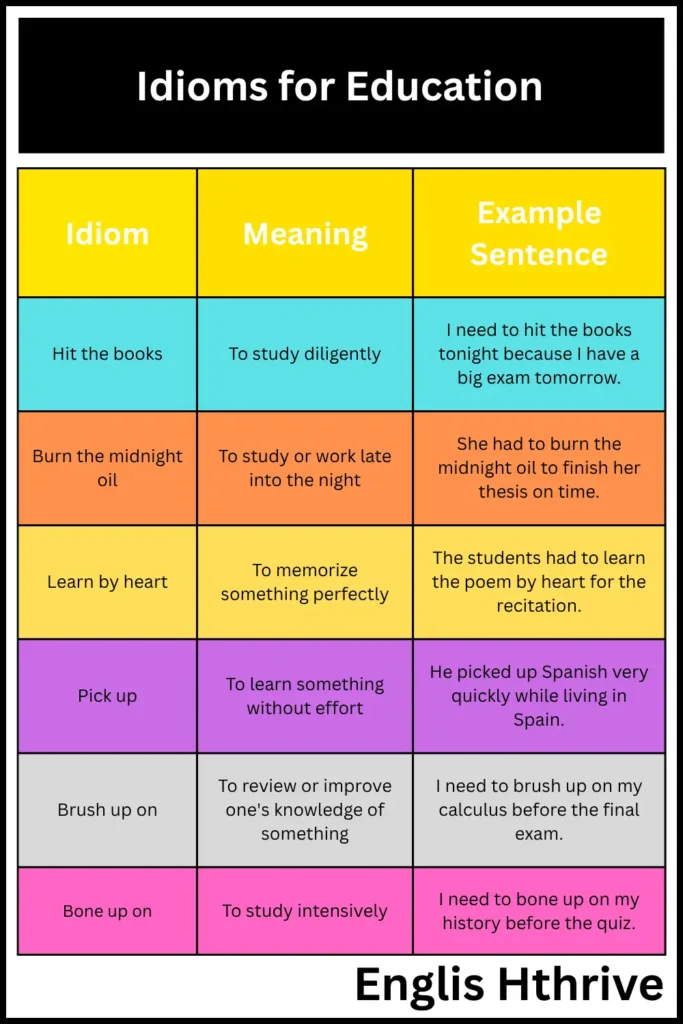
The following table provides examples of idioms related to learning and studying, along with their meanings and example sentences. Understanding these idioms will enhance your comprehension of academic discussions and texts.
| Idiom | Meaning | Example Sentence |
|---|---|---|
| Hit the books | To study diligently | I need to hit the books tonight because I have a big exam tomorrow. |
| Burn the midnight oil | To study or work late into the night | She had to burn the midnight oil to finish her thesis on time. |
| Learn by heart | To memorize something perfectly | The students had to learn the poem by heart for the recitation. |
| Pick up | To learn something without effort | He picked up Spanish very quickly while living in Spain. |
| Brush up on | To review or improve one’s knowledge of something | I need to brush up on my calculus before the final exam. |
| Bone up on | To study intensively | I need to bone up on my history before the quiz. |
| Rack one’s brains | To think very hard about something | I racked my brains trying to remember the answer to the question. |
| Swot up | To study very hard, especially for an examination | She’s been swotting up on chemistry all week. |
| Get the hang of | To learn how to do something | It took me a while, but I finally got the hang of coding. |
| Read up on | To get information about something by reading | I need to read up on the latest research in this field. |
| Be a quick study | To learn something quickly | He’s a quick study, so he’ll master this software in no time. |
| Go back to basics | To return to the fundamental principles | If you’re struggling with this concept, let’s go back to basics. |
| Hit the books hard | To study with great intensity | With finals approaching, it’s time to hit the books hard. |
| Learn the ropes | To learn the basics of a job or task | It takes time to learn the ropes when you start a new job. |
| Put one’s thinking cap on | To concentrate and think carefully | Alright everyone, put your thinking caps on; we have a problem to solve. |
| Study up | To prepare for an exam by studying | Make sure you study up for the test next week. |
| To know something inside out | To know something very well | She knows this subject inside out. |
| Cover a lot of ground | To deal with many subjects or issues | The lecture covered a lot of ground, from ancient history to modern politics. |
| Keep up with | To stay at the same level as others | It’s hard to keep up with all the new research in this field. |
| From the old school | Traditional in style or methods | My professor is from the old school and prefers lecturing to group activities. |
 Idioms for Education
Teaching and Instruction Idioms
The following table provides examples of idioms used to describe teaching and instruction. These idioms are helpful for understanding discussions about pedagogy and educational strategies.
| Idiom | Meaning | Example Sentence |
|---|---|---|
| Show someone the ropes | To teach someone how to do a job or task | The manager will show you the ropes when you start your new job. |
| Teach an old dog new tricks | To teach someone new skills or habits (often implying it’s difficult) | It’s hard to teach an old dog new tricks, but my grandfather is learning to use a smartphone. |
| Learn a lesson | To learn something from an experience, often a negative one | He learned a lesson about the importance of studying after failing the exam. |
| By rote | Learning something by memorization without understanding | The students learned the multiplication tables by rote. |
| Lay down the law | To state rules or requirements strictly | The teacher had to lay down the law after the students became too noisy. |
| Read someone the riot act | To scold someone severely | The principal read the students the riot act for their disruptive behavior. |
| Get through to someone | To make someone understand something | It’s hard to get through to him sometimes, but he’s a good student. |
| Drive something home | To emphasize a point | The teacher drove home the importance of regular attendance. |
| Take someone under your wing | To mentor or guide someone | The senior researcher took the new student under her wing. |
| Give someone a crash course | To teach someone something quickly and intensively | I gave her a crash course in programming before the competition. |
| Lead by the nose | To control someone completely | The manipulative teacher led his students by the nose with his charismatic teaching style. |
| Start from scratch | To begin something from the beginning | The teacher had to start from scratch when teaching the new concept. |
| Back to square one | Having to start over again | After many failed attempts, the project went back to square one. |
| A learning curve | The rate at which someone learns a new skill | There’s a steep learning curve when you start using this software. |
| Put someone on the right track | To guide someone in the correct direction | The mentor put the student on the right track with his advice. |
| Set an example | To behave in a way that others can imitate | Teachers should set an example for their students. |
| Walk someone through something | To explain something step-by-step | The tutor walked me through the problem. |
| Speak the same language | To understand each other | It’s easier to work with people who speak the same language. |
| Get your wires crossed | To misunderstand each other | We got our wires crossed and both prepared the same presentation. |
| In layman’s terms | In simple language that anyone can understand | Can you explain it in layman’s terms? |
Academic Performance Idioms
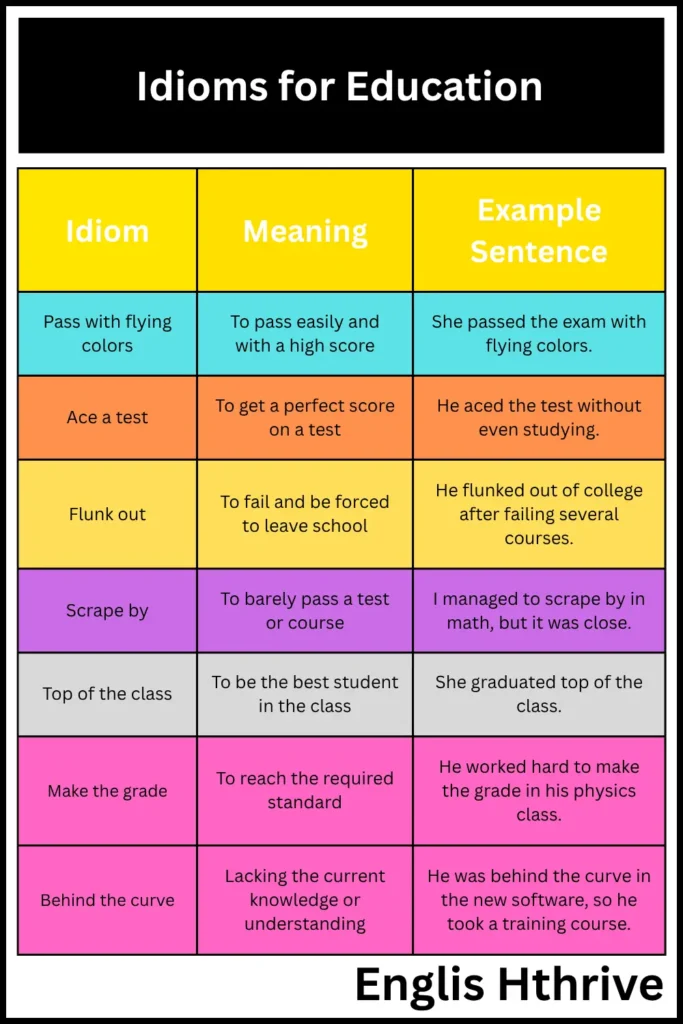
This table includes idioms that describe academic performance, covering both success and failure. These expressions are commonly used in discussions about grades, exams, and overall academic standing.
| Idiom | Meaning | Example Sentence |
|---|---|---|
| Pass with flying colors | To pass easily and with a high score | She passed the exam with flying colors. |
| Ace a test | To get a perfect score on a test | He aced the test without even studying. |
| Flunk out | To fail and be forced to leave school | He flunked out of college after failing several courses. |
| Scrape by | To barely pass a test or course | I managed to scrape by in math, but it was close. |
| Top of the class | To be the best student in the class | She graduated top of the class. |
| Make the grade | To reach the required standard | He worked hard to make the grade in his physics class. |
| Behind the curve | Lacking the current knowledge or understanding | He was behind the curve in the new software, so he took a training course. |
| Ahead of the curve | More advanced than others | She is ahead of the curve in her understanding of the subject. |
| Keep your nose to the grindstone | To work very hard | If you keep your nose to the grindstone, you’ll succeed. |
| Cut class | To skip a class without permission | He cut class to go to the beach with his friends. |
| Playing hooky | Being absent from school without permission | The students were playing hooky and went to the arcade. |
| Well-read | Having read many books and having a lot of knowledge | She is a well-read scholar. |
| Bookworm | Someone who loves reading | He is such a bookworm; he spends all his free time in the library. |
| Street smart | Having the knowledge and skills to deal with difficult or dangerous situations | Though he wasn’t academically gifted, he was street smart. |
| Book smart | Intelligent and knowledgeable because of studying | She is book smart, but lacks practical experience. |
| Learn the hard way | To learn something through difficult or unpleasant experiences | He learned the hard way that procrastination is not a good strategy. |
| Get a head start | To start something early and gain an advantage | She got a head start by studying during the summer. |
| Straight A student | A student who consistently gets excellent grades | She is a straight A student. |
| Black sheep | A person who is different from the rest of the family or group | He was considered the black sheep of the family because he didn’t go to college. |
| Teacher’s pet | The teacher’s favorite student | She was the teacher’s pet and always got special treatment. |
 Idioms for Education
Challenges and Difficulties Idioms
This table presents idioms related to the challenges and difficulties encountered in education. Understanding these idioms can help you discuss the struggles and obstacles faced by students and educators.
| Idiom | Meaning | Example Sentence |
|---|---|---|
| A hard nut to crack | A difficult problem or person to deal with | This math problem is a hard nut to crack. |
| Up against a wall | In a difficult situation with no easy solution | I’m up against a wall with this research project. |
| In over one’s head | In a situation that is too difficult to handle | He was in over his head in the advanced class. |
| Back to the drawing board | To start something over because the first attempt failed | The experiment failed, so it’s back to the drawing board. |
| Miss the boat | To miss an opportunity | He missed the boat by not applying for the scholarship on time. |
| Fall behind | To fail to keep up with the required pace | She fell behind in her studies after being sick. |
| Lose ground | To lose progress or advantage | The project lost ground due to the lack of funding. |
| Draw a blank | To be unable to remember something | I drew a blank when the teacher asked me the question. |
| Go the extra mile | To do more than is expected | She always goes the extra mile to help her students. |
| Cut corners | To do something poorly in order to save time or money | The construction company cut corners and the building collapsed. |
| Bite off more than one can chew | To take on more than one can handle | He bit off more than he could chew when he enrolled in five courses. |
| Skating on thin ice | In a risky or dangerous situation | He’s skating on thin ice after missing so many classes. |
| Rough patch | A difficult period | She’s going through a rough patch in her studies. |
| Under the weather | Feeling unwell | He’s been under the weather and hasn’t been able to study. |
| A tall order | A difficult task | Graduating with honors is a tall order. |
| Get bogged down | To become so involved in details that you cannot progress | He got bogged down in the details of the research and couldn’t finish on time. |
| Hit a wall | To reach a point where you cannot make any more progress | I’ve hit a wall with this project; I need some help. |
| Between a rock and a hard place | Faced with two equally difficult choices | He was between a rock and a hard place, having to choose between studying and working. |
| At wit’s end | At the limit of your mental resources | She was at her wit’s end trying to solve the problem. |
| In the same boat | In the same difficult situation | We are all in the same boat when it comes to this challenging course. |
Success and Achievement Idioms
The following table provides examples of idioms used to describe success and achievement in education. These idioms are useful for celebrating accomplishments and discussing positive outcomes.
| Idiom | Meaning | Example Sentence |
|---|---|---|
| Come a long way | To make great progress | She’s come a long way since she started learning English. |
| On the right track | Moving in the right direction | You’re on the right track with your research. |
| Get ahead | To make progress and be successful | Hard work is the key to getting ahead in life. |
| Make strides | To make significant progress | The students are making strides in their reading skills. |
| Reach for the stars | To aim for ambitious goals | Always reach for the stars, no matter how difficult it seems. |
| Climb the ladder | To advance in a career or field | He’s been climbing the ladder in his company. |
| Reap the rewards | To enjoy the benefits of one’s efforts | After years of hard work, she’s finally reaping the rewards. |
| Bear fruit | To produce positive results | His efforts finally bore fruit when he got the scholarship. |
| Hit the nail on the head | To be exactly right about something | You hit the nail on the head with your analysis. |
| Go places | To be successful in the future | He’s a talented student; he’s going to go places. |
| Strike gold | To find something valuable or successful | The researchers struck gold with their new discovery. |
| Make a name for oneself | To become famous or respected | She’s making a name for herself in the field of medicine. |
| Rise to the occasion | To perform well in a difficult situation | He rose to the occasion and delivered an excellent presentation. |
| Take off | To become successful quickly | Her career took off after she published her first book. |
| On top of the world | Feeling extremely happy and successful | She felt on top of the world after graduating. |
| Get the thumbs up | To receive approval or support | The project got the thumbs up from the committee. |
| In the bag | Assured of success | With a strong lead, the victory was in the bag. |
| Home stretch | The final part of a task or project | We’re in the home stretch of the semester. |
| Make headway | To make progress | We’re making headway on the project. |
| Put your best foot forward | To make the best possible impression | Always put your best foot forward during job interviews. |
Usage Rules
Using idioms correctly requires understanding their specific meanings and contexts. Here are some general rules to follow:
- Do not take idioms literally: The meaning of an idiom is figurative, not literal.
- Use idioms in appropriate contexts: Idioms are often informal and may not be suitable for formal writing or speech.
- Do not change the words in an idiom: Idioms are fixed expressions, and changing the words will alter or destroy their meaning.
- Be aware of cultural differences: Idioms are culturally specific, and what is common in one culture may not be understood in another.
- Pay attention to the grammatical structure: Use the idiom in a grammatically correct sentence.
Common Mistakes
One of the most common mistakes is taking idioms literally, leading to misinterpretations. Another frequent error is changing the wording of an idiom, which can make it nonsensical.
Using idioms in inappropriate contexts, such as formal academic writing, is also a common mistake. Here are some examples of common mistakes and their corrections:
| Incorrect | Correct | Explanation |
|---|---|---|
| I hit the books with my hand. | I need to hit the books tonight. | The idiom “hit the books” means to study, not literally hit books. |
| She burned the midnight oil with gasoline. | She had to burn the midnight oil to finish her thesis. | The idiom “burn the midnight oil” means to study late, not literally burn oil. |
| He learned the poem by his heart. | He learned the poem by heart. | The correct idiom is “learn by heart,” not “learn by his heart.” |
| I must brush up me on French. | I need to brush up on my French. | The correct idiom is “brush up on,” and the possessive pronoun is needed. |
| He has to rack his brains’ head. | He had to rack his brains trying to remember. | The correct idiom is “rack one’s brains”, the ‘head’ is redundant. |
Practice Exercises: Idioms for Education
Test your understanding of idioms with the following exercises:
Exercise 1: Fill in the Blanks
Fill in the blanks with the appropriate idiom from the list below.
Idiom List: Hit the books, Burn the midnight oil, Learn by heart, Pick up, Brush up on, Bone up on, Rack one’s brains, Get the hang of, Read up on, Show someone the ropes
| Question | Answer |
|---|---|
| 1. I need to ______ my Spanish before my trip to Mexico. | Brush up on |
| 2. She had to ______ to finish the project on time. | Burn the midnight oil |
| 3. I need to ______ the history of the area before visiting the museum. | Read up on |
| 4. He managed to ______ the new software quickly. | Get the hang of |
| 5. The students had to ______ the poem for the competition. | Learn by heart |
| 6. I need to ______ for the upcoming exam. | Hit the books |
| 7. She ______ French very easily while living in Paris. | Pick up |
| 8. He had to ______ trying to remember the password. | Rack one’s brains |
| 9. I need to _______ my knowledge of quantum physics before the lecture. | Bone up on |
| 10. The senior employee will ______ to the new recruits. | Show someone the ropes |
Exercise 2: Multiple Choice
Choose the correct meaning of the idiom in the following sentences.
| Question | Options | Answer |
|---|---|---|
| 1. He aced the test. | a) Failed miserably, b) Got a perfect score, c) Barely passed, d) Didn’t take the test | b) Got a perfect score |
| 2. She flunked out of college. | a) Graduated with honors, b) Dropped out voluntarily, c) Failed and was forced to leave, d) Transferred to another school | c) Failed and was forced to leave |
| 3. He’s skating on thin ice. | a) Enjoying a leisurely activity, b) In a risky situation, c) Feeling confident, d) Perfectly safe | b) In a risky situation |
| 4. She’s in over her head. | a) Comfortable and confident, b) In a difficult situation, c) Enjoying her studies, d) Perfectly prepared | b) In a difficult situation |
| 5. They’re making strides in their research. | a) Making significant progress, b) Facing setbacks, c) Giving up, d) Taking a break | a) Making significant progress |
| 6. He had to go back to the drawing board. | a) Continue as planned, b) Start all over, c) Make minor adjustments, d) Abandon the project | b) Start all over |
| 7. She missed the boat. | a) Arrived early, b) Missed an opportunity, c) Took a vacation, d) Was perfectly on time | b) Missed an opportunity |
| 8. He is a bookworm. | a) Someone who hates reading, b) Someone who loves reading, c) Someone who writes books, d) Someone who sells books | b) Someone who loves reading |
| 9. Stop cutting corners. | a) Save time, b) Do something poorly, c) Be efficient, d) Work harder | b) Do something poorly |
| 10. He is teacher’s pet. | a) A disobedient student, b) The teacher’s favorite student, c) A student who dislikes the teacher, d) A student who always asks questions | b) The teacher’s favorite student |
Exercise 3: Sentence Completion
Complete the following sentences using the correct idiom.
| Question | Answer |
|---|---|
| 1. After failing the first exam, he knew he had to ______. | hit the books hard |
| 2. The new student was nervous, but the teacher ______. | showed him the ropes |
| 3. She was so busy with her studies that she felt like she was ______. | burning the midnight oil |
| 4. Although the task was difficult, he decided to ______. | give it a shot |
| 5. He didn’t understand the lecture, so he asked the professor to explain it ______. | in layman’s terms |
| 6. After several failed attempts, they had to ______. | go back to square one |
| 7. The project was so complex that he felt like he had ______. | bitten off more than he could chew |
| 8. She worked hard and eventually began to ______. | reap the rewards |
| 9. He was so stressed about the exam that he was ______. | at wit’s end |
| 10. With the deadline approaching, they were in the ______. | home stretch |
Advanced Topics
For advanced learners, exploring the etymology and historical context of idioms can provide a deeper understanding of their meanings. Researching the cultural origins of idioms can also reveal fascinating insights into the values and beliefs of different societies.
Additionally, analyzing how idioms are used in literature and media can enhance comprehension and appreciation of the English language. Advanced learners can also focus on mastering more obscure or less commonly used idioms to further refine their language skills.
Understanding the nuances of idiomatic expressions can significantly improve communication skills and cultural awareness.
FAQs on Idioms for Education
What is the difference between an idiom and a proverb?
An idiom is a phrase whose meaning is different from the literal meaning of its words, while a proverb is a short, well-known saying that expresses a general truth or piece of advice. Idioms are figurative expressions, while proverbs are statements of wisdom.
How can I improve my understanding of idioms?
Read widely, listen to native speakers, and pay attention to the context in which idioms are used. Keep a notebook of new idioms and practice using them in your own speech and writing. Use online resources and language learning apps to reinforce your understanding.
Are idioms the same in all English-speaking countries?
No, idioms can vary between different English-speaking countries. While many idioms are common across all English-speaking regions, some are specific to certain countries or regions. For example, an idiom commonly used in the United States may not be well-known or understood in the United Kingdom, and vice versa. It is important to be aware of these regional differences when communicating with people from different English-speaking backgrounds. Researching the idioms specific to a particular region can enhance your understanding and communication skills.
Is it okay to use idioms in formal essays or reports?
Generally, it is best to avoid using idioms in formal essays or reports, as they can make your writing sound less professional. Formal writing typically requires precise and straightforward language, while idioms are often informal and can introduce ambiguity. However, there may be exceptions depending on the specific context and the tone of your writing. If you are unsure, it is best to err on the side of caution and use more formal language.
How can I effectively memorize idioms?
Memorizing idioms can be challenging, but there are several effective strategies you can use. One approach is to create flashcards with the idiom on one side and its meaning and an example sentence on the other. Review these flashcards regularly to reinforce your memory. Another strategy is to use idioms in your own speech and writing as much as possible. The more you use an idiom, the more likely you are to remember it. Additionally, try to associate idioms with visual images or personal experiences to make them more memorable. Finally, use online resources and language learning apps to practice and reinforce your understanding of idioms.
Conclusion: Idioms for Education
Mastering idioms related to education is a valuable skill for anyone learning or using the English language. These figurative expressions add depth and color to communication, allowing for more nuanced and expressive interactions.
By understanding the definitions, usage rules, and common mistakes associated with idioms, learners can improve their comprehension and fluency. The practice exercises provided in this article offer a practical way to reinforce your knowledge and build confidence in using idioms correctly.
Whether you are a student, teacher, or language enthusiast, the ability to use and understand idioms will undoubtedly enhance your communication skills and cultural awareness, making you a more effective and articulate communicator in academic and professional settings.