

Idioms for Costumes and Disguises are colorful expressions that bring life and depth to the English language. Learning these idioms enhances your understanding of nuanced language and boosts your ability to communicate effectively.
This article provides a comprehensive guide to idioms about costumes, exploring their meanings, origins, and usage. Whether you’re an English language learner or a native speaker, this resource will equip you with the knowledge to confidently incorporate these idioms into your everyday conversations and writing.
This guide is designed for English learners of all levels, from beginners to advanced speakers, who want to improve their understanding and use of idiomatic expressions. It is also valuable for educators seeking to enrich their lesson plans with practical and engaging content.
By the end of this article, you’ll be able to recognize, interpret, and confidently use a variety of idioms related to costumes and disguises.
Definition of Costume Idioms
Costume idioms are expressions that use clothing, disguises, or appearances metaphorically to convey a particular meaning or feeling. These idioms often relate to hiding one’s true nature, pretending to be someone else, or projecting a certain image.
Unlike literal language, the individual words in an idiom don’t define its overall meaning; instead, the expression as a whole carries a unique figurative meaning.
Costume idioms are a subset of general idiomatic expressions, drawing specifically from the imagery of clothing and disguises. Understanding these idioms requires recognizing the implied meanings behind the words, rather than interpreting them literally.
For example, the idiom “a wolf in sheep’s clothing” doesn’t refer to an actual wolf dressed as a sheep, but rather to someone who appears harmless but is actually dangerous.
The function of costume idioms is to add color and depth to communication, allowing speakers and writers to convey complex ideas and emotions in a concise and memorable way. These idioms can be used in various contexts, from casual conversations to formal writing, to enhance the impact and clarity of the message.
By understanding and using costume idioms effectively, you can improve your ability to express yourself with precision and flair.
Structural Breakdown of Costume Idioms
The structure of costume idioms can vary, but they often follow common patterns found in idiomatic expressions. These patterns include the use of metaphors, similes, and other figurative language devices.
Understanding the structural elements of costume idioms can help you recognize and interpret them more easily.
Many costume idioms involve a metaphorical comparison between a costume or disguise and a person’s behavior or character. For example, “to wear a mask” metaphorically suggests hiding one’s true feelings or intentions.
The structure here involves a verb (“wear”) and a noun (“mask”) combined to create a figurative meaning.
Another common structural element is the use of similes, which explicitly compare two things using “like” or “as.” For example, “as different as night and day” can be used to describe two people who are wearing drastically different costumes, highlighting their contrasting appearances and potentially their contrasting personalities or roles.
Costume idioms can also involve prepositional phrases that add context and nuance to the expression. For instance, “dressed to kill” uses the preposition “to” to convey the intention behind the costume, suggesting that the person is trying to impress or attract attention.
The combination of “dressed” and “to kill” creates a specific idiomatic meaning that goes beyond the literal interpretation of the words.
Types and Categories of Costume Idioms
Costume idioms can be categorized based on their meaning and usage. Here are a few common categories:
Idioms Related to Deception
These idioms involve hiding one’s true nature or intentions behind a false appearance. Examples include “a wolf in sheep’s clothing” and “to wear a mask.” These idioms often carry negative connotations, suggesting dishonesty or manipulation.
Idioms Related to Appearance
These idioms focus on the way someone looks or presents themselves, often with the intention of making a particular impression. Examples include “dressed to the nines” and “dressed to kill.” These idioms can be used to describe both positive and negative aspects of someone’s appearance.
Idioms Related to Role-Playing
These idioms involve taking on a particular role or persona, either temporarily or permanently. Examples include “to play dress-up” and “to put on an act.” These idioms can be used to describe both genuine and insincere behavior.
Idioms Related to Conformity
These idioms relate to fitting in or standing out from a crowd, often in terms of appearance or behavior. Examples include “cut from the same cloth” and “a fish out of water.” These idioms can be used to describe both positive and negative aspects of conformity.
Examples of Costume Idioms
This section provides a comprehensive collection of costume idioms, organized by category, with clear explanations and examples of their usage. Understanding these idioms will help you recognize them in context and use them effectively in your own communication.
Table 1: Idioms Related to Deception
The table below lists idioms that describe situations where someone is not being truthful or is hiding their true intentions behind a false appearance. These idioms often carry negative connotations, suggesting dishonesty or manipulation.
| Idiom | Meaning | Example Sentence |
|---|---|---|
| A wolf in sheep’s clothing | Someone who appears harmless but is actually dangerous. | Be careful of him; he’s a wolf in sheep’s clothing. |
| To wear a mask | To hide one’s true feelings or intentions. | She wears a mask at work to hide her unhappiness. |
| To pull the wool over someone’s eyes | To deceive or trick someone. | He tried to pull the wool over my eyes, but I saw through his lies. |
| To put on a front | To pretend to be something one is not. | He puts on a front of confidence, but he’s actually very insecure. |
| To disguise oneself | To change one’s appearance to avoid being recognized. | The spy disguised himself as a janitor to infiltrate the building. |
| To cover up | To hide or conceal something, often a mistake or wrongdoing. | The company tried to cover up the environmental damage. |
| To whitewash | To conceal or gloss over faults or wrongdoings. | The government tried to whitewash the scandal. |
| To play a part | To pretend to be someone else. | He played the part of a concerned citizen to gain their trust. |
| To feign ignorance | To pretend not to know something. | She feigned ignorance when asked about the missing money. |
| To lead someone down the garden path | To deceive someone, often in a charming or subtle way. | He led her down the garden path with promises of a bright future. |
| A false face | A deceptive appearance. | He showed a false face to the public, hiding his true intentions. |
| To hide behind a facade | To conceal one’s true self or intentions behind an outward appearance. | She hid behind a facade of happiness, but inside she was heartbroken. |
| To masquerade as | To pretend to be someone or something else. | He masqueraded as a doctor to gain access to the hospital. |
| To put on airs | To behave in a pretentious or affected manner. | She put on airs when she spoke to the waiter. |
| To play possum | To pretend to be dead or asleep, often to avoid detection or harm. | He played possum when he saw the bully approaching. |
| To be two-faced | To be insincere and say different things to different people. | I don’t trust him; he’s very two-faced. |
| To double-cross | To betray someone with whom one is supposedly working. | He double-crossed his partner and stole all the money. |
| To stab someone in the back | To betray someone’s trust. | She stabbed me in the back by telling my boss about my mistakes. |
| To con someone | To deceive someone for personal gain. | He conned her out of her life savings. |
| To hoodwink | To deceive or trick someone. | The magician hoodwinked the audience with his illusions. |
| To bamboozle | To trick or deceive someone. | He tried to bamboozle me with his complicated explanation. |
| To pull a fast one | To deceive someone quickly and cleverly. | He tried to pull a fast one on me, but I caught him in the act. |
| To mislead | To give someone the wrong idea or impression. | The advertisement was misleading and didn’t accurately represent the product. |
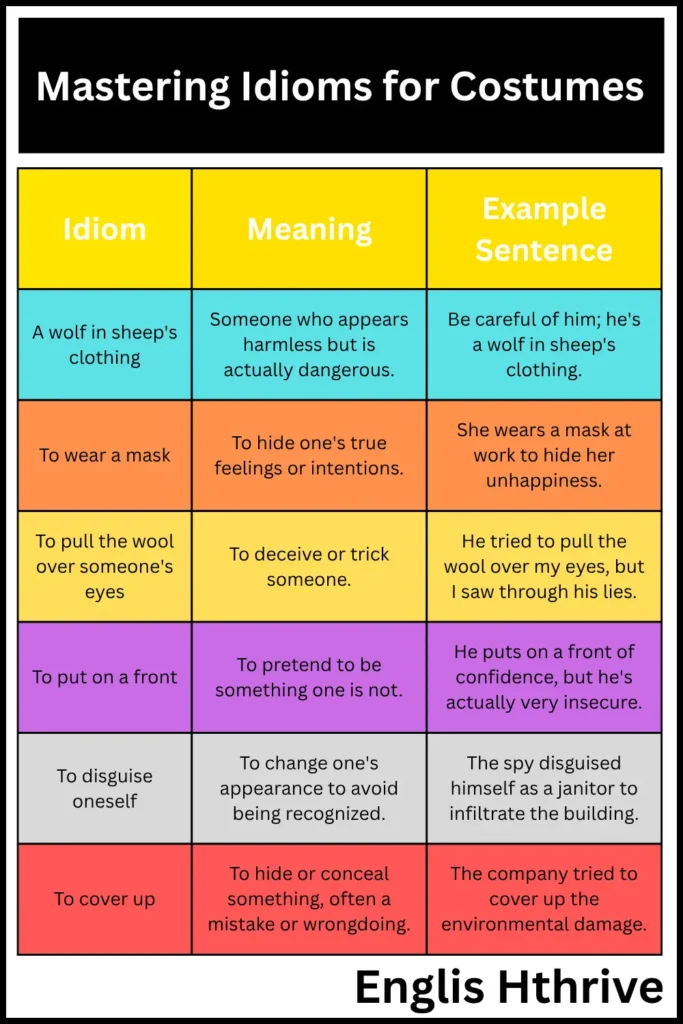
Table 2: Idioms Related to Appearance
The table below presents idioms that describe someone’s appearance, often with the intention of making a particular impression. These idioms can be used to describe both positive and negative aspects of someone’s appearance, depending on the context.
| Idiom | Meaning | Example Sentence |
|---|---|---|
| Dressed to the nines | Wearing very elegant or fashionable clothes. | She was dressed to the nines for the gala. |
| Dressed to kill | Wearing clothes intended to impress or attract attention. | He was dressed to kill for his date. |
| To scrub up well | To look attractive after making an effort to improve one’s appearance. | He scrubs up well for formal occasions. |
| To look like a million dollars | To look very attractive or wealthy. | She looked like a million dollars in her new dress. |
| To be a sight for sore eyes | To be a welcome or pleasant sight. | After a long journey, the hotel was a sight for sore eyes. |
| To stand out from the crowd | To be noticeably different or better than others. | Her unique style made her stand out from the crowd. |
| To blend in | To look or behave in a way that does not attract attention. | He tried to blend in with the locals to avoid suspicion. |
| To be a fashion victim | To be someone who slavishly follows fashion trends, often with unflattering results. | She’s a fashion victim; she wears whatever is trendy, regardless of whether it suits her. |
| To be the spitting image of | To look exactly like someone else, usually a relative. | She is the spitting image of her mother. |
| To be all dolled up | To be dressed in a fancy or elaborate way. | She was all dolled up for the party. |
| To be ragged | To be wearing old, torn, or worn-out clothes. | The homeless man was ragged and dirty. |
| To be well-groomed | To have a neat and tidy appearance. | He is always well-groomed and impeccably dressed. |
| To be scruffy | To be untidy and slightly dirty in appearance. | He looked scruffy in his old jeans and t-shirt. |
| To be dressed down | To be wearing informal or casual clothes. | She was dressed down for the casual Friday at work. |
| To be dressed up | To be wearing formal or elegant clothes. | They were dressed up for the wedding. |
| To have a certain look | To have a particular appearance that conveys a certain impression. | He has a certain look that makes people trust him immediately. |
| To make a splash | To attract a lot of attention with one’s appearance or behavior. | She made a splash at the event with her stunning dress. |
| To look the part | To have an appearance that is appropriate for a particular role or situation. | He looked the part of a successful businessman. |
| To cut a figure | To present a particular appearance or impression. | She cut a striking figure in her red dress. |
| To be a shadow of one’s former self | To be much weaker or less impressive than in the past. | After his illness, he was a shadow of his former self. |
| To be a diamond in the rough | To have hidden potential or qualities that are not immediately obvious. | He’s a diamond in the rough; he just needs the right opportunity. |
| To be a plain Jane | To be an ordinary or unattractive woman. | She considered herself a plain Jane until she discovered her talent for painting. |
| To be a knockout | To be extremely attractive or impressive. | She was a knockout in her evening gown. |
Table 3: Idioms Related to Role-Playing
The following table includes idioms that involve taking on a particular role or persona, either temporarily or permanently. These idioms can be used to describe both genuine and insincere behavior, depending on the context.
| Idiom | Meaning | Example Sentence |
|---|---|---|
| To play dress-up | To pretend to be someone else, often by wearing costumes. | The children love to play dress-up in their grandparents’ old clothes. |
| To put on an act | To pretend to be someone one is not. | He was just putting on an act to impress her. |
| To play a role | To perform a particular function or part in a situation. | She played a crucial role in the success of the project. |
| To step into someone’s shoes | To take over someone else’s job or responsibilities. | He stepped into his father’s shoes after he retired. |
| To be in character | To behave in a way that is consistent with a particular role or persona. | The actor remained in character even after the scene was over. |
| To break character | To stop behaving in a way that is consistent with a particular role or persona. | He broke character when he started laughing during the serious scene. |
| To play the fool | To behave in a silly or foolish way. | He was just playing the fool to make everyone laugh. |
| To play the hero | To act in a way that is intended to make one appear brave or noble. | He played the hero by rescuing the cat from the tree. |
| To play the victim | To act as if one is suffering or helpless, often to gain sympathy or attention. | She always plays the victim to get what she wants. |
| To be a drama queen | To be someone who exaggerates their emotions or reactions. | She’s such a drama queen; everything is always a crisis. |
| To be a showman | To be someone who is skilled at entertaining or attracting attention. | He’s a natural showman; he knows how to captivate an audience. |
| To be on stage | To be performing or behaving in a way that is intended to impress others. | He’s always on stage; he loves being the center of attention. |
| To be off stage | To be behaving in a natural or unpretentious way. | He’s much more relaxed when he’s off stage. |
| To be a natural | To be someone who is naturally talented or skilled at something. | She’s a natural actress; she doesn’t even have to try. |
| To be a fake | To be someone who is not genuine or sincere. | I think he’s a fake; he’s always trying to impress people. |
| To be a phony | To be someone who is not genuine or sincere. | She’s such a phony; she’s always pretending to be someone she’s not. |
| To be a pretender | To be someone who pretends to be something they are not. | He’s just a pretender; he doesn’t really know anything about art. |
| To be a poser | To be someone who pretends to be something they are not, often to impress others. | He’s such a poser; he only wears those clothes to look cool. |
| To be a wannabe | To be someone who wants to be like someone else, often in a superficial way. | She’s just a wannabe; she copies everything that celebrity does. |
| To be a chameleon | To be someone who adapts easily to different situations or environments. | He’s a chameleon; he can fit in anywhere. |
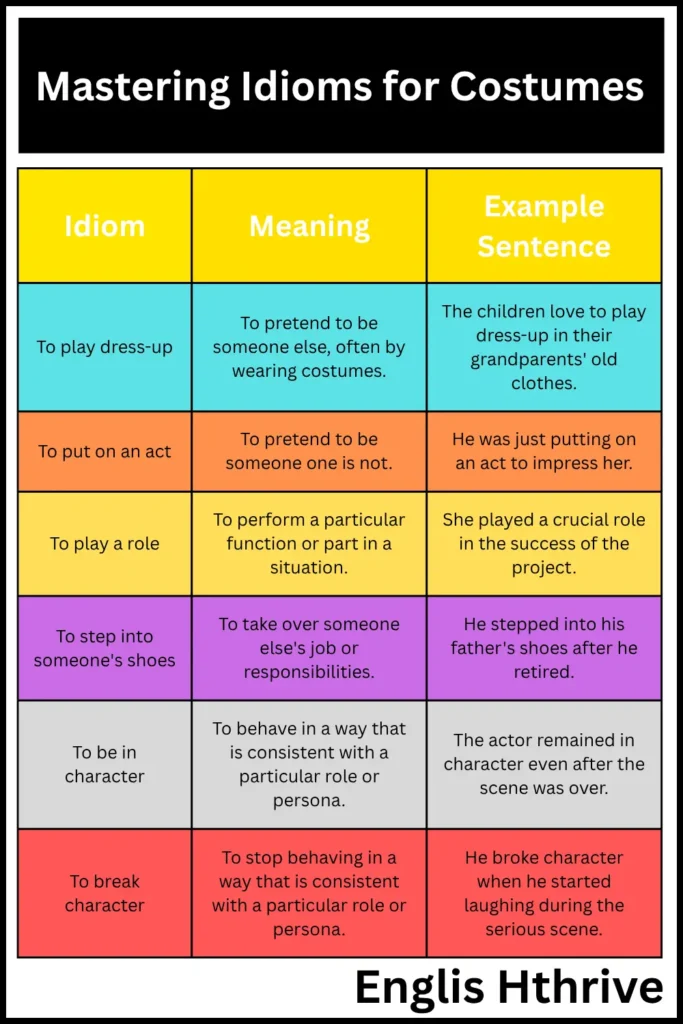
Table 4: Idioms Related to Conformity
This table presents idioms that relate to fitting in or standing out from a crowd, often in terms of appearance or behavior. These idioms can be used to describe both positive and negative aspects of conformity and individuality.
| Idiom | Meaning | Example Sentence |
|---|---|---|
| Cut from the same cloth | To be very similar in character or nature. | They’re cut from the same cloth; they both have a strong work ethic. |
| A fish out of water | Someone who is uncomfortable or out of place in a particular situation. | He felt like a fish out of water at the fancy party. |
| To go with the flow | To accept what is happening without resistance or complaint. | I just try to go with the flow and not worry too much. |
| To march to the beat of one’s own drum | To behave or act independently and unconventionally. | She’s always marched to the beat of her own drum; she doesn’t care what others think. |
| To be a square peg in a round hole | Someone who does not fit into a particular group or situation. | He felt like a square peg in a round hole at the conservative company. |
| To follow the crowd | To do what everyone else is doing, often without thinking critically. | He just follows the crowd; he never has his own opinion. |
| To be a conformist | Someone who follows accepted rules and standards. | She’s a conformist; she always does what is expected of her. |
| To be an individualist | Someone who is independent and self-reliant. | He’s an individualist; he likes to do things his own way. |
| To be a trendsetter | Someone who starts new trends or fashions. | She’s a trendsetter; everyone copies her style. |
| To be a follower | Someone who follows the ideas or actions of others. | He’s a follower; he never comes up with his own ideas. |
| To fit in | To be accepted by a group or community. | She tried hard to fit in at her new school. |
| To stand out | To be easily noticeable or different. | Her bright red hair made her stand out in the crowd. |
| To be one of the boys | To be accepted as an equal by a group of men. | She’s one of the boys; she can hold her own in any conversation. |
| To be an outsider | Someone who is not accepted by a group or community. | He always felt like an outsider in his hometown. |
| To be in the mainstream | To be part of the dominant culture or trend. | Her music is very mainstream; it appeals to a wide audience. |
| To be on the fringes | To be on the outer edges of a group or society. | His views are on the fringes of the political spectrum. |
| To swim against the tide | To go against the prevailing opinion or trend. | She always swims against the tide; she never agrees with the majority. |
| To go against the grain | To act or think in a way that is contrary to what is expected or normal. | He always goes against the grain; he likes to challenge the status quo. |
| To toe the line | To conform to a particular standard or expectation. | He always toes the line; he never breaks the rules. |
| To color inside the lines | To behave in a conventional or predictable way. | She always colors inside the lines; she’s very cautious and conservative. |
Usage Rules for Costume Idioms
Using costume idioms correctly requires understanding their specific meanings and contexts. Here are some general rules to follow:
- Context is Key: Always consider the context in which you are using the idiom. The same idiom can have different meanings depending on the situation.
- Audience Awareness: Be mindful of your audience. Some idioms may be unfamiliar to certain groups of people, especially non-native speakers.
- Figurative vs. Literal: Remember that idioms are figurative expressions, not literal statements. Avoid interpreting the individual words in an idiom literally.
- Grammatical Correctness: Ensure that the idiom is grammatically correct within the sentence. Pay attention to verb tenses, subject-verb agreement, and other grammatical rules.
- Overuse Avoidance: Avoid overuse of idioms, as this can make your writing or speech sound unnatural or forced. Use idioms sparingly and only when they enhance the message.
It’s also important to note that some idioms have variations in wording. For example, “pulling someone’s leg” and “to pull someone’s leg” are both acceptable variations of the same idiom.
However, it’s best to stick to the most common and widely recognized form of the idiom.
Common Mistakes with Idioms for Costumes
Using costume idioms incorrectly can lead to confusion or miscommunication. Here are some common mistakes to avoid:
- Literal Interpretation: Interpreting the idiom literally instead of understanding its figurative meaning.
- Incorrect Wording: Using the wrong words or changing the order of words in the idiom.
- Misunderstanding Context: Using the idiom in an inappropriate context.
- Overuse: Using too many idioms in a short period of time.
- Grammatical Errors: Making grammatical errors within the idiom or the surrounding sentence.
Here are some examples of common mistakes and how to correct them:
| Incorrect | Correct | Explanation |
|---|---|---|
| He is a sheep in wolf’s clothing. | He is a wolf in sheep’s clothing. | The correct idiom is “a wolf in sheep’s clothing,” not the other way around. |
| She wore her face. | She wore a mask. | The idiom is “to wear a mask,” which means to hide one’s true feelings or intentions. |
| He pulled the leg of me. | He pulled my leg. | The correct wording is “to pull someone’s leg,” not “to pull the leg of someone.” |
| She was dressed to nine. | She was dressed to the nines. | The correct idiom is “dressed to the nines,” which means wearing very elegant clothes. |
Practice Exercises: Idioms for Costumes
Test your understanding of costume idioms with these practice exercises. Each exercise includes multiple-choice questions designed to challenge your knowledge and improve your ability to recognize and use costume idioms correctly.
Exercise 1: Multiple Choice
Choose the correct meaning of the idiom in each sentence.
| Question | Options | Answer |
|---|---|---|
| He’s a wolf in sheep’s clothing. | a) He’s harmless. b) He’s dangerous but appears harmless. c) He’s a sheep. | b) He’s dangerous but appears harmless. |
| She wore a mask at the party. | a) She was wearing a costume. b) She was hiding her true feelings. c) She was feeling cold. | b) She was hiding her true feelings. |
| He tried to pull the wool over my eyes. | a) He tried to make me warm. b) He tried to deceive me. c) He tried to sell me wool. | b) He tried to deceive me. |
| She was dressed to the nines. | a) She was wearing casual clothes. b) She was wearing elegant clothes. c) She was wearing nine dresses. | b) She was wearing elegant clothes. |
| He felt like a fish out of water. | a) He felt comfortable. b) He felt out of place. c) He felt like swimming. | b) He felt out of place. |
| They’re cut from the same cloth. | a) They are wearing the same clothes. b) They are very similar in character. c) They are different. | b) They are very similar in character. |
| He’s always putting on an act. | a) He’s a good actor. b) He’s pretending to be someone he’s not. c) He’s performing on stage. | b) He’s pretending to be someone he’s not. |
| She stepped into her mother’s shoes. | a) She wore her mother’s shoes. b) She took over her mother’s responsibilities. c) She bought new shoes. | b) She took over her mother’s responsibilities. |
| He plays the fool to make people laugh. | a) He’s a professional comedian. b) He behaves in a silly way. c) He’s a wise man. | b) He behaves in a silly way. |
| She’s such a drama queen! | a) She’s a good actress. b) She exaggerates her emotions. c) She’s calm and collected. | b) She exaggerates her emotions. |
Exercise 2: Fill in the Blanks
Fill in the blanks with the correct idiom from the list below.
(pulling my leg, dressed to kill, a fish out of water, wearing a mask, cut from the same cloth, play dress-up, putting on an act, wolf in sheep’s clothing, stepped into his shoes, going with the flow)
| Question | Answer |
|---|---|
| He’s just ___________; he’s not really that confident. | putting on an act |
| She was ___________ for her date tonight. | dressed to kill |
| Are you serious, or are you ___________? | pulling my leg |
| He felt like ___________ at the formal dinner. | a fish out of water |
| They are ___________; they both love to read. | cut from the same cloth |
| The children love to ___________ with their grandparents’ old clothes. | play dress-up |
| He is a ___________, pretending to be friendly but secretly plotting against us. | wolf in sheep’s clothing |
| She’s ___________ because she doesn’t want anyone to know she’s sad. | wearing a mask |
| He ___________ when his father retired. | stepped into his shoes |
| I’m just ___________ and accepting whatever happens. | going with the flow |
Advanced Topics in Idioms for Costumes
For advanced learners, exploring the historical and cultural origins Idioms for Costumes can provide a deeper understanding of their meanings and usage. Many costume idioms have roots in literature, folklore, and historical events, reflecting the social and cultural values of their time.
For example, the idiom “a wolf in sheep’s clothing” originates from Aesop’s Fables, which are ancient Greek stories that teach moral lessons. The fable tells the story of a wolf who disguises himself as a sheep to deceive and attack the flock.
This idiom reflects the timeless theme of deception and the importance of being wary of appearances.
Another advanced topic is the use of costume idioms in literature and film. Authors and filmmakers often use Idioms Costumes to add depth and complexity to their characters and stories.
By understanding the nuances of these idioms, you can gain a greater appreciation for the artistic choices made by writers and directors.
FAQs on Idioms for Costumes and Disguises
Here are some frequently asked questions about costume idioms:
What is the difference between an idiom and a literal expression?
An idiom is a phrase or expression whose meaning cannot be understood from the literal meanings of its individual words. A literal expression, on the other hand, means exactly what it says.
Why are idioms important to learn?
Idioms are an integral part of the English language, and understanding them is essential for effective communication. They add color and depth to your language skills and help you to understand native speakers more easily.
How can I improve my understanding of idioms?
To improve your understanding of idioms, read widely, listen to native speakers, and pay attention to the context in which idioms are used. Practice using idioms in your own writing and speaking.
Are idioms the same in all English-speaking countries?
No, idioms can vary between different English-speaking countries and regions. Some idioms may be more common in one country than another.
Can I create my own idioms?
While it is possible to create new idioms, they may not be widely understood or accepted. It is best to focus on learning and using established idioms correctly.
How do I know when to use an idiom?
Use idioms when they enhance your message and make it more engaging or expressive. Avoid using idioms if you are unsure of their meaning or if they are inappropriate for the context.
Is it okay to use idioms in formal writing?
While idioms can add color to your writing, it’s generally best to avoid them in highly formal or academic writing, as they can be seen as too informal.
What should I do if I don’t understand an idiom?
If you don’t understand an idiom, look it up in a dictionary or ask a native speaker for clarification. Pay attention to the context in which the idiom isused.
Conclusion: Idioms for Costumes and Disguises
Mastering idioms related to costumes and disguises can significantly enhance your understanding and use of the English language. By learning the definitions, structures, and usage rules of these idioms, you can communicate more effectively and expressively.
Practice using these idioms in your everyday conversations and writing to improve your fluency and confidence. Remember to consider the context, audience, and cultural nuances when using idioms to ensure that your message is clear and appropriate.
With continued practice and attention to detail, you can confidently incorporate costume idioms into your language skills and enrich your communication.