

Appositives are an important part of English grammar that make our sentences more informative and engaging. They help us add extra details about a noun or pronoun without starting a new sentence.
For example, in the sentence My sister, an excellent pianist, plays every evening, the phrase an excellent pianist gives more information about my sister.
There are two main types of appositives — restrictive and nonrestrictive. Knowing the difference between them helps you write clearly and use punctuation correctly.
In this guide, we’ll explain what each type means, when to use commas, and how they can make your writing sound more natural and professional.
Whether you’re an English learner or a student improving your writing, this lesson on restrictive and nonrestrictive appositives will make grammar easier to understand and apply
What Are Appositives?
Before diving into the differences between restrictive and nonrestrictive appositives, let’s first define what an appositive is. An appositive is a noun or noun phrase that renames or gives additional information about a noun or pronoun in the sentence. It provides extra context, helping to clarify or expand upon what the noun represents.
For example:
-
My sister, an excellent pianist, plays every evening.
-
In this sentence, “an excellent pianist” is an appositive providing additional information about “my sister.”
-
Now that we know what appositives are, let’s break down the two main types: restrictive and nonrestrictive.
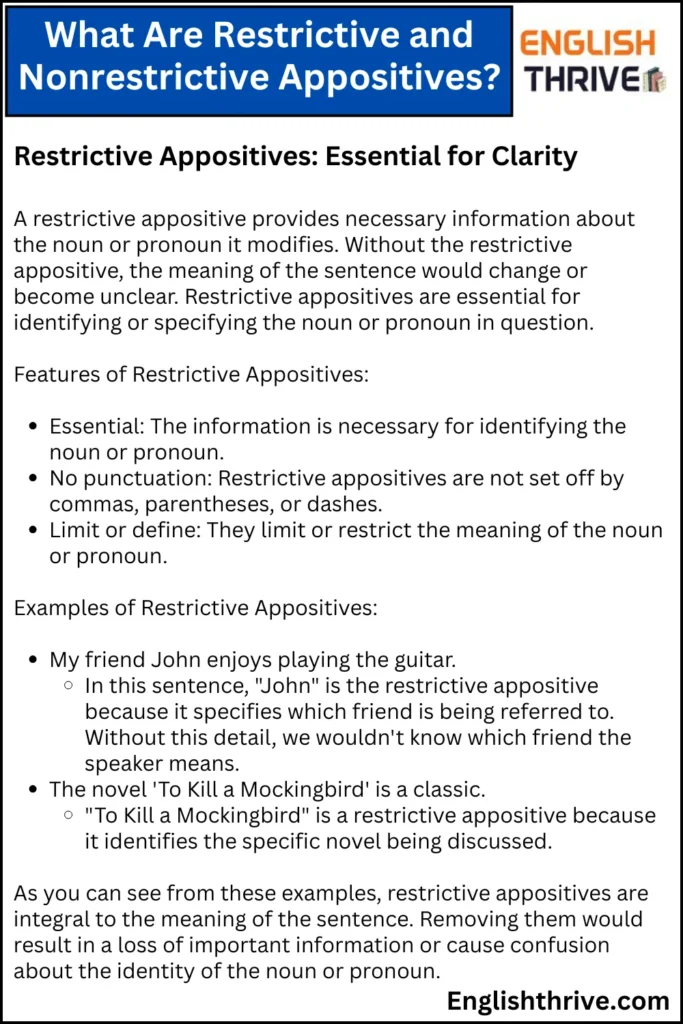
Restrictive Appositives: Essential for Clarity
A restrictive appositive provides necessary information about the noun or pronoun it modifies. Without the restrictive appositive, the meaning of the sentence would change or become unclear. Restrictive appositives are essential for identifying or specifying the noun or pronoun in question.
Features of Restrictive Appositives:
-
Essential: The information is necessary for identifying the noun or pronoun.
-
No punctuation: Restrictive appositives are not set off by commas, parentheses, or dashes.
-
Limit or define: They limit or restrict the meaning of the noun or pronoun.
Examples of Restrictive Appositives:
-
My friend John enjoys playing the guitar.
-
In this sentence, “John” is the restrictive appositive because it specifies which friend is being referred to. Without this detail, we wouldn’t know which friend the speaker means.
-
-
The novel ‘To Kill a Mockingbird’ is a classic.
-
“To Kill a Mockingbird” is a restrictive appositive because it identifies the specific novel being discussed.
-
As you can see from these examples, restrictive appositives are integral to the meaning of the sentence. Removing them would result in a loss of important information or cause confusion about the identity of the noun or pronoun.
Why Punctuation Is Important:
Since restrictive appositives are necessary to the sentence’s meaning, they are not separated by commas. The lack of commas signals that this information is a vital part of the sentence, so removing it would change the meaning.
Nonrestrictive Appositives: Extra Detail, Not Essential
Nonrestrictive appositives, on the other hand, provide additional information but are not essential for understanding the sentence. This extra detail enhances the meaning of the noun or pronoun but does not alter its basic identity.
Features of Nonrestrictive Appositives:
-
Non-essential: They add extra information but are not crucial for identifying the noun or pronoun.
-
Punctuation: Nonrestrictive appositives are set off by commas, parentheses, or dashes.
-
Add descriptive detail: They provide extra information that enhances understanding but can be removed without changing the core meaning of the sentence.
Examples of Nonrestrictive Appositives:
-
My brother, an avid reader, loves spending time in the library.
-
“An avid reader” is a nonrestrictive appositive because it adds extra detail about “my brother,” but it isn’t essential to identify him. We still know who the brother is without this information.
-
-
Paris, the capital of France, is a popular tourist destination.
-
“The capital of France” is a nonrestrictive appositive. It gives extra information about “Paris,” but the main point—that Paris is a tourist destination—is still clear without it.
-
Punctuation for Nonrestrictive Appositives:
Because nonrestrictive appositives are extra details, they are set off by punctuation, usually commas. The punctuation helps to signal that the information is supplementary and not necessary for the sentence’s meaning. This allows the reader to understand that the sentence would still make sense without the appositive.
Differences Between Restrictive and Nonrestrictive Appositives
To help you clearly distinguish between the two types of appositives, let’s summarize their differences in the following table:
| Feature | Restrictive Appositive | Nonrestrictive Appositive |
|---|---|---|
| Essentiality | Provides essential information about the noun. | Adds non-essential information or extra detail. |
| Punctuation | No punctuation (no commas, dashes, or parentheses). | Set off by commas, parentheses, or dashes. |
| Function | Limits or restricts the noun it modifies. | Adds descriptive details but doesn’t limit the noun. |
| Example | “My friend John enjoys playing the guitar.” | “My brother, an avid reader, loves spending time in the library.” |
Understanding these distinctions will help you use restrictive and nonrestrictive appositives correctly in your writing, ensuring your sentences are both clear and precise.
Why Knowing the Difference Matters
Understanding when to use a restrictive or nonrestrictive appositive is crucial for effective writing. Misusing appositives can lead to confusion and reduce the clarity of your message. Here’s why getting it right matters:
-
Clarity: Using the correct punctuation (or lack thereof) helps convey whether the information is essential to understanding the sentence or just extra detail.
-
Flow: Nonrestrictive appositives often add richness to the sentence, providing extra context without overwhelming the reader. On the other hand, restrictive appositives ensure that you clearly specify the noun or pronoun being referred to.
-
Precision: By using restrictive appositives when necessary and nonrestrictive ones for extra details, you create more precise and well-organized sentences that maintain your reader’s focus.
Examples of Restrictive Appositives
Restrictive appositives often appear in situations where identifying the noun or pronoun is crucial. Let’s take a look at more examples:
-
The book “1984” is a dystopian masterpiece.
-
Here, “1984” is the restrictive appositive because it identifies the specific book being referenced. Without it, the sentence would lose its meaning.
-
-
The lawyer Susan Williams won the case.
-
“Susan Williams” is restrictive because it identifies which lawyer is being referred to. The sentence wouldn’t make sense without this detail.
-
Examples of Nonrestrictive Appositives
Now, let’s look at more examples where the appositive provides additional detail, but its removal won’t affect the sentence’s main meaning:
-
David, my childhood friend, just moved to California.
-
“My childhood friend” adds detail about “David,” but the sentence still makes sense without it. It’s nonrestrictive and set off by commas.
-
-
Einstein, a brilliant physicist, developed the theory of relativity.
-
“A brilliant physicist” is nonrestrictive, offering extra information about Einstein but not altering the fundamental meaning of the sentence.
-
Common Mistakes with Restrictive and Nonrestrictive Appositives
Even though restrictive and nonrestrictive appositives might seem straightforward, writers often make some common mistakes. Let’s explore these pitfalls and how to avoid them:
1. Misplacing Punctuation for Nonrestrictive Appositives
One of the most common mistakes is using punctuation incorrectly with nonrestrictive appositives. Nonrestrictive appositives must be set off with commas, parentheses, or dashes. Without the correct punctuation, your sentence can become confusing.
-
Incorrect: My sister an avid traveler enjoys hiking.
-
This sentence lacks commas around the appositive, making it hard to read. The correct version should be: My sister, an avid traveler, enjoys hiking.
-
-
Correct: My sister, an avid traveler, enjoys hiking.
-
Here, the commas help to separate the appositive “an avid traveler” from the main part of the sentence.
-
2. Using a Nonrestrictive Appositive When a Restrictive One Is Needed
Sometimes writers use nonrestrictive appositives when they should be using restrictive ones. This usually happens when the information provided is crucial for identifying the noun.
-
Incorrect: The actress, Emma Watson, is an advocate for women’s rights.
-
Here, “Emma Watson” is not extra information; it’s crucial for identifying which actress is being referred to. It should be a restrictive appositive.
-
-
Correct: The actress Emma Watson is an advocate for women’s rights.
-
In this case, “Emma Watson” is a restrictive appositive because it specifically identifies which actress is being discussed.
-
3. Forgetting to Use Commas with Nonrestrictive Appositives
Another common mistake is forgetting to use commas with nonrestrictive appositives, which can lead to ambiguity. Commas are essential to show that the appositive is nonessential.
-
Incorrect: Paris the capital of France is a popular tourist destination.
-
This sentence needs commas around “the capital of France” to indicate that it’s additional information about Paris.
-
-
Correct: Paris, the capital of France, is a popular tourist destination.
-
The commas here make it clear that “the capital of France” is an extra detail about Paris and not essential to the meaning of the sentence.
-
FAQs on Restrictive and Nonrestrictive Appositives
What is a restrictive appositive?
A restrictive appositive gives essential information about a noun. It identifies or limits which person or thing we are talking about. Example: My friend John is coming over.
What is a nonrestrictive appositive?
A nonrestrictive appositive adds extra information that isn’t necessary to identify the noun. It’s separated by commas. Example: My friend, John, is coming over.
How do I know when to use commas with appositives?
Use commas with nonrestrictive appositives, but not with restrictive appositives. Commas show the extra detail is not essential to the sentence’s meaning.
Why are restrictive and nonrestrictive appositives important?
They help make your writing clear and precise. Knowing the difference ensures your readers understand whether the information is essential or just additional detail.
Can I use dashes or parentheses instead of commas?
Yes. Dashes or parentheses can replace commas in nonrestrictive appositives for emphasis or stylistic reasons. Example: Paris—the capital of France—is beautiful in spring.
Consolation on Restrictive and Nonrestrictive Appositives
Understanding restrictive and nonrestrictive appositives is a simple way to make your writing clearer and more expressive. Restrictive appositives give essential details that identify a noun, while nonrestrictive appositives add helpful extra information. Using them correctly not only improves sentence structure but also shows confidence in your writing skills.
Practice spotting and using appositives in your own sentences, and soon you’ll write with more accuracy and style. If you’d like to keep learning, explore more grammar lessons on EnglishThrive.com — your guide to mastering English, one simple rule at a time