

Have you ever pictured a kangaroo bounding across the plains or a komodo dragon prowling its island, wondering what else hides under the letter K? Animals Starting With K sprinkle the planet with surprises, from dusty outbacks to chilly oceans, each with a tale to tell. I’ve trekked through forests and flipped through field guides for years, captivated by K-creatures like koalas and kingfishers and their knack for standing out.
We’ll dive into a lineup of mammals, birds, reptiles, and more, uncovering adaptations that’ll stick with you—whether you’re a student, a nature nut, or just curious. Ready to explore this K-packed wild ride with me? Let’s get hopping!
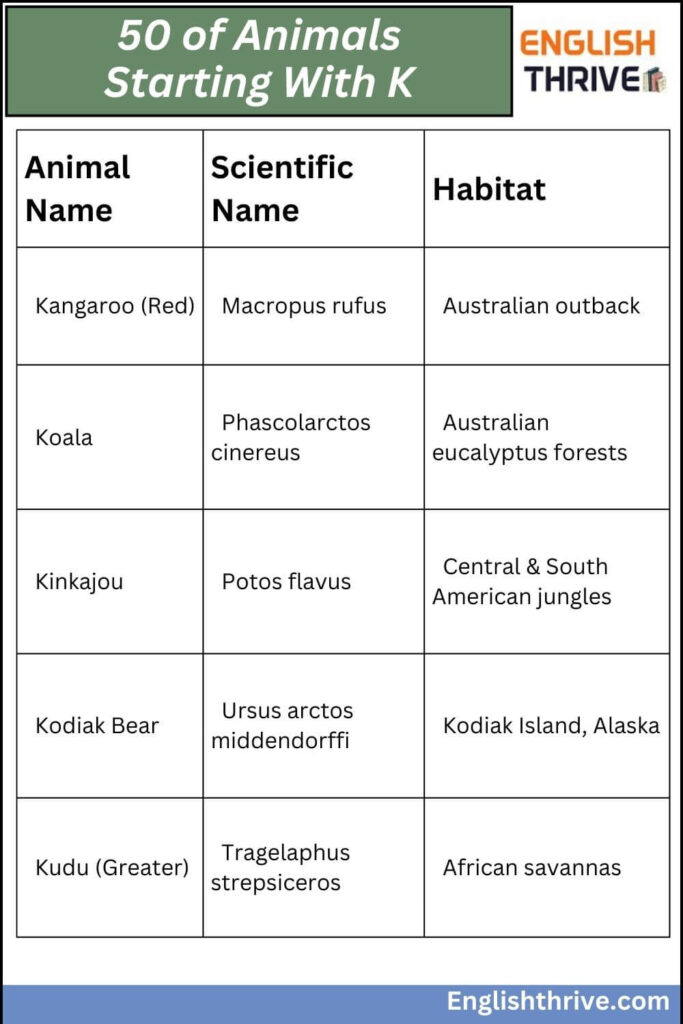
50 of Animals Starting With K
| Animal Name | Scientific Name | Type | Habitat | Conservation Status | Fascinating Fact |
|---|---|---|---|---|---|
| Kangaroo (Red) | Macropus rufus | Mammal | Australian outback | Least Concern | Hops up to 35 mph, pouch keeps joeys safe for months. |
| Koala | Phascolarctos cinereus | Mammal | Australian eucalyptus forests | Vulnerable | Sleeps 20 hours a day; eucalyptus is its only food. |
| Kinkajou | Potos flavus | Mammal | Central & South American jungles | Least Concern | Tail acts like a fifth hand for tree climbing. |
| Kodiak Bear | Ursus arctos middendorffi | Mammal | Kodiak Island, Alaska | Least Concern | The biggest brown bear subspecies weighs up to 1,500 pounds. |
| Kudu (Greater) | Tragelaphus strepsiceros | Mammal | African savannas | Least Concern | Spiral horns stretch over 5 feet in males. |
| Kakapo | Strigops habroptila | Bird | New Zealand forests | Critically Endangered | Flightless parrot smells prey with a super snout. |
| Kingfisher (Belted) | Megaceryle alcyon | Bird | North American rivers | Least Concern | Dives headfirst to snatch fish with pinpoint aim. |
| Kiwi (Brown) | Apteryx australis | Bird | New Zealand forests | Vulnerable | Lays an egg a third of its body weight. |
| Kestrel (American) | Falco sparverius | Bird | Americas, open fields | Least Concern | Hovers mid-air to spot tiny prey below. |
| Kookaburra | Dacelo novaeguineae | Bird | Australian woodlands | Least Concern | The laughing call echoes like a jungle chorus. |
| Komodo Dragon | Varanus komodoensis | Reptile | Indonesian islands | Vulnerable | A venomous bite can take down a buffalo. |
| King Cobra | Ophiophagus hannah | Reptile | Southeast Asian forests | Vulnerable | Longest venomous snake, hood flares when mad. |
| Krait (Common) | Bungarus caeruleus | Reptile | South Asian fields, forests | Least Concern | Bites while you sleep; venom stops breathing. |
| Kingsnake (Eastern) | Lampropeltis getula | Reptile | Eastern North America | Least Concern | Squeezes prey, immune to other snakes’ venom. |
| Knobbed Hornbill | Rhyticeros cassidix | Bird | Indonesian rainforests | Vulnerable | Helmet-like casque amplifies its calls. |
| Koi | Cyprinus rubrofuscus | Fish | Ponds worldwide (domestic) | Not Evaluated | Lives up to 70 years, bred for stunning colors. |
| Krill (Antarctic) | Euphausia superba | Crustacean | Southern Ocean | Least Concern | Tiny size, but billions feed whales and seals. |
| Katydid | Tettigoniidae (family) | Insect | Forests, grasslands worldwide | Varies by species | Wings mimic leaves to fool predators. |
| Kangaroo Rat | Dipodomys deserti | Mammal | North American deserts | Least Concern | Jumps 9 feet to escape, needs no water. |
| Kea | Nestor notabilis | Bird | New Zealand mountains | Endangered | Smartest parrot loves to prank hikers. |
| Kob | Kobus kob | Mammal | African grasslands | Least Concern | Leaps in groups to confuse lions. |
| Kanchil (Lesser Mouse-deer) | Tragulus kanchil | Mammal | Southeast Asian forests | Least Concern | Tiny deer fits in your hand and hides in bushes. |
| Kit Fox | Vulpes macrotis | Mammal | North American deserts | Least Concern | Big ears cool it down in scorching heat. |
| Kakariki | Cyanoramphus novaezelandiae | Bird | New Zealand forests | Vulnerable | Bright green feathers, chatty forest dweller. |
| Kipunji | Rungwecebus kipunji | Mammal | Tanzanian highlands | Critically Endangered | Monkey with a mohawk, discovered in 2003. |
| Kelp Gull | Larus dominicanus | Bird | Southern Hemisphere coasts | Least Concern | Drops clam on rocks to crack them open. |
| Kissing Gourami | Helostoma temminckii | Fish | Southeast Asian rivers | Least Concern | “Kisses” to test rivals, not to flirt. |
| Kestrel (Common) | Falco tinnunculus | Bird | Europe, Africa, Asia | Least Concern | Wind-hovers like a kite to hunt mice. |
| Kapok Bug | Pyrrhocoris apterus | Insect | Europe, on kapok trees | Least Concern | Red body warns birds it tastes bad. |
| Killifish (Bluefin) | Lucania goodei | Fish | North American freshwaters | Least Concern | Survives dry spells in muddy puddles. |
| Kagu | Rhynochetos jubatus | Bird | New Caledonia forests | Endangered | Ghostly gray, barks like a dog to claim turf. |
| Knifefish (Clown) | Chitala ornata | Fish | Southeast Asian rivers | Not Evaluated | Swims backward with a wavy fin. |
| Kerodon (Rock Cavy) | Kerodon rupestris | Mammal | Brazilian rocky hills | Least Concern | Climbs rocks like a mini mountain goat. |
| Karoo Prinia | Prinia maculosa | Bird | South African scrublands | Least Concern | Tail flicks like a metronome when it sings. |
| Kite (Black) | Milvus migrans | Bird | Worldwide skies | Least Concern | Soars with a forked tail and scavenges smartly. |
| Kiang | Equus kiang | Mammal | Tibetan Plateau | Least Concern | Wild ass gallops across high altitudes. |
| Kobold Frog | Pristimantis attenboroughi | Amphibian | Andean cloud forests | Data Deficient | Named after David Attenborough, tiny as a dime. |
| Klipspringer | Oreotragus oreotragus | Mammal | African rocky hills | Least Concern | Jumps 25 feet straight up on tiptoes. |
| King Eider | Somateria spectabilis | Bird | Arctic coasts | Least Concern | Dives deep for clams in icy waters. |
| Knot (Red) | Calidris canutus | Bird | Arctic tundra migrates globally | Near Threatened | Flies 9,000 miles nonstop during migration. |
| Kori Bustard | Ardeotis kori | Bird | African savannas | Near Threatened | Heaviest flying birdwalks more than it flies. |
| Kulan | Equus hemionus kulan | Mammal | Central Asian steppes | Endangered | Speedy wild donkey, loves open plains. |
| Kuhli Loach | Pangio kuhlii | Fish | Southeast Asian streams | Least Concern | Slithers like an eeel andglows under blacklight. |
| Key Deer | Odocoileus virginianus clavium | Mammal | Florida Keys | Endangered | Tideerer, swims between islands. |
| Kodkod | Leopardus guigna | Mammal | Chilean, Argentine forests | Vulnerable | SThe smallestwild catthe Americas is acas, tree ninja. |
| Kaka | Nestor meridionalis | Bird | New Zealand forests | Endangeredparrot | parrot, cracks nuts with a curved beak. |
| Kelpie (Australian) | Canis lupus dingo (hybrid) | Mammal | Australian farms (domestic) | Not Evaluated | Herds sheep with a stare, tireless worker. |
| Killdeer | Charadrius vociferus | Bird | North American fields | Least Concern | Fakes a broken wing to trick predators. |
| Kinglet (Ruby-crowned) | Regulus calendula | Bird | North American forests | Least Concern | Tiny bird,birdhes a red crown when excited. |
| Knobby Newt | Tylototriton verrucosus | Amphibian | Southeast Asian hills | Least Concern | Warty skin hides it in muddy streams. |
FAQs About Animals Starting With K
What’s the strongest animal that starts with K?
I’d put my money on the komodo dragon. I watched one in a documentary once—those Indonesian giants don’t mess around. They grow up to 10 feet and 300 pounds, with a bite that’s venomous enough to take down a buffalo in days. Their jagged teeth tear through anything, and they’re patient hunters, stalking like something out of a prehistoric movie.
Sure, a kangaroo’s got a mean kick, but the komodo’s raw power and stealth make it the muscle champ of animals that start with k. It’s like nature built a tank with scales—tough, gritty, and ruling its island turf without breaking a sweat.
How do koalas survive on just eucalyptus leaves?
Koalas are picky eaters, and I love that about them. I saw one at a sanctuary, lazily chewing eucalyptus like it was gourmet stuff—it’s all they eat! Those leaves are low on nutrients and tough to digest, but koalas have a long gut that breaks them down slow, squeezing out every bit of energy. They sleep 20 hours a day to save fuel, too—talk about a chill lifestyle. Eucalyptus is toxic to most, but their livers handle it like champs. It’s a perfect fit for their Australian tree homes, showing how animals that start with k can turn a weird diet into a winning survival trick.
Why is the kakapo so rare?
The kakapo’s story tugs at my heart. These flightless parrots—only about 200 left in New Zealand—are like hidden treasures I’ve read about. They ditched wings for climbing and sniffing out food, which worked great until cats and rats crashed their forest party. I heard about Sirocco, a famous one who charmed the world—imagine a honey-scented bird waddling up trees at night! Now, every kakapo’s tracked to protect them, but their rarity hits hard. Among animals that start with k, they’re the fragile gems, fighting to hang on, and it’s a race to keep their quirky legacy alive.
What makes kingfishers such great hunters?
Kingfishers are like river ninjas—I’ve seen one dive so fast it was a blue blur. Their trick is that sharp beak and eagle-eye aim—they spot fish from a perch, then plunge headfirst, nailing it every time. The belted kind in North America even hovers before striking, like a tiny helicopter. I love how they turn quiet streams into their hunting grounds, perfectly built for the job. Animals that start with k don’t get flashier than this—kingfishers mix speed, precision, and a splash of color, making them the rockstars of riverside life. It’s pure skill, honed over ages.
Are there endangered Animals Starting With K?
Oh yeah, a few K-crew members are in tough spots. The kakapo’s critically endangered—less than 200 left, battling invaders in New Zealand. Then there’s the kipunji, a mohawked monkey from Tanzania, discovered in 2003 and already on the brink with maybe 1,000 left.
The key deer’s another—I read they’re down to a few hundred, swimming between Florida Keys. Animals that start with k like these show how fragile nature can be. I get chills thinking about losing them, but conservation’s giving them a shot—proof we can still step up for the underdogs in this wild alphabet.
Wrapping Up the K-Adventure
What a trek through the K-wilds, right? Animals Starting With K have this knack for grabbing you—whether it’s a kangaroo’s bounce, a koala’s lazy charm, or a komodo dragon’s raw grit. I’ve spilled my love for these critters, from that first koala I met as a kid to the kingfishers I’ve watched dive like champs, because they’re more than just a list—they’re nature’s rebels and dreamers.
They show us how to adapt, like the kiwi sniffing out life without wings, or fight on, like the kakapo clinging to hope. So, what’s next for you? Share a K-fact with a friend, spot one in the wild, or just marvel at their weird, wonderful ways—let’s keep their stories hopping!