

Have you ever wondered why we say “cats” but “sheep” stays the same whether there’s one or many? Understanding singular and plural rules is a must for anyone looking to improve their English grammar. These rules form the foundation of clear communication.
In this article, we’ll dive into Rules for Using Singular and Plural Nouns, explain them in simple terms, and provide plenty of examples to help you master the topic. Ready to get started? Let’s go!
Understanding Singular and Plural Nouns
Nouns are words that name people, places, things, or ideas. They can exist in two forms:
- Singular nouns: Refer to one item (e.g., book, dog, city).
- Plural nouns: Refer to more than one item (e.g., books, dogs, cities).
The difference between singular and plural nouns might seem straightforward, but English has its fair share of exceptions. Let’s break down the essential rules.

Rule 1: Add -s to Most Nouns
The simplest way to form a plural noun is to add -s to the end of the word.
| Singular | Plural |
|---|---|
| car | cars |
| table | tables |
| apple | apples |
Rule 2: Add -es for Nouns Ending in Specific Sounds
If a noun ends in -ch, -sh, -s, -x, or -z, add -es to form the plural.
| Singular | Plural |
| box | boxes |
| brush | brushes |
| church | churches |
Rule 3: Change -y to -ies for Nouns Ending in a Consonant + Y
When a noun ends in -y preceded by a consonant, change -y to -ies.
| Singular | Plural |
| baby | babies |
| city | cities |
| berry | berries |
If the -y is preceded by a vowel, simply add -s.
| Singular | Plural |
| boy | boys |
| key | keys |
| day | days |
Rule 4: Irregular Plurals
Some nouns form their plurals in irregular ways. These don’t follow standard rules and must be memorized.
| Singular | Plural |
| child | children |
| man | men |
| woman | women |
| mouse | mice |
| tooth | teeth |
Rule 5: Nouns That Stay the Same
Certain nouns don’t change in their plural form.
| Singular | Plural |
| sheep | sheep |
| fish | fish |
| deer | deer |
Rule 6: Foreign-Origin Nouns
Many English nouns borrowed from other languages follow their original pluralization rules.
| Singular | Plural |
| cactus | cacti |
| criterion | criteria |
| phenomenon | phenomena |
Rule 7: Compound Nouns
In compound nouns, pluralize the primary word.
| Singular | Plural |
| mother-in-law | mothers-in-law |
| passerby | passersby |
Rule 8: Some Nouns Are Always Plural
These nouns are used only in plural form and often refer to items with two parts.
Examples:
- Scissors
- Trousers
- Glasses
FAQs About Singular and Plural Rules
1. What are 20 examples of plural nouns and singular nouns?
Here’s a table to illustrate:
| Singular | Plural |
| dog | dogs |
| cat | cats |
| hero | heroes |
| loaf | loaves |
| tooth | teeth |
| child | children |
| goose | geese |
| city | cities |
| foot | feet |
| mouse | mice |
| woman | women |
| man | men |
| sheep | sheep |
| fish | fish |
| deer | deer |
| cactus | cacti |
| box | boxes |
| watch | watches |
| cherry | cherries |
| baby | babies |
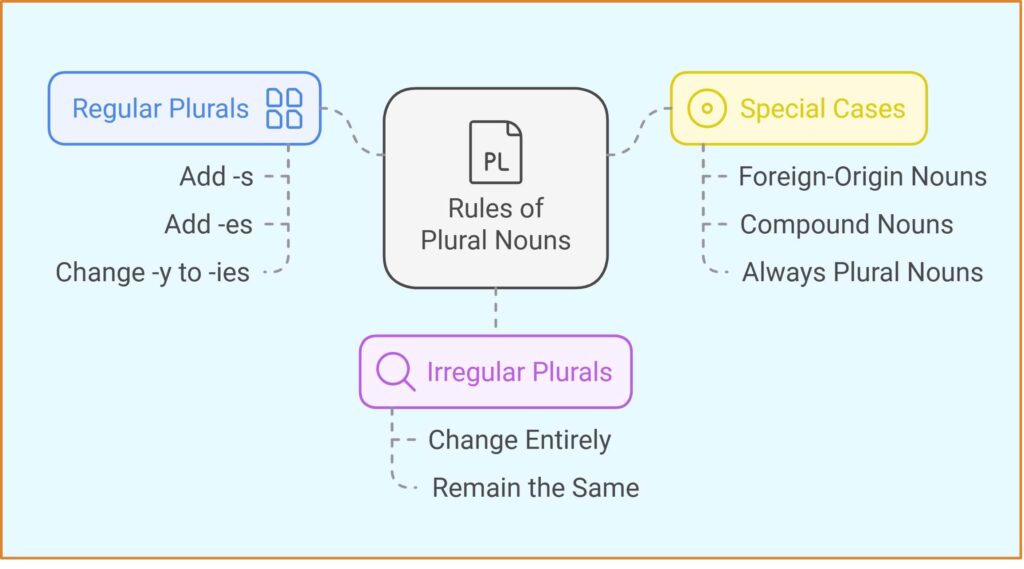
2. What are the 8 rules of plural nouns?
The eight rules of plural nouns are:
- Add -s to most nouns.
- Add -es to nouns ending in -ch, -sh, -s, -x, or -z.
- Change -y to -ies if preceded by a consonant.
- Irregular nouns change entirely (e.g., man → men).
- Some nouns remain the same (e.g., sheep, fish).
- Foreign-origin nouns follow specific rules (e.g., criterion → criteria).
- For compound nouns, pluralize the main word (e.g., mother-in-law → mothers-in-law).
- Certain nouns are always plural (e.g., scissors, trousers).
3. What is the rule of singular and plural?
The general rule is to add -s for plurals, but you must also account for exceptions such as irregular forms and foreign-origin nouns.
4. How to use singular and plural nouns in sentences?
- Singular: “The dog is barking.”
- Plural: “The dogs are barking.”
5. Are there nouns without plural forms?
Yes, some uncountable nouns like water, information, and rice don’t have plural forms. Use quantifiers like “a glass of water” or “a piece of information.”
6. What are the common mistakes with singular and plural nouns?
- Using “sheeps” instead of “sheep.”
- Forgetting to change “man” to “men.”
- Adding “-s” to uncountable nouns like “furnitures.”
Conclusion
Mastering singular and plural rules is easier than you think with a little practice. From regular forms to irregular exceptions, these rules are key to writing and speaking fluently. Bookmark this guide, and don’t hesitate to refer back whenever you’re in doubt. Keep practicing, and soon these rules will be second nature!