

What Is the Present Perfect Tense?
The present perfect tense connects something that happened in the past with the present. We use it when the exact past time is not important, but the experience, action, or result still matters now.
It is formed with have/has + past participle (V3).
Examples:
- I have lost my keys. (I still don’t have them.)
- She has finished her homework. (Her homework is complete now.)
- We have visited Paris twice. (This is part of our life experience.)
The key idea is simple: the action happened before now, but there is a reason to connect it to now.
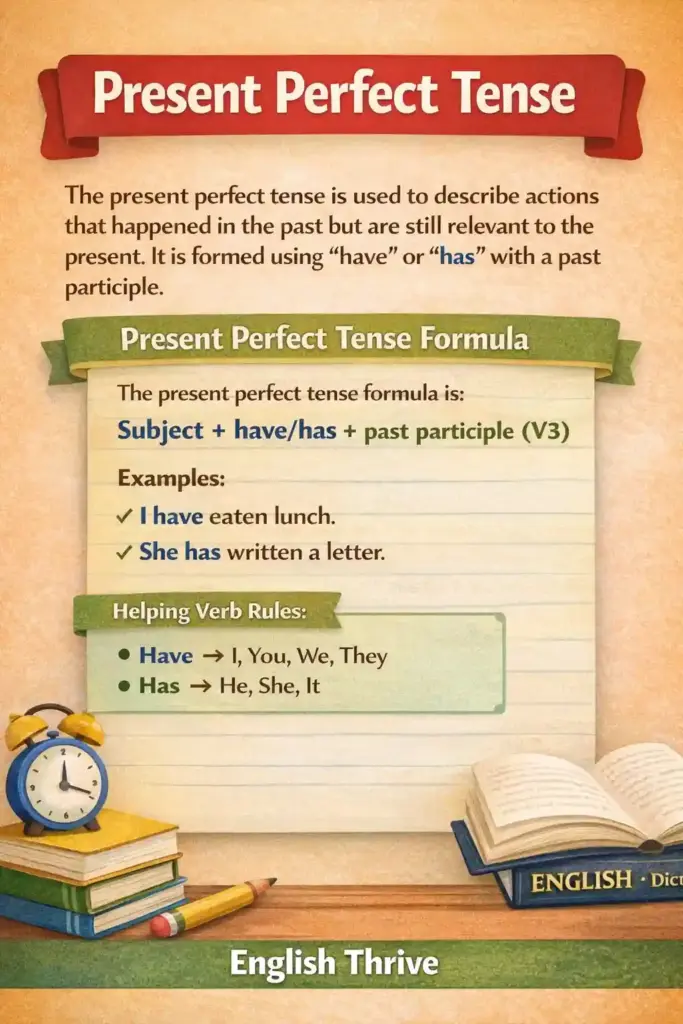
Present Perfect Tense Formula
The present perfect tense formula is:
Subject + have/has + past participle (V3)
Examples:
- I have eaten lunch.
- She has written a letter.
Helping Verb Rules
- Have → I, You, We, They
- Has → He, She, It
When Do We Use the Present Perfect Tense?
We use the present perfect tense to talk about life experiences, recent actions, changes over time, and completed actions with present results.
1. To Talk About Life Experiences
We use it for things someone has done in life without saying when.
Examples:
- I have visited Japan.
- She has never flown in a plane.
- Have you ever eaten sushi?
Common words: ever, never, before
2. To Describe Recent Actions
Used for actions that happened recently and are still important now.
Examples:
- She has just arrived.
- I have already eaten lunch.
- Have they finished yet?
Common words: just, already, yet
3. To Show Change Over Time
Used to show progress or change.
Examples:
- You have improved a lot.
- They have grown so much.
- Technology has changed our lives.
4. Completed Actions With Present Results
The action is finished, but the result affects now.
Examples:
- I have lost my keys.
- She has broken her phone.
Present Perfect Tense Examples (Basic Sentences)
- I have finished my homework.
- She has called her friend.
- They have visited us twice.
- He has eaten all the cookies.
- We have cleaned the room.
- You have seen that movie before.
- The baby has fallen asleep.
- My parents have gone to the market.
- She has written a letter.
- I have lost my keys again.
Present Perfect Tense Examples – Positive Sentences
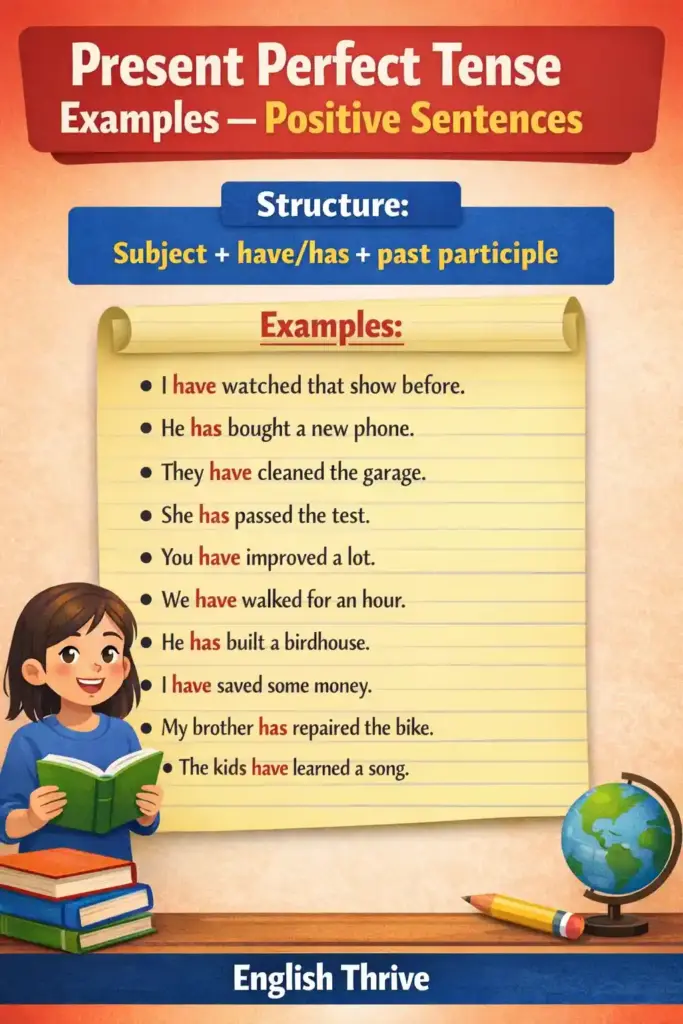
Positive sentences show that something has happened.
Structure:
Subject + have/has + past participle
Examples:
- I have watched that show before.
- He has bought a new phone.
- They have cleaned the garage.
- She has passed the test.
- You have improved a lot.
- We have walked for an hour.
- He has built a birdhouse.
- I have saved some money.
- My brother has repaired the bike.
- The kids have learned a song.
Present Perfect Tense Examples – Negative Sentences
Negative present perfect sentences are formed using:
Subject + have/has + not + past participle
Example:
I haven’t finished my work yet.
Examples:
- I haven’t seen her today.
- He hasn’t eaten anything yet.
- We haven’t finished our project.
- They haven’t gone to the zoo.
- She hasn’t replied to my text.
- The bus hasn’t arrived yet.
- I haven’t heard that song.
- You haven’t washed the dishes.
- He hasn’t fixed his laptop.
- We haven’t received the package.
Present Perfect Tense Examples—Interrogative Sentences
Present perfect questions are formed using:
Have/Has + subject + past participle?
Example:
Have you eaten lunch?
Examples:
- Have you seen my book?
- Has she called yet?
- Have they finished the game?
- Has he left already?
- Have we met before?
- Has your sister arrived?
- Have I missed anything?
- Has Tom gone home?
- Have the kids cleaned up?
- Has the movie started?
Present Perfect Tense With Already, Just, and Yet
These words are commonly used with the present perfect tense.
- Already → sooner than expected
- Just → very recently
- Yet → questions and negatives
Examples:
- I’ve already eaten lunch.
- She has just arrived at school.
- Have they finished yet?
- He’s already done his homework.
- We’ve just seen the news.
- I’ve just cleaned the kitchen.
- They’ve already left the house.
- Has she returned yet?
Present Perfect Tense Examples for Life Experiences
- I have visited Paris once.
- She has never flown in a plane.
- Have you ever eaten sushi?
- We have lived in three countries.
- He has tried scuba diving.
- I have met a famous singer.
- They have won a trophy.
- She has written a poem.
Present Perfect Tense Examples Showing Recent Actions
- I have just eaten breakfast.
- She has called me.
- We have lost the game.
- He has left the building.
- They have reached the station.
- I have dropped my pen.
- The dog has run away.
- She has fallen asleep.
Have vs Has in Present Perfect With Examples
Rules:
- Have → I, You, We, They
- Has → He, She, It
Examples:
- I have finished the book.
- She has cleaned the windows.
- They have made a cake.
- He has sent the email.
- It has started to rain.
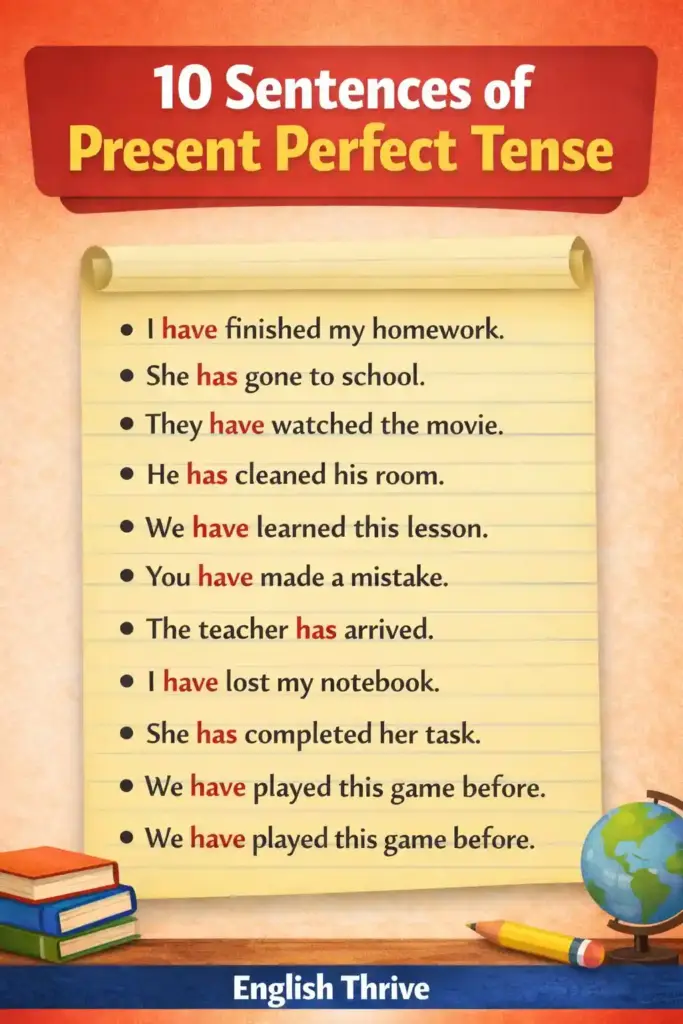
10 Sentences of Present Perfect Tense
- I have finished my homework.
- She has gone to school.
- They have watched the movie.
- He has cleaned his room.
- We have learned this lesson.
- You have made a mistake.
- The teacher has arrived.
- I have lost my notebook.
- She has completed her task.
- We have played this game before.
Present Perfect Tense Examples for Class 3 and Class 4
- I have eaten my lunch.
- She has opened the door.
- They have finished the work.
- He has washed his hands.
- We have cleaned the board.
- Mom has cooked food.
- Dad has gone to work.
- The children have played outside.
Common Present Perfect Tense Mistakes
The present perfect can be confusing when choosing between have/has, the past participle, and the simple past. Here are four common mistakes to avoid.
1. Using Present Perfect With a Finished Past Time
Wrong: I have seen her yesterday.
Correct: I saw her yesterday.
Why? Yesterday refers to a specific, finished time in the past. We normally use the simple past, not the present perfect, with finished past-time expressions.
2. Using “Have” Instead of “Has”
Wrong: She have finished her homework.
Correct: She has finished her homework.
Why? Use has with he, she, and it. Use have with I, you, we, and they.
3. Using the Past Form Instead of the Past Participle
Wrong: He has went home.
Correct: He has gone home.
Why? After have or has, use the past participle (V3). For go, the forms are go → went → gone, so gone is required here.
4. Using Simple Past With “Since”
Wrong: We lived here since 2020.
Correct: We have lived here since 2020.
Why? When a situation started in the past and continues to the present, we can use the present perfect with since. Here, since 2020 tells us when the continuing situation began.
Present Perfect vs Simple Past
The present perfect and simple past both describe past actions, but we use them differently. The main difference is whether the past action is still connected to the present.
| Present Perfect | Simple Past |
|---|---|
| Connects a past action to the present | Describes a finished action in the past |
| Exact past time is usually not mentioned | Often tells us when the action happened |
| Often focuses on experience or a result now | Focuses on a completed past event |
Compare these examples:
- I have lost my keys.
I still cannot find them now. - I lost my keys yesterday.
Yesterday tells us exactly when it happened. - She has visited Paris twice.
This describes her life experience up to now. - She visited Paris in 2024.
This refers to a specific finished time in the past.
Quick Tip: If you mention a finished past time such as yesterday, last week, two years ago, or in 2020, use the simple past rather than the present perfect.
Present Perfect Tense Practice
Choose the correct answer.
- She ___ her homework already.
a) finished
b) has finished
c) have finished - I ___ that movie three times.
a) have seen
b) saw
c) has seen - He ___ to London last year.
a) has gone
b) went
c) have gone - They ___ the project yet.
a) haven’t finished
b) didn’t finished
c) hasn’t finished - ___ you ever eaten sushi?
a) Did
b) Has
c) Have
Answers
- b) has finished — Use has + V3 with she.
- a) have seen — No finished past time is given, and this describes an experience up to now.
- b) went — Last year is a finished past time, so use the simple past.
- a) haven’t finished — Use have not + V3 with they.
- c) Have — Use Have you ever + V3 to ask about life experience.
FAQs About Present Perfect Tense Examples
1. When should I use the present perfect tense?
Use the present perfect tense when a past action has a connection to the present. This includes life experiences, recent events, changes over time, and completed actions with a result that matters now.
Example: I have lost my keys.
The action happened in the past, but the problem still matters now.
2. Can we use “yesterday” with the present perfect tense?
Usually, no. Words such as yesterday, last night, last year, and two days ago refer to a finished past time, so we normally use the simple past.
Wrong: I have seen her yesterday.
Correct: I saw her yesterday.
But when the time period is still continuing, the present perfect can be used:
Example: I have answered five emails today.
3. What is the difference between “have” and “has” in the present perfect?
Use have with I, you, we, and they. Use has with he, she, and it.
- I have finished my work.
- They have arrived.
- She has finished her work.
- He has arrived.
Conclusion
The present perfect becomes easier when you stop thinking only about the formula and focus on the meaning. Ask yourself: Did something happen in the past that still matters now? If the answer is yes, the present perfect may be the tense you need.
Use the present perfect tense examples in this guide to practice experiences, recent events, and present results. Pay special attention to have/has + past participle, and compare your sentences with the simple past when a finished time such as yesterday or last week is mentioned.