

Looking for clear, real-life complete sentence examples to help you understand grammar better? You’re in the right place! Whether you’re a student, teacher, ESL learner, or just someone wanting to sharpen their writing skills, seeing full sentences in everyday situations makes all the difference. In this post, we’ve organized a variety of practical examples by category—like school, work, emotions, and more—so you can see how grammar works naturally. These aren’t just random phrases; they reflect how we actually speak and write. Understanding sentence structure through relatable examples builds confidence and fluency. Ready to level up your language skills? Let’s dive into these complete, correct, and super useful sentences you can learn from and use every day.
Quick answer: A complete sentence has a subject (who or what), a verb (the action or state) and expresses a complete thought. It starts with a capital letter and ends with a full stop, question mark or exclamation mark. Example: She made pancakes for breakfast.
Complete Sentence Formula
| Part | Question it answers | Example |
|---|---|---|
| Subject | Who or what is the sentence about? | My brother plays football. |
| Verb | What does the subject do or be? | My brother plays football. |
| Complete thought | Does it make sense on its own? | My brother plays football every Friday. |
Complete Sentence vs Sentence Fragment
| Fragment (incomplete) | What is missing | Complete sentence |
|---|---|---|
| Running to the bus. | Subject and helping verb | I was running to the bus. |
| Because I was tired. | Complete thought | I went to bed early because I was tired. |
| The girl in the red dress. | Verb | The girl in the red dress sang a song. |
| After the movie ended. | Main clause | We had dinner after the movie ended. |

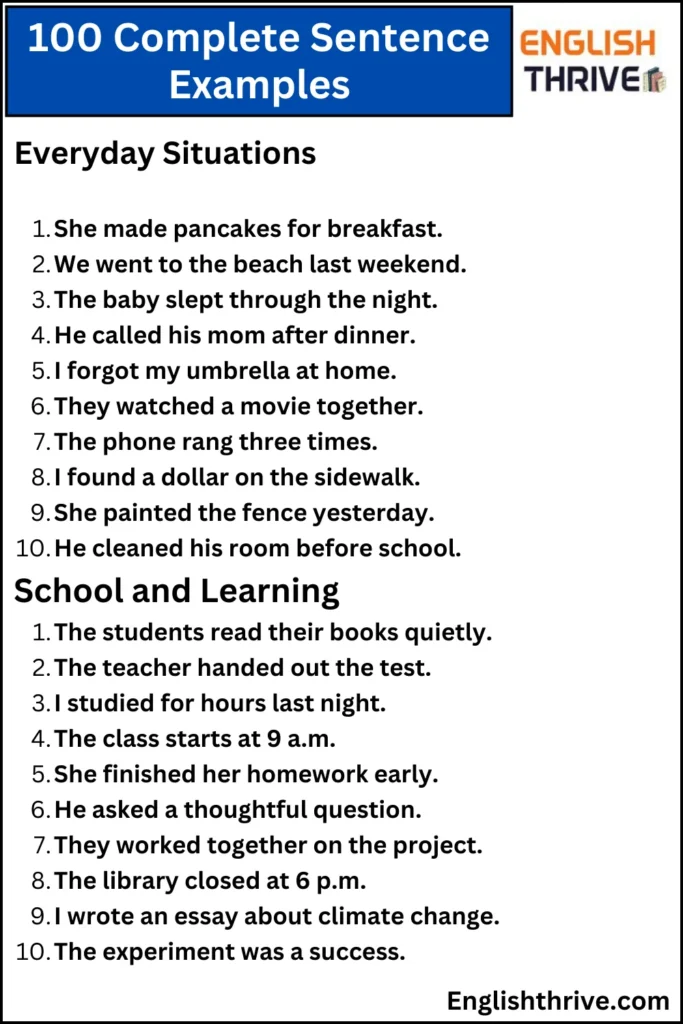
Below are 100 complete sentence examples grouped by topic. Each one has a subject, a verb and a complete thought.
100 Complete Sentence Examples
Everyday Situations
-
She made pancakes for breakfast.
-
We went to the beach last weekend.
-
The baby slept through the night.
-
He called his mom after dinner.
-
I forgot my umbrella at home.
-
They watched a movie together.
-
The phone rang three times.
-
I found a dollar on the sidewalk.
-
She painted the fence yesterday.
-
He cleaned his room before school.
School and Learning
-
The students read their books quietly.
-
The teacher handed out the test.
-
I studied for hours last night.
-
The class starts at 9 a.m.
-
She finished her homework early.
-
He asked a thoughtful question.
-
They worked together on the project.
-
The library closed at 6 p.m.
-
I wrote an essay about climate change.
-
The experiment was a success.
Work and Business
-
He submitted the report on time.
-
The meeting starts at 10 a.m.
-
She emailed the client this morning.
-
We launched the new product yesterday.
-
They reviewed the proposal together.
-
The CEO made an announcement.
-
He organized the files alphabetically.
-
I updated the company website.
-
We celebrated hitting our sales goals.
-
The printer ran out of ink.
Travel and Places
-
We flew to Chicago last summer.
-
She visited her grandparents in Florida.
-
They explored the ancient ruins.
-
I booked a hotel near the airport.
-
The plane landed ahead of schedule.
-
He took the train to Boston.
-
We stayed at a beautiful cabin.
-
The car broke down on the highway.
-
I saw the Eiffel Tower in person.
-
She hiked through the forest trail.
Emotions and Thoughts
-
I felt nervous before the interview.
-
He was excited to start his job.
-
She missed her friends deeply.
-
They worried about the storm.
-
He hoped for a better outcome.
-
I wondered what would happen next.
-
She dreamed about traveling the world.
-
He regretted his decision.
-
They felt proud of their achievements.
-
I believed everything would be okay.
Nature and Weather
-
The sun set behind the hills.
-
It rained all day yesterday.
-
The wind howled through the trees.
-
Snow covered the streets.
-
The leaves turned red in fall.
-
I saw lightning in the distance.
-
The flowers bloomed in spring.
-
The clouds moved quickly across the sky.
-
Birds chirped in the early morning.
-
The river flowed gently.
Family and Friends
-
My sister baked cookies for us.
-
We played board games all night.
-
He helped his grandma carry groceries.
-
She called me after the show.
-
I told my brother a funny story.
-
They invited us over for dinner.
-
We walked the dog together.
-
My parents took us camping.
-
She taught her niece how to read.
-
He played catch with his son.
Food and Drink
-
I made spaghetti for dinner.
-
She poured a cup of coffee.
-
He added salt to the soup.
-
We ordered takeout from the new place.
-
The cake tasted delicious.
-
They picked apples from the orchard.
-
She sipped her tea slowly.
-
I packed a lunch for school.
-
He grilled burgers on the patio.
-
The kids ate all the cookies.
Hobbies and Activities
-
She knits scarves in her free time.
-
He played the guitar beautifully.
-
I started reading a new novel.
-
We went biking around the lake.
-
They practiced yoga together.
-
He painted a stunning landscape.
-
She danced to her favorite song.
-
I wrote a poem about summer.
-
We sang around the campfire.
-
He fixed his old radio.
Random Everyday Sentences
-
The lights turned off suddenly.
-
I tripped on the rug.
-
She laughed at the joke.
-
He caught the last bus home.
-
The baby clapped her hands.
-
We cleaned the garage on Saturday.
-
They played in the backyard.
-
I listened to music all afternoon.
-
She waved from across the street.
-
The dog barked at the mailman.
Conclusion On Complete sentence Examples
Now that you’ve gone through these complete sentence examples, you can see how everyday language works in real situations. Whether you’re a student learning grammar, a teacher creating lessons, or just brushing up your writing skills, these examples offer clear, practical support. Real-world sentences help build stronger communication and a better understanding of structure. From emotions to travel to daily tasks, these examples are great for practice or inspiration. Bookmark this page, revisit it when you need a quick grammar boost, and feel free to share it with others who want to improve their writing. Good writing starts with strong sentences—and now you’ve got plenty to work with. Keep learning, keep writing, and keep growing!
Practice: Complete or Fragment?
Decide whether each line is a complete sentence or a fragment. Answers are below.
- The children played in the park.
- When the rain stopped.
- Opened the window.
- My mother cooks rice every day.
- Because the shop was closed.
- We waited.
Answers: 1. Complete. 2. Fragment (no main clause; add “we went outside”). 3. Fragment (no subject; add “She”). 4. Complete. 5. Fragment (add “We went home because the shop was closed”). 6. Complete: a sentence can be short if it has a subject and a verb.
FAQs About Complete Sentences
What are the 3 parts of a complete sentence?
A subject, a verb (predicate) and a complete thought.
Can a complete sentence be two words?
Yes. “She smiled.” and “Birds fly.” are complete sentences because each has a subject and a verb and makes sense alone.
Is “Go home.” a complete sentence?
Yes. In commands, the subject you is understood: “(You) go home.”
What is the difference between a complete sentence and a fragment?
A fragment is missing a subject, a verb or a complete thought. See more in our 100 sentence fragment examples.