

Have you ever read a sentence and wondered how we know how, when, or where something happens? That’s where adverbs quietly do their job. They may look small, but they add life, detail, and clarity to our sentences.
In this guide, we’ll answer the question “What does ‘adverb’ mean in grammar?” explain how adverbs work, explore their types, and walk through clear examples so you can use them confidently in writing and speaking.
What Is an Adverb?
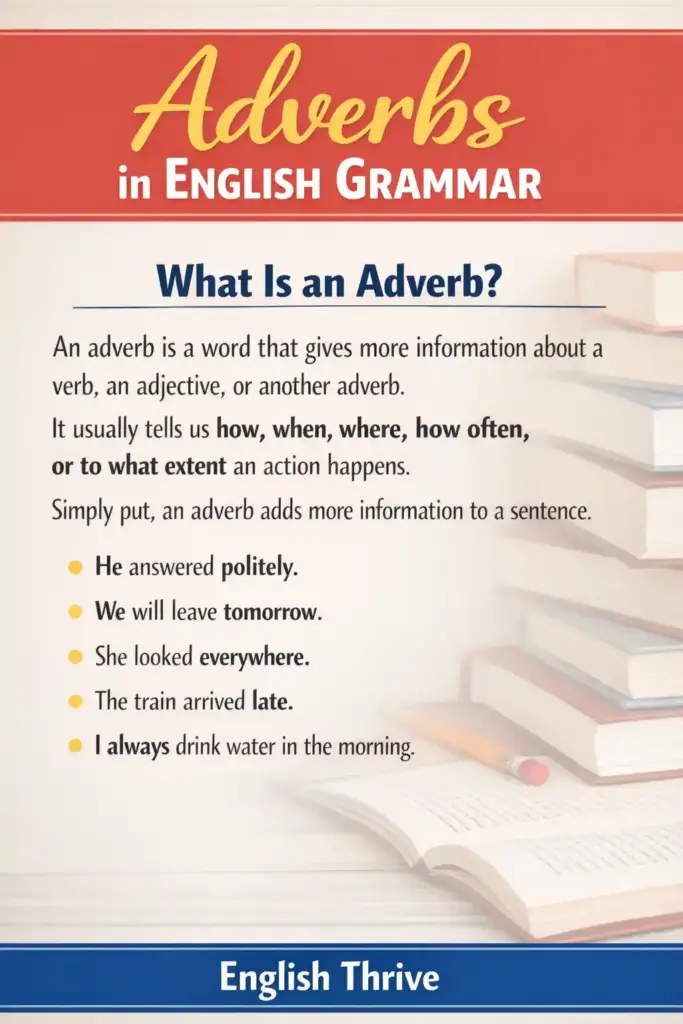
An adverb is a word that gives more information about a verb, an adjective, or another adverb. It usually tells us how, when, where, how often, or to what extent an action happens. Simply put, an adverb adds more information to a sentence.
Adverb Meaning in Simple Words
In simple words, an adverb explains more about the action or description in a sentence.
Look at this example:
- She runs quickly.
The word “quickly” tells us how she runs. That’s the adverb doing its job.
What Does an Adverb Do?
Adverbs are flexible. They don’t just describe actions. They can also describe descriptions themselves.
How Adverbs Modify Verbs
This is the most common role of an adverb.
- He speaks clearly.
- The baby slept peacefully.
Here, the adverbs explain how the actions happen.
How Adverbs Modify Adjectives
Adverbs can also describe adjectives by showing degree or intensity.
- She is very happy.
- The movie was extremely interesting.
The words “very” and “extremely” tell us how much.
How Adverbs Modify Other Adverbs
Yes, adverbs can even modify other adverbs.
- She runs very fast.
- He finished quite quickly.
In these cases, the first adverb strengthens or weakens the second one.
Adverb Examples
Seeing examples makes grammar much easier to understand.
Simple Adverb Examples in Sentences
Here are a few clear adverb examples:
- He answered politely.
- We will leave tomorrow.
- She looked everywhere.
- The train arrived late.
- I always drink water in the morning.
Each adverb adds useful detail to the sentence.
Common Adverbs Used in Daily English
These adverb words appear in everyday conversations and writing:
| Adverb | Use |
|---|---|
| always | frequency |
| quickly | manner |
| here | place |
| now | time |
| very | degree |
Types of Adverbs in English Grammar
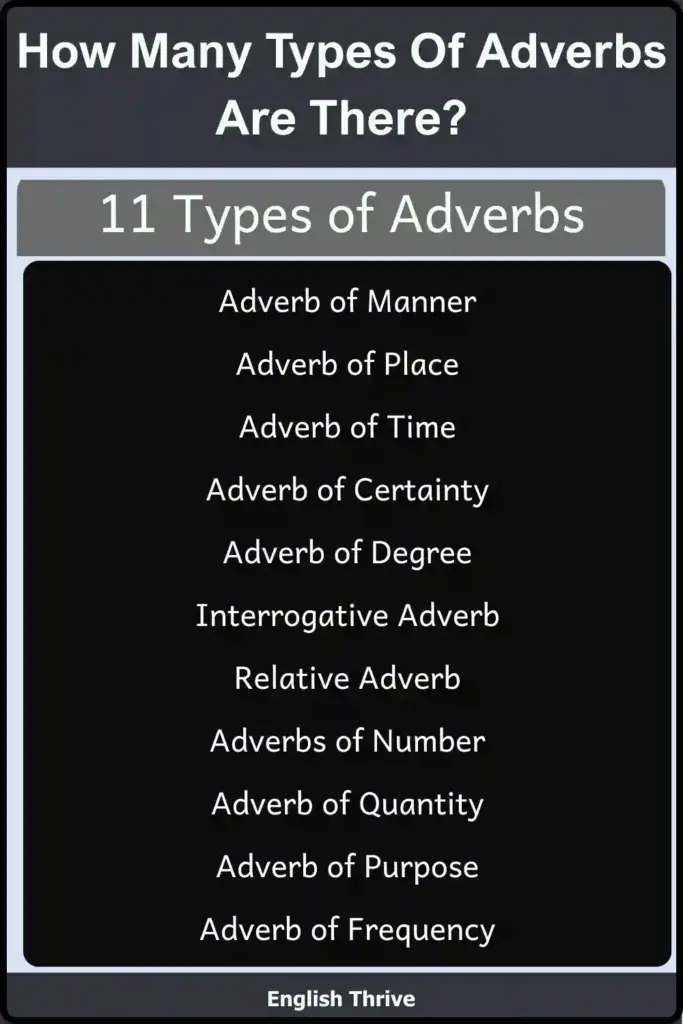
Adverbs are grouped into different types based on the kind of information they give. Learning these types makes it much easier to understand what an adverb means in grammar and how adverbs function in real sentences.
Below are the major types of adverbs, explained one by one with lists and examples.
Adverb of Manner
Definition
An adverb of time shows the moment or period when an action takes place. It answers the question How?
Adverb of Manner List
- quickly
- slowly
- carefully
- loudly
- softly
- neatly
- politely
- angrily
- happily
- silently
Example Sentences
- She spoke politely to the guests.
- He finished the work quickly.
- The child slept peacefully.
- She closed the door quietly.
- He drove carefully on the road.
Adverb of Place
Definition
An adverb of place shows where an action happens. It answers the question Where?
Adverb of Place List
- here
- there
- outside
- inside
- upstairs
- downstairs
- everywhere
- nowhere
- nearby
- abroad
Example Sentences
- Please sit here.
- The children are playing outside.
- He looked everywhere for his keys.
- She went abroad last year.
- The dog is waiting inside.
Adverb of Time
Definition
An adverb of time tells us when an action happens. It answers the question When?
Adverb of Time List
- today
- yesterday
- tomorrow
- now
- then
- soon
- late
- early
- already
- recently
Example Sentences
- I will call you tomorrow.
- She arrived early.
- He is leaving now.
- We met yesterday.
- They have already finished.
Adverb of Certainty
Definition
An adverb of certainty shows how sure or confident we are about an action or statement.
Adverb of Certainty List
- definitely
- certainly
- probably
- surely
- maybe
- perhaps
- clearly
- obviously
- undoubtedly
- possibly
Example Sentences
- She will definitely attend the meeting.
- He is probably at home.
- This is clearly a mistake.
- She will surely succeed.
- They are perhaps late.
Adverb of Degree
Definition
An adverb of degree tells us how much or to what extent something happens.
Adverb of Degree List
- very
- too
- quite
- extremely
- almost
- enough
- hardly
- completely
- totally
- nearly
Example Sentences
- She is very happy today.
- The water is too hot.
- He was almost late.
- I am quite tired.
- The room is completely clean.
Interrogative Adverb
Definition
An interrogative adverb is used to ask questions. It appears at the beginning of a question.
Interrogative Adverb List
- when
- where
- why
- how
- how long
- how often
- how far
- how much
- how many
- how soon
Example Sentences
- When are you leaving?
- Where do you live?
- Why are you upset?
- How did you solve this?
- How often do you exercise?
Relative Adverb
Definition
A relative adverb connects a clause to a noun and gives more information about time, place, or reason.
Relative Adverb List
- when
- where
- why
- whenever
- wherever
- wherein
- whereby
- whereupon
- whence
- wherein
Example Sentences
- This is the day when we met.
- That is the place where I grew up.
- I know the reason why he left.
- She remembers the moment when it happened.
- This is the house where she lives.
Adverbs of Number
Definition
An adverb of number tells us how many times or in what order something happens.
Adverbs of Number List
- once
- twice
- thrice
- again
- first
- second
- third
- often
- repeatedly
- lastly
Example Sentences
- I have visited this place twice.
- He called me again.
- She tried once more.
- This happened first last year.
- He checked the answer again.
Adverb of Quantity
Definition
An adverb of quantity shows how much of something is involved.
Adverb of Quantity List
- much
- little
- enough
- all
- none
- more
- less
- plenty
- sufficient
- entire
Example Sentences
- She eats little sugar.
- There is enough food.
- He drank too much coffee.
- They spent less money.
- She used all her energy.
Adverb of Purpose
Definition
An adverb of purpose explains why an action is done.
Adverb of Purpose List
- therefore
- hence
- thus
- so
- accordingly
- consequently
- in order
- purposely
- intentionally
- deliberately
Example Sentences
- He was tired; therefore, he rested.
- She studied hard, so she passed.
- It was raining; thus, we stayed home.
- He spoke softly intentionally.
- The road was closed; hence, we stopped.
Adverb of Frequency
Definition
An adverb of frequency tells us how often an action happens.
Adverb of Frequency List
- always
- usually
- often
- sometimes
- rarely
- never
- frequently
- occasionally
- regularly
- seldom
Example Sentences
- I always wake up early.
- She often reads books.
- He never lies.
- They sometimes eat out.
- We rarely travel in winter.
Adverb Phrase
An adverb is not always a single word. Sometimes, a group of words works together as an adverb.
What Is an Adverb Phrase?
An adverb phrase is a group of words that acts like an adverb. It gives more information about a verb, adjective, or another adverb.
It often answers questions like how, when, where, or why.
Adverb Phrase Examples
- She spoke in a very calm voice.
- He completed the task with great care.
- We met early in the morning.
- She waited for a long time.
- He ran as fast as possible.
In each sentence, the highlighted words function as one adverb unit.
Adverb Clause
Now let’s look at a slightly more advanced structure.
What Is an Adverb Clause?
An adverb clause is a group of words with a subject and a verb that functions as an adverb. It usually begins with words like when, because, if, although, or while.
Adverb Clause Examples
- I stayed inside because it was raining.
- She smiled when she saw the gift.
- He will call you after he finishes work.
- We canceled the trip although the weather improved.
- She studies hard so that she can succeed.
Difference Between Adverb Phrase and Adverb Clause
| Adverb Phrase | Adverb Clause |
|---|---|
| No subject and verb | Has subject and verb |
| Shorter structure | Longer structure |
| Acts as a single unit | Acts as a dependent clause |
Conjunctive Adverb
You may also see adverbs that connect ideas.
What Is a Conjunctive Adverb?
A conjunctive adverb connects two independent clauses and shows a relationship like contrast, result, or addition.
Common Conjunctive Adverbs List
- however
- therefore
- moreover
- otherwise
- consequently
- meanwhile
- nevertheless
- instead
- likewise
- similarly
Conjunctive Adverb Examples in Sentences
- He was tired; however, he continued working.
- The road was blocked; therefore, we turned back.
- She loves music; moreover, she plays the piano.
- It was raining; nevertheless, they went out.
- I was busy; meanwhile, she waited patiently.
Adverb vs Adjective
Many learners confuse adverbs and adjectives.
Difference Between Adjective and Adverb
| Adjective | Adverb |
|---|---|
| Describes a noun | Describes a verb adjective or adverb |
| Answers what kind | Answers how when where |
| Example: happy | Example: happily |
Adjective vs Adverb Examples
- She is a careful driver. (adjective)
- She drives carefully. (adverb)
- He gave a quick reply.
- He replied quickly.
Common Mistakes Between Adjectives and Adverbs
- ❌ He runs quick
- ✅ He runs quickly
- ❌ She sings beautiful
- ✅ She sings beautifully
How to Identify an Adverb in a Sentence
Finding adverbs becomes easy with a few tricks.
Position of Adverbs
Adverbs can appear:
- before the verb
- after the verb
- at the beginning or end of a sentence
Example:
- She often reads books.
- He finished quickly.
Question Words Adverbs Answer
Ask these questions:
- How?
- When?
- Where?
- How often?
- To what extent?
If a word answers one of these, it’s likely an adverb.
Quick Identification Tips
- Many adverbs end in -ly
- Check what the word describes
- Remove the word and see if meaning changes
Common Mistakes with Adverbs
Using Adjective Instead of Adverb
- ❌ She talks polite
- ✅ She talks politely
Incorrect Placement of Adverbs
- ❌ He drives every day carefully
- ✅ He drives carefully every day
Overusing Adverbs in Writing
Too many adverbs can weaken writing. Sometimes, a strong verb works better.
- Weak: He ran very fast
- Better: He sprinted
FAQs on What Does Adverb Mean in Grammar?
What is an adverb in simple words?
An adverb is a word that gives more information about an action or description. It often tells how when or where something happens.
What does an adverb mean?
An adverb means a word that modifies a verb an adjective or another adverb by adding extra detail.
What are some examples of adverbs?
Common adverbs include quickly slowly always here yesterday very and often.
What is the difference between an adjective and an adverb?
An adjective describes a noun while an adverb describes a verb adjective or another adverb.
What is a conjunctive adverb with examples?
A conjunctive adverb connects ideas. Examples include however therefore and moreover.
What is an adverb clause in grammar?
An adverb clause is a group of words with a subject and verb that acts as an adverb.
How many types of adverbs are there?
There are 11 types of adverbs. They are:
-
Adverb of Certainty
-
Adverb of Degree
-
Adverb of Frequency
-
Adverb of Manner
-
Adverb of Number
-
Adverb of Place
-
Adverb of Purpose
-
Adverb of Quantity
-
Adverb of Time
-
Interrogative Adverb
-
Relative Adverb
Conclusion
So now you know what does adverb mean in grammar and how adverbs work in real sentences. From single-word adverbs to phrases clauses and conjunctive adverbs, these small words make a big difference in meaning and clarity.