

Stress is a common experience, and the English language offers a rich variety of idioms to describe and discuss it. Understanding these idioms is crucial for both comprehending native speakers and expressing yourself more vividly.
This article provides a comprehensive guide to idioms about stress, covering their definitions, usage, and examples. Whether you’re an English language learner or a native speaker looking to expand your vocabulary, this guide will help you navigate the colorful world of stress-related idioms.
This article will systematically break down the definitions, structural elements, and usage rules of common idioms used to describe stress. By providing a multitude of examples and practical exercises, readers will gain a solid understanding of how to effectively use these idioms in everyday conversation and writing.
This knowledge is beneficial for anyone aiming to improve their fluency and expressiveness in English.
Definition of Idioms for Stress
An idiom is a phrase or expression whose meaning cannot be understood from the literal meanings of its individual words. Instead, it has a figurative meaning that is known through common usage.
Idioms related to stress are phrases that describe feelings of pressure, anxiety, or being overwhelmed. These idioms add color and depth to our language, allowing us to express complex emotions in a concise and relatable way.
These idioms often rely on metaphors and similes to convey the feeling of stress. For example, “to be under the weather” doesn’t literally mean someone is beneath the atmosphere; it means they are feeling unwell, which can be a symptom of stress.
Similarly, “to have a lot on one’s plate” signifies having many responsibilities or tasks, leading to stress. Understanding the figurative meaning is key to mastering these expressions.
The function of stress idioms extends beyond simply describing a state of mind. They can also be used to empathize with others, offer advice, or even lighten the mood in a stressful situation.
Using these idioms correctly demonstrates a strong grasp of the English language and enhances communication skills.
Structural Breakdown of Idioms
Idioms are typically phrases, meaning they consist of more than one word. They can be verb phrases (e.g., blow off steam), noun phrases (e.g., a nervous wreck), or prepositional phrases (e.g., on edge). The structure of an idiom is fixed, meaning its words cannot be changed or rearranged without altering its meaning or making it nonsensical.
Many idioms incorporate verbs, often in combination with prepositions or adverbs, to create phrasal verbs. For instance, “to wind up” (meaning to become stressed or anxious) is a phrasal verb.
Other idioms use adjectives to describe the state of stress, such as “stressed out” or “uptight.” The grammatical structure of the idiom is crucial to its meaning, and understanding this structure is important for correct usage.
The structural elements of idioms contribute to their figurative meaning. The specific words chosen and their arrangement create a mental image or association that conveys the feeling of stress.
For example, the idiom “to be at the end of one’s rope” evokes the image of someone clinging to a rope, suggesting that they are struggling to hold on under pressure. This figurative language adds depth and resonance to the expression.
Types and Categories of Stress Idioms
Stress idioms can be categorized based on the specific aspect of stress they describe. Some idioms focus on the feeling of being overwhelmed, while others describe the physical symptoms of stress or the actions taken to relieve stress.
Here are some common categories:
Idioms Describing Overwhelm
These idioms convey the feeling of being burdened or burdened by too many responsibilities.
Idioms Describing Anxiety and Worry
These idioms express feelings of unease, nervousness, or apprehension.
Idioms Describing Physical Symptoms of Stress
These idioms describe the physical manifestations of stress, such as tension or exhaustion.
Idioms Describing Coping Mechanisms for Stress
These idioms refer to actions or strategies used to relieve stress.
Examples of Stress Idioms
The following tables provide examples of idioms related to stress, categorized by their meaning. Each idiom is accompanied by a definition and example sentence to illustrate its usage.
Table 1: Idioms Describing Overwhelm
This table presents idioms that describe the feeling of being overwhelmed, along with their definitions and example sentences. Understanding these idioms can help you express feelings of burden and excessive responsibility.
| Idiom | Definition | Example Sentence |
|---|---|---|
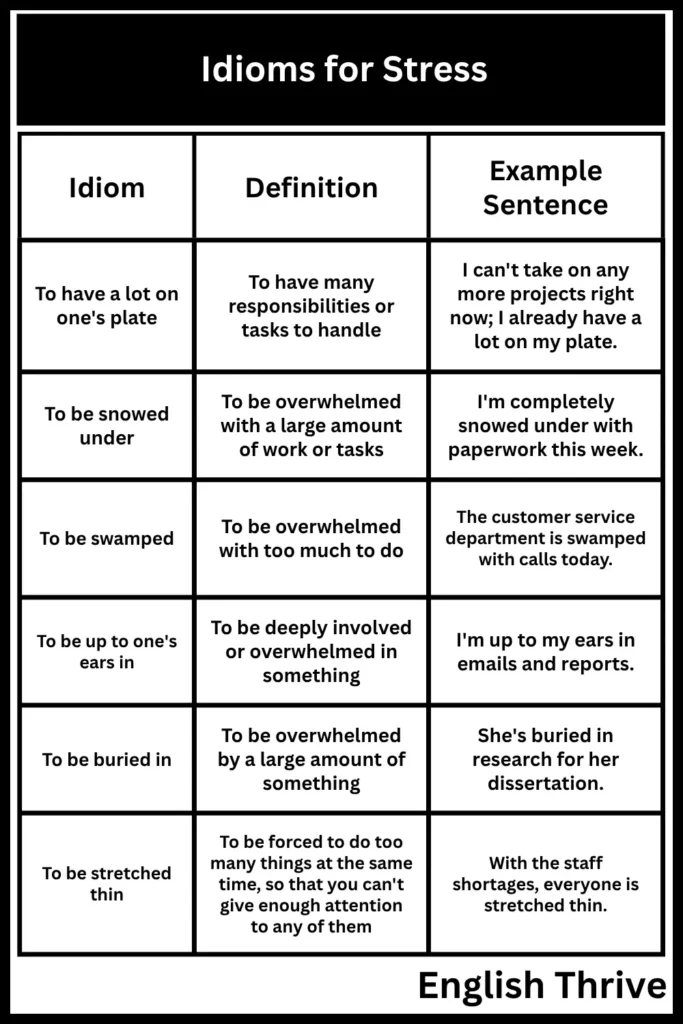
| To have a lot on one’s plate | To have many responsibilities or tasks to handle | I can’t take on any more projects right now; I already have a lot on my plate. |
| To be snowed under | To be overwhelmed with a large amount of work or tasks | I’m completely snowed under with paperwork this week. |
| To be swamped | To be overwhelmed with too much to do | The customer service department is swamped with calls today. |
| To be up to one’s ears in | To be deeply involved or overwhelmed in something | I’m up to my ears in emails and reports. |
| To be buried in | To be overwhelmed by a large amount of something | She’s buried in research for her dissertation. |
| To be stretched thin | To be forced to do too many things at the same time, so that you can’t give enough attention to any of them | With the staff shortages, everyone is stretched thin. |
| To juggle multiple balls | To try to manage many activities at the same time | Working and studying at the same time means you have to juggle multiple balls. |
| To have one’s hands full | To be very busy and have a lot of things to do | She has her hands full with three kids and a full-time job. |
| To be overloaded | To have too much work or responsibility | He felt completely overloaded with the new project. |
| To be drowning in | To be overwhelmed by a large amount of something | I’m drowning in paperwork and deadlines. |
| To be at full stretch | Working as hard as you can | The team is at full stretch to meet the project deadline. |
| To be running around like a headless chicken | To be very busy and rushed, but not achieving much | He’s been running around like a headless chicken all day, trying to get everything done. |
| To feel like a hamster on a wheel | To feel like you are constantly busy but not making any progress | Working long hours every day makes me feel like a hamster on a wheel. |
| To be snowed under with work | Having too much work to do | I can’t go out tonight, I’m snowed under with work. |
| To be under pressure | Feeling stressed because of demands on your time and energy | She’s under a lot of pressure to meet the sales targets. |
| To be pushed to the limit | To be tested to the greatest extent of your abilities or endurance | The athletes were pushed to the limit during the training camp. |
| To be on overload | Experiencing an excessive amount of stress or pressure | My brain is on overload with all this information. |
| To have too many irons in the fire | To be involved in too many activities or projects at the same time | He has too many irons in the fire and can’t focus on any one thing properly. |
| To be spread too thin | To try to do too many things at the same time, so that you cannot give enough attention to any of them | She’s spread too thin trying to manage both her job and her family responsibilities. |
| To be juggling too many plates | To try to manage many different things at the same time | He’s juggling too many plates and needs to delegate some tasks. |
| To be in over one’s head | To be involved in a situation that is too difficult for you to deal with | He took on the project without realizing he was in over his head. |
| To be drowning in work | To have so much work that you are unable to cope | I’m drowning in work and can’t even think about taking a break. |
| To be overwhelmed | To feel that you cannot cope with something | She felt completely overwhelmed by the amount of homework. |
| To be burdened with | To be weighed down by something heavy or difficult | He was burdened with responsibilities after his father passed away. |
| To be weighed down | To be made heavy or less effective by a burden | She felt weighed down by the constant criticism. |
Table 2: Idioms Describing Anxiety and Worry
This table highlights idioms that describe feelings of anxiety, worry, and nervousness. Understanding these idioms allows for more nuanced expression of emotional states related to stress.
| Idiom | Definition | Example Sentence |
|---|---|---|
| To be on edge | To be nervous or anxious | I’ve been on edge all day waiting for the results. |
| To be a nervous wreck | To be extremely nervous or anxious | She was a nervous wreck before her presentation. |
| To be stressed out | To be feeling worried or anxious | I’m so stressed out about the upcoming exams. |
| To be uptight | To be tense and nervous | He seemed very uptight during the meeting. |
| To have butterflies in one’s stomach | To feel nervous, usually before doing something important | I always get butterflies in my stomach before a performance. |
| To bite one’s nails | To be nervous or anxious | She started biting her nails as she waited for the phone to ring. |
| To be on pins and needles | To be very anxious or excited about something that is going to happen | We were on pins and needles waiting for the announcement. |
| To worry oneself sick | To worry excessively about something | She worried herself sick when her son was late coming home. |
| To be beside oneself | To be extremely worried or upset | He was beside himself with grief after the accident. |
| To lose sleep over something | To worry about something so much that you can’t sleep | Don’t lose sleep over such a small problem. |
| To be in a state of anxiety | To be experiencing a continuous feeling of worry or nervousness | She was in a state of anxiety before the surgery. |
| To be worked up | To be very excited, nervous, or upset | He got all worked up about the traffic. |
| To be on tenterhooks | To be in a state of suspense or agitation | We were on tenterhooks waiting for the final results. |
| To be in a cold sweat | To be very nervous or frightened | He woke up in a cold sweat after having a nightmare. |
| To be jumping out of one’s skin | To be very nervous or frightened | The loud noise made her jump out of her skin. |
| To stew in one’s own juices | To worry or suffer about something you have done | Let him stew in his own juices for a while; he’ll learn his lesson. |
| To get cold feet | To become nervous just before an important event | He got cold feet right before the wedding. |
| To be shaking in one’s boots | To be very frightened or nervous | The new recruits were shaking in their boots before their first mission. |
| To be on edge of one’s seat | To be very excited and interested in what is happening | The audience was on the edge of their seats during the thrilling movie. |
| To have a nervous breakdown | A period of mental illness resulting from stress | She had a nervous breakdown after years of working under pressure. |
| To be climbing the walls | To be very anxious or bored | The kids were climbing the walls during the long car ride. |
| To fret over | To be constantly worried about something | Don’t fret over things you can’t control. |
| To be keyed up | To be nervous or excited | The players were keyed up before the big game. |
| To be wound up | To be very worried, nervous, or angry | She gets easily wound up when she’s tired. |
| To be in a flap | To be in a state of panic or excitement | Everyone was in a flap trying to meet the deadline. |
Table 3: Idioms Describing Physical Symptoms of Stress
This table presents idioms that describe the physical manifestations of stress, such as tension, exhaustion, or illness. These idioms help articulate the physical toll that stress can take.
| Idiom | Definition | Example Sentence |
|---|---|---|
| To be under the weather | To feel unwell or slightly ill | I’m feeling a bit under the weather today, so I’m staying home. |
| To feel run down | To feel tired and exhausted | I’ve been feeling run down lately, probably due to stress. |
| To be burned out | To be exhausted and unable to function normally due to overwork | After years of working long hours, she was completely burned out. |
| To be at the end of one’s rope | To have no more patience or strength to deal with a difficult situation | I’m at the end of my rope with these constant problems. |
| To be frazzled | To be exhausted and stressed | She felt completely frazzled after the long day. |
| To be strung out | To be feeling very anxious, tired, and unable to think clearly | He looked strung out after pulling an all-nighter. |
| To be dead on one’s feet | To be extremely tired | After the marathon, I was dead on my feet. |
| To have a splitting headache | To have a very severe headache | I have a splitting headache from all the noise. |
| To feel the strain | To experience the negative effects of stress or pressure | You could see he was feeling the strain of the responsibility. |
| To be wiped out | To be extremely tired | I was completely wiped out after the hike. |
| To be drained | To feel emotionally or physically exhausted | The meeting left me feeling completely drained. |
| To be shattered | To be extremely tired | I’m absolutely shattered after the journey. |
| To have a short fuse | To become angry very easily | He’s had a short fuse lately because of the stress at work. |
| To be on edge | To be easily irritated or nervous | She’s been on edge all week due to the upcoming deadline. |
| To be hanging by a thread | To be in a very unstable or precarious situation | His health was hanging by a thread after the surgery. |
| To be running on fumes | To continue operating despite being exhausted | I’m running on fumes trying to finish this project. |
| To be at breaking point | To be at the point where you can no longer cope with stress | She was at breaking point after dealing with the crisis. |
| To have ants in one’s pants | To be unable to stay still because you are nervous or excited | The children had ants in their pants waiting for the presents. |
| To be out of sorts | To be slightly unwell or unhappy | I’ve been feeling a bit out of sorts all day. |
| To be feeling low | To feel depressed or unhappy | She’s been feeling low since she lost her job. |
| To have a knot in one’s stomach | To feel nervous or anxious | I had a knot in my stomach before the presentation. |
| To be feeling the pressure | To be experiencing stress due to demands placed on you | The team is feeling the pressure to win the championship. |
| To be on one’s last nerve | To be at the limit of one’s patience | The constant interruptions were on my last nerve. |
| To be ready to snap | To be close to losing control due to stress or anger | She was ready to snap after the long argument. |
| To be twitchy | To be nervous and restless | He was twitchy waiting for the test results. |
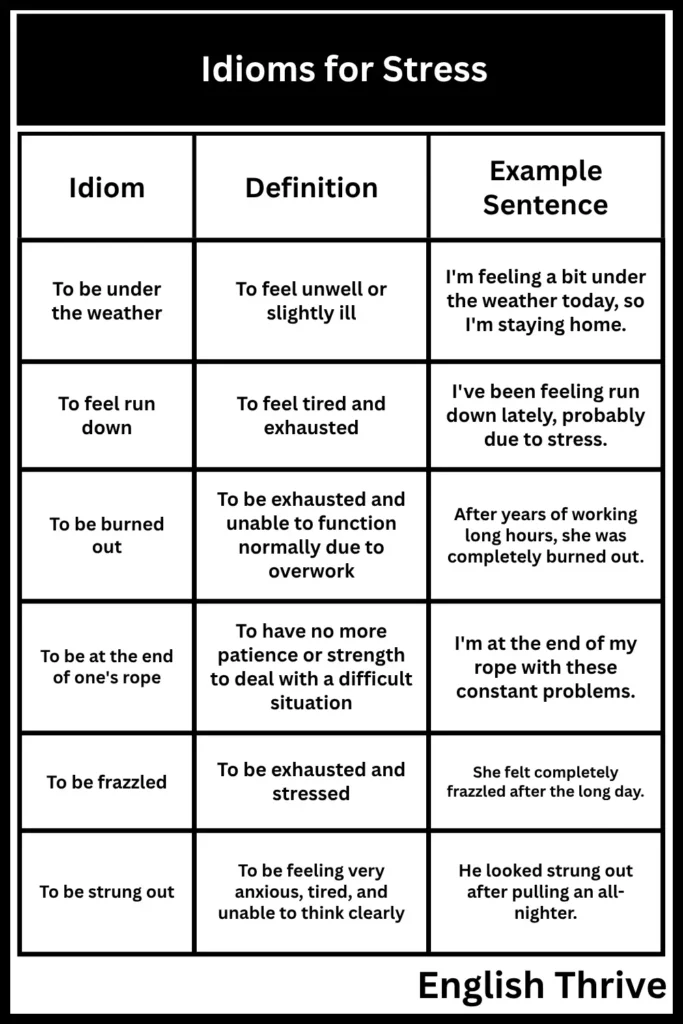
Table 4: Idioms Describing Coping Mechanisms for Stress
This table showcases idioms that describe actions or strategies used to relieve stress. Knowing these idioms can help in discussing stress management and relaxation techniques.
| Idiom | Definition | Example Sentence |
|---|---|---|
| To blow off steam | To release pent-up emotions or energy, often through physical activity | I went for a run to blow off steam after the stressful meeting. |
| To let one’s hair down | To relax and enjoy oneself | It’s good to let your hair down and have some fun after a long week. |
| To take it easy | To relax and avoid stress | You need to take it easy and not worry so much. |
| To chill out | To relax and calm down | I like to chill out by watching a movie. |
| To unwind | To relax and reduce stress | A hot bath helps me unwind after a long day. |
| To take a breather | To take a short break to relax | Let’s take a breather before we start the next task. |
| To take a load off | To relax and relieve stress | Come in and take a load off; you look tired. |
| To get away from it all | To escape from a stressful situation | We need to get away from it all and go on vacation. |
| To recharge one’s batteries | To rest and regain energy | I need to recharge my batteries this weekend. |
| To take one’s mind off something | To stop thinking about something that is worrying you | I went for a walk to take my mind off the problem. |
| To switch off | To stop thinking about work or studies | It’s important to switch off at the end of the day. |
| To clear one’s head | To get rid of confusing or worrying thoughts | I went for a drive to clear my head. |
| To find an outlet | To find a way to express or release pent-up emotions | He found an outlet for his stress through painting. |
| To let things slide | To not worry about things that are not important | Sometimes you just have to let things slide to reduce stress. |
| To put things into perspective | To consider the relative importance of things | Talking to a friend helped me put things into perspective. |
| To step back | To take a break from a situation to get a clearer view | I needed to step back from the project to see the bigger picture. |
| To take a chill pill | To calm down and relax | You need to take a chill pill and stop worrying so much. |
| To count one’s blessings | To be grateful for the good things in one’s life | When I’m stressed, I try to count my blessings. |
| To pamper oneself | To treat oneself to something enjoyable | She decided to pamper herself with a spa day. |
| To treat oneself | To do something special for yourself as a reward or comfort | I’m going to treat myself to a nice dinner after finishing this project. |
| To take a break from it all | To temporarily escape a stressful situation | They decided to take a break from it all and go camping. |
| To get a grip | To control your emotions and deal with a situation | You need to get a grip and stop panicking. |
| To shake it off | To dismiss or forget about something that is bothering you | Just shake it off and try again tomorrow. |
| To lighten up | To become less serious or worried | You need to lighten up and enjoy life more. |
| To take a step back | To withdraw temporarily from a situation to gain perspective | He decided to take a step back from the project to re-evaluate his approach. |
Usage Rules for Stress Idioms
Using idioms correctly requires understanding their specific context and connotations. While idioms add color to language, using them inappropriately can lead to confusion or miscommunication.
Here are some general rules to follow:
- Context is key: Consider the situation and audience before using an idiom. Some idioms are informal and may not be suitable for formal settings.
- Know the meaning: Ensure you understand the precise meaning of the idiom. Using an idiom with a slightly different meaning can alter the message.
- Use sparingly: Overusing idioms can make your speech sound unnatural or forced. Use them judiciously to enhance your language.
- Avoid mixing idioms: Combining parts of different idioms can create nonsensical expressions. Stick to the correct form of each idiom.
- Consider cultural differences: Be aware that some idioms may not translate well or have the same meaning in other cultures.
For example, the idiom “to be at the end of one’s rope” should be used when someone is truly out of patience or resources. Using it for a minor inconvenience would be an exaggeration.
Similarly, “to blow off steam” should be used to describe a healthy way of releasing emotions, not an act of aggression. Understanding these nuances is crucial for effective communication.
Some idioms can be modified slightly to fit the grammatical structure of the sentence. For example, “to have a lot on one’s plate” can be changed to “he has a lot on his plate” or “she had a lot on her plate.” However, avoid altering the core words or structure of the idiom, as this can change its meaning.
Common Mistakes with Stress Idioms
One common mistake is taking idioms literally. For example, someone might misunderstand “to have butterflies in one’s stomach” to mean that there are actual insects in their stomach.
It’s important to remember that idioms are figurative expressions and should not be interpreted literally.
Another common mistake is using the wrong form of an idiom. For example, saying “to be on the edge” instead of “to be on edge” changes the meaning of the phrase.
Similarly, mixing idioms, such as saying “to have a lot on one’s mind” instead of “to have a lot on one’s plate,” can lead to confusion.
Here are some examples of correct and incorrect usage:
| Incorrect | Correct | Explanation |
|---|---|---|
| I’m feeling under the weather conditions. | I’m feeling under the weather. | The correct idiom is “under the weather,” not “under the weather conditions.” |
| She’s a nervous ship. | She’s a nervous wreck. | The correct idiom is “a nervous wreck,” not “a nervous ship.” |
| He blew out steam. | He blew off steam. | The correct idiom is “blow off steam,” not “blow out steam.” |
| I need to take it easily. | I need to take it easy. | The correct idiom is “take it easy,” not “take it easily.” |
| They were on pins and needles waiting the results. | They were on pins and needles waiting for the results. | The correct idiom is “waiting for the results,” not “waiting the results.” |
Practice Exercises
Test your understanding of stress idioms with these exercises. Fill in the blanks with the appropriate idiom from the list provided.
Exercise 1: Fill in the Blanks
Choose the correct idiom from the list to complete each sentence.
Idiom List: on edge, snowed under, blow off steam, at the end of my rope, take it easy, butterflies in my stomach, burned out, under the weather, have a lot on my plate, chill out
- I can’t go out tonight; I’m completely ________ with work.
- She’s been ________ lately and needs a vacation.
- I always get ________ before a big presentation.
- He’s been ________ all day waiting for the phone call.
- I’m ________ with these constant problems; I don’t know what to do.
- You need to ________ and not worry so much.
- I’m feeling a bit ________ today, so I’m staying home.
- I ________ with all these responsibilities.
- I need to ________ after a long day at work.
- Just ________ and relax.
Answer Key:
- snowed under
- burned out
- butterflies in my stomach
- on edge
- at the end of my rope
- take it easy
- under the weather
- have a lot on my plate
- blow off steam
- chill out
Exercise 2: Matching
Match the idiom with its correct definition.
| Idiom | Definition |
|---|---|
| 1. To be swamped | A. To be extremely tired |
| 2. To be wiped out | B. To relax and calm down |
| 3. To chill out | C. To be overwhelmed with too much to do |
| 4. To have a short fuse | D. To release pent-up emotions |
| 5. To blow off steam | E. To become angry very easily |
Answer Key:
- 1-C
- 2-A
- 3-B
- 4-E
- 5-D
Exercise 3: Multiple Choice
Choose the correct meaning of the idiom in the sentence.
- He’s been running around like a headless chicken all day. What does this mean?
- He’s been very calm and organized.
- He’s been very busy and rushed, but not achieving much.
- He’s been very relaxed and carefree.
- She’s at breaking point after dealing with the crisis. What does this mean?
- She’s very happy and content.
- She’s at the point where she can no longer cope with stress.
- She’s feeling very energetic and motivated.
- I need to take a chill pill and stop worrying so much. What does this mean?
- I need to become more anxious and stressed.
- I need to calm down and relax.
- I need to become more organized and efficient.
- They decided to take a break from it all and go camping. What does this mean?
- They decided to continue working hard.
- They decided to temporarily escape a stressful situation.
- They decided to create more stress for themselves.
- She’s been on edge all week due to the upcoming deadline. What does this mean?
- She’s been very relaxed and carefree.
- She’s been easily irritated or nervous.
- She’s been very happy and excited.
Answer Key:
- 2. He’s been very busy and rushed, but not achieving much.
- 2. She’s at the point where she can no longer cope with stress.
- 2. I need to calm down and relax.
- 2. They decided to temporarily escape a stressful situation.
- 2. She’s been easily irritated or nervous.
Advanced Topics: Nuances and Variations
Some stress
idioms have subtle nuances that depend on context and regional variations. For instance, the intensity of stress described by “feeling the strain” might differ based on whether it’s used in a workplace or personal relationship context.
Similarly, idioms like “on edge” can have varying degrees of intensity, ranging from mild nervousness to severe anxiety.
Regional variations also play a role in the usage and understanding of stress idioms. While some idioms are universally recognized, others may be more common in specific regions or dialects.
For example, an idiom popular in British English might not be as well-known or understood in American English. Therefore, it’s important to be aware of these regional differences and tailor your language accordingly.
Furthermore, the historical context of an idiom can provide additional insight into its meaning and usage. Some idioms have evolved over time, with their original meanings shifting or expanding.
Understanding the etymology of an idiom can enhance your appreciation of its figurative language and help you use it more effectively.
Frequently Asked Questions
What is the difference between an idiom and a proverb?
An idiom is a phrase whose meaning is different from the literal meaning of its words, while a proverb is a short, well-known saying that expresses a general truth or piece of advice. Idioms are more about figurative language, whereas proverbs are about wisdom or common sense.
How can I improve my understanding of idioms?
The best way to improve your understanding of idioms is through exposure and practice. Read widely, listen to native speakers, and make a conscious effort to learn new idioms.
Use them in your own speech and writing to reinforce your understanding.
Are idioms important for learning English?
Yes, idioms are an integral part of the English language. Understanding and using idioms correctly can significantly enhance your fluency and comprehension.
They also add color and expressiveness to your language, making you a more effective communicator.
Can idioms be translated directly into other languages?
No, idioms typically cannot be translated directly into other languages because their meanings are figurative and culturally specific. A direct translation would likely result in a nonsensical or incorrect meaning.
Instead, it’s necessary to find an equivalent idiom in the target language that conveys a similar meaning.
How do I avoid misusing idioms?
To avoid misusing idioms, always double-check their meaning and usage before using them. Consult a dictionary or language resource to ensure you understand the idiom correctly.
Pay attention to the context and audience to ensure the idiom is appropriate for the situation.
Conclusion
Mastering idioms for stress is a valuable skill for anyone looking to improve their English language proficiency. By understanding the definitions, structural elements, usage rules, and common mistakes associated with these idioms, you can express yourself more effectively and comprehend native speakers more easily.
Practice using these idioms in your everyday conversations and writing to enhance your fluency and expressiveness. With consistent effort, you’ll be able to navigate the colorful world of stress-related idioms with confidence and ease.