

Idioms add color and depth to the English language, allowing us to express ourselves in nuanced and culturally rich ways. When it comes to the act of leaving, a plethora of idioms exist, each carrying its own subtle shade of meaning.
Understanding these idioms not only enhances your comprehension of spoken and written English but also enables you to communicate more effectively and creatively. This article delves into the world of idioms for leaving, exploring their definitions, structural nuances, and practical applications.
Whether you’re an ESL learner or a native speaker aiming to refine your linguistic skills, this guide will equip you with the knowledge to confidently navigate the expressive landscape of saying goodbye. This comprehensive exploration will cover various categories of leaving idioms, usage rules, common mistakes, and practice exercises to ensure a thorough understanding.
This article is designed for English language learners, teachers, and anyone interested in expanding their knowledge of idiomatic expressions. By mastering these idioms, you’ll be able to understand and use them effectively in various contexts, from casual conversations to formal writing.
This will not only improve your communication skills but also give you a deeper appreciation for the richness and complexity of the English language.
Definition of Idioms for Leaving
An idiom is a phrase or expression whose meaning cannot be understood from the literal meanings of its individual words. Instead, the idiom carries a figurative or symbolic meaning that is specific to a particular language or culture.
Idioms for leaving are expressions that describe the act of departing, exiting, or going away. These idioms often add color, emotion, or a particular nuance to the simple act of leaving.
They can describe the manner of departure, the reason for leaving, or the emotional impact of the departure on those involved.
Idioms related to leaving can be classified based on their function. Some idioms describe the speed or abruptness of leaving, while others focus on the secrecy or unexpectedness of the departure.
Still others might soften the blow of leaving, using euphemisms to make the act seem less harsh. Understanding these classifications helps in choosing the right idiom for the intended context.
The context in which an idiom is used is crucial. The same idiom can have different connotations depending on the situation.
For example, “to take a powder” might be appropriate in a casual conversation but not in a formal business setting. Therefore, it is essential to consider the audience, the tone, and the overall purpose of the communication when using idioms for leaving.
Structural Breakdown
The structure of idioms for leaving varies greatly depending on the specific idiom. Some idioms are verb phrases, while others are prepositional phrases or even complete sentences.
Understanding the grammatical structure of an idiom is essential for using it correctly. Here’s a breakdown of common structural patterns:
- Verb + Particle: Many idioms consist of a verb followed by a particle (e.g., a preposition or adverb). For example, “take off” (to leave quickly) and “slip away” (to leave unnoticed). The meaning of the idiom is different from the literal meaning of the verb and particle combined.
- Verb + Prepositional Phrase: Some idioms include a verb followed by a prepositional phrase. For instance, “part ways with” (to end a relationship or association).
- Figurative Language: Many idioms employ figurative language, such as metaphors and similes. For example, “cut and run” (to abandon a difficult situation) uses the metaphor of cutting a rope to escape.
- Fixed Expressions: Some idioms are fixed expressions that cannot be altered without changing their meaning or making them nonsensical. For example, “hit the road” (to begin a journey).
Idioms often cannot be translated literally into other languages. Their meaning is culturally specific and relies on shared understanding.
Attempting a literal translation usually results in a nonsensical or inaccurate expression. The key is to understand the underlying concept that the idiom conveys and find an equivalent expression in the target language.
Types and Categories of Leaving Idioms
Idioms for leaving can be categorized based on the specific nuance they convey about the act of departure. This categorization helps in understanding the subtle differences between various idioms and choosing the most appropriate one for a given situation.
Abrupt Departures
These idioms describe a sudden or hasty departure, often implying a sense of urgency or unexpectedness. They suggest that the person left quickly and without much preparation or warning.
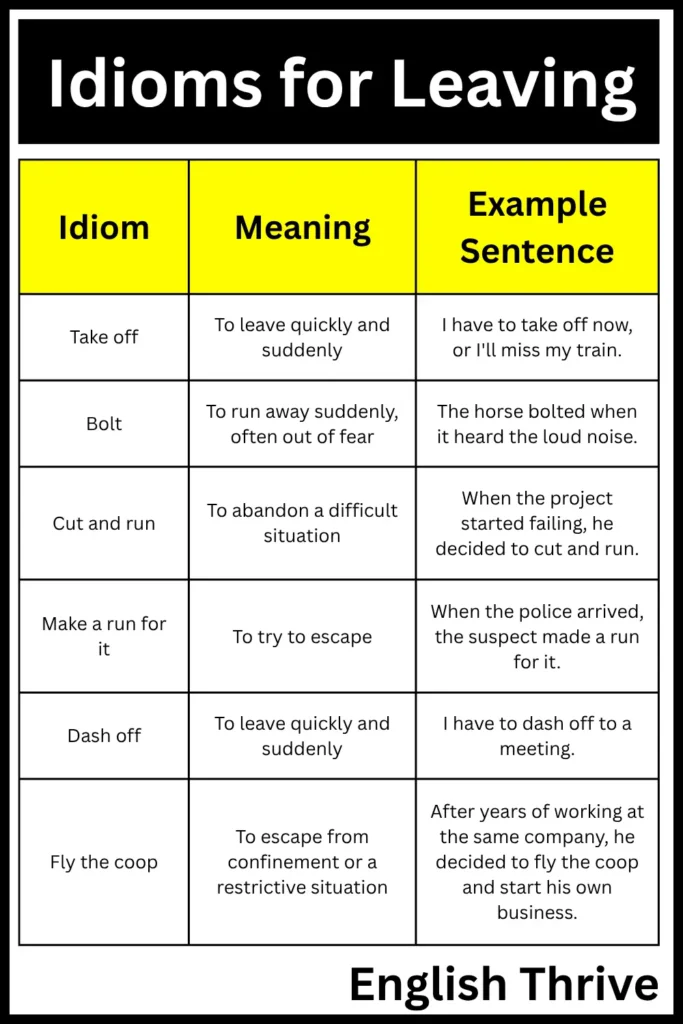
Idioms in this category include “take off,” “bolt,” “cut and run,” and “make a run for it.”
Gradual Departures
These idioms describe a departure that happens slowly or over time. They suggest a more deliberate and less hurried exit.
Examples include “fade away,” “drift apart,” and “slowly back away.”
Secret Departures
These idioms describe a departure that is done discreetly or without being noticed. They imply a desire to avoid attention or detection.
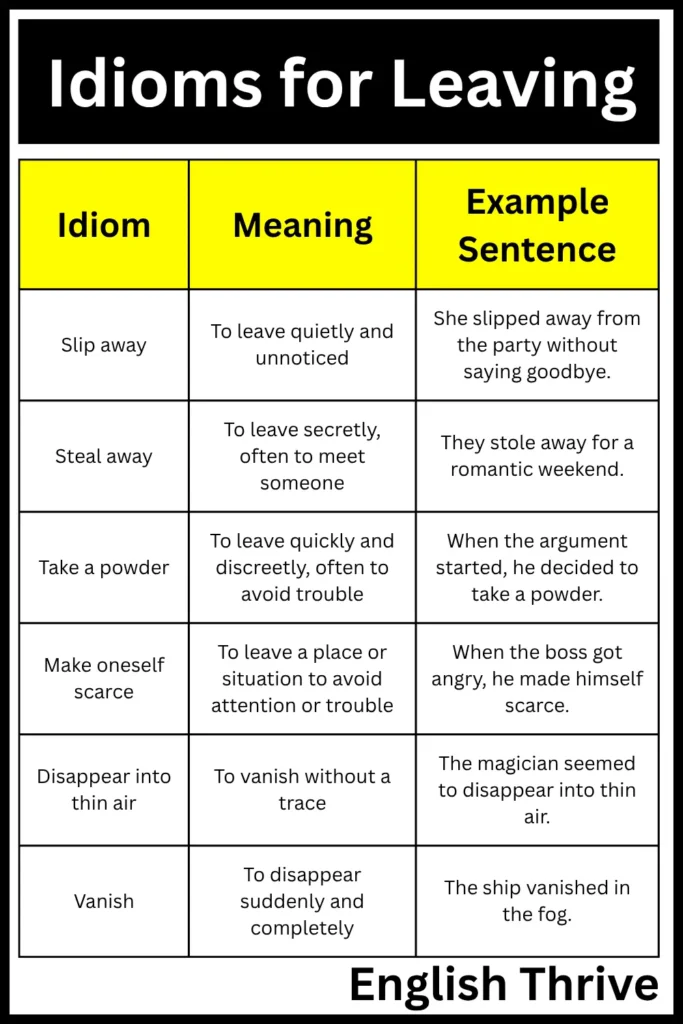
Idioms in this category include “slip away,” “steal away,” and “take a powder.”
Forced Departures
These idioms describe a departure that is compelled or required, often against one’s will. They suggest that the person leaving has no choice in the matter.
Examples include “get the boot,” “be given the sack,” and “be shown the door.”
Euphemistic Departures
These idioms describe a departure using softer or more indirect language, often to avoid causing offense or distress. They are used to make the act of leaving seem less harsh or unpleasant.
Idioms in this category include “pass away,” “go to a better place,” and “kick the bucket” (when referring to death).
Examples of Leaving Idioms
The following tables provide extensive examples of idioms for leaving, organized by category. Each example is presented with its meaning and a sample sentence to illustrate its usage.
Examples of Abrupt Departure Idioms
This table provides examples of idioms related to abrupt departures, highlighting their meanings and usage in sentences. Understanding these idioms will help you describe sudden and unexpected exits.
| Idiom | Meaning | Example Sentence |
|---|---|---|
| Take off | To leave quickly and suddenly | I have to take off now, or I’ll miss my train. |
| Bolt | To run away suddenly, often out of fear | The horse bolted when it heard the loud noise. |
| Cut and run | To abandon a difficult situation | When the project started failing, he decided to cut and run. |
| Make a run for it | To try to escape | When the police arrived, the suspect made a run for it. |
| Dash off | To leave quickly and suddenly | I have to dash off to a meeting. |
| Fly the coop | To escape from confinement or a restrictive situation | After years of working at the same company, he decided to fly the coop and start his own business. |
| Up and leave | To leave suddenly and without explanation | She just decided to up and leave one day, without telling anyone where she was going. |
| Take to one’s heels | To run away quickly | Upon seeing the bear, they took to their heels. |
| Clear out | To leave a place quickly | When the fire alarm rang, everyone had to clear out of the building. |
| Beat a retreat | To withdraw quickly from a dangerous or unpleasant situation | Seeing the angry crowd, the politician decided to beat a retreat. |
| Skedaddle | To leave quickly and hurriedly | “Let’s skedaddle before it starts raining,” she said. |
| Scram | To leave immediately; often used as a command | “Scram! I don’t want to see you here again,” he shouted. |
| High-tail it | To leave quickly, often in a hurry or to escape | We had to high-tail it out of there when the party got too wild. |
| Take French leave | To leave without permission or notice | He took French leave from the office and went to the beach. |
| Skip town | To leave a town or area suddenly, typically to avoid trouble or responsibility | He skipped town after the scandal broke. |
| Run off | To leave suddenly, often without telling anyone | They ran off together to get married. |
| Make off | To leave quickly, especially after stealing something | The thief made off with the jewelry. |
| Dart off | To move or leave suddenly and rapidly | She darted off to answer the phone. |
| Zoom off | To leave quickly in a vehicle | He zoomed off on his motorcycle. |
| Peel out | To leave quickly in a car, often with the tires screeching | The driver peeled out of the parking lot. |
| Shoot through | To leave quickly | I have to shoot through, see you later! |
| Hit and run | To leave the scene after causing an accident | It was a hit and run, and the driver didn’t stop. |
| Take flight | To leave suddenly, as if escaping | The birds took flight when the cat approached. |
| Break away | To separate oneself and leave | He tried to break away from the crowd. |
Examples of Gradual Departure Idioms
This table provides examples of idioms related to gradual departures, highlighting their meanings and usage in sentences. Understanding these idioms will help you describe exits that occur slowly over time.
| Idiom | Meaning | Example Sentence |
|---|---|---|
| Fade away | To gradually disappear or lose importance | The memories of that summer eventually faded away. |
| Drift apart | To gradually become less close to someone | Over the years, they drifted apart due to different interests. |
| Slowly back away | To gradually move away from a situation | Seeing the snake, he slowly backed away. |
| Wane | To decrease in power or importance over time | Her enthusiasm for the project began to wane. |
| Taper off | To gradually decrease or diminish | The number of attendees tapered off as the conference went on. |
| Peter out | To gradually come to an end | The road petered out into a narrow path. |
| Dissolve | To gradually disappear or break apart | Their partnership eventually dissolved due to disagreements. |
| Ebb away | To gradually recede or diminish | His strength began to ebb away as he grew older. |
| Pass on | To die (euphemistic) | She passed on peacefully in her sleep. |
| Slip away | To gradually disappear or fade from memory | The opportunity slipped away before we could seize it. |
| Melt away | To gradually disappear or vanish | The snow melted away in the warm sunshine. |
| Wind down | To gradually reduce activity or intensity | The company is winding down its operations for the year. |
| Draw to a close | To gradually come to an end | The meeting is drawing to a close. |
| Die down | To gradually decrease in intensity | The storm eventually died down. |
| Decline | To gradually decrease in quality or quantity | His health began to decline in his old age. |
| Fall away | To gradually separate or detach | The support for the policy began to fall away. |
| Slow down | To gradually reduce speed or activity | The car slowed down as it approached the intersection. |
| Subside | To gradually decrease or become less intense | The floodwaters began to subside. |
| Taper off | To diminish or reduce gradually | The pain tapered off after taking the medication. |
| Give way | To gradually collapse or yield | The old bridge began to give way under the weight. |
Examples of Secret Departure Idioms
This table provides examples of idioms related to secret departures, highlighting their meanings and usage in sentences. Understanding these idioms will help you describe exits that are done discreetly and without being noticed.
| Idiom | Meaning | Example Sentence |
|---|---|---|
| Slip away | To leave quietly and unnoticed | She slipped away from the party without saying goodbye. |
| Steal away | To leave secretly, often to meet someone | They stole away for a romantic weekend. |
| Take a powder | To leave quickly and discreetly, often to avoid trouble | When the argument started, he decided to take a powder. |
| Make oneself scarce | To leave a place or situation to avoid attention or trouble | When the boss got angry, he made himself scarce. |
| Disappear into thin air | To vanish without a trace | The magician seemed to disappear into thin air. |
| Vanish | To disappear suddenly and completely | The ship vanished in the fog. |
| Go AWOL | To be absent without leave (originally military) | He went AWOL from his job after a disagreement with his boss. |
| Abscond | To leave secretly and suddenly, especially to avoid arrest or prosecution | The treasurer absconded with the company’s funds. |
| Go missing | To disappear and be unaccounted for | The hiker went missing in the mountains. |
| Keep a low profile | To avoid attracting attention | After the scandal, he decided to keep a low profile. |
| Hide out | To stay in a secret place to avoid being found | The fugitive was hiding out in an abandoned cabin. |
| Sneak away | To leave quietly and secretly | They snuck away from the boring meeting. |
| Secretly depart | To leave without anyone knowing | She secretly departed in the early hours of the morning. |
| Ghost | To suddenly end all contact with someone without explanation | He ghosted her after a few dates. |
Examples of Forced Departure Idioms
This table provides examples of idioms related to forced departures, highlighting their meanings and usage in sentences. Understanding these idioms will help you describe situations where someone is compelled to leave.
| Idiom | Meaning | Example Sentence |
|---|---|---|
| Get the boot | To be fired from a job | He got the boot after failing to meet his sales targets. |
| Be given the sack | To be fired from a job | She was given the sack for being late too often. |
| Be shown the door | To be dismissed or forced to leave | He was shown the door after arguing with the manager. |
| Be given marching orders | To be ordered to leave | The soldiers were given marching orders to deploy immediately. |
| Be ousted | To be forced out of a position of power | The CEO was ousted by the board of directors. |
| Be expelled | To be forced to leave a school or organization | He was expelled from school for cheating. |
| Be deported | To be forced to leave a country | He was deported after his visa expired. |
| Be evicted | To be forced to leave a property | They were evicted from their apartment for not paying rent. |
| Be run out of town | To be forced to leave a town or area due to disapproval | The gambler was run out of town after cheating at cards. |
| Be pushed out | To be forced to leave a job or position | She was pushed out of her job by her rivals. |
| Be retired | To be forced to leave a job due to age or health | He was retired from the police force due to his age. |
| Be dismissed | To be officially removed from a job or position | She was dismissed from her post for misconduct. |
| Be terminated | To have one’s employment ended | His contract was terminated due to budget cuts. |
Examples of Euphemistic Departure Idioms
This table provides examples of idioms related to euphemistic departures, highlighting their meanings and usage in sentences. Understanding these idioms will help you describe departures in a softer, more indirect way.
| Idiom | Meaning | Example Sentence |
|---|---|---|
| Pass away | To die (euphemistic) | Her grandmother passed away peacefully in her sleep. |
| Go to a better place | To die (euphemistic) | We believe he has gone to a better place. |
| Kick the bucket | To die (informal, euphemistic) | He finally kicked the bucket after a long illness. |
| Meet one’s maker | To die (euphemistic) | He met his maker after a long and fulfilling life. |
| Cross over | To die (euphemistic) | She has crossed over to the other side. |
| Departed | To die (formal, euphemistic) | The departed soul will be missed by all. |
| Leave us | To die (euphemistic) | He left us too soon. |
| Be no more | To die (formal, euphemistic) | The kingdom is no more. |
| Go to one’s reward | To die and go to heaven (religious, euphemistic) | He has gone to his reward after a life of service. |
| Succumb | To die from an illness or injury | He succumbed to his injuries after the accident. |
| Expire | To die (formal, euphemistic) | His visa has expired, and he must leave the country. (also literal meaning) |
| Be called home | To die (religious, euphemistic) | She was called home to be with the Lord. |
| Move on | To leave a job or position (euphemistic) | He has decided to move on to a new opportunity. |
| Step down | To resign from a job or position (euphemistic) | The CEO decided to step down due to health reasons. |
Usage Rules
Using idioms correctly requires understanding their specific meanings and the contexts in which they are appropriate. Here are some key usage rules to keep in mind:
- Know the Meaning: Always ensure you fully understand the meaning of an idiom before using it. Using an idiom incorrectly can lead to confusion or miscommunication.
- Consider the Context: Idioms are often informal and may not be appropriate in formal settings. Choose idioms that are suitable for the audience, tone, and purpose of your communication.
- Pay Attention to Grammar: Use the correct grammatical form of the idiom. Some idioms are fixed expressions and cannot be altered without changing their meaning.
- Be Aware of Cultural Differences: Idioms are culturally specific and may not be understood by people from different backgrounds. Avoid using idioms when communicating with people who may not be familiar with them.
- Avoid Overuse: Using too many idioms can make your language sound unnatural or contrived. Use them sparingly and only when they add value to your communication.
Some idioms have specific grammatical requirements. For example, some idioms require a particular tense or verb form.
Pay attention to these requirements to ensure you use the idiom correctly. For instance, idioms with phrasal verbs often require the correct particle to maintain their meaning.
Idioms can be misused if taken literally. Always remember that idioms have figurative meanings that are different from the literal meanings of their individual words.
Understanding the intended meaning and the cultural context is essential for correct usage.
Common Mistakes
Many learners make common mistakes when using idioms. Being aware of these mistakes can help you avoid them and use idioms more effectively.
- Literal Interpretation: Interpreting idioms literally instead of understanding their figurative meaning.
- Incorrect Word Order: Changing the word order of fixed idioms, which can alter their meaning or make them nonsensical.
- Using the Wrong Tense: Failing to use the correct tense or verb form in an idiom.
- Misunderstanding the Context: Using an idiom in an inappropriate context, such as a formal setting.
- Overusing Idioms: Using too many idioms, making the language sound unnatural or forced.
Here are some examples of common mistakes and their corrections:
| Incorrect | Correct | Explanation |
|---|---|---|
| “He took a powder of the room.” | “He took a powder from the room.” | The correct preposition is “from,” not “of.” |
| “She was given the sack yesterday.” | “She got the sack yesterday.” | The correct way to say is “got the sack” |
| “They faded away quickly.” | “They faded away.” | “Fade away” already implies a gradual process. |
| “He met his maker last week.” | “He met his maker last week.” | This is correct. |
| “She is kicking the bucket.” | “She kicked the bucket.” | The action is in the past. |
By being mindful of these common mistakes, you can improve your accuracy and confidence in using idioms for leaving.
Practice Exercises
These practice exercises will help you reinforce your understanding of idioms for leaving. Each exercise focuses on different aspects of idiom usage, from identifying the correct meaning to constructing sentences.
Exercise 1: Multiple Choice
Choose the correct meaning of the idiom in each sentence.
| Question | Options | Answer |
|---|---|---|
| 1. I have to take off now. What does “take off” mean? | a) Remove clothing b) Leave quickly c) Start a journey d) Become angry | b) Leave quickly |
| 2. He decided to cut and run when the project started failing. What does “cut and run” mean? | a) Trim something b) Abandon a situation c) Start a new project d) Get injured | b) Abandon a situation |
| 3. She slipped away from the party unnoticed. What does “slipped away” mean? | a) Fell down b) Left quietly c) Danced gracefully d) Made a speech | b) Left quietly |
| 4. He got the boot after failing to meet his targets. What does “got the boot” mean? | a) Received a gift b) Was promoted c) Was fired d) Bought new shoes | c) Was fired |
| 5. Her grandmother passed away peacefully. What does “passed away” mean? | a) Went on vacation b) Died c) Moved to a new house d) Graduated | b) Died |
| 6. They drifted apart over the years. What does “drifted apart” mean? | a) Sailed away b) Grew closer c) Became less close d) Moved to different cities | c) Became less close |
| 7. He took a powder when the argument started. What does “took a powder” mean? | a) Applied makeup b) Left quickly c) Started a fight d) Cleaned the room | b) Left quickly |
| 8. The CEO was ousted by the board of directors. What does “was ousted” mean? | a) Was promoted b) Was forced out c) Retired voluntarily d) Received an award | b) Was forced out |
| 9. The snow melted away in the sun. What does “melted away” mean? | a) Became colder b) Disappeared gradually c) Turned into ice d) Caused a flood | b) Disappeared gradually |
| 10. Let’s skedaddle before it starts raining. What does “skedaddle” mean? | a) Dance b) Leave quickly c) Sing d) Stay put | b) Leave quickly |
Exercise 2: Fill in the Blanks
Fill in the blanks with the correct idiom for leaving.
| Question | Answer |
|---|---|
| 1. When the police arrived, the suspect __________. | made a run for it |
| 2. After years of working there, he decided to __________. | fly the coop |
| 3. She just decided to __________ one day, without saying goodbye. | up and leave |
| 4. Upon seeing the bear, they __________. | took to their heels |
| 5. When the fire alarm rang, everyone had to __________ of the building. | clear out |
| 6. Seeing the angry crowd, the politician decided to __________. | beat a retreat |
| 7. “Let’s __________ before it starts raining,” she said. | skedaddle |
| 8. “__________! I don’t want to see you here again,” he shouted. | Scram |
| 9. We had to __________ out of there when the party got too wild. | high-tail it |
| 10. He __________ from the office and went to the beach. | took French leave |
Exercise 3: Sentence Construction
Create a sentence using each of the following idioms for leaving.
| Idiom | Sentence |
|---|---|
| Take off | I need to take off early to catch my flight. |
| Cut and run | He chose to cut and run rather than face the consequences. |
| Slip away | She managed to slip away unnoticed during the chaos. |
| Get the boot | He got the boot from his job after the scandal. |
| Pass away | Her grandfather passed away peacefully in his sleep. |
| Drift apart | They drifted apart as their interests changed. |
| Take a powder | He decided to take a powder when the police arrived. |
| Be shown the door | After numerous warnings, he was finally shown the door. |
| Fade away | The pain from the injury eventually began to fade away. |
| Make oneself scarce | He made himself scarce when he realized he was in trouble. |
Advanced Topics
For advanced learners, exploring the etymology and historical context of idioms can provide a deeper understanding of their meanings and usage. Many idioms have interesting origins that shed light on their figurative sense.
For example, the idiom “kick the bucket” is believed to have originated from the practice of hanging animals upside down from a bucket before slaughtering them.
Analyzing the cultural significance of idioms can also enhance your understanding. Idioms often reflect the values, beliefs, and
customs of a particular culture.
By studying the cultural context of idioms, you can gain insights into the worldview and history of the people who use them. For instance, idioms related to the sea are common in maritime cultures, reflecting the importance of the ocean in their lives.
Furthermore, comparing idioms across different languages can reveal interesting similarities and differences. While some idioms may have direct equivalents in other languages, others may be unique to a particular culture.
This comparative analysis can deepen your appreciation for the diversity of human expression.
FAQ About Idioms for Leaving
Here are some frequently asked questions about idioms for leaving:
Q: Why are idioms important in English?
A: Idioms add color, depth, and nuance to the English language. They allow speakers to express themselves in a more vivid and engaging way, and they reflect the cultural richness of the language.
Q: How can I learn new idioms?
A: The best way to learn new idioms is through exposure to the language. Read books, watch movies, listen to podcasts, and pay attention to how native speakers use idioms in conversation.
You can also use online resources and idiom dictionaries to expand your knowledge.
Q: Is it okay to use idioms in formal writing?
A: In general, it is best to avoid using idioms in formal writing, as they can sound informal or inappropriate. However, there may be exceptions depending on the specific context and audience.
Always consider the tone and purpose of your writing when deciding whether to use idioms.
Q: How can I avoid misusing idioms?
A: To avoid misusing idioms, make sure you fully understand their meaning and the contexts in which they are appropriate. Pay attention to grammar and word order, and be aware of cultural differences.
If you are unsure about the meaning or usage of an idiom, it is best to avoid using it.
Q: Are there regional differences in idiom usage?
A: Yes, idiom usage can vary by region. Some idioms may be more common in certain parts of the world than others.
Be aware of these regional differences and adjust your language accordingly when communicating with people from different backgrounds.
Q: How do I know if an expression is an idiom?
A: If the expression doesn’t make sense when you interpret it literally, it’s likely an idiom. Idioms have figurative meanings that differ from the literal meanings of their individual words.
Conclusion: Idioms for Leaving
Mastering idioms for leaving is an essential step in achieving fluency and expressiveness in English. By understanding the definitions, structural nuances, and usage rules of these idioms, you can communicate more effectively and creatively in a variety of contexts.
Whether you are describing an abrupt departure, a gradual farewell, or a euphemistic passing, the right idiom can add depth and color to your language. Continue to practice and expand your knowledge of idioms, and you will find yourself becoming a more confident and articulate communicator.
Embrace the richness and complexity of the English language, and enjoy the journey of linguistic discovery.