

Marriage is a significant milestone in life, often celebrated with unique cultural expressions. English idioms add color and depth to how we discuss marriage, engagements, and weddings.
Mastering these idioms not only enhances your understanding of English but also allows you to participate more fully in conversations about this important life event. This article explores common idioms related to getting married, offering definitions, examples, and practical exercises.
Whether you’re an English language learner or simply looking to enrich your vocabulary, this guide will provide valuable insights and improve your fluency.
Definition of Idioms for Getting Married
An idiom is a phrase or expression whose meaning cannot be understood from the literal meanings of the individual words. Instead, idioms have a figurative meaning that is culturally understood.
Idioms related to getting married are phrases that describe engagements, weddings, and the state of marriage in a non-literal way. They often add humor, emotion, or cultural context to conversations about these topics.
Understanding these idioms is crucial for comprehending nuanced English and participating in discussions about relationships and marriage.
These idioms function as a form of figurative language, enriching communication and adding depth to conversations. They frequently appear in both spoken and written English, especially in informal settings, literature, and media.
The context in which they are used is crucial for interpreting their intended meaning.
Structural Breakdown of Idioms
Idioms, structurally, are fixed expressions. This means the words and their order are generally not changeable without altering or destroying the idiom’s meaning.
They can consist of various grammatical structures, including:
- Phrasal verbs: Verbs combined with prepositions or adverbs (e.g., “tie the knot”).
- Noun phrases: Groups of words with a noun as the head (e.g., “shotgun wedding”).
- Clauses: Groups of words containing a subject and a verb (e.g., “to live happily ever after”).
The meaning of the idiom is usually not deducible from the individual words. For example, “tie the knot” literally means to make a knot, but idiomatically it means to get married.
It’s important to learn the meaning of the entire phrase rather than trying to interpret it word by word.
Types of Idioms Related to Marriage
Idioms related to marriage can be categorized based on the stage of the relationship they describe:
Engagement Idioms
These idioms refer to the period when a couple decides to get married and announces their intention. They often describe the proposal, the commitment, and the excitement surrounding the upcoming wedding.
Wedding Idioms
These idioms describe the wedding ceremony and reception, focusing on the events, preparations, and celebrations that occur on the wedding day.
Marriage Idioms
These idioms describe the state of being married, including the challenges, joys, and long-term aspects of the relationship. They often reflect cultural attitudes and expectations about marriage.
Examples of Idioms for Getting Married
Here are several examples of idioms related to getting married, categorized by stage:
Engagement Examples
The following table provides examples of idioms related to engagements. Each idiom is explained with its meaning and demonstrated in a sentenc
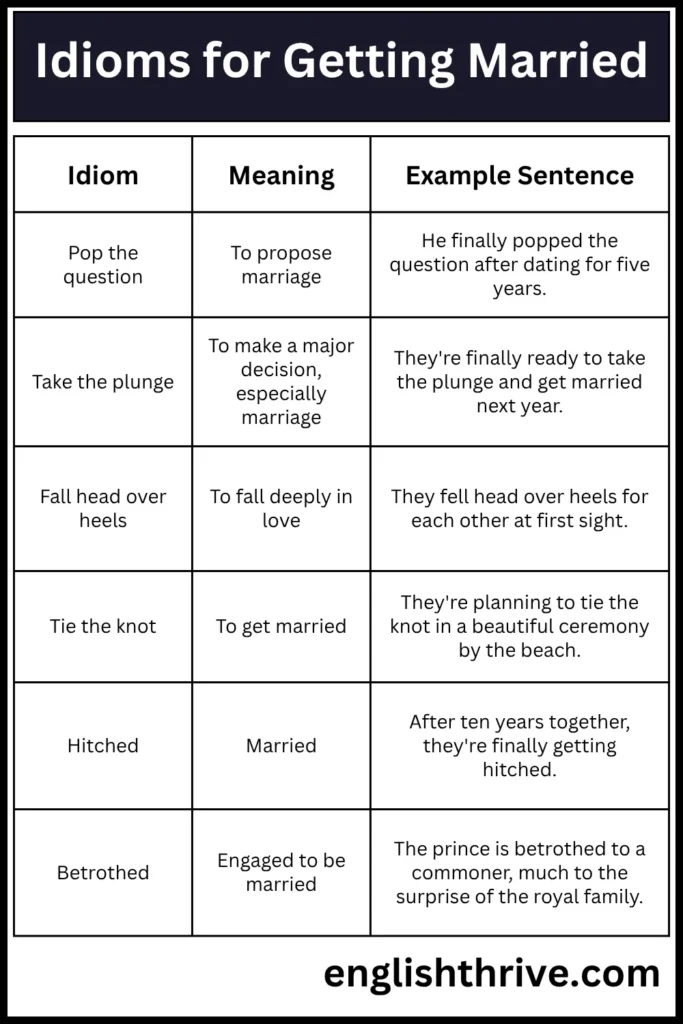
| Idiom | Meaning | Example Sentence |
|---|---|---|
| Pop the question | To propose marriage | He finally popped the question after dating for five years. |
| Take the plunge | To make a major decision, especially marriage | They’re finally ready to take the plunge and get married next year. |
| Fall head over heels | To fall deeply in love | They fell head over heels for each other at first sight. |
| Tie the knot | To get married | They’re planning to tie the knot in a beautiful ceremony by the beach. |
| Hitched | Married | After ten years together, they’re finally getting hitched. |
| Betrothed | Engaged to be married | The prince is betrothed to a commoner, much to the surprise of the royal family. |
| Seal the deal | To finalize an agreement or decision, in this case, marriage | Proposing with a diamond ring was how he wanted to seal the deal. |
| Put a ring on it | To propose marriage (often used humorously) | He knew he had to put a ring on it before someone else did. |
| Ask for her hand in marriage | To formally ask a woman’s father for permission to marry her | He plans to ask for her hand in marriage this weekend. |
| Lovebirds | A pair of people who are obviously very much in love | The lovebirds couldn’t keep their hands off each other. |
| Head over heels in love | Completely and intensely in love | Since the day they met, they’ve been head over heels in love. |
| On cloud nine | Extremely happy and elated | She’s been on cloud nine since he proposed. |
| Pop the question | To ask someone to marry you | He decided to pop the question during their romantic getaway. |
| Ready to settle down | Prepared to commit to a long-term relationship and marriage | After years of dating, they were finally ready to settle down. |
| A match made in heaven | A couple that seems perfectly suited for each other | Everyone says they are a match made in heaven. |
| Meant to be | Destined to be together | They believe they were meant to be after overcoming so many obstacles. |
| Take someone’s breath away | To overwhelm someone with beauty or emotion, often leading to a proposal | The scenery took her breath away, and he knew it was the perfect moment to propose. |
| Get down on one knee | To kneel when proposing marriage | He decided to get down on one knee at their favorite restaurant. |
| Two peas in a pod | Very similar or compatible | They are like two peas in a pod, always agreeing on everything. |
| Start a new chapter | To begin a new phase of life, such as marriage | Getting engaged meant they were ready to start a new chapter together. |
| Seal their love | To make a commitment to love each other forever | They decided to seal their love with a promise ring. |
| Find the one | To find the person you want to marry | After years of searching, she finally found the one. |
| Make an honest woman of her | A humorous way of saying a man is going to marry a woman | He’s finally going to make an honest woman of her after all these years. |
| Give one’s heart to someone | To fall deeply in love and commit to someone | She knew she wanted to give her heart to him the moment they met. |
| A diamond is forever | Suggests the lasting nature of love symbolized by a diamond engagement ring | The jeweler emphasized that a diamond is forever, just like their love. |
Wedding Examples
The following table provides examples of idioms related to weddings. Each idiom is explained with its meaning and demonstrated in a sentence.
| Idiom | Meaning | Example Sentence |
|---|---|---|
| Walk down the aisle | To proceed towards the altar to get married | She was so nervous as she walked down the aisle. |
| Say “I do” | To make a marriage vow | When the minister asked, they both happily said “I do.” |
| Wedding bells | The sound of church bells, symbolizing a wedding | We can hear wedding bells in their future. |
| A shotgun wedding | A wedding that is arranged because the woman is pregnant | It was a bit of a shotgun wedding, but they’re very happy together. |
| White wedding | A traditional wedding ceremony where the bride wears a white dress | She always dreamed of having a white wedding. |
| Honeymoon | A vacation taken by newlyweds | They went on a honeymoon to the Maldives after the wedding. |
| Tie the knot | To get married | After dating for five years, they finally decided to tie the knot. |
| Get hitched | To get married (informal) | They’re planning to get hitched next summer. |
| Exchange vows | To make promises to each other during the wedding ceremony | They exchanged vows in front of their closest friends and family. |
| Cut the cake | To ceremonially cut the wedding cake | The bride and groom cut the cake together, symbolizing their union. |
| First dance | The first dance shared by the bride and groom at the wedding reception | Their first dance was to a song that was special to them. |
| Throw the bouquet | A tradition where the bride throws her bouquet to a group of single women | She decided to throw the bouquet and her best friend caught it. |
| Wedding bliss | The state of happiness and joy experienced during a wedding | They were in wedding bliss throughout the entire celebration. |
| Newlyweds | A couple who have recently married | The newlyweds were glowing with happiness. |
| Bridal shower | A party held for a bride-to-be, where she receives gifts | Her friends threw her a surprise bridal shower last weekend. |
| Wedding reception | The party held after the wedding ceremony | The wedding reception was held at a beautiful venue. |
| Get swept off one’s feet | To fall in love quickly and intensely, often leading to a quick wedding | She got swept off her feet and they were married within a few months. |
| A match made in heaven | A couple that seems perfectly suited for each other | Everyone agreed that they were a match made in heaven on their wedding day. |
| Start married life | To begin the journey of being married | They were excited to start their married life together. |
| Toast the happy couple | To offer a congratulatory speech and drink to the bride and groom | The best man will toast the happy couple during the reception. |
| Have and to hold | A phrase from traditional wedding vows | They promised to have and to hold each other for the rest of their lives. |
| A day to remember | A significant or memorable event, like a wedding | Their wedding was truly a day to remember. |
| Say their vows | To make promises to each other during the wedding ceremony | They said their vows with tears in their eyes. |
| Wedding crashers | People who attend a wedding without being invited | They were worried about wedding crashers showing up at the reception. |
| Blushing bride | The bride who is happy and perhaps a little nervous on her wedding day | The blushing bride looked radiant in her white dress. |
Marriage Examples
The following table provides examples of idioms related to marriage. Each idiom is explained with its meaning and demonstrated in a sentence.
| Idiom | Meaning | Example Sentence |
|---|---|---|
| Live happily ever after | To have a long and happy marriage | They hoped to live happily ever after. |
| Tied to someone’s apron strings | To be overly dependent on one’s spouse, often the wife | He’s still tied to his wife’s apron strings. |
| Wear the pants in the family | To be the dominant partner in a marriage | Everyone knows she wears the pants in the family. |
| Old married couple | A couple who have been married for a long time and act like it | They bicker like an old married couple, but they love each other. |
| Ball and chain | A spouse, often used humorously to imply a burden | He jokingly refers to his wife as his ball and chain. |
| Through thick and thin | Through good times and bad times | They’ve been together through thick and thin. |
| Happy wife, happy life | A saying that suggests keeping one’s wife happy is the key to a happy marriage | He always says, “Happy wife, happy life,” and it seems to work for them. |
| On the rocks | Experiencing difficulties or problems (often used regarding relationships) | Their marriage has been on the rocks for a while now. |
| Patch things up | To resolve a disagreement or problem | They’re trying to patch things up after their argument. |
| Turn over a new leaf | To start behaving in a better way | They decided to turn over a new leaf and work on their marriage. |
| Keep the home fires burning | To maintain a happy and comfortable home life | She keeps the home fires burning while he’s away on business. |
| Make a house a home | To create a warm and welcoming environment in one’s house | They worked hard to make their house a home. |
| In the dog house | In disfavor or trouble with someone, often one’s spouse | He’s in the dog house for forgetting their anniversary. |
| Wear the trousers | To be the dominant partner in a marriage (British English) | She wears the trousers in their relationship. |
| Like an old married couple | To bicker and argue frequently, but still love each other | They fight like an old married couple, but they’re inseparable. |
| Grow old together | To spend one’s later years together in a relationship | They hope to grow old together. |
| A marriage of convenience | A marriage entered into for practical reasons rather than love | Their marriage was a marriage of convenience to secure their family’s business. |
| The honeymoon is over | The initial period of happiness in a marriage has ended | The honeymoon is over, and now they have to deal with the realities of married life. |
| A rocky marriage | A marriage with many challenges and difficulties | They have had a rocky marriage, but they’re still together. |
| Marriage is a journey | Marriage is a long and ongoing process with ups and downs | They knew that marriage is a journey, not a destination. |
| Till death do us part | A phrase from traditional wedding vows, signifying a lifelong commitment | They promised to stay together till death do us part. |
| Better half | A humorous way of referring to one’s spouse | He always introduces his wife as his better half. |
| Second honeymoon | A vacation taken to rekindle the romance in a marriage | They decided to go on a second honeymoon to reconnect. |
| Marriage counseling | Therapy to help couples resolve issues in their marriage | They’re considering marriage counseling to work through their problems. |
| Relationship goals | An ideal relationship that others aspire to achieve | Everyone says they are relationship goals. |
Usage Rules for Marriage Idioms
When using idioms related to marriage, keep the following rules in mind:
- Context is key: Ensure the idiom fits the context of the conversation. Some idioms are informal and may not be appropriate in formal settings.
- Audience awareness: Consider your audience. Not everyone may be familiar with all idioms, especially if they are not native English speakers.
- Correct usage: Use the idiom as it is commonly known. Avoid altering the words or structure.
- Cultural sensitivity: Be mindful of cultural differences. Some idioms may have different connotations or may not be appropriate in all cultures.
For example, using “shotgun wedding” might be considered insensitive in some contexts, as it implies an unplanned pregnancy. Always consider the potential impact of your words.
Common Mistakes When Using Marriage Idioms
Here are some common mistakes to avoid when using idioms related to marriage:
| Incorrect | Correct | Explanation |
|---|---|---|
| He popped the question to her. | He popped the question. | “Popping the question” already implies asking someone to marry you, so “to her” is redundant. |
| They are tying a knot next year. | They are tying the knot next year. | The correct idiom is “tie the knot,” not “tie a knot.” |
| She fell head over heels in him. | She fell head over heels for him. | The correct preposition to use with “fall head over heels” is “for.” |
| Their marriage is on the rocks but they are trying to patch up things. | Their marriage is on the rocks but they are trying to patch things up. | The idiom is “patch things up,” not “patch up things.” |
| He is wearing the trousers on the family. | He wears the trousers in the family. | The correct idiom is “wear the trousers in the family,” not “on the family.” |
Avoiding these common mistakes will help you use marriage-related idioms correctly and confidently.
Practice Exercises
Test your understanding of idioms related to marriage with these practice exercises.
Exercise 1: Fill in the Blanks
Fill in the blanks with the correct idiom from the list below.
Idiom List: pop the question, take the plunge, tie the knot, on cloud nine, a match made in heaven, through thick and thin, the honeymoon is over, wear the pants, in the dog house, live happily ever after
| Question | Answer |
|---|---|
| 1. He decided to _______ during their vacation. | pop the question |
| 2. They are finally ready to _______ and get married. | take the plunge |
| 3. They are planning to _______ next summer. | tie the knot |
| 4. She’s been _______ since he proposed. | on cloud nine |
| 5. Everyone says they are _______. | a match made in heaven |
| 6. They’ve been together _______. | through thick and thin |
| 7. _______, and now they have to deal with the realities of married life. | The honeymoon is over |
| 8. Everyone knows she _______ in the family. | wears the pants |
| 9. He’s _______ for forgetting their anniversary. | in the dog house |
| 10. They hoped to _______. | live happily ever after |
Exercise 2: Multiple Choice
Choose the correct meaning of the idiom in the following sentences.
| Question | Options | Answer |
|---|---|---|
| 1. They decided to get hitched next year. What does “get hitched” mean? | a) Get divorced b) Get engaged c) Get married d) Go on a trip | c) Get married |
| 2. Their marriage has been on the rocks lately. What does “on the rocks” mean? | a) Very successful b) Experiencing difficulties c) Very stable d) Going smoothly | b) Experiencing difficulties |
| 3. He always jokes that his wife is his ball and chain. What does “ball and chain” mean in this context? | a) A close friend b) A loving partner c) A burden d) A source of support | c) A burden |
| 4. They are trying to patch things up after their argument. What does “patch things up” mean? | a) Ignore the problem b) Make things worse c) Resolve a disagreement d) Start a new argument | c) Resolve a disagreement |
| 5. They hope to grow old together. What does “grow old together” mean? | a) Separate after a long time b) Spend their later years together c) Stay young forever d) Become enemies | b) Spend their later years together |
| 6. She was nervous as she walked down the aisle. What does “walked down the aisle” mean? | a) Went shopping b) Got divorced c) Proceeded to get married d) Went for a walk | c) Proceeded to get married |
| 7. He is completely head over heels in love with her. What does “head over heels in love” mean? | a) Mildly fond b) Deeply and intensely in love c) Slightly annoyed d) Not interested | b) Deeply and intensely in love |
| 8. When did he pop the question? What does “pop the question” mean? | a) Ask a question b) Propose marriage c) Make a suggestion d) Tell a secret | b) Propose marriage |
| 9. The couple are truly a match made in heaven. What does “a match made in heaven” mean? | a) A disastrous couple b) A perfectly suited couple c) A mismatched pair d) A couple who argue a lot | b) A perfectly suited couple |
| 10. They have been together through thick and thin. What does “through thick and thin” mean? | a) Only in good times b) Only in bad times c) Through good times and bad times d) Never at all | c) Through good times and bad times |
Advanced Topics: Nuances and Cultural Context
Idioms are deeply rooted in culture, and their meanings can vary across different English-speaking regions. For example, the idiom “wear the trousers” is more commonly used in British English than in American English, where “wear the pants” is preferred.
Similarly, certain idioms might carry different connotations depending on the cultural context.
Understanding the historical and cultural background of an idiom can provide deeper insights into its meaning and usage. Some idioms may have originated from specific historical events or social customs, and knowing this background can help you appreciate the richness and complexity of the English language.
FAQs About Idioms for Getting Married
Here are some frequently asked questions about idioms related to getting married:
What is the difference between an idiom and a literal expression?
An idiom is a phrase whose meaning cannot be understood from the literal meanings of the individual words, while a literal expression means exactly what the words say. For example, “tie the knot” is an idiom meaning “get married,” while “tie a knot” literally means to make a knot.
Why is it important to learn idioms?
Learning idioms is important because they are commonly used in everyday conversation and writing. Understanding idioms will help you comprehend nuanced English and communicate more effectively.
How can I learn new idioms?
You can learn new idioms by reading English books, watching English movies and TV shows, listening to English podcasts, and paying attention to how native speakers use language. It’s also helpful to keep a notebook of new idioms and practice using them in your own conversations.
Are idioms the same in all English-speaking countries?
No, idioms can vary across different English-speaking countries. Some idioms are more common in certain regions than others. It’s important to be aware of these regional differences when using idioms.
Is it okay to use idioms in formal writing?
It depends on the idiom and the context of the writing. Some idioms are informal and may not be appropriate in formal writing, while others are more neutral and can be used in a variety of settings. It’s always best to consider your audience and the purpose of your writing when deciding whether to use an idiom.
How do I know when to use an idiom?
Use idioms when they fit the context of the conversation and when you are confident that your audience will understand them. Avoid using idioms if you are unsure of their meaning or if you think they might be confusing or offensive to your audience.
Are there any resources for learning more about idioms?
Yes, there are many resources available for learning more about idioms, including dictionaries of idioms, websites that explain idioms, and language learning apps that focus on idioms.
How can I remember idioms better?
To remember idioms better, try using them in your own conversations and writing. You can also create flashcards or use mnemonic devices to help you recall the meanings of idioms. Additionally, try to understand the context in which the idiom is used, as this can help you remember its meaning more easily.
Conclusion
Understanding idioms related to getting married is essential for mastering nuanced English and participating fully in conversations about relationships and marriage. This article has provided a comprehensive overview of common idioms, their meanings, usage rules, and common mistakes to avoid.
By studying these idioms and practicing their use, you can enhance your vocabulary, improve your fluency, and communicate more effectively in English.