

Direct and indirect speech help us share what people say in writing. We use them in stories, articles, exams, and daily communication. Sometimes we repeat the exact words. Other times, we report the meaning in our own words. Choosing the right form makes your message clear and easy to understand.
Learning direct and indirect speech improves both writing and speaking. It is useful for stories, news, school work, and grammar exams.
In this guide, you will learn the meaning, rules, differences, common mistakes, and correct use of direct and indirect speech. Simple explanations and clear examples are included to help you learn faster.
 Direct and Indirect Speech
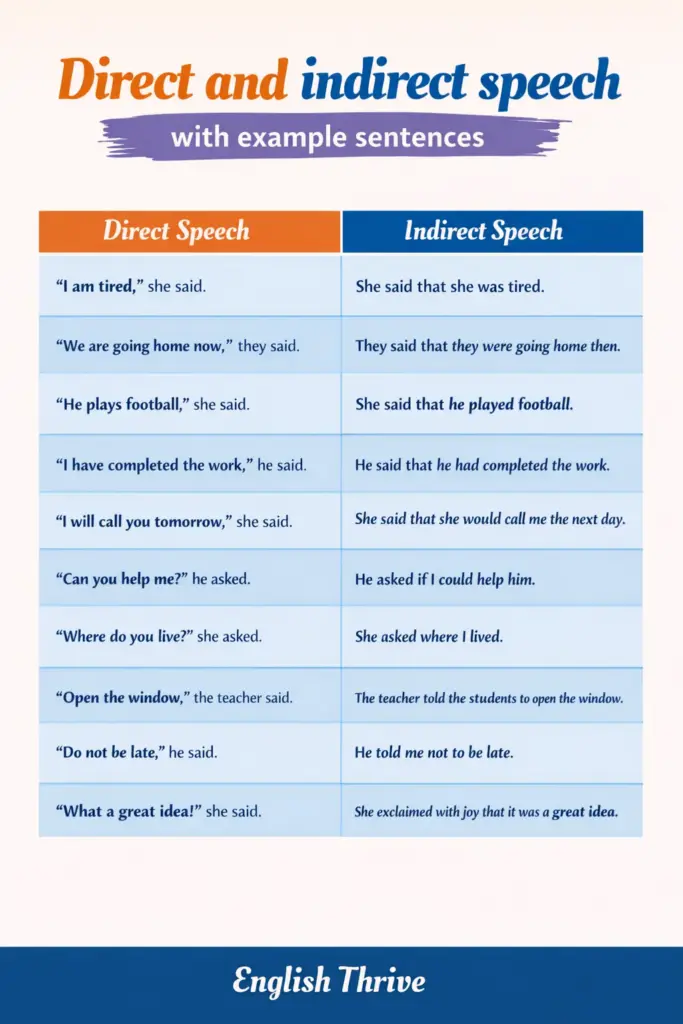
What Is Speech (Narration) in English Grammar?
In English grammar, speech (also called narration) means telling someone what another person has said.
Definition of Speech (Narration)
Speech (Narration) is the method of expressing the spoken words of a person to someone else, either in the same words or in changed words.
Example:
- Rahul said, “I am tired.”
- Rahul said that he was tired.
Both sentences report speech, but they use different forms of narration.
Types of Speech in English
There are two main types of speech:
- Direct Speech
- Indirect Speech ( Reported Speech)
What Is Direct Speech?
Definition of Direct Speech
Direct speech repeats the exact words of the speaker without any change.
The speaker’s original words are placed inside quotation marks (“ ”).
Key Features of Direct Speech
- Uses quotation marks
- Keeps the original tense
- Keeps the original pronouns
- Shows the speaker’s exact words and tone
Examples of Direct Speech
- She said, “I am busy.”
- He said, “I will call you tomorrow.”
- The teacher said, “Complete your homework.”
In all these sentences, the speaker’s words are not changed.
Structure of Direct Speech
Reporting verb + comma + quotation marks
Example:
- He said, “I love coffee.”
Common reporting verbs used in direct speech:
- said
- asked
- replied
- exclaimed
What Is Indirect (Reported) Speech?
Definition of Indirect Speech
Indirect speech reports the meaning of what someone said, not the exact words.
Quotation marks are not used, and the sentence is usually changed to match the situation.
Key Features of Indirect Speech
- No quotation marks
- Often uses “that,” “if,” or “whether”
- Changes in:
- Tense
- Pronouns
- Time and place words
Examples of Indirect Speech
- She said that she was busy.
- He said that he would call me the next day.
- The teacher told us to complete our homework.
The meaning does not change, only the words do.
Why Indirect Speech Is Used
Indirect speech is commonly used:
- In formal writing
- In news reports
- In academic answers
- To summarize conversations
It makes writing smoother and more natural.
Direct vs Indirect Speech: Key Differences
Understanding the difference between direct and indirect speech is very important.
Let’s compare them clearly.
Structural Difference
- Direct Speech: Uses exact words and quotation marks
- Indirect Speech: Uses reported meaning without quotation marks
Example:
- Direct: She said, “I am happy.”
- Indirect: She said that she was happy.
Difference in Tense
- Direct Speech: Tense does not change
- Indirect Speech: Tense usually changes (backshifting)
Example:
- Direct: He said, “I work here.”
- Indirect: He said that he worked there.
Difference in Pronouns
- Direct Speech: Pronouns stay the same
- Indirect Speech: Pronouns change according to the speaker
Example:
- Direct: She said, “I like music.”
- Indirect: She said that she liked music.
Difference in Time and Place Words
Words like “now,” “today,” and “here” often change in indirect speech.
Example:
- Direct:He said, “I have a lot of work today.
- Indirect: He said that he had a lot of work that day.
Difference in Usage
| Direct Speech | Indirect Speech |
|---|---|
| Conversations | Formal writing |
| Dialogues | News reports |
| Stories | Academic answers |
| Interviews | Summaries |
Quick Tip:
If you want to show exact words or emotions, use direct speech.
If you want to report information smoothly, use indirect speech.
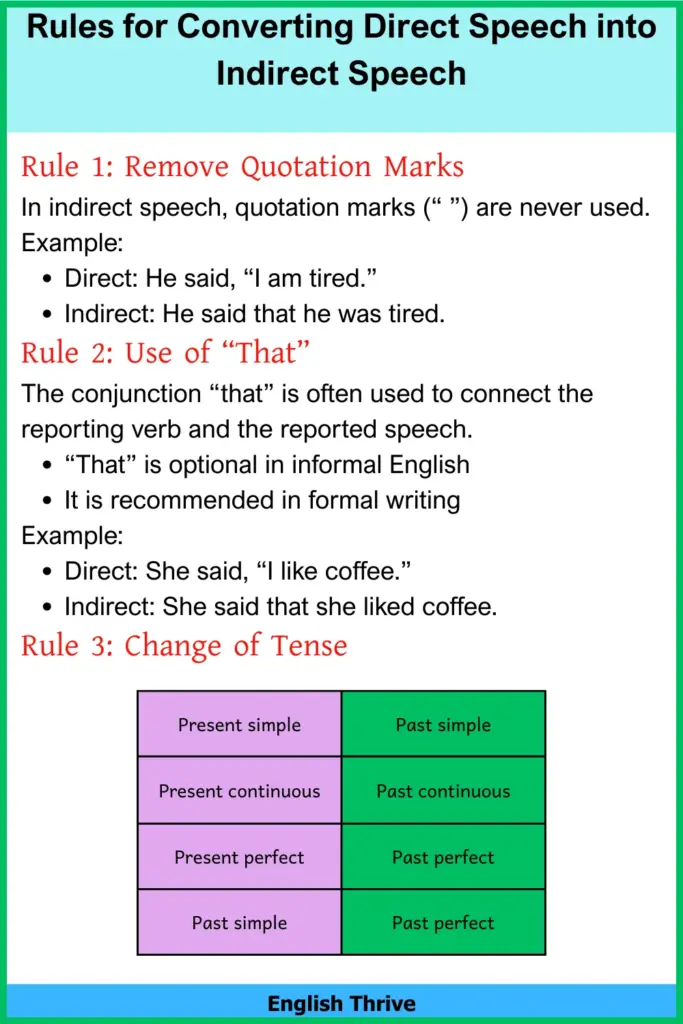
Rules for Converting Direct Speech into Indirect Speech
When we change direct speech into indirect speech, we must follow some fixed grammar rules.
These rules help us keep the meaning correct and the sentence grammatically accurate.
Rule 1: Remove Quotation Marks
In indirect speech, quotation marks (“ ”) are never used.
Example:
- Direct: He said, “I am tired.”
- Indirect: He said that he was tired.
Rule 2: Use of “That”
The conjunction “that” is often used to connect the reporting verb and the reported speech.
- “That” is optional in informal English
- It is recommended in formal writing
Example:
- Direct: She said, “I like coffee.”
- Indirect: She said that she liked coffee.
Rule 3: Change of Tense
Tense change is the most important rule in indirect speech.
When Does Tense Change?
Tense usually changes only when the reporting verb is in the past tense.
Example:
- He said, “I am late.” → tense changes
- He says, “I am late.” → tense does NOT change
Tense Change Chart
| Direct Speech Tense | Indirect Speech Tense |
|---|---|
| Present Simple | Past Simple |
| Present Continuous | Past Continuous |
| Present Perfect | Past Perfect |
| Past Simple | Past Perfect |
| Will | Would |
| Can | Could |
Tense Change Examples
1. Present Simple → Past Simple
- Direct: He said, “I work here.”
- Indirect: He said that he worked there.
2. Present Continuous → Past Continuous
- Direct: She said, “I am studying.”
- Indirect: She said that she was studying.
3. Present Perfect → Past Perfect
- Direct: He said, “I have cleaned the room.”
- Indirect: He said that he had cleaned the room.
4. Will → Would
- Direct: She said, “I will call you.”
- Indirect: She said that she would call me.
When Tense Does NOT Change
Tense does not change in these cases:
- The reporting verb appears in the present or future tense.
- The statement expresses a universal truth
Examples:
- He says, “The sun rises in the east.”
→ He says that the sun rises in the east.
Rule 4: Change of Pronouns
Pronouns change according to the speaker and listener.
Pronoun Change Rules
- First person changes according to the subject
- Second person changes according to the object
- Third person usually remains the same
Pronoun Change Examples
- Direct: He said, “I am ready.”
→ Indirect: He said that he was ready. - Direct: She said to me, “You are late.”
→ Indirect: She told me that I was late. - Direct: They said, “We are happy.”
→ Indirect: They said that they were happy.
Rule 5: Change of Time and Place Words
Words related to time and place usually change in indirect speech.
Common Time & Place Changes
| Direct Speech | Indirect Speech |
|---|---|
| now | then |
| today | that day |
| tomorrow | the next day |
| yesterday | the previous day |
| here | there |
| this | that |
Example
- Direct: He said, “I can’t talk today“
- Indirect: He said that he couldn’t talk that day.
Conversion of Sentence Types
Now let’s learn how different sentence types are converted into indirect speech.
Assertive Sentences (Statements)
Assertive sentences are simple statements.
Rules for Assertive Sentences
- Use “said” or “told.”
- Use that
- Apply tense, pronoun, and time changes
Examples
- Direct: He said, “She is my friend.”
- Indirect: He said that she was his friend.
- Direct: She said to me, “I am tired.”
- Indirect: She told me that she was tired.
Interrogative Sentences (Questions)
Interrogative sentences ask questions.
Rules for Interrogative Sentences
- Change “said” to “asked.”
- Remove the question mark (?)
- Use:
- if/whether for yes–no questions
- question word for WH-questions
Yes/No Question Examples
- Direct: She said, “Are you coming?”
- Indirect: She asked if I was coming.
WH-Question Examples
- Direct: He said, “Where are you going?”
- Indirect: He asked where I was going.
Imperative Sentences (Commands, Requests, Advice)
Imperative sentences express:
- Commands
- Requests
- Advice
- Orders
Rules for Imperative Sentences
- Use: told / ordered / requested / advised
- Use to + verb
- Use not to for negative commands
Examples
- Direct: The teacher said, “Sit down.”
- Indirect: The teacher told the students to sit down.
- Direct: He said, “Do not be late.”
- Indirect: He told me not to be late..
Exclamatory Sentences in Indirect Speech
Exclamatory sentences show strong feelings or emotions, such as joy, sorrow, surprise, or anger.
Rules for Exclamatory Sentences
- Remove the exclamation mark (!)
- Change the sentence into an assertive sentence
- Replace said with:
- exclaimed with joy
- exclaimed with sorrow
- exclaimed with surprise
Examples
- Direct: He said, “Congratulations! You won the prize!”
Indirect: He exclaimed with joy that I had won the prize. - Direct: She said, “Alas! I have lost my wallet!”
Indirect: She exclaimed with sorrow that she had lost her wallet. - Direct: They said, “What a beautiful place!”
Indirect: They exclaimed with joy that it was a very beautiful place.
Special Cases in Indirect Speech
Sometimes, indirect speech does not follow the usual tense-changing rules.
Case 1: Universal Truths
If the statement expresses a fact or universal truth, the tense does not change.
- Direct: The teacher said, “The earth revolves around the sun.”
- Indirect: The teacher said that the earth revolves around the sun.
Case 2: Present or Future Reporting Verb
If the reporting verb is in the present or future tense, tense does not change.
- Direct: He says, “I am busy.”
- Indirect: He says that he is busy.
Case 3: Modal Verb Changes
Some modal verbs change in indirect speech.
| Direct | Indirect |
|---|---|
| will | would |
| can | could |
| may | might |
| must | had to (sometimes remains must) |
Example:
- Direct: She said, “I must finish this work.”
- Indirect: She said that she had to finish that work.
Common Mistakes in Direct and Indirect Speech
Learners often make mistakes while converting sentences. Let’s fix them.
Mistake 1: Wrong Tense Change
❌ He said that he is tired.
✅ He said that he was tired.
✔ Always check the reporting verb first.
Mistake 2: Incorrect Pronouns
❌ She said that I was happy.
✅ She said that she was happy.
✔ Pronouns must match the speaker.
Mistake 3: No Time Change
❌ He said that he would come tomorrow.
✅ He said that he would come the next day.
✔ Time words usually change.
Mistake 4: Mixing Direct and Indirect Speech
❌ She said “I am tired and that she wanted rest.”
✅ She said that she was tired and wanted rest.
✔ Never mix both forms in one sentence.
100 Examples of Direct and Indirect Speech
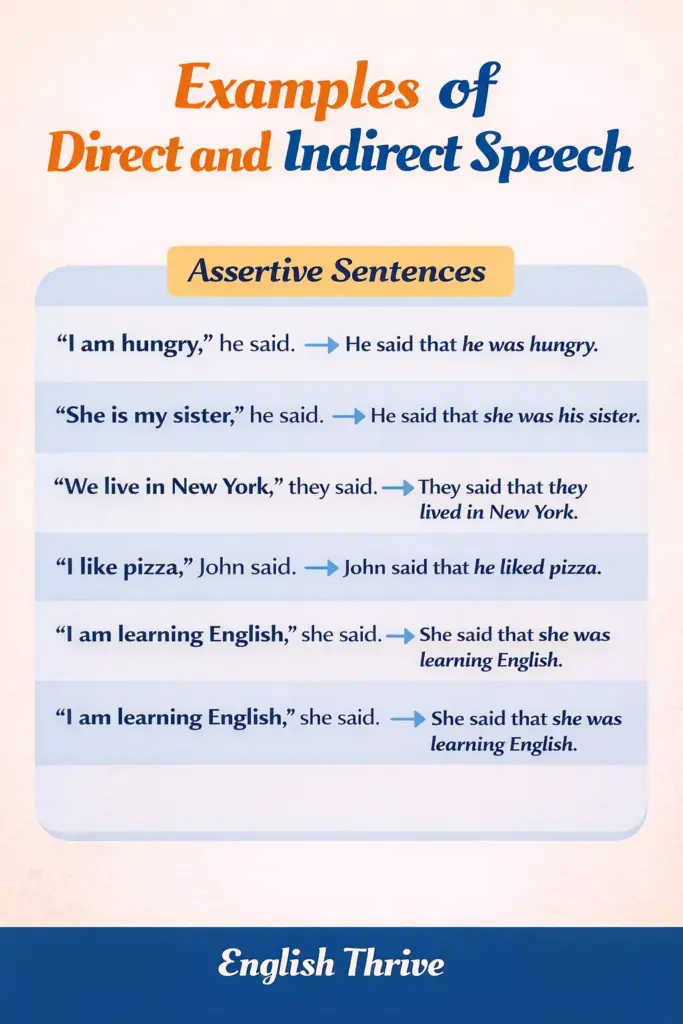
A. Assertive Sentences (Statements)
- “I am hungry,” he said.
→ He said that he was hungry. - “She is my sister,” he said.
→ He said that she was his sister. - “We live in New York,” they said.
→ They said that they lived in New York. - “I like pizza,” John said.
→ John said that he liked pizza. - “I am learning English,” she said.
→ She said that she was learning English. - “He likes coffee,” she said.
→ She said that he liked coffee. - “I have finished my homework,” he said.
→ He said that he had finished his homework. - “They have arrived,” she said.
→ She said that they had arrived. - “I bought a new phone,” he said.
→ He said that he had bought a new phone. - “We played football,” they said.
→ They said that they had played football. - “I was sleeping,” he said.
→ He said that he had been sleeping. - “She was cooking dinner,” he said.
→ He said that she had been cooking dinner. - “I will call you,” she said.
→ She said that she would call me. - “We will help you,” they said.
→ They said that they would help me. - “I can swim,” he said.
→ He said that he could swim. - “She can drive,” he said.
→ He said that she could drive. - “I may be late,” he said.
→ He said that he might be late. - ““We must start at once,” they said.
→ They said that they had to start at once. - “I don’t like noise,” she said.
→ She said that she didn’t like noise. - “He doesn’t know me,” she said.
→ She said that he didn’t know her. - “I am very tired,” he said.
→ He said that he was very tired. - “She loves music,” he said.
→ He said that she loved music. - “We are waiting outside,” they said.
→ They said that they were waiting outside. - “I have lost my keys,” she said.
→ She said that she had lost her keys. - “They were playing chess,” he said.
→ He said that they had been playing chess. - “I will finish it today,” he said.
→ He said that he would finish it that day. - “She can solve this problem,” he said.
→ He said that she could solve that problem. - “We must follow the rules,” they said.
→ They said that they had to follow the rules. - “I like this dress,” she said.
→ She said that she liked that dress. - “He is working late,” she said.
→ She said that he was working late. - “I am feeling better now,” he said.
→ He said that he was feeling better then. - “She has completed the task,” he said.
→ He said that she had completed the task. - “We were playing cards,” they said.
→ They said that they had been playing cards. - “I will not forget this,” she said.
→ She said that she would not forget that. - “He can speak French,” she said.
→ She said that he could speak French. - “I may call you later,” he said.
→ He said that he might call me later. - “We are proud of you,” they said.
→ They said that they were proud of me. - “She was crying,” he said.
→ He said that she had been crying. - “I need some help,” she said.
→ She said that she needed some help. - “They are ready,” he said.
→ He said that they were ready.
B. Interrogative Sentences (Questions)
Yes / No Questions (If / Whether)
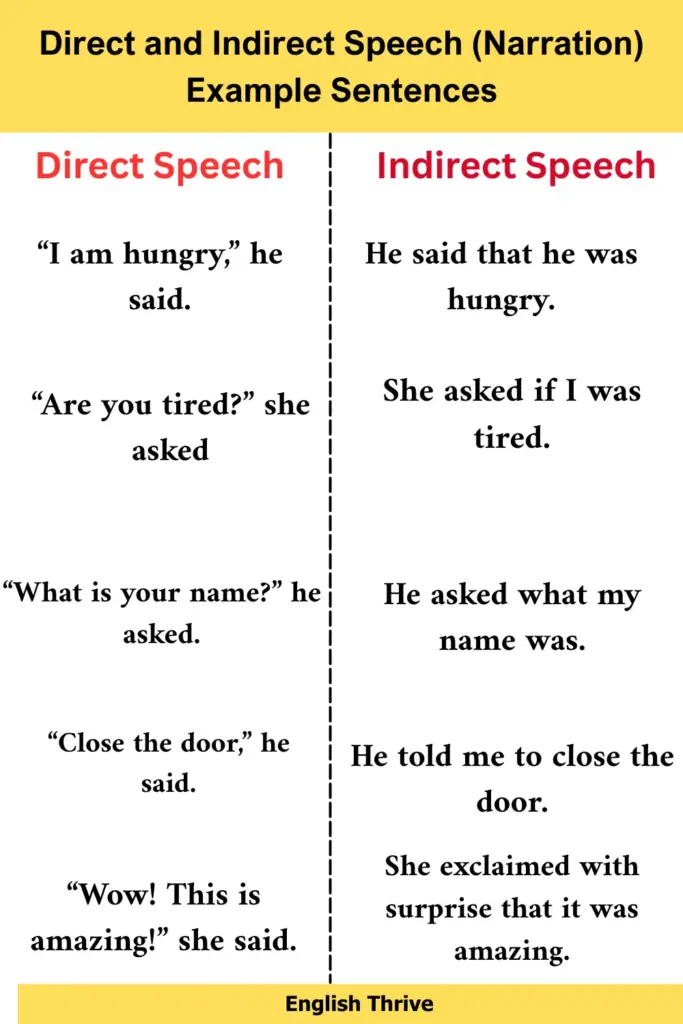
- “Are you tired?” she asked.
→ She asked if I was tired. - “Do you like coffee?” he asked.
→ He asked if I liked coffee. - “Can you help me?” she asked.
→ She asked if I could help her. - “Will you come today?” he asked.
→ He asked if I would come that day. - “Did you see the movie?” she asked.
→ She asked if I had seen the movie. - ““Have you completed the task?” he asked.
→He asked if I had completed the task. - “Is she at home?” he asked.
→ He asked if she was at home. - “Were they late?” she asked.
→ She asked if they had been late. - “Can she sing?” he asked.
→ He asked if she could sing. - “Will they join us?” she asked.
→ She asked if they would join us.
WH-Questions
- “What is your name?” he asked.
→ He asked what my name was. - “Where do you live?” she asked.
→ She asked where I lived. - “When will you arrive?” he asked.
→ He asked when I would arrive. - “Why are you angry?” she asked.
→ She asked why I was angry. - “How did you solve it?” he asked.
→ He asked how I had solved it. - “Which book do you want?” she asked.
→ She asked which book I wanted. - “Who is your teacher?” he asked.
→ He asked who my teacher was. - “Where are they going now?” she asked.
→ She asked where they were going then. - “What time is it?” he asked.
→ He asked what time it was. - “How long have you lived here?” she asked.
→ She asked how long I had lived there.
C. Imperative Sentences (Commands, Requests, Advice)
- “Close the door,” he said.
→ He told me to close the door. - “Please sit down,” the teacher said.
→ The teacher requested us to sit down. - “Don’t make noise,” she said.
→ She told me not to make noise. - “Bring me a glass of water,” he said.
→ He told me to bring him a glass of water. - “Start your exercises,” the teacher said.
→ The teacher told the students to start their exercises. - “Please help your brother,” she said.
→ She asked me to help my brother. - “Don’t touch this wire,” the electrician said.
→ The electrician warned us not to touch that wire. - “Take a left turn,” he said.
→ He told me to take a left turn. - “Please call me tonight,” she said.
→ She asked me to call her that night. - “Study harder,” the coach said.
→ The coach advised us to study harder. - “Read the lesson carefully,” the teacher said.
→ The teacher told the students to read the lesson carefully. - “Don’t be late,” he said.
→ He told me not to be late. - “Follow the instructions,” she said.
→ She told us to follow the instructions. - “Please wait here,” he said.
→ He asked me to wait there. - “Turn off the lights,” she said.
→ She told me to turn off the lights. - “Do not argue,” the judge said.
→ The judge ordered them not to argue. - “Keep quiet,” the librarian said.
→ The librarian told us to keep quiet. - “Try again,” the teacher said.
→ The teacher encouraged me to try again. - “Save your work,” he said.
→ He told me to save my work. - “Please forgive me,” she said.
→ She begged me to forgive her.
D. Exclamatory Sentences
- “Hurrah! We won the match!” they said.
→ They exclaimed with joy that they had won the match. - “Alas! I failed the exam!” he said.
→ He exclaimed with sorrow that he had failed the exam. - “Wow! This is amazing!” she said.
→ She exclaimed with surprise that it was amazing. - “What a lovely morning!” he said.
→ He exclaimed with joy that it was a very lovely morning. - “Oh no! I lost my keys!” she said.
→ She exclaimed with sorrow that she had lost her keys. - “Bravo! You did well!” he said.
→ He exclaimed with joy that I had done well. - “How foolish I was!” she said.
→ She exclaimed with regret that she had been very foolish. - “What a pleasant surprise!” he said.
→ He exclaimed with joy that it was a pleasant surprise. - “Alas! My friend is no more!” she said.
→ She exclaimed with sorrow that her friend was no more. - “How beautiful this painting is!” he said.
→ He exclaimed with admiration that the painting was very beautiful. - “Great! We finished early!” they said.
→ They exclaimed with joy that they had finished early. - “Oh dear! I missed the bus!” she said.
→ She exclaimed with sorrow that she had missed the bus. - “What a brave soldier!” he said.
→ He exclaimed with admiration that the soldier was very brave. - “How lucky you are!” she said.
→ She exclaimed with joy that I was very lucky. - “Alas! The king is dead!” they said.
→ They exclaimed with sorrow that the king was dead. - “What a terrible accident!” he said.
→ He exclaimed with shock that it was a terrible accident. - “Hurrah! Our team qualified!” she said.
→ She exclaimed with joy that their team had qualified. - “How cold it is today!” he said.
→ He exclaimed with surprise that it was very cold that day. - “What a clever answer!” the teacher said.
→ The teacher exclaimed with praise that it was a very clever answer. - “Oh! I forgot my wallet!” she said.
→ She exclaimed with regret that she had forgotten her wallet.
Direct and Indirect Speech Exercises With Answers
Exercise 1: Convert into Indirect Speech
- She said, “I am very happy.”
- He said, “I will help you.”
- The teacher said, “Do your homework.”
Answers
- She said that she was very happy.
- He said that he would help me.
- The teacher told us to do our homework.
Exercise 2: Convert into Direct Speech
- He said that he was tired.
- She asked if I was coming.
Answers
- He said, “I am tired.”
- She asked, “Are you coming?”
FAQs about Direct and Indirect Speech
What is direct and indirect speech with examples?
Direct speech repeats exact words, while indirect speech reports the meaning.
Example:
- Direct: She said, “I am busy.”
- Indirect: She said that she was busy.
Is indirect speech more formal than direct speech?
Yes. Indirect speech is commonly used in academic, professional, and news writing.
Are quotation marks used in indirect speech?
No. Quotation marks are used only in direct speech.
Is tense change always necessary?
No. Tense does not change if:
- The reporting verb is in the present
- The statement is a universal truth
 Direct and Indirect Speech