

British and American English come from the same language, but they use many different words and expressions in everyday life. A phrase that sounds normal in the UK may sound unusual in the US. This can confuse English learners, especially when listening to movies, TV shows, or native speakers.
Learning these differences is very helpful. It makes conversations easier, helps you avoid misunderstandings. It also allows you to sound more natural when speaking English.
In this guide, you will learn:
Common British and American phrases
What each phrase means
How to use them in real-life situations
Which expressions can be confusing
Pronunciation and tone differences
Note: In this article:
GB = British English (United Kingdom)
US = American English (United States)
Why British and American Phrases Differ
British and American English sound very similar, but the phrases people use can be quite different. These differences did not happen overnight. They developed slowly over hundreds of years. Here are the main reasons why British and American phrases are not always the same:
1. Historical Development
When English settlers moved to North America, the language began to change in different ways. Americans created new words based on their daily life, new inventions, and other cultures they met. Meanwhile, British English kept many older words and forms.
Example:
GB: “I’ll ring you.”
US: “I’ll call you.”
Both mean the same, but “call” became more common in the US after the invention of the telephone.
2. Cultural Influence and Media
Movies, music, TV shows, and books shape how people speak. American pop culture is popular worldwide, so many American phrases spread quickly. British media, on the other hand, continues to use traditional expressions and regional slang.
Example:
GB: “That film was brilliant!”
US: “That movie was awesome!”
They express the same idea but with different cultural tones.
3. Everyday Lifestyle and Context
Many phrases come from daily routines — transportation, food, weather, or habits. Each culture chooses different words based on what feels natural to them.
Example:
GB: “Let’s queue for tickets.”
US: “Let’s get in line for tickets.”
The action is the same, but the word choice reflects local customs.
4. Tone, Humor, and Politeness
British English often uses polite understatement or subtle humor. American English is usually more direct and expressive.
Example:
GB: “Not bad.” (often means “really good”)
US: “That’s great!” (straightforward compliment)
Both are positive, but the style is different.
5. Influence of Regional Dialects
Even within each country, people don’t all speak the same way. Regions have their own slang and expressions.
Example:
London slang: “That’s proper good.”
Southern US slang: “That’s real nice.”
These variations add color and personality to each dialect.
 British vs American Phrases
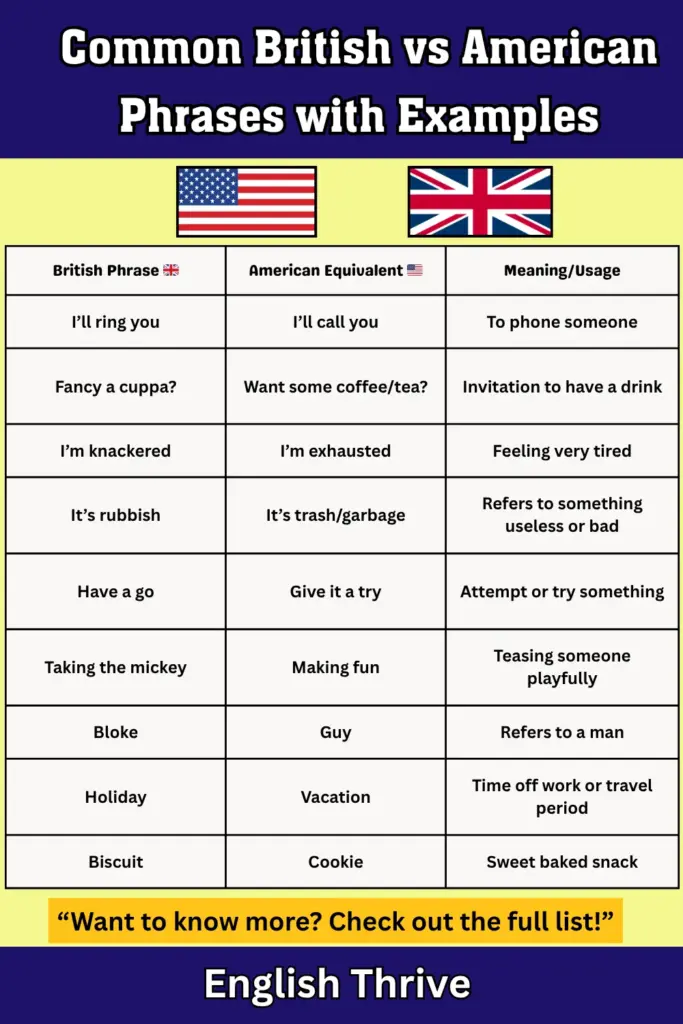
Common British vs American Phrases with Examples
The easiest way to understand the differences between British and American English is to look at real examples. Below is a clear table that shows:
The British phrase
The American phrase
What each phrase means
This helps you see how both versions express the same ideas using different words.
Common British and American Phrases
| British Phrase (GB) | American Equivalent (US) | Meaning / Usage |
|---|---|---|
| I’ll ring you | I’ll call you | To phone someone |
| Fancy a cuppa? | Want some coffee/tea? | Invitation to have a drink |
| I’m knackered | I’m exhausted | Feeling very tired |
| It’s rubbish | It’s trash/garbage | Something useless or very bad |
| Have a go | Give it a try | Try something |
| Taking the mickey | Making fun | Teasing someone playfully |
| Bloke | Guy | A man |
| Holiday | Vacation | Time off work or travel |
| Biscuit | Cookie | Sweet baked snack |
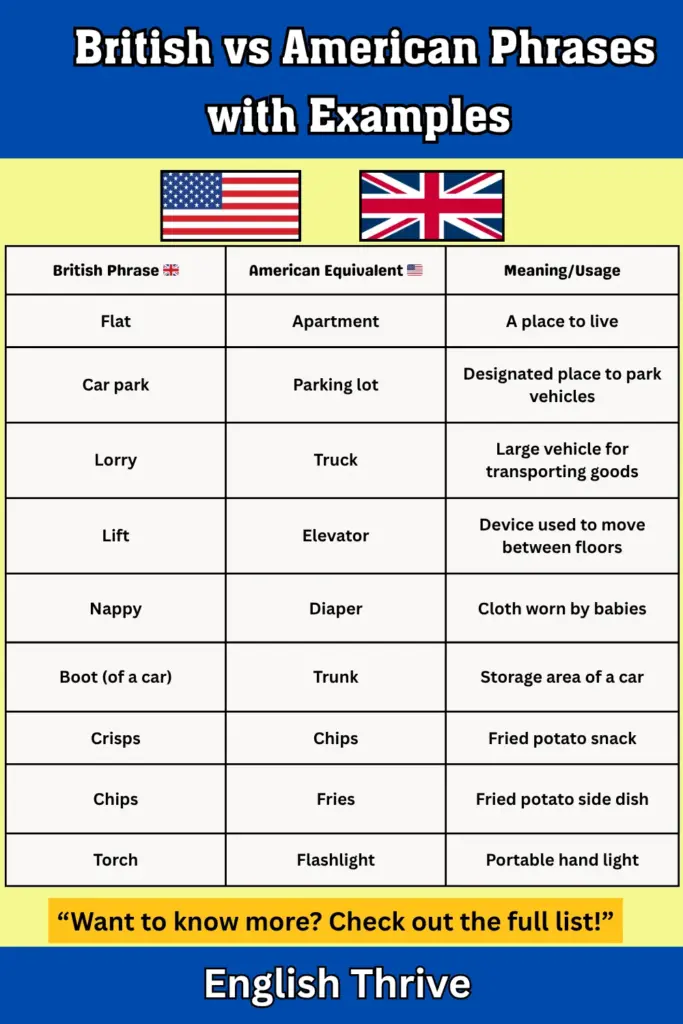
| Flat | Apartment | A place to live |
| Car park | Parking lot | Place to park cars |
| Lorry | Truck | Large vehicle for goods |
| Lift | Elevator | Moves between floors |
| Nappy | Diaper | Baby’s cloth or cover |
| Boot (of a car) | Trunk | Storage area of a car |
| Crisps | Chips | Thin fried potato snack |
| Chips | Fries | Thick fried potatoes |
| Torch | Flashlight | Portable hand light |
| Chemist | Pharmacy | Drugstore/medicine shop |
| Post | Sending letters or parcels |
British vs American Phrases
Phrases That May Confuse English Learners
Some English words look the same in British and American English, but they have very different meanings. These differences can easily confuse learners — and sometimes lead to funny or embarrassing situations.
Here are some of the most common phrases to watch out for:
1. “Pants”
| British English (GB) | American English (US) |
|---|---|
| Pants = underwear | Pants = trousers |
➡️ If you say “I like your pants” in the UK, people may laugh because they think you’re talking about underwear!
2. “Chips”
| GB | US |
|---|---|
| Chips = fries | Chips = crisps |
➡️ In the UK, “fish and chips” means fish and fries.
➡️ In the US, “chips” are the crunchy snack in a bag.
3. “Rubber”
| GB | US |
|---|---|
| Rubber = eraser | Rubber = condom |
➡️ A very important difference to remember!
4. “Bonnet” & “Boot”
| GB | US |
|---|---|
| Bonnet = car hood | Hood = car hood |
| Boot = car trunk | Trunk = car trunk |
➡️ These are common when talking about cars.
5. “Football”
| GB | US |
|---|---|
| Football = soccer | Football = American football |
➡️ Same word, completely different sports.
6. “Table a Meeting”
| GB | US |
|---|---|
| Table = discuss now | Table = postpone/delay |
➡️ This can cause confusion in international workplaces.
7. “Public School”
| GB | US |
|---|---|
| Public school = private, fee-paying school | Public school = free, government school |
➡️ Total opposite meanings!
8. “Quite”
| GB | US |
|---|---|
| Quite good = fairly good | Quite good = very good |
➡️ Same phrase, different levels of enthusiasm.
9. “To Knock Up”
| GB | US |
|---|---|
| Knock up = wake someone by knocking | Knock up = get someone pregnant |
➡️ Definitely a phrase to use very carefully!
10. “Cheers”
| GB | US |
|---|---|
| Cheers = thank you / goodbye | Cheers = toast when drinking |
➡️ In the UK, people say “Cheers!” even when leaving a shop.
Summary Insight:
These confusing phrases do not mean one version of English is wrong. They just show how language changes depending on culture, region, and daily life. The more you see these differences, the easier they are to understand.
100 Everyday British vs American Phrases
British vs American Phrases
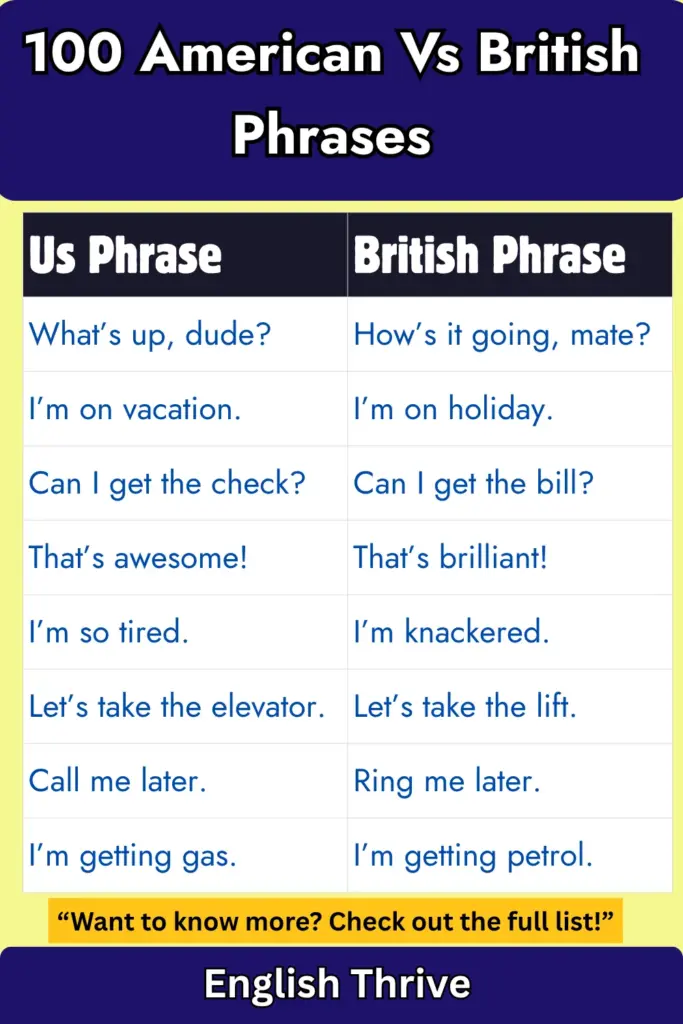
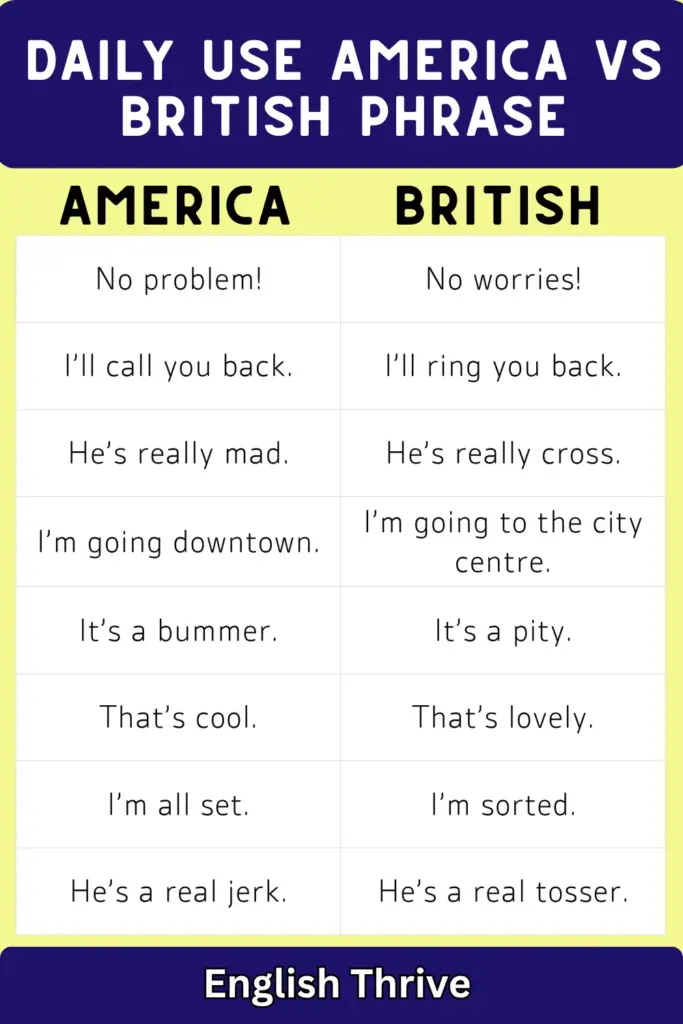
Below is a large list of everyday phrases that are commonly used in both British and American English. These phrases have the same meaning, but the words are different.
Everyday Phrases: GB vs US
| American Phrase (US) | British Phrase (GB) |
|---|---|
| What’s up, dude? | How’s it going, mate? |
| I’m on vacation. | I’m on holiday. |
| Can I get the check? | Can I get the bill? |
| That’s awesome! | That’s brilliant! |
| I’m so tired. | I’m knackered. |
| Let’s take the elevator. | Let’s take the lift. |
| Call me later. | Ring me later. |
| I’m getting gas. | I’m getting petrol. |
| Throw it in the trash. | Put it in the bin. |
| I’m going to the movies. | I’m going to the cinema. |
| It’s raining hard. | It’s chucking it down. |
| I need to use the restroom. | I need to use the loo. |
| I’ll take a rain check. | I’ll take a rain date. |
| Let’s grab some fries. | Let’s grab some chips. |
| That’s total garbage. | That’s absolute rubbish. |
| I’m broke. | I’m skint. |
| No problem! | No worries! |
| I’ll call you back. | I’ll ring you back. |
| He’s really mad. | He’s really cross. |
| I’m going downtown. | I’m going to the city centre. |
| It’s a bummer. | It’s a pity. |
| That’s cool. | That’s lovely. |
| I’m all set. | I’m sorted. |
| He’s a real jerk. | He’s a real tosser. |
| You did a great job. | You did a cracking job. |
| It’s my turn. | It’s my go. |
| Take out the trash. | Take out the rubbish. |
| I live in an apartment. | I live in a flat. |
| She’s pregnant. | She’s expecting. |
| It’s a piece of cake. | It’s easy peasy. |
| Let’s go to the mall. | Let’s go to the shopping centre. |
| I need a flashlight. | I need a torch. |
| I can’t find my cell phone. | I can’t find my mobile. |
| He’s a stand-up guy. | He’s a proper bloke. |
| That’s a tough break. | That’s bad luck. |
| It costs five bucks. | It costs five quid. |
| Time to go to work. | Time to go to the office. |
| I’m starving. | I’m famished. |
| Let’s take out food. | Let’s get a takeaway. |
| Can I have some candy? | Can I have some sweets? |
| I’m going to the drugstore. | I’m going to the chemist. |
| It’s over there. | It’s just over there. |
| That’s so funny. | That’s hilarious. |
| I’m feeling good today. | I’m feeling quite well today. |
| He’s crazy. | He’s barking mad. |
| Let’s grab a drink. | Let’s have a pint. |
| I’m pissed off. | I’m cheesed off. |
| He’s drunk. | He’s pissed. |
| That’s messed up. | That’s dodgy. |
| Let’s hit the road. | Let’s set off. |
| I’ll take the subway. | I’ll take the underground. |
| I’m in college. | I’m at university. |
| He’s in kindergarten. | He’s in nursery. |
| It’s a tie game. | It’s a draw. |
| Take the elevator up. | Take the lift up. |
| Wait in line. | Queue up. |
| I need to take a shower. | I need to have a shower. |
| Let’s meet on the weekend. | Let’s meet at the weekend. |
| That’s awesome news! | That’s brilliant news! |
| I’m sick. | I’m ill. |
| I’m mad at you. | I’m cross with you. |
| He’s my roommate. | He’s my flatmate. |
| I’m going to the store. | I’m going to the shop. |
| Fill out the form. | Fill in the form. |
| Write your zip code. | Write your postcode. |
| I’m taking out the trash. | I’m taking out the rubbish. |
| I’m calling 911! | I’m calling 999! |
| Go straight ahead. | Go straight on. |
| Take a left turn. | Turn left. |
| It’s half past three. | It’s half three. |
| It’s quarter after two. | It’s quarter past two. |
| Let’s grab dinner. | Let’s have tea. |
| Let’s go to the bar. | Let’s go to the pub. |
| That’s a bummer. | That’s a shame. |
| He’s nuts. | He’s mental. |
| I don’t get it. | I don’t understand it. |
| I’m going to the DMV. | I’m going to the DVLA. |
| She’s in first grade. | She’s in year two. |
| I mailed the letter. | I posted the letter. |
| I’m taking the freeway. | I’m taking the motorway. |
| I’ll call you tomorrow. | I’ll ring you tomorrow. |
| It’s not my fault. | It’s not my problem. |
| Let’s take a break. | Let’s have a rest. |
| I’ll pick you up. | I’ll collect you. |
| I got laid off. | I got made redundant. |
| Let’s grab a coffee. | Let’s have a cuppa. |
| He’s in trouble. | He’s in a spot of bother. |
| That’s hilarious! | That’s a good laugh! |
| It’s really expensive. | It’s quite dear. |
| It’s super cheap. | It’s dead cheap. |
| I’m fine, thanks. | I’m alright, cheers. |
| Can you call me? | Can you ring me? |
| Wait a second. | Hang on a moment. |
| Go ahead. | After you. |
| I’ll see you later. | I’ll catch you later. |
| You nailed it! | You smashed it! |
| It’s not working. | It’s gone wrong. |
| That’s not fair. | That’s out of order. |
| It’s over there. | It’s just over there, innit? |
British vs American Phrases
Pronunciation and Tone Differences in Phrases
British and American English do not just use different words — they also sound different. Pronunciation, rhythm, and tone can change how phrases feel, even when the words are similar.
Below are the key differences explained in easy language.
1. The “R” Sound
One of the biggest differences is how each version pronounces the letter R.
American English (US)
Americans pronounce the R clearly.
Words like “car,” “mother,” and “hard” have a strong R sound.
👉 Example: “Carrr”
British English (GB)
Many British accents do not pronounce the R at the end.
The R becomes softer or silent.
👉 Example: “Cah” (for “car”)
2. Stress and Rhythm
Stress = which word or syllable is said louder or with more emphasis.
US English
Stronger, more even rhythm
Words often have more equal stress
GB English
Softer rhythm
Pitch goes up and down more
Stress changes more between words
Example sentence:
US: “I can’t possibly do that.” (stronger overall stress)
GB: “I can’t possibly do that.” (stress on “possibly”)
Both mean the same, but the feeling is different.
3. Intonation and Politeness
Tone expresses emotion. British and American English often use tone in different ways.
British English
More indirect
Uses understatement
Sounds polite or soft
Example:
“Not bad.” → This often means “really good.”
American English
More direct
More enthusiastic
Shows emotion clearly
Example:
“That’s awesome!” → Very strong and positive.
Why These Differences Matter
When speaking with people from the US or UK, their tone may change the meaning. For example:
A British “Not bad” = very positive
An American “Not bad” = average or okay
Understanding these small differences helps you:
✔ avoid misunderstandings
✔ communicate more naturally
✔ sound more confident
Real-Life Examples in Context
Seeing phrases in real conversations helps you understand how British and American English are used in everyday life. Below are simple dialogues that show common differences.
Conversation 1 – Travel Plans
GB (British):
Emma: Shall we take the lift to the car park?
US (American):
Olivia: Do you mean the elevator to the parking lot?
Emma: Yes, exactly! I keep forgetting what you call it here.
Conversation 2 – At a Café
GB:
Liam: Fancy a cuppa before we head out?
US:
Jack: Sure! You mean coffee, right?
GB:
Liam: Actually, tea. We can get coffee later.
Conversation 3 – Casual Chat
GB:
Ella: I’m absolutely knackered after that run.
US:
Sophia: Same here — I’m totally exhausted!
Ella: Looks like we both need a nap.
Conversation 4 – At Work
GB:
Tom: Let’s table this issue for now and talk about it tomorrow.
US:
John: Wait… do you mean discuss it now or postpone it?
Tom: Oh, right! In Britain, “table” means to discuss it now.
Tips to Master British and American Phrases
Learning both British and American English is easier when you practice a little each day. Here are some simple tips that can help you understand and use both versions more confidently.
1. Watch and Listen Actively
Listen to both British and American voices in:
movies
TV shows
YouTube videos
podcasts
Examples:
British: The Crown, Sherlock
American: Friends, The Office (US)
Pay attention to how people use phrases and how their tone sounds.
2. Read Different Types of Content
Reading from both regions helps you learn vocabulary naturally.
Try reading:
BBC or The Guardian (British)
The New York Times or Time Magazine (American)
This helps you see how words are used in real sentences.
3. Use Both in Practice
Practice makes learning easier.
Try this:
Write one short paragraph in British English
Write another in American English
Focus on using the correct spelling and vocabulary for each.
4. Talk with Native Speakers or Language Partners
Join English-speaking groups online or on language apps.
Ask them:
“Does this phrase sound natural in your dialect?”
Most people are happy to help.
5. Keep a Phrase Journal
Write new phrases you learn in a notebook or on your phone.
Include:
whether it is GB or US
the meaning
one example sentence
Reviewing often will help you remember better.
Common Mistakes Learners Make
Many beginners make the same mistakes when trying to use both British and American English. Here are a few to avoid:
1. Mixing Both Styles in One Sentence
Example of a mix:
“My favourite color is blue.”
(“Favourite” = British, “color” = American)
Stick to one style in each sentence.
2. Assuming Words Mean the Same Everywhere
Words like “chips,” “pants,” or “rubber” do not mean the same thing in every dialect.
Always check the meaning first.
4. Ignoring Tone and Context
Some phrases sound natural in one country but unusual in another.
Example:
“Cheers!”
GB: means “thank you” or “goodbye”
US: usually only used when drinking
These simple tips will help you understand both versions of English and use them with confidence.
Final Thoughts
British and American English may use different words, phrases, and tones, but both versions are correct. They simply reflect the culture and habits of the people who use them.
When you understand these differences, you can:
Communicate more clearly
Avoid confusing situations
Sound more natural with native speakers
Enjoy movies, conversations, and books from both countries
Remember, learning a language is not about being perfect. It’s about expressing yourself and connecting with others. Whether you say “vacation” or “holiday,” “apartment” or “flat,” the most important thing is that people understand you.
Stay curious, keep practicing, and enjoy exploring both accents and styles of English.
“English is one language with two beautiful voices — enjoy learning both.”