

Finding animal names that begin with the letter “X” might seem like a challenge, but there are a surprising number of fascinating creatures whose names fit the bill. From rare reptiles to majestic birds, animals that start with X are unique and often intriguing. If you’ve ever wondered about the animals that inhabit the more obscure corners of the animal kingdom, this list will be a rewarding dive into the lesser-known fauna.
In this article, we’ll explore a variety of animals starting with the letter “X,” shedding light on their habitats, characteristics, and some fun facts about them. You’ll be amazed at the diversity of life that exists, even in the most unusual letters of the alphabet. Let’s get started with some intriguing animal species that start with X.
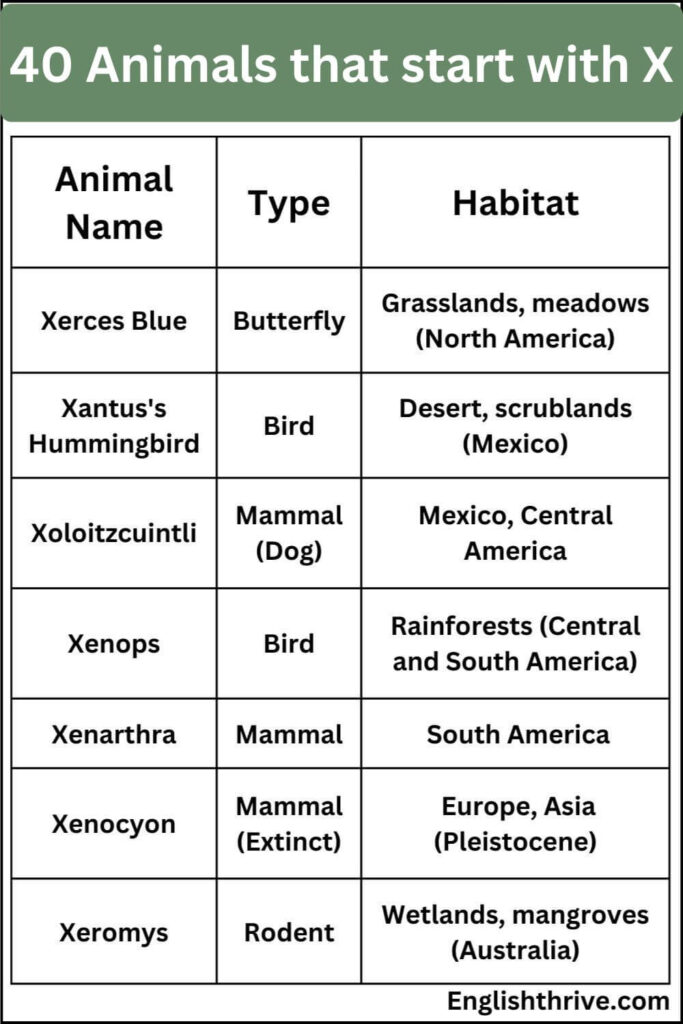
40 Animals that start with X
| Animal Name | Type | Habitat | Interesting Facts |
|---|---|---|---|
| Xerces Blue | Butterfly | Grasslands, meadows (North America) | Extinct butterfly, first species to be protected under the Endangered Species Act. |
| Xantus’s Hummingbird | Bird | Desert, scrublands (Mexico) | Named after John Xantus, a Hungarian naturalist. Known for its vibrant green and blue plumage. |
| Xoloitzcuintli | Mammal (Dog) | Mexico, Central America | One of the oldest and rarest dog breeds, the Mexican Hairless dog, with a history dating back thousands of years. |
| Xenops | Bird | Rainforests (Central and South America) | Small, insectivorous bird, known for foraging in dense vegetation using specialized beaks. |
| Xenarthra | Mammal | South America | Group of mammals including anteaters, armadillos, and sloths, known for their unique joint structure. |
| Xenocyon | Mammal (Extinct) | Europe, Asia (Pleistocene) | Extinct genus of large canid related to wolves. |
| Xeromys | Rodent | Wetlands, mangroves (Australia) | Endangered rodent species, nocturnal, plays a role in controlling insect populations. |
| Xantus’s Leaf-Toed Gecko | Reptile | Arid regions, rocky hills (Mexico) | Rare species of gecko adapted to arid environments, with specialized toe pads for climbing. |
| Xenocara | Fish | Coral reefs (Pacific Ocean) | Genus of brightly colored reef fish, popular in aquariums for their striking appearance. |
| Xingyu’s Armadillo | Mammal | Grasslands, tropical regions (South America) | This armadillo species is known for its distinctive armor and nocturnal habits. |
| Xenoturbella | Marine Invertebrate | Deep ocean floor (Atlantic) | A simple, primitive marine invertebrate, believed to be one of the most ancient animal groups. |
| Xenocereus | Cactus (Plant) | Desert regions (Mexico) | A genus of cacti often found in arid desert regions, important for local ecosystems. |
| Xiphosura | Arthropod | Coastal and freshwater habitats | A class that includes horseshoe crabs, which have existed for over 450 million years and are not true crabs. |
| Xenon | Fish | Freshwater lakes (North America) | Genus of fish, often found in freshwater lakes, known for their resilience to environmental changes. |
| Xerophilous Beetle | Insect | Desert regions | These beetles are adapted to arid conditions, capable of surviving extreme heat and drought. |
| Xeric Salamander | Amphibian | Desert (North America) | Adapted to dry, rocky environments; it is able to burrow to escape extreme temperatures. |
| Xylocopa | Bee | Woodlands, tropical regions | Carpenter bee species known for creating nests by burrowing into wood, important for pollination. |
| Xeric Ant | Insect | Deserts and arid climates | A species of ant specially adapted to life in dry, hot conditions, capable of surviving with minimal water. |
| Xenopsylla | Insect | Worldwide, particularly in homes | A genus of fleas, including the infamous Xenopsylla cheopis (rat flea), known for spreading diseases like plague. |
| Xeromys | Rodent | Wetlands (Australia) | An endangered rodent, once abundant in the mangrove swamps of northern Australia. |
| Xenophora | Mollusk | Oceans (Tropical regions) | A genus of sea snails that collect various objects, including shells, as a form of defense against predators. |
| Xander’s Piranha | Fish | Freshwater rivers (South America) | A rare species of piranha, known for its powerful jaws and sharp teeth used for hunting in river environments. |
| Xema sabini | Bird | Coastal regions (North America) | A species of gull found in coastal areas, known for its strong flight abilities. |
| Xyloryctes | Insect | Tropical regions (South America) | A genus of moths, often found in tropical climates, that are known for their nocturnal behavior and distinct larvae. |
| Xenia Coral | Coral | Coral reefs (Pacific Ocean) | Soft coral species known for its fascinating ability to move and sway with the water currents. |
| Xiphophorus | Fish | Freshwater rivers (Mexico) | Genus of fish, including the popular swordtail, known for their long, ornamental tails. |
| Xenodon | Reptile (Snake) | Central and South America | A genus of snakes that are primarily nocturnal and feed on amphibians and small reptiles. |
| Xerotolerant Cactus | Plant | Arid regions (Mexico, Arizona) | A type of cactus able to endure extreme heat and dryness, often with minimal rainfall. |
| Xanthocephalus | Bird | Wetlands (North America) | A genus of birds commonly found in wetlands, often known for their vibrant yellow heads. |
| Xerotilapia | Fish | Lakes and rivers (Africa) | A genus of cichlid fish, native to lakes and rivers in Africa, particularly known for its adaptability in various aquatic conditions. |
| Xanthocephalus texanus | Bird | Grasslands (Texas, USA) | This bird species is found in grassland habitats and is easily recognizable by its distinctive yellow head and black wings. |
| Xenophyes | Insect | Rainforests (South America) | A genus of insects found primarily in South American rainforests, characterized by their camouflage abilities. |
| Xenodon punctatissimus | Reptile (Snake) | Forests, Central America | A rare species of snake, known for its striking appearance and subtle camouflage patterns that help it blend into the forest floor. |
| Xysticus | Spider | Worldwide (mostly temperate zones) | A genus of crab spiders, characterized by their ability to ambush prey from camouflage. |
| Xeroxena | Mollusk | Coastal regions | Marine mollusks often found in coastal waters, where they contribute to the biodiversity of shallow ocean habitats. |
| Xenorhynchus | Fish | Freshwater lakes (Central Asia) | A species of fish, typically found in Central Asian lakes, known for its long snout used to sift through sediment for food. |
| Xylaria | Fungus | Forest floors (Temperate regions) | A genus of fungi often found decaying wood on forest floors, playing a crucial role in decomposition. |
| Xerophyllum | Plant | North American plains | Known for its tall, grass-like appearance, Xerophyllum thrives in dry, open fields and is often found in temperate North America. |
| Xanthoceras sorbifolium | Tree | China, East Asia | A deciduous tree known for its beautiful white flowers that bloom in spring. |
| Xenostegia | Fish | Tropical waters (Pacific Ocean) | A tropical fish genus, notable for its colorful appearance and adaptability to various types of reef environments. |
FAQs About Animals that Start with X
What are some examples of animals that start with X?
There are several animals that begin with the letter X, although many are rare or obscure. Notable examples include the Xerces Blue, a butterfly that is now extinct; the Xoloitzcuintli, a Mexican hairless dog breed; and the Xenops, a small bird found in the rainforests of Central and South America. Additionally, there are extinct animals like the Xenocyon, a large canid, and lesser-known species like the Xeromys, a rodent from Australia.
What is the Xerces Blue butterfly?
The Xerces Blue was a small butterfly once found in the grasslands of California. It is famously known as the first butterfly to be declared extinct due to human activity, particularly the destruction of its natural habitat. The species was last observed in the 1940s, and despite efforts to find a population, it remains one of the most significant examples of human impact on biodiversity. Conservationists still study the Xerces Blue to learn more about habitat protection and species preservation.
What makes the Xoloitzcuintli special?
The Xoloitzcuintli, also known as the Mexican hairless dog, is one of the oldest and rarest dog breeds. This ancient breed has been around for thousands of years, and it holds cultural significance in Mexico. The Xoloitzcuintli is not just unique for its hairlessness but also for its size variation—ranging from small to large. Additionally, it is known for its loyal and calm temperament, making it a great companion. The breed has a long history and was revered by the Aztecs, Toltecs, and Maya civilizations.
Where can you find the Xantus’s hummingbird?
The Xantus’s Hummingbird is found in the desert and scrubland regions of Mexico. This hummingbird is famous for its striking, iridescent green and blue plumage, especially in males. It is primarily found in the Baja California Peninsula but can also be spotted in other dry regions across Mexico. Unfortunately, like many species, this hummingbird is threatened by habitat loss and climate change. Conservation efforts are underway to protect its natural environment.
What is Xenarthra, and which animals belong to it?
Xenarthra refers to a group of placental mammals that include anteaters, sloths, and armadillos. These creatures are native to South America, with some species found in Central America as well. The name Xenarthra means “strange joints,” referring to their unique joint structures. These animals are well-adapted to their environments, with anteaters specializing in insect-eating, sloths in a slow, arboreal lifestyle, and armadillos with their tough, protective armor.
What do Xenops eat?
Xenops, a small bird species found in Central and South America’s tropical rainforests, primarily feed on insects. These birds have specialized beaks that allow them to forage for insects in dense foliage, even in hard-to-reach places. They are insectivores and play an important role in controlling insect populations within their ecosystem.
Conclusion On Animals That Start with W
Exploring animals that start with X offers a fascinating glimpse into the diversity and complexity of the animal kingdom. While many of these creatures, such as the Xerces Blue Butterfly and Xenocyon canid, are rare or even extinct, they provide valuable insights into the evolution and conservation of wildlife. Others, like the Xoloitzcuintli and Xantus’s Hummingbird, continue to thrive today, each with their own unique characteristics and significance.
In conclusion, although “X” may seem like a rare letter when it comes to animal names, a surprising variety of species start with it. From the ancient Xoloitzcuintli dog to the elusive Xenops bird, animals that begin with X hold a special place in the biodiversity of our planet. Understanding and protecting these species is essential for maintaining the delicate balance of nature.