

Have you ever noticed how adding the right adverb can instantly transform a simple sentence into something more impactful? Adverbs that start with I are particularly interesting as they help us express intensity, immediacy, and intent in our communication.
As a language instructor for over a decade, I’ve seen how mastering these adverbs can dramatically improve both writing and speaking skills.
Let’s explore these versatile words together and discover how they can add precision and power to your expressions.
Definition of Adverbs with Examples
An adverb is a word that modifies or provides more information about a verb, an adjective, or another adverb. Adverbs that start with I frequently express intensity, method, or timing of actions, adding clarity and emphasis to our communication.
Examples:
- Immediately – He immediately responded to the emergency call.
- Intelligently – She intelligently solved the complex problem.
- Intensely – The team intensely focused on their goal.
- Invariably – The sun invariably rises in the east.
- Impressively – The young athlete performed impressively in the competition.
45 List of Adverbs That Start With I
| Adverb | Synonym | Example |
|---|---|---|
| Ideally | Perfectly | The plan worked ideally for everyone involved. |
| Idiotically | Foolishly | He idiotically forgot to save his work. |
| Idly | Lazily | She sat idly watching the clouds pass by. |
| Ignominiously | Shamefully | The team ignominiously lost the match. |
| Ignorantly | Unknowingly | He ignorantly made the situation worse. |
| Illegally | Unlawfully | The driver illegally parked in the restricted zone. |
| Illicitly | Improperly | They illicitly accessed the private files. |
| Illogically | Irrationally | She illogically jumped to conclusions. |
| Imaginatively | Creatively | The artist imaginatively used colors in his work. |
| Immediately | Instantly | They immediately responded to the emergency. |
| Immensely | Greatly | The audience immensely enjoyed the performance. |
| Immaculately | Perfectly | The house was immaculately clean. |
| Immaturely | Childishly | He reacted immaturely to the criticism. |
| Imminently | Soon | The storm is imminently approaching. |
| Impartially | Fairly | The judge ruled impartially on the case. |
| Impatiently | Restlessly | She waited impatiently for the results. |
| Impeccably | Flawlessly | The suit was impeccably tailored. |
| Imperceptibly | Unnoticeably | The temperature imperceptibly rose throughout the day. |
| Imperially | Regally | The palace was imperially decorated. |
| Impertinently | Rudely | He impertinently interrupted the speaker. |
| Impetuously | Rashly | She impetuously made the decision. |
| Implicitly | Indirectly | He implicitly suggested a solution. |
| Impressively | Remarkably | The student performed impressively on the test. |
| Improperly | Incorrectly | The form was improperly filled out. |
| Impulsively | Spontaneously | She impulsively bought the dress. |
| Inadequately | Insufficiently | The problem was inadequately addressed. |
| Inaudibly | Silently | He inaudibly whispered the answer. |
| Incessantly | Continuously | The phone rang incessantly all day. |
| Incidentally | Casually | Incidentally, I met your sister yesterday. |
| Incompetently | Poorly | The task was incompetently handled. |
| Incongruously | Inappropriately | The modern art looked incongruously placed in the ancient building. |
| Inconspicuously | Discreetly | She inconspicuously left the party. |
| Increasingly | Progressively | The situation became increasingly difficult. |
| Incredibly | Amazingly | The story was incredibly fascinating. |
| Indecently | Improperly | He behaved indecently at the formal event. |
| Independently | Autonomously | She works independently from home. |
| Indifferently | Apathetically | He responded indifferently to the news. |
| Indignantly | Angrily | She reacted indignantly to the accusation. |
| Indirectly | Obliquely | He indirectly referred to the problem. |
| Individually | Separately | The students were individually assessed. |
| Industriously | Diligently | The ants worked industriously all summer. |
| Ineffectively | Unsuccessfully | The medicine worked ineffectively. |
| Inevitably | Unavoidably | The rain inevitably ruined the outdoor event. |
| Inexorably | Relentlessly | Time moved inexorably forward. |
| Infectiously | Contagiously | She smiled infectiously at the crowd. |
35 Positive Adverbs That Start With I
| Adverb | Description (with synonyms) | Example sentence |
|---|---|---|
| Ideally | In a perfect or most suitable manner (perfectly, optimally, flawlessly) | The project went ideally according to plan. |
| Imaginatively | In a creative and inventive way (creatively, innovatively, resourcefully) | The children imaginatively solved the puzzle. |
| Immediately | Without delay or hesitation (instantly, promptly, straightaway) | She immediately responded to the emergency call. |
| Immaculately | In a perfectly clean or neat way (perfectly, spotlessly, flawlessly) | The house was immaculately maintained. |
| Immensely | To a very great extent (greatly, enormously, tremendously) | They immensely enjoyed their vacation. |
| Impartially | In a fair and unbiased manner (fairly, objectively, neutrally) | The referee judged impartially throughout the match. |
| Impeccably | Without fault or error (flawlessly, perfectly, faultlessly) | He was impeccably dressed for the occasion. |
| Impressively | In a way that creates admiration (remarkably, wonderfully, extraordinarily) | The young pianist performed impressively at the recital. |
| Improvisationally | In a spontaneous and creative way (spontaneously, extemporaneously, freely) | The jazz musician played improvisationally during the solo. |
| Incessantly | In a continuous manner (continuously, constantly, perpetually) | The birds sang incessantly throughout spring. |
| Incisively | In a clear and direct manner (sharply, precisely, accurately) | She thought incisively about the complex problem. |
| Incredibly | In an amazing or unbelievable way (amazingly, remarkably, extraordinarily) | The team played incredibly well in the finals. |
| Independently | In a self-reliant manner (autonomously, self-sufficiently, freely) | She works independently from her home office. |
| Industriously | In a diligent and hardworking way (diligently, assiduously, busily) | The students worked industriously on their projects. |
| Inevitably | In an unavoidable way (certainly, necessarily, surely) | Success inevitably follows hard work. |
| Infinitely | Without limit or end (endlessly, boundlessly, limitlessly) | The universe extends infinitely in all directions. |
| Influentially | With great impact or effect (powerfully, effectively, significantly) | She spoke influentially at the conference. |
| Informatively | In an educational and helpful way (helpfully, instructively, enlighteningly) | The guide spoke informatively about local history. |
| Ingeniously | In a clever and original way (cleverly, brilliantly, creatively) | He ingeniously solved the technical problem. |
| Inherently | In an essential or natural way (naturally, intrinsically, fundamentally) | The solution was inherently simple. |
| Inimitably | In a unique and unrepeatable way (uniquely, distinctively, incomparably) | She danced inimitably across the stage. |
| Innovatively | In a new and creative way (creatively, originally, inventively) | The company innovatively approached the challenge. |
| Insightfully | With deep understanding (perceptively, wisely, astutely) | She commented insightfully on the situation. |
| Inspirationally | In a motivating way (motivationally, uplifting, encouragingly) | The coach spoke inspirationally to the team. |
| Instantaneously | Happening immediately (immediately, instantly, promptly) | The computer responded instantaneously to the command. |
| Instinctively | In a natural and unlearned way (naturally, automatically, spontaneously) | She instinctively knew how to handle the situation. |
| Instructively | In an educational manner (educationally, informatively, helpfully) | The professor explained instructively to the class. |
| Integrally | In an essential or fundamental way (essentially, fundamentally, necessarily) | The components worked integrally together. |
| Intellectually | In a thoughtful and rational way (mentally, rationally, cognitively) | They discussed the issue intellectually. |
| Intelligently | In a smart and logical way (wisely, sensibly, cleverly) | She intelligently approached the problem. |
| Intensely | With great force or strength (powerfully, strongly, deeply) | The athletes trained intensely for the competition. |
| Interactively | In a way involving participation (participatively, engagingly, actively) | The workshop was conducted interactively. |
| Interestingly | In an engaging way (fascinatingly, captivating, engagingly) | She presented the material interestingly. |
| Intuitively | Based on natural feelings (instinctively, naturally, spontaneously) | He intuitively understood what needed to be done. |
| Invariably | Without fail or change (consistently, always, unfailingly) | The mail arrives invariably at 10 AM. |
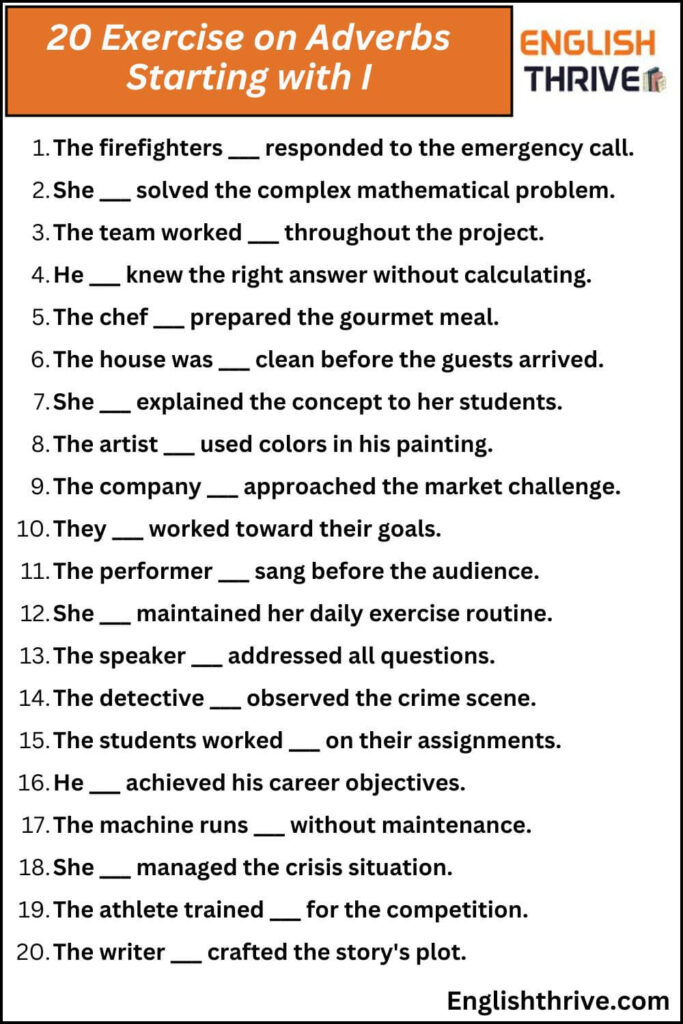
20 Exercise on Adverbs Starting with I
(with Answers at the Bottom)
- The firefighters ___ responded to the emergency call.
- She ___ solved the complex mathematical problem.
- The team worked ___ throughout the project.
- He ___ knew the right answer without calculating.
- The chef ___ prepared the gourmet meal.
- The house was ___ clean before the guests arrived.
- She ___ explained the concept to her students.
- The artist ___ used colors in his painting.
- The company ___ approached the market challenge.
- They ___ worked toward their goals.
- The performer ___ sang before the audience.
- She ___ maintained her daily exercise routine.
- The speaker ___ addressed all questions.
- The detective ___ observed the crime scene.
- The students worked ___ on their assignments.
- He ___ achieved his career objectives.
- The machine runs ___ without maintenance.
- She ___ managed the crisis situation.
- The athlete trained ___ for the competition.
- The writer ___ crafted the story’s plot.
Answer:
- Immediately
- Intelligently
- Industriously
- Instinctively
- Impeccably
- Immaculately
- Informatively
- Imaginatively
- Innovatively
- Intensely
- Impressively
- Invariably
- Insightfully
- Intently
- Independently
- Inevitably
- Invariably
- Intelligently
- Intensely
- Ingeniously
20 Multiple Choice Questions
- Which adverb means “without delay”? a) Instantly b) Immediately c) Internally d) Indirectly
- What type of adverb is “increasingly”? a) Adverb of manner b) Adverb of degree c) Adverb of time d) Adverb of place
- Which sentence uses an adverb of manner? a) He works independently. b) The project is inevitably delayed. c) She immediately left. d) They increasingly worry.
- Which adverb can modify both a verb and an adjective? a) Instantly b) Incredibly c) Initially d) Independently
- Which sentence uses an adverb correctly? a) She danced imaginative. b) He spoke intelligently. c) They work intense. d) We run immediate.
- What type of adverb is “intuitively”? a) Adverb of manner b) Adverb of degree c) Adverb of time d) Adverb of place
- Choose the correct adverb: a) She sang incredible. b) He worked intensive. c) They performed impressively. d) We speak instant.
- Which adverb means “without changing”? a) Independently b) Increasingly c) Invariably d) Instantly
- What type of adverb is “intensely”? a) Adverb of time b) Adverb of manner c) Adverb of place d) Adverb of frequency
- Which sentence uses the adverb correctly? a) The team played intensive. b) She ran immediate. c) He spoke intelligently. d) They work incredible.
- Which adverb describes frequency? a) Immediately b) Inevitably c) Incessantly d) Internally
- Choose the correct usage: a) She sings incredible. b) He works industriously. c) They run intense. d) We speak immediate.
- What type of adverb is “impressively”? a) Adverb of manner b) Adverb of time c) Adverb of place d) Adverb of degree
- Which adverb shows manner? a) Increasingly b) Immediately c) Intelligently d) Inevitably
- Choose the correct form: a) He spoke intelligent. b) She ran immediate. c) They worked industriously. d) We sing incredible.
- Which is an adverb of degree? a) Immediately b) Intensely c) Internally d) Initially
- What type of adverb is “ideally”? a) Adverb of manner b) Adverb of time c) Adverb of place d) Adverb of degree
- Select the correct usage: a) She dances incredible. b) He works intensive. c) They speak intelligently. d) We run immediate.
- Which adverb modifies another adverb? a) Incredibly b) Initially c) Instantly d) Internally
- Choose the correct form: a) The artist painted imaginative. b) The student studied industriously. c) The runner moved intense. d) The speaker talked immediate.
Multiple Choice Answer:
- b) Immediately
- b) Adverb of degree
- a) He works independently
- b) Incredibly
- b) He spoke intelligently
- a) Adverb of manner
- c) They performed impressively
- c) Invariably
- b) Adverb of manner
- c) He spoke intelligently
- c) Incessantly
- b) He works industriously
- a) Adverb of manner
- c) Intelligently
- c) They worked industriously
- b) Intensely
- a) Adverb of manner
- c) They speak intelligently
- a) Incredibly
- b) The student studied industriously
FAQs on Adverbs That Start With I
How do I know when to use I-adverbs in my writing?
Understanding when to use adverbs that start with I requires considering the specific meaning and impact you want to convey. These adverbs often express intensity, manner, or timing. For example, use “immediately” when emphasizing quick action, “intelligently” when describing how something is done thoughtfully, or “increasingly” when showing gradual change. The key is to choose adverbs that add meaningful information without being redundant. Consider whether the adverb truly enhances your message or if a stronger verb might work better.
What’s the difference between I-adverbs and their adjective forms?
The main distinction lies in what these words modify. I-adverbs modify verbs, other adverbs, or adjectives, while their adjective counterparts modify nouns. For example, “intelligent” is an adjective that describes a noun (“an intelligent student”), while “intelligently” is an adverb that describes how an action is performed (“she answered intelligently”). Most I-adverbs are formed by adding “-ly” to their adjective forms, though there are exceptions. Understanding this difference helps in using these words correctly in sentences.
Can I-adverbs be used at the beginning of a sentence?
Yes, I-adverbs can often start sentences, particularly when you want to emphasize the manner, time, or degree of an action. For instance, “Immediately, she recognized her mistake” or “Inevitably, the truth came out.” However, placement depends on what you’re modifying and the emphasis you want to create. Some I-adverbs, like “indeed” or “incidentally,” work especially well at the beginning of sentences as sentence modifiers.
How can I avoid overusing I-adverbs?
To avoid overusing I-adverbs, focus on choosing strong, specific verbs that inherently convey your meaning. Instead of saying “walked incredibly slowly,” you might say “crept” or “inched.” Be particularly careful with intensifiers like “incredibly” or “intensely.” When you do use I-adverbs, ensure they add essential information that can’t be expressed through verb choice alone. This approach will make your writing more concise and powerful.
What are common mistakes to avoid with I-adverbs?
Common mistakes include using them redundantly (like “initially began” when “began” is sufficient), confusing adverb and adjective forms (using “immediate” instead of “immediately”), and misplacing them in sentences (putting them too far from the words they modify). Also, be careful not to use multiple I-adverbs in the same sentence unless absolutely necessary. Pay attention to whether the adverb truly adds meaning or just creates wordiness.
Conclusion
Mastering adverbs that start with I enhances your ability to express ideas with precision and impact. These versatile words help convey how actions are performed, when they occur, and to what degree they happen. While they should be used judiciously, understanding their proper usage can significantly improve your writing and speaking skills. Remember to choose them thoughtfully, place them carefully, and always consider whether they truly enhance your message.