

Learning opposite words in English—also known as antonyms—is one of the easiest ways to expand your English vocabulary.
These opposite word pairs help you express ideas clearly, understand meanings faster, and improve both your speaking and writing skills.
In this guide, you’ll discover 100 new opposite words in English with meanings and examples. Whether you’re a beginner or an advanced learner, this list will help you strengthen your vocabulary and use English more confidently.
What Are Opposite Words in English?
Opposite words (or antonyms) are words that have completely different or contrasting meanings.
For example:
- Hot ↔ Cold
- Big ↔ Small
- Happy ↔ Sad
Understanding opposites helps you describe things better. Instead of saying “not big,” you can use “small.”
Why Learning Opposite Words Is Important
- Improves your speaking and writing skills.
- Expands your English vocabulary quickly.
- Helps in reading comprehension and exam preparation.
- Makes learning fun through contrast and comparison.
Types of Opposite Words
1. Gradable Antonyms—show degree or scale (e.g., hot–cold, tall–short).
2. Complementary Antonyms—direct opposites, one excludes the other (e.g., male–female).
3. Relational Antonyms—show relationship (e.g., buy–sell, teacher–student).
List of 100 New Opposite Words in English
Below is the full list of 100 common and advanced opposite words divided into two sections for easy learning.
Basic Opposite Words
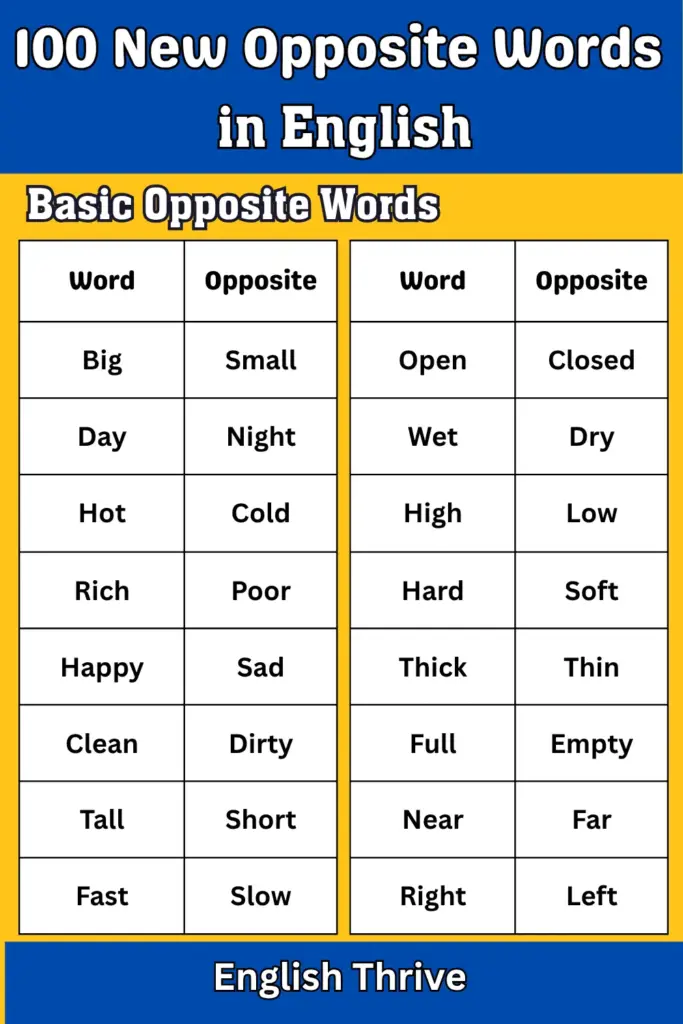
| Word | Opposite |
|---|---|
| Big | Small |
| Day | Night |
| Hot | Cold |
| Rich | Poor |
| Happy | Sad |
| Clean | Dirty |
| Tall | Short |
| Fast | Slow |
| Good | Bad |
| Light | Dark |
| Strong | Weak |
| Old | Young |
| Up | Down |
| Open | Closed |
| Wet | Dry |
| High | Low |
| Hard | Soft |
| Thick | Thin |
| Full | Empty |
| Near | Far |
| Right | Left |
| Alive | Dead |
| Easy | Difficult |
| Beautiful | Ugly |
| Wide | Narrow |
| Loud | Quiet |
| Heavy | Light |
| Inside | Outside |
| True | False |
| Modern | Ancient |
| Polite | Rude |
| Love | Hate |
| Buy | Sell |
| Laugh | Cry |
| Begin | End |
| Come | Go |
| Win | Lose |
| Push | Pull |
| Give | Take |
| Friend | Enemy |
| Before | After |
| Open | Shut |
| Kind | Cruel |
| Sweet | Sour |
| Strong | Weak |
| Hot | Cool |
| Agree | Disagree |
| Big | Tiny |
| Safe | Dangerous |
| Near | Distant |
Advanced Opposite Words
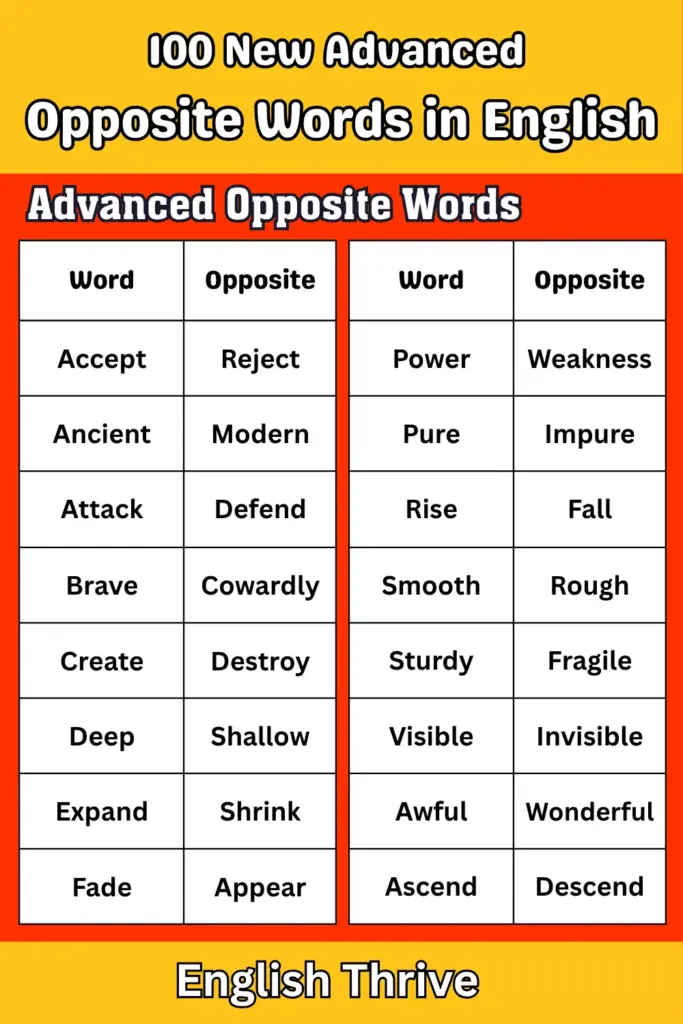
| Word | Opposite |
|---|---|
| Accept | Reject |
| Ancient | Modern |
| Attack | Defend |
| Brave | Cowardly |
| Create | Destroy |
| Deep | Shallow |
| Expand | Shrink |
| Fade | Appear |
| Fail | Succeed |
| Follow | Lead |
| Generous | Greedy |
| Hardworking | Lazy |
| Healthy | Sick |
| Increase | Decrease |
| Innocent | Guilty |
| Interior | Exterior |
| Isolate | Connect |
| Land | Sea |
| Loose | Tight |
| Male | Female |
| Positive | Negative |
| Power | Weakness |
| Pure | Impure |
| Rise | Fall |
| Smooth | Rough |
| Sturdy | Fragile |
| Visible | Invisible |
| Awful | Wonderful |
| Ascend | Descend |
| Truth | Lie |
| Awaken | Sleep |
| Benefit | Harm |
| Borrow | Lend |
| Careful | Careless |
| Combine | Separate |
| Encourage | Discourage |
| Expand | Contract |
| Include | Exclude |
| Major | Minor |
| Natural | Artificial |
| Private | Public |
| Remember | Forget |
| Success | Failure |
| Unity | Division |
| Valuable | Worthless |
| Victory | Defeat |
| Wisely | Foolishly |
| Acceptable | Unacceptable |
| Approve | Disapprove |
| Confident | Doubtful |
Opposite Words with Meanings and Example Sentences
Here are a few examples showing how these words are used in real sentences:
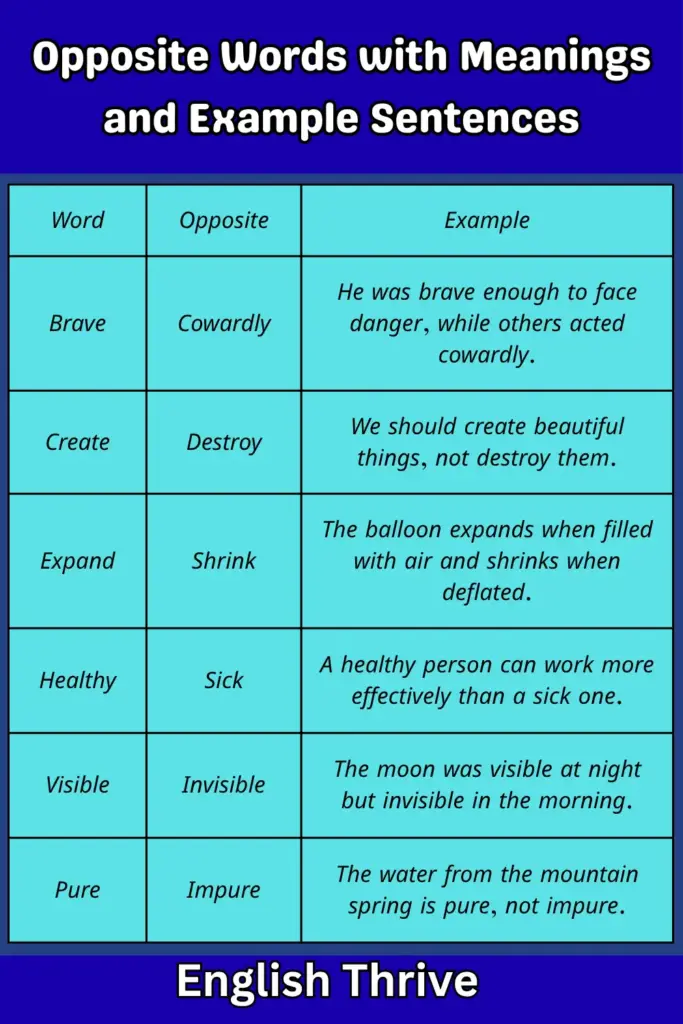
| Word | Opposite | Example |
|---|---|---|
| Brave | Cowardly | He was brave enough to face danger, while others acted cowardly. |
| Create | Destroy | We should create beautiful things, not destroy them. |
| Expand | Shrink | The balloon expands when filled with air and shrinks when deflated. |
| Healthy | Sick | A healthy person can work more effectively than a sick one. |
| Visible | Invisible | The moon was visible at night but invisible in the morning. |
| Pure | Impure | The water from the mountain spring is pure, not impure. |
Download PDF: 100 New Opposite Words in English
How to Learn and Remember Opposite Words Easily
Here are a few easy tips to help you memorize opposite words faster:
1. Use Flashcards
Write one word on the front and its opposite on the back.
Quiz yourself daily—it really helps!
2. Group Words by Category
For example:
- Feelings: Happy ↔ Sad, Love ↔ Hate
- Size: Big ↔ Small, Thick ↔ Thin
- Time: Day ↔ Night, Before ↔ After
3. Practice with Real Sentences
Use new opposite words in short sentences or conversations.
Example:
“Today is hot, but yesterday was cold.”
4. Play Word Games or Quizzes
Learning becomes easier when it’s fun. Try antonym quizzes online or word-matching games.
FAQs About Opposite Words in English
Q1: What are the top 100 opposite words in English?
The top 100 opposite words include pairs like big–small, rich–poor, happy–sad, and many more listed above.
You can also download the complete list as a PDF.
Q2: What are 50 basic opposite words?
Some basic pairs are hot–cold, tall–short, good–bad, up–down, open–closed, and old–young.
Q3: What is the difference between opposite words and antonyms?
There’s no difference! “Opposite words” and “antonyms” both mean words that have opposite meanings.
Final Thoughts
Learning opposite words is a fun and effective way to expand your English vocabulary and improve sentence formation.
Practice a few pairs daily, and soon you’ll be using them naturally in your conversations and writing.
Keep exploring more English vocabulary lists:
Words That Start With X in Different Categories.
If you want to build your vocabulary faster, check out this guide:
How to Improve Vocabulary in English: 15 Proven Tips That Actually Work