

English is a truly global language, spoken across continents, cultures, and countries. Yet, not all English looks or sounds the same. Among the most recognized varieties are American English and British English.
Although they share the same origins, centuries of geographical separation and cultural evolution have created clear differences in spelling, pronunciation, vocabulary, grammar, and punctuation.
Understanding these differences helps learners improve clarity, consistency, and confidence — especially in international communication, academic settings, and travel.
This guide breaks down the key distinctions with clear explanations, examples, and comparison charts.
Difference Between American and British English
1. Why Are There Differences Between American and British English?
To understand how the two forms developed, we need to look briefly at their history.
1. The Historical Split
When English settlers reached North America in the early 1600s, they brought the language of that time. Over the next few centuries, both regions evolved independently, influenced by local culture, migration, technology, and interaction with other languages.
2. Noah Webster’s Influence
In the early 19th century, American lexicographer Noah Webster aimed to simplify English spelling and make it more logical.
He:
-
removed unnecessary letters (colour → color)
-
preferred phonetic spelling (defence → defense)
-
introduced standardized spelling rules in his dictionary
Webster’s reforms shaped modern American English, while British English retained many traditional spellings found in the Oxford English Dictionary.
3. Global Spread and Media Influence
As both nations expanded their global influence:
-
The United States spread its version of English through film, television, and the internet.
-
The United Kingdom influenced global education systems and Commonwealth countries.
Today, neither version is “better” — but consistency matters. Whether you choose color or colour, use one standard throughout your writing.
2. Spelling Differences Between American and British English
Spelling is one of the most noticeable areas where the two varieties diverge. Below are the most common patterns.
A. “-or” vs “-our”
| American English | British English | Example Sentence |
|---|---|---|
| color | colour | The colour of the wall is blue. |
| labor | labour | The labour market is growing. |
| favor | favour | Could you do me a favour? |
Rule: American English drops the “u” in many -our words.
B. “-ize” vs “-ise”
| American English | British English | Example Sentence |
|---|---|---|
| organize | organise | We need to organise the files properly. |
| realize | realise | I didn’t realise it was so late. |
| recognize | recognise | She didn’t recognise him at first. |
Rule: American English prefers -ize, while British English often uses -ise.
(Note: “-ize” is still acceptable in British English, especially in academic contexts.)
C. “-er” vs “-re”
| American English | British English | Example Sentence |
|---|---|---|
| center | centre | The shopping centre is near the station. |
| theater | theatre | We’re going to the theatre tonight. |
| meter | metre | The swimming pool is 50 metres long. |
Rule: British English often ends these words in -re, while American English uses -er.
D. “-og” vs “-ogue”
| American English | British English | Example Sentence |
|---|---|---|
| dialog | dialogue | Let’s start an open dialogue about this issue. |
| catalog | catalogue | I received a product catalogue today. |
| monolog | monologue | His speech turned into a long monologue. |
Rule: American English frequently removes the “-ue” in longer endings.
E. Double “L”
| American English | British English | Example Sentence |
|---|---|---|
| traveler | traveller | She’s a frequent traveller. |
| canceled | cancelled | The flight was cancelled due to bad weather. |
| modeling | modelling | She’s studying modelling at art school. |
Rule: British English doubles the l before certain suffixes.
F. Other Common Examples
| American English | British English |
|---|---|
| defense | defence |
| check | cheque |
| gray | grey |
| program | programme |
| jewelry | jewellery |
Key Takeaway:
American English generally simplifies spelling, while British English preserves older forms.
Difference Between American and British English
3.Vocabulary Differences Between American and British English
Vocabulary is where differences are most obvious and sometimes amusing. Below are commonly confused terms.
A. Everyday Life Vocabulary
| Category | American English | British English | Example Sentence |
|---|---|---|---|
| Housing | apartment | flat | I just moved into a new flat in the city. |
| Transportation | elevator | lift | Please take the lift to the fifth floor. |
| Clothing | sweater | jumper | I bought a warm jumper for winter. |
| Road Signs | truck | lorry | The lorry blocked the road. |
| Waste | garbage/trash can | rubbish/bin | Put the rubbish in the bin. |
B. Food and Dining Vocabulary
| American English | British English | Example Sentence |
|---|---|---|
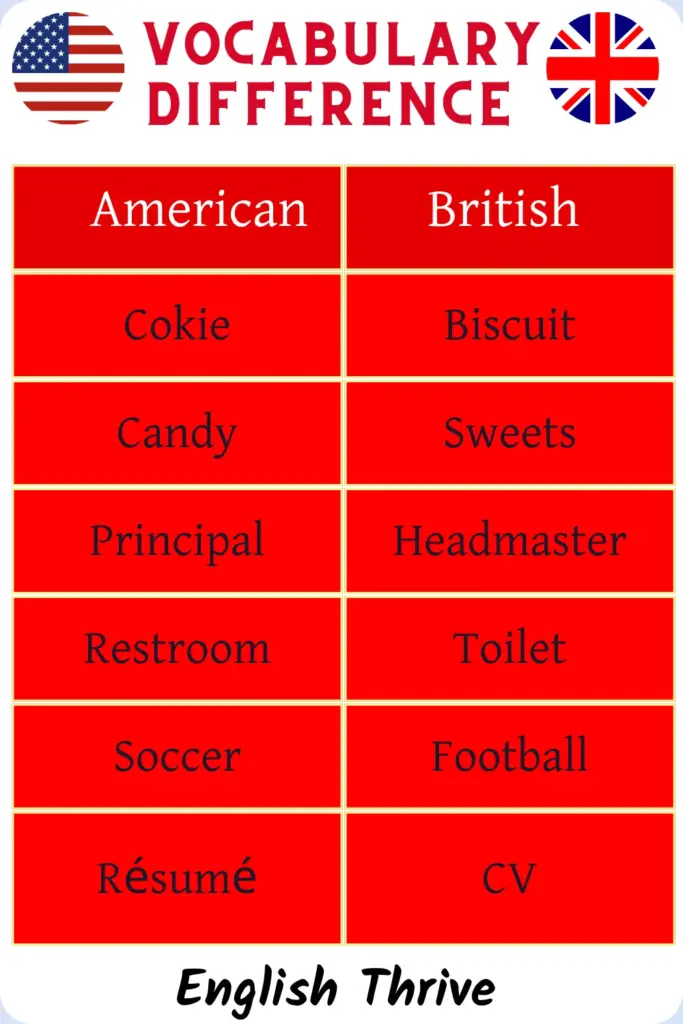
| cookie | biscuit | Would you like a biscuit with your tea? |
| candy | sweets | Kids love sweets after school. |
| fries | chips | I ordered chips with my burger. |
| chips | crisps | Pass me the crisps, please. |
| eggplant | aubergine | I don’t like aubergine in pasta. |
| zucchini | courgette | Add chopped courgette to the dish. |
| takeout | takeaway | Let’s get takeaway tonight. |
C. Education and Work Vocabulary
| American English | British English | Example Sentence |
|---|---|---|
| principal | headmaster | The headmaster gave a speech at assembly. |
| grade | mark | I got a good mark on my essay. |
| vacation | holiday | We’re going on holiday next month. |
| résumé | CV | Update your CV before applying. |
| semester | term | The next term starts in September. |
D. Travel and Daily Items
| American English | British English | Example Sentence |
|---|---|---|
| flashlight | torch | Use a torch when it’s dark. |
| parking lot | car park | The car park was full. |
| line | queue | Please stand in a queue. |
| diaper | nappy | Change the baby’s nappy before bed. |
E. Sports and Culture
| American English | British English | Example Sentence |
|---|---|---|
| soccer | football | Football is the most popular sport in the UK. |
| movie | film | Let’s watch a film tonight. |
| restroom | toilet | The toilet is down the hall. |
Pronunciation Differences
Pronunciation differences shape the sound of each accent.
A. Rhotic vs Non-Rhotic Speech
-
American English: rhotic — the “r” is pronounced clearly (car, far, hard).
-
British English (RP): non-rhotic — final “r” is silent (cah, fah, hahd).
B. Vowel and Stress Differences
| Word | American Pronunciation | British Pronunciation |
|---|---|---|
| tomato | tuh-MAY-to | tuh-MAH-to |
| schedule | SKED-jool | SHED-yool |
| advertisement | ad-VER-tis-ment | ad-ver-TISE-ment |
| garage | guh-RAHZH | GAH-rij |
| mobile | MO-buhl | MO-byle |
American vowels tend to be shorter and flatter, while British vowels are often longer and more rounded.
C. Intonation and Stress
-
Americans often stress the first syllable (AD-dress, PRO-gress).
-
British speakers may stress the second (ad-DRESS, pro-GRESS).
5.Grammar Differences
Most grammar distinctions are subtle but important.
A. Collective Nouns
| American English | British English |
|---|---|
| The team is winning. | The team are winning. |
| The government has announced a policy. | The government have announced a policy. |
B. Verb Usage
| American English | British English | Example |
|---|---|---|
| take a shower | have a shower | I’ll have a shower before dinner. |
| take a test | sit an exam | Students sit exams twice a year. |
| on the weekend | at the weekend | I’ll visit you at the weekend. |
| different from | different to | This plan is different to the old one. |
C. Simple Past vs Present Perfect
| American English | British English |
|---|---|
| Did you eat yet? | Have you eaten yet? |
| I already saw that movie. | I’ve already seen that film. |
| He just left. | He’s just left. |
D. Prepositions
| American English | British English | Example |
|---|---|---|
| on the weekend | at the weekend | We’re travelling at the weekend. |
| in the hospital | in hospital | She’s still in hospital recovering. |
| Monday through Friday | Monday to Friday | We’re open Monday to Friday. |
E. Shall vs Will
-
British English: “Shall we go?”
-
American English: “Should we go?” or “Will we go?”
6.Punctuation and Formatting Differences
Even punctuation differs slightly.
| Category | American English | British English | Note |
|---|---|---|---|
| Dates | MM/DD/YYYY | DD/MM/YYYY | 04/25/2025 vs 25/04/2025 |
| Time | 12-hour clock | 24-hour clock common | 5:00 PM vs 17:00 |
| Abbreviations | Mr., Dr. | Mr, Dr | Periods often omitted |
| Quotation Marks | punctuation inside quotes | punctuation outside quotes | “Hello,” she said. vs “Hello”, she said. |
| Oxford Comma | common | often omitted | Red, white, and blue vs Red, white and blue |
Difference Between American and British English
7.Common Confusing Words
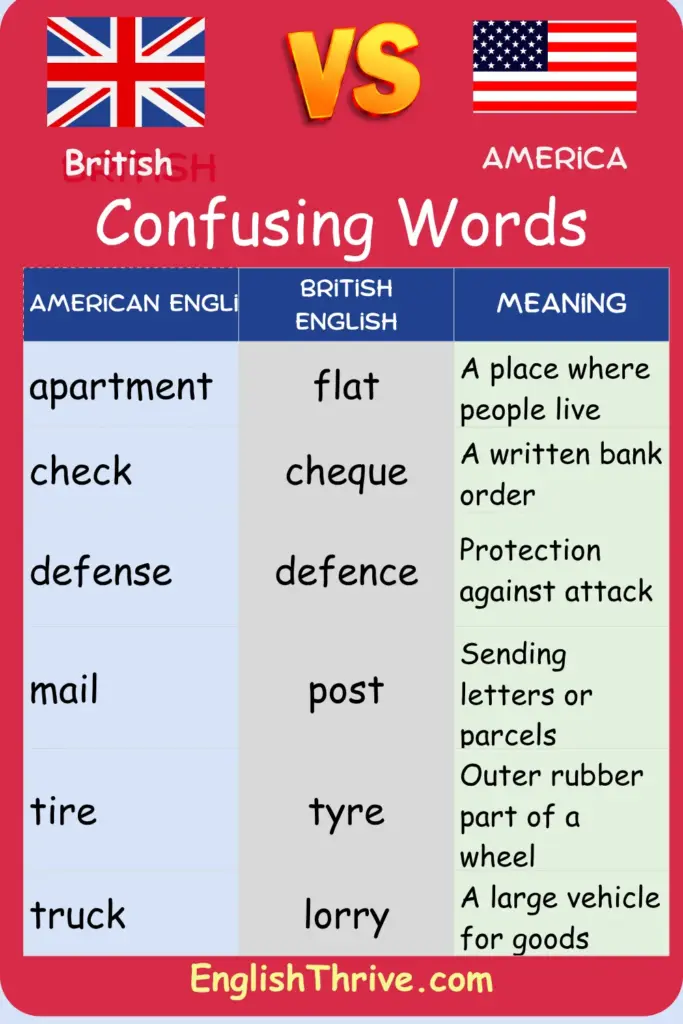
| American English | British English | Meaning |
|---|---|---|
| check | cheque | Bank payment |
| defense | defence | Protection |
| tire | tyre | Outer part of a wheel |
| post | Sending letters | |
| apartment | flat | Housing |
| truck | lorry | Large vehicle |
| vacation | holiday | Time off |
| restroom | toilet | Public bathroom |
| sidewalk | pavement | Path beside a road |
| cookie | biscuit | Sweet baked snack |
8. Which One Should You Learn?
| Situation | Recommended Version | Reason |
|---|---|---|
| IELTS, Cambridge, UK-based exams | British English | These exams use British conventions. |
| TOEFL, U.S. companies | American English | Preferred in U.S. academic and business settings. |
| Academic writing, international communication | Either — be consistent | Mixing styles reduces clarity. |
| Living or travelling abroad | Match the country | Helps with local usage. |
Pro Tip: There is no “right” version — both are correct. The key is consistency.
9.Summary Table: Quick Comparison
| Aspect | American English | British English |
|---|---|---|
| Spelling | color, organize, center | colour, organise, centre |
| Vocabulary | elevator, fries, cookie | lift, chips, biscuit |
| Pronunciation | rhotic | non-rhotic |
| Grammar | the team is | the team are |
| Dates | MM/DD/YYYY | DD/MM/YYYY |
| Punctuation | “Hello,” | “Hello”, |
| Time Format | 12-hour | 24-hour |
10. FAQs
1. What is the main difference between American and British English?
The biggest differences appear in spelling, pronunciation, vocabulary, and grammar.
2. Which English is used in IELTS and TOEFL?
-
IELTS: British English
-
TOEFL: American English
Both accept either style as long as it’s used consistently.
3. Is American English easier to learn?
Many learners find American spelling more straightforward, but British English is common in formal and academic contexts.
4. Do British and American speakers understand each other?
Yes. The differences rarely cause confusion for native speakers.
5. Should I mix both versions in writing?
No. Mixing styles (e.g., color and organise) looks inconsistent. Choose one system and stick to it.
Final Thoughts
The differences between American and British English reflect centuries of history, culture, and linguistic evolution. Whether you prefer color or colour, truck or lorry, both systems are equally valid.
To communicate effectively:
-
Choose one version
-
Stay consistent
-
Focus on clarity
Understanding both varieties makes you a more confident, adaptable English user — whether you’re studying for exams, writing professionally, or travelling internationally.