

Prepositions are essential components of the English language, acting as bridges that connect nouns, pronouns, and phrases to other parts of a sentence, providing crucial context and detail. While many prepositions are commonly recognized, those beginning with the letter “I” often present unique challenges and opportunities for effective communication. Mastering these Illuminating I Prepositions—in, into, inside, onto, and instead of—can significantly enhance your writing and speaking skills by enabling you to express relationships, locations, and substitutions with greater precision. This article is designed for English language learners of all levels, from beginners seeking to establish a solid foundation to advanced speakers aiming to refine their nuanced understanding of prepositional usage.
This guide will delve into the definitions, structural roles, and practical applications of these prepositions, providing numerous examples and practice exercises to solidify your comprehension. By the end of this article, you will not only be able to confidently identify and use these prepositions but also avoid common errors and appreciate the subtle distinctions that define their effective use in various contexts.
Definition of Prepositions
A preposition is a word that connects a noun, pronoun, or noun phrase to other words in a sentence. It typically indicates the temporal, spatial, or logical relationship of the object to the rest of the sentence.
Prepositions are essential for providing context and clarity, helping to specify locations, directions, time, and other relationships.
Prepositions belong to a closed class of words, meaning that new prepositions are rarely added to the English language. They are primarily classified based on their function and the types of relationships they express.
Understanding the role of prepositions is crucial for constructing grammatically correct and meaningful sentences.
Structural Breakdown of Prepositions
Prepositions usually precede a noun or pronoun, forming what is known as a prepositional phrase. This phrase typically consists of the preposition and its object, which is the noun or pronoun that the preposition relates to the rest of the sentence. The prepositional phrase can function as an adjective, modifying a noun, or as an adverb, modifying a verb, adjective, or another adverb.
The basic structure of a prepositional phrase is: Preposition + (Modifiers) + Object. Modifiers can include articles (a, an, the), adjectives, or other descriptive words that provide additional information about the object of the preposition.
Here’s a breakdown with examples:
- Preposition: in, on, at, to, from
- Object: the box, the table, the meeting, the store, school
- Prepositional Phrase: in the box, on the table, at the meeting, to the store, from school
Prepositions Starting with ‘I’
This section focuses on common prepositions that start with the letter “I”: in, into, inside, onto and instead of. Each preposition has distinct meanings and usage rules, which will be explored in detail below.
In
The preposition in is used to indicate location, containment, time periods, and states. It expresses that something is enclosed or surrounded by something else, or that something exists within a specific context.
Uses of “In”:
- Location: Denotes that something is situated within a place or area.
- Time: Refers to specific time periods such as months, years, and seasons.
- Containment: Indicates that something is enclosed or contained within something else.
- State or Condition: Describes a particular state, condition, or circumstance.
Into
The preposition into indicates movement or direction toward the inside of something. It suggests entry or transformation from one state or location to another. It commonly implies a change or transition.
Uses of “Into”:
- Movement: Indicates motion or direction towards the interior of something.
- Transformation: Describes a change from one state or condition to another.
- Entry: Suggests the act of entering a place or space.
Inside
The preposition inside specifies that something is located within the interior of something else. It emphasizes the enclosed nature of the location, often implying a degree of protection or privacy.
Uses of “Inside”:
- Location: Indicates that something is located within the interior of a place or object.
- Containment: Emphasizes the enclosed nature of the location.
Onto
The preposition onto indicates movement to a position on a surface. It implies placement or contact with the top of something.
Uses of “Onto”:
- Movement: Indicates motion or direction ending on the surface of something.
- Placement: Describes the act of placing something on the surface of something else.
- Contact: Suggests physical contact with a surface.
Instead Of
The prepositional phrase instead of indicates substitution or replacement of one thing for another. It implies a choice or preference between alternatives.
Uses of “Instead Of”:
- Substitution: Indicates that one thing is being used or done in place of another.
- Replacement: Suggests that one thing is taking the place of another.
- Choice: Implies a preference or selection between alternatives.
Examples of ‘I’ Prepositions in Sentences
This section provides detailed examples of how to use these prepositions correctly in sentences. The examples are categorized to illustrate each preposition’s specific uses.
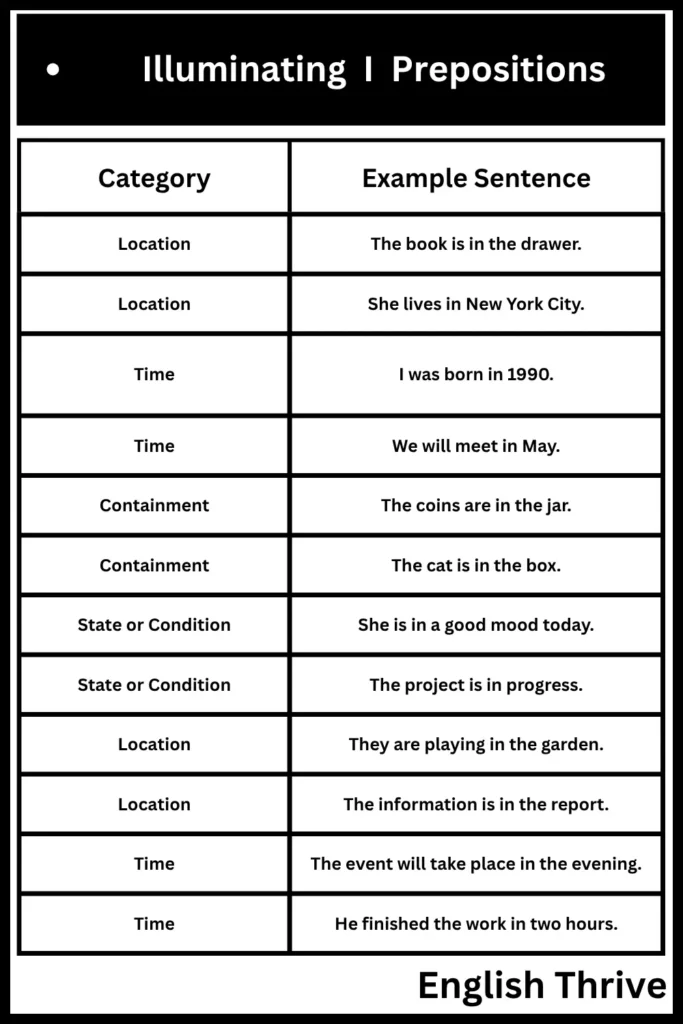
Examples with “In”
The following table illustrates various uses of the preposition “in” with example sentences:
| Category | Example Sentence |
|---|---|
| Location | The book is in the drawer. |
| Location | She lives in New York City. |
| Time | I was born in 1990. |
| Time | We will meet in May. |
| Containment | The coins are in the jar. |
| Containment | The cat is in the box. |
| State or Condition | She is in a good mood today. |
| State or Condition | The project is in progress. |
| Location | They are playing in the garden. |
| Location | The information is in the report. |
| Time | The event will take place in the evening. |
| Time | He finished the work in two hours. |
| Containment | The letter is in the envelope. |
| Containment | The fish are swimming in the pond. |
| State or Condition | He is in love with her. |
| State or Condition | The company is in debt. |
| Location | The car is parked in the garage. |
| Location | The students are sitting in the classroom. |
| Time | She will arrive in a few minutes. |
| Time | The course starts in September. |
| Containment | The water is in the bottle. |
| Containment | The toys are in the toy box. |
| State or Condition | She is in good health. |
| State or Condition | The house is in excellent condition. |
Examples with “Into”
The following table provides examples of “into” used for movement, transformation, and entry:
| Category | Example Sentence |
|---|---|
| Movement | She walked into the room. |
| Movement | The cat jumped into the box. |
| Transformation | The caterpillar turned into a butterfly. |
| Transformation | Water turns into ice at 0 degrees Celsius. |
| Entry | He went into the store to buy milk. |
| Entry | The children ran into the school. |
| Movement | The car crashed into the wall. |
| Movement | The river flows into the sea. |
| Transformation | The prince was transformed into a frog. |
| Transformation | The raw materials were processed into finished products. |
| Entry | She stepped into the elevator. |
| Entry | The train pulled into the station. |
| Movement | The bird flew into the window. |
| Movement | The ball rolled into the hole. |
| Transformation | His anger turned into sadness. |
| Transformation | The dough was shaped into a pizza. |
| Entry | They entered into a contract. |
| Entry | The key fit into the lock. |
| Movement | The light shone into the darkness. |
| Movement | The rain poured into the bucket. |
| Transformation | The sugar dissolved into the water. |
| Transformation | The investigation delved into the matter. |
| Entry | She delved into her memories. |
| Entry | The children burst into laughter. |
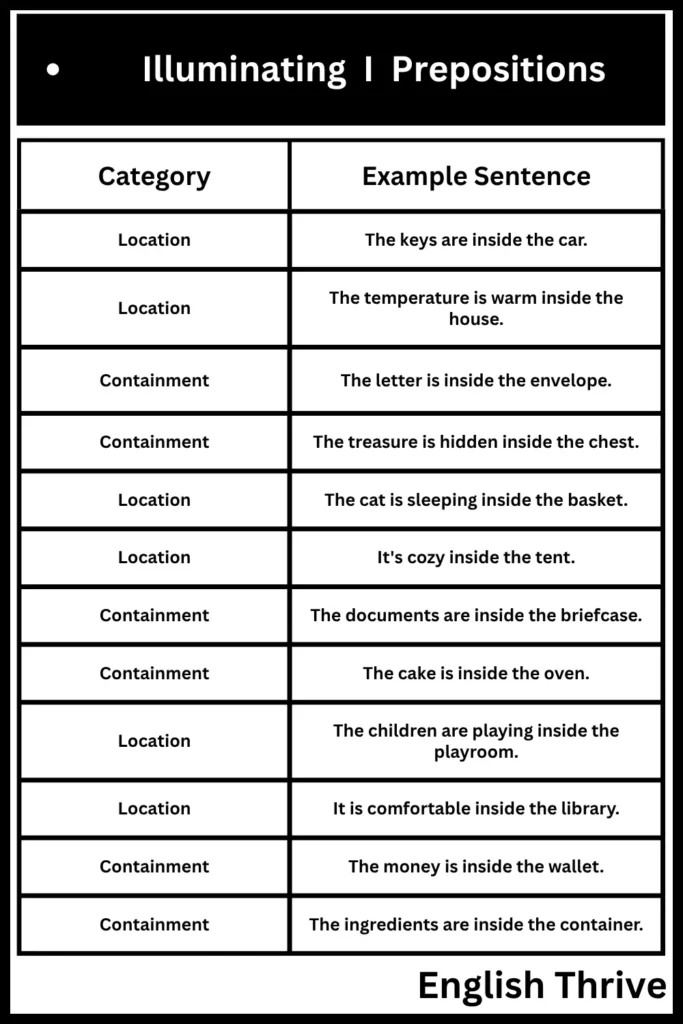
Examples with “Inside”
The following table demonstrates the use of “inside” to indicate location and containment:
| Category | Example Sentence |
|---|---|
| Location | The keys are inside the car. |
| Location | The temperature is warm inside the house. |
| Containment | The letter is inside the envelope. |
| Containment | The treasure is hidden inside the chest. |
| Location | The cat is sleeping inside the basket. |
| Location | It’s cozy inside the tent. |
| Containment | The documents are inside the briefcase. |
| Containment | The cake is inside the oven. |
| Location | The children are playing inside the playroom. |
| Location | It is comfortable inside the library. |
| Containment | The money is inside the wallet. |
| Containment | The ingredients are inside the container. |
| Location | The office is inside the building. |
| Location | It’s quiet inside the museum. |
| Containment | The batteries are inside the remote. |
| Containment | The secret is inside the box. |
| Location | The engine is inside the car. |
| Location | It’s warm inside the blanket. |
| Containment | The book is inside the bag. |
| Containment | The memories are inside her heart. |
| Location | The bakery is inside the mall. |
| Location | It’s cool inside the cave. |
| Containment | The seeds are inside the fruit. |
| Containment | The answer is inside the puzzle. |
Examples with “Onto”
The following table illustrates the uses of “onto” for movement, placement, and contact:
| Category | Example Sentence |
|---|---|
| Movement | The cat jumped onto the roof. |
| Movement | He climbed onto the stage. |
| Placement | She put the book onto the shelf. |
| Placement | Place the dishes onto the table. |
| Contact | The glue stuck onto the paper. |
| Contact | The paint dried onto the canvas. |
| Movement | The bird flew onto the branch. |
| Movement | The car drove onto the bridge. |
| Placement | She placed the vase onto the mantelpiece. |
| Placement | Put the luggage onto the conveyor belt. |
| Contact | The snow settled onto the ground. |
| Contact | The sticker adhered onto the surface. |
| Movement | The spider crawled onto the wall. |
| Movement | He stepped onto the platform. |
| Placement | She laid the blanket onto the grass. |
| Placement | Put the cake onto the stand. |
| Contact | The dust collected onto the furniture. |
| Contact | The dew formed onto the leaves. |
| Movement | The child hopped onto the bus. |
| Movement | The train rolled onto the tracks. |
| Placement | She set the glass onto the coaster. |
| Placement | Place the sign onto the post. |
| Contact | The ink stained onto the fabric. |
| Contact | The frost settled onto the window. |
Examples with “Instead Of”
The following table illustrates the uses of “instead of” for substitution, replacement, and choice:
| Category | Example Sentence |
|---|---|
| Substitution | I drank water instead of soda. |
| Substitution | She used a pen instead of a pencil. |
| Replacement | We went to the park instead of the beach. |
| Replacement | He took the bus instead of driving. |
| Choice | I chose coffee instead of tea. |
| Choice | She decided to stay home instead of going out. |
| Substitution | They ordered pizza instead of pasta. |
| Substitution | He used a knife instead of a fork. |
| Replacement | We watched a movie instead of reading a book. |
| Replacement | She listened to music instead of watching TV. |
| Choice | I preferred walking instead of running. |
| Choice | He opted for silence instead of arguing. |
| Substitution | They baked a cake instead of buying one. |
| Substitution | She wore a dress instead of jeans. |
| Replacement | We visited the museum instead of the zoo. |
| Replacement | He took a nap instead of doing chores. |
| Choice | I selected apples instead of oranges. |
| Choice | She chose to forgive instead of holding a grudge. |
| Substitution | They wrote a letter instead of sending an email. |
| Substitution | She used a map instead of a GPS. |
| Replacement | We went hiking instead of going shopping. |
| Replacement | He cooked dinner instead of ordering takeout. |
| Choice | I preferred staying indoors instead of going out in the rain. |
| Choice | She chose to be kind instead of being rude. |
Usage Rules for ‘I’ Prepositions
Understanding the specific rules for using each preposition is essential for accurate and effective communication. This section outlines the key rules and considerations for in, into, inside, onto and instead of.
- “In”: Use “in” for static locations, time periods, and containment. Avoid using “in” when indicating movement or entry; use “into” instead.
- “Into”: Use “into” to indicate movement towards the interior of something or a transformation. Do not use “into” to describe a static location; use “in” or “inside” instead.
- “Inside”: Use “inside” to emphasize that something is located within an enclosed space. “Inside” can often be used interchangeably with “in” for location, but it adds a sense of enclosure or protection.
- “Onto”: Use “onto” to indicate movement or placement on a surface. Distinguish it from “on to,” which is the preposition “on” followed by the word “to.”
- “Instead Of”: Use “instead of” to indicate substitution or replacement. Ensure that the elements being compared are parallel in structure.
Common Mistakes with ‘I’ Prepositions
Even experienced English speakers sometimes make mistakes with prepositions. This section highlights common errors and provides correct examples to help you avoid them.
| Incorrect | Correct | Explanation |
|---|---|---|
| She went in the house. | She went into the house. | “Into” indicates movement towards the interior of the house. |
| The book is into the table. | The book is on the table. | “Into” implies movement; “on” indicates a static location on a surface. |
| The cat is in the box, inside. | The cat is inside the box. | Using both “in” and “inside” is redundant; “inside” is sufficient. |
| He jumped on to the water. | He jumped onto the raft. | “Onto” indicates movement to a surface. Jumping into water would use “into.” |
| Instead to go to the movies, we stayed home. | Instead of going to the movies, we stayed home. | “Instead of” is the correct prepositional phrase for substitution. |
| The money is in inside the safe. | The money is inside the safe. | “Inside” already implies being within an enclosed space, so “in” is redundant. |
| She transformed in a superhero. | She transformed into a superhero. | “Into” is used to indicate transformation or change of state. |
| The picture is onto the wall. | The picture is on the wall. | “Onto” implies movement or placement; “on” indicates a static location on a surface. |
| I will have tea instead coffee. | I will have tea instead of coffee. | “Instead of” is the correct phrase to indicate a substitution. |
Practice Exercises
These exercises will help you practice using the prepositions in, into, inside, onto and instead of correctly. Choose the correct preposition to complete each sentence.
Exercise 1: Choose the Correct Preposition (In/Into)
| Question | Answer |
|---|---|
| 1. The keys are ______ the drawer. | in |
| 2. She walked ______ the room. | into |
| 3. I was born ______ 1985. | in |
| 4. The cat jumped ______ the box. | into |
| 5. We will meet ______ May. | in |
| 6. The coins are ______ the jar. | in |
| 7. He drove ______ the city. | into |
| 8. The meeting is ______ the afternoon. | in |
| 9. She put the letter ______ the envelope. | into |
| 10. The children are playing ______ the garden. | in |
Exercise 2: Choose the Correct Preposition (Inside/In)
| Question | Answer |
|---|---|
| 1. The cat is ______ the house. | inside |
| 2. The book is ______ the bag. | in |
| 3. The treasure is hidden ______ the chest. | inside |
| 4. She lives ______ a small town. | in |
| 5. The office is ______ the building. | inside |
| 6. The cookies are ______ the jar. | in |
| 7. The money is ______ the wallet. | inside |
| 8. The information is ______ the report. | in |
| 9. The cake is ______ the oven. | inside |
| 10. He is ______ a good mood. | in |
Exercise 3: Choose the Correct Preposition (Onto/On)
| Question | Answer |
|---|---|
| 1. The cat jumped ______ the table. | onto |
| 2. The book is ______ the shelf. | on |
| 3. She placed the vase ______ the mantelpiece. | onto |
| 4. The picture is ______ the wall. | on |
| 5. He climbed ______ the stage. | onto |
| 6. The snow is ______ the ground. | on |
| 7. She put the dishes ______ the table. | onto |
| 8. The keys are ______ the hook. | on |
| 9. The bird is sitting ______ the branch. | on |
| 10. He stepped ______ the platform. | onto |
Exercise 4: Choose the Correct Preposition (Instead Of)
| Question | Answer |
|---|---|
| 1. I drank water ______ soda. | instead of |
| 2. We went to the park ______ the beach. | instead of |
| 3. I chose coffee ______ tea. | instead of |
| 4. They ordered pizza ______ pasta. | instead of |
| 5. She used a knife ______ a fork. | instead of |
| 6. We watched a movie ______ reading a book. | instead of |
| 7. He opted for silence ______ arguing. | instead of |
| 8. They baked a cake ______ buying one. | instead of |
| 9. She wore a dress ______ jeans. | instead of |
| 10. I selected apples ______ oranges. | instead of |
Advanced Topics in Prepositional Usage
For advanced learners, understanding the nuances of prepositional usage is crucial for mastering the English language. This includes recognizing idiomatic expressions, phrasal verbs, and the subtle differences in meaning that prepositions can convey.
Idiomatic Expressions: Many prepositions are part of idiomatic expressions, where the meaning of the phrase cannot be deduced from the individual words. For example, “in a nutshell” means “briefly” or “in summary.”
Phrasal Verbs: Prepositions often combine with verbs to form phrasal verbs, which have meanings that are distinct from the individual verb and preposition. For example, “look into” means “investigate.”
Subtle Differences: The choice of preposition can significantly alter the meaning of a sentence. For example, “He is interested in music” means he has an interest, while “He is interested to learn music” means he is willing to learn.
FAQs on Illuminating I Prepositions
What is the difference between “in” and “into”?”
In” indicates a static location or state, while “into” indicates movement or a change of state. For example, “The book is in the box” (location), but “She put the book into the box” (movement).
When should I use “inside” instead of “in”?
Use “inside” when you want to emphasize that something is located within an enclosed space. While “in” can also indicate location, “inside” adds a sense of enclosure or protection. For example, “The cat is in the house” (general location), but “The cat is inside the house” (emphasizing the enclosed nature of the location).
What is the difference between “onto” and “on to”?”
Onto” is a preposition that indicates movement or placement on a surface. “On to” is the preposition “on” followed by the word “to,” and it is used when “to” is part of a verb or phrase. For example, “The cat jumped onto the roof” (preposition), but “We moved on to the next topic” (“on” followed by “to”).
How do I use “instead of” correctly?”
Instead of” is used to indicate substitution or replacement. Ensure that the elements being compared are parallel in structure. For example, “I drank water instead of soda” (both nouns), or “Instead of going to the movies, we stayed home” (both gerund phrases).
Can “in” be used to describe direction?
No, “in” is generally used for static locations, containment, or time periods. To describe direction or movement towards the interior of something, use “into”. For example, you would say “She walked into the room,” not “She walked in the room” if you want to indicate that she entered the room.
Is it ever correct to use “in to” as two separate words?
Yes, “in to” can be used as two separate words when “to” is part of a verb or another construction. For instance, “They turned the application in to the office.” Here, “in” is part of the phrasal verb “turn in,” and “to” is a separate preposition indicating direction.
Are there any common idioms that use “inside”
?Yes, there are several idioms that use “inside.” For example, “know something inside out” means to know something very thoroughly. Another example is “an inside job,” which refers to a crime committed by someone with access to the premises or information.
What are some alternatives to using “instead of”?
Depending on the context, you can use alternatives such as “rather than,” “in place of,” “as opposed to,” or “alternatively.” The choice depends on the specific nuance you want to convey. For example, “I’ll have tea rather than coffee” or “We’ll use this tool in place of the other one.”
Conclusion
Mastering prepositions, particularly those starting with “I”—in, into, inside, onto and instead of—is crucial for achieving fluency and precision in English. This comprehensive guide has provided definitions, structural breakdowns, examples, usage rules, and practice exercises to help you confidently use these prepositions in various contexts.
Remember to pay close attention to the nuances of each preposition and practice regularly to reinforce your understanding. By avoiding common mistakes and continually expanding your knowledge, you can significantly enhance your communication skills and express yourself with greater clarity and accuracy.