

Idioms are colorful expressions that add depth and nuance to the English language. Understanding idioms, especially those related to age, is crucial for advanced English proficiency.
These idioms appear frequently in everyday conversations, literature, and media. This article provides a comprehensive guide to idioms about age, exploring their meanings, origins, and usage.
Whether you’re an ESL learner or a native speaker looking to refine your communication skills, this guide will help you confidently incorporate these expressions into your vocabulary.
What are Idioms About Age?
Idioms about age are expressions whose meanings cannot be understood simply by knowing the literal definitions of the individual words. Instead, these phrases carry a figurative or symbolic meaning related to different stages of life, the process of aging, or perceptions of age.
They often reflect cultural attitudes towards youth, maturity, and old age. Understanding these idioms requires familiarity with their specific context and accepted usage.
These idioms serve various functions in language. They can add humor, emphasize a point, or provide a concise way to express a complex idea about someone’s age or experience.
They are often more vivid and memorable than literal descriptions, making communication more engaging and effective. Mastering these idioms is essential for achieving fluency and a deeper understanding of English.
Structural Breakdown of Age Idioms
Age idioms don’t follow a specific grammatical structure, but they often incorporate common grammatical elements in unique ways. Understanding these elements can help in deciphering and using the idioms correctly.
Noun Phrases
Many age idioms are built around noun phrases that represent a stage of life or a characteristic associated with age. For example, “the dawn of life” uses a noun phrase to metaphorically describe early childhood.
Verb Phrases
Verb phrases in age idioms often describe actions or states related to aging or behaving in a way appropriate (or inappropriate) for one’s age. An example is “act your age,” where the verb “act” is used to suggest behaving in a manner expected of someone of a particular age.
Prepositional Phrases
Prepositional phrases can add context or detail to the meaning of an age idiom. For instance, “over the hill” uses the preposition “over” to indicate a decline associated with aging.
Adjectival Phrases
Adjectival phrases modify nouns to describe age-related qualities. For example, “young at heart” uses the adjective “young” to describe someone’s enduring spirit, regardless of their physical age.
Types and Categories of Idioms About Age
Idioms about age can be categorized based on the specific aspect of age they relate to. Here are some common categories:
Idioms Describing Youth
These idioms focus on the characteristics and experiences of being young, such as innocence, potential, and inexperience. Examples include “wet behind the ears” and “in the spring of one’s life.”
Idioms Describing Maturity
These idioms refer to the qualities of being mature and experienced, such as wisdom, responsibility, and stability. Examples include “coming of age” and “old head on young shoulders.”
Idioms Describing Old Age
These idioms often touch on the challenges and perceptions associated with aging, such as decline, wisdom, and reflection. Examples include “over the hill” and “golden years.”
Idioms Describing Age-Related Behavior
These idioms comment on how someone is behaving in relation to their age, either appropriately or inappropriately. Examples include “act your age” and “no spring chicken.”
Examples of Idioms About Age
The following tables provide a comprehensive list of idioms about age, categorized for easy understanding. Each table includes the idiom, its meaning, and example sentences to illustrate its usage.
Table 1: Idioms Describing Youth
This table presents idioms related to youth, focusing on their meanings and usage within sentences.
| Idiom | Meaning | Example Sentence |
|---|---|---|
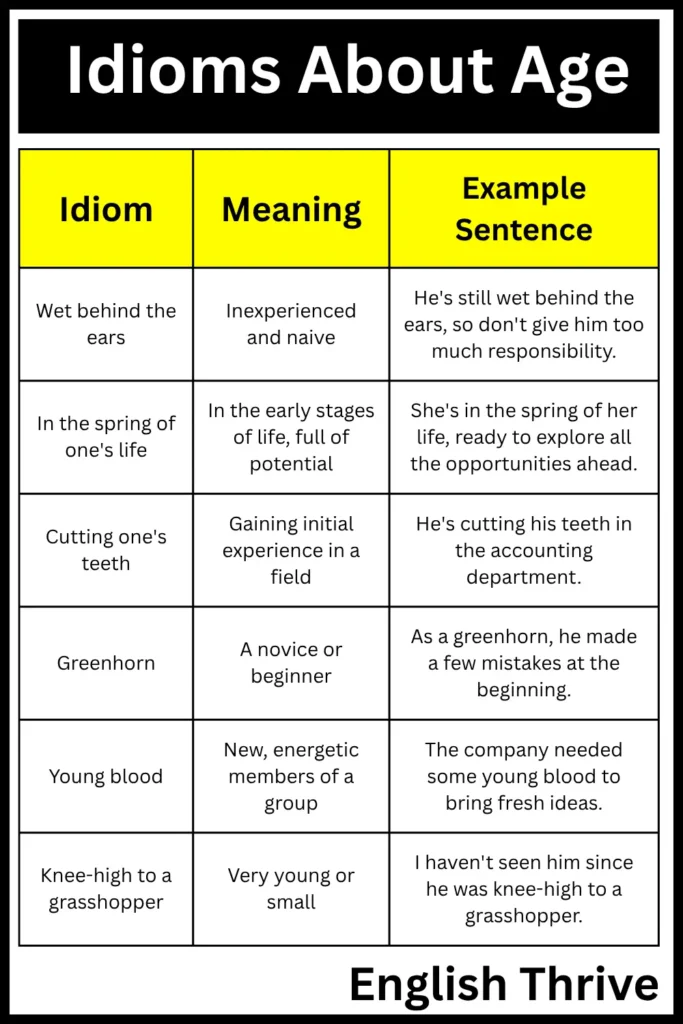
| Wet behind the ears | Inexperienced and naive | He’s still wet behind the ears, so don’t give him too much responsibility. |
| In the spring of one’s life | In the early stages of life, full of potential | She’s in the spring of her life, ready to explore all the opportunities ahead. |
| Cutting one’s teeth | Gaining initial experience in a field | He’s cutting his teeth in the accounting department. |
| Greenhorn | A novice or beginner | As a greenhorn, he made a few mistakes at the beginning. |
| Young blood | New, energetic members of a group | The company needed some young blood to bring fresh ideas. |
| Knee-high to a grasshopper | Very young or small | I haven’t seen him since he was knee-high to a grasshopper. |
| In one’s salad days | A time of youthful inexperience and enthusiasm | During his salad days, he was full of energy and ambition. |
| Not dry behind the ears | Inexperienced | He’s not dry behind the ears yet, so he needs more guidance. |
| A babe in the woods | An innocent and inexperienced person | She’s a babe in the woods when it comes to international politics. |
| In its infancy | In the early stages of development | The project is still in its infancy. |
| Born yesterday | Naive or easily deceived | I wasn’t born yesterday; I know what you’re trying to do. |
| Just out of diapers | Very young and inexperienced | He acts like he’s just out of diapers. |
| Still learning to walk | In the early stages of learning something | The startup is still learning to walk, but it has potential. |
| A fresh face | A new and often younger person | The company needs a fresh face to revitalize its image. |
| A spring chicken | A young and energetic person (often used in the negative) | She’s no spring chicken, but she’s still very active. |
| Coming up in the world | Making progress in life or career | He’s a young man coming up in the world. |
| Starting out | Beginning a career or activity | She’s just starting out in the field of medicine. |
| New kid on the block | Someone new to a place or situation | He’s the new kid on the block at the office. |
| A blank slate | Someone without prior experience or knowledge | She approached the project as a blank slate, ready to learn. |
| At the dawn of life | In the early stages of life | He is at the dawn of life, full of dreams and aspirations. |
| Full of pep | Energetic and lively | The kids were full of pep after their summer vacation. |
| Bright-eyed and bushy-tailed | Enthusiastic and eager | She arrived at the internship bright-eyed and bushy-tailed. |
| A clean slate | A fresh start | After the scandal, he wanted a clean slate to rebuild his reputation. |
| Full of vim and vigor | Full of energy and enthusiasm | Despite his age, he was full of vim and vigor. |
| In bud | In the early stages of development | Her talent was still in bud, waiting to blossom. |
| In the cradle | In the very early stages of development | The technology is still in the cradle, but it has great potential. |
| A whippersnapper | A young and often cheeky person | The whippersnapper thinks he knows everything. |
 Idioms About Age
Table 2: Idioms Describing Maturity
This table presents idioms that describe maturity, focusing on their meanings and usage within sentences.
| Idiom | Meaning | Example Sentence |
|---|---|---|
| Coming of age | Reaching adulthood; a significant stage of development | Her journey through college was a true coming of age. |
| Old head on young shoulders | A young person who thinks or acts wisely, like an older person | He’s only 16, but he has an old head on young shoulders. |
| Wise beyond one’s years | Having wisdom and understanding beyond what is expected at one’s age | She’s wise beyond her years, offering insightful advice to everyone. |
| Of age | Having reached the legal age for a certain activity | Now that he’s of age, he can vote in the election. |
| Grown-up | Mature and responsible | It’s time to be a grown-up and take responsibility for your actions. |
| Established | Having a secure and successful position | He’s an established lawyer with a good reputation. |
| In one’s prime | At the peak of one’s abilities or career | She was in her prime during the 1990s. |
| Experienced | Having knowledge or skill from having done something for a long time | He’s an experienced programmer with over 10 years in the field. |
| Seasoned | Experienced and skilled | She’s a seasoned journalist who has covered many important events. |
| Long in the tooth | Getting old | He’s getting a bit long in the tooth to be playing professional sports. |
| Middle-aged spread | Weight gain associated with middle age | He’s started to develop a bit of a middle-aged spread. |
| Over the hill | Past one’s prime | Some people think he’s over the hill, but he’s still very capable. |
| Mature beyond one’s years | Showing a level of maturity not usually expected at one’s age | She’s mature beyond her years, handling difficult situations with grace. |
| Knowing the ropes | Understanding how things work in a particular place or situation | Once you know the ropes, you’ll find it easier to navigate the company. |
| Having seen it all | Having experienced many things in life | He’s seen it all in his long career in the military. |
| Been around the block | Experienced in life, often in a worldly way | She’s been around the block and knows how to handle herself. |
| At a certain age | Having reached a particular age, often implying maturity | At a certain age, you start to appreciate the simple things in life. |
| In full bloom | At the height of beauty or development | Her career was in full bloom when she decided to start a family. |
| Ripe old age | A very old age | He lived to a ripe old age, surrounded by his family. |
| A man/woman of the world | Someone who is sophisticated and experienced | She’s a woman of the world, having traveled extensively. |
| Getting on | Getting older | He’s getting on, but he still enjoys playing golf. |
| Past one’s sell-by date | No longer useful or effective | Some people thought the politician was past his sell-by date. |
| In one’s golden years | The later years of life, often associated with retirement | They are enjoying their golden years traveling the world. |
| Of a certain vintage | Old or experienced | The car is of a certain vintage, but it’s still in good condition. |
| No chicken | Not young (often used with “spring”) | She’s no spring chicken, but she can still run a mile. |
Table 3: Idioms Describing Old Age
This table shows idioms describing old age, focusing on their meanings and usage within sentences.
| Idiom | Meaning | Example Sentence |
|---|---|---|
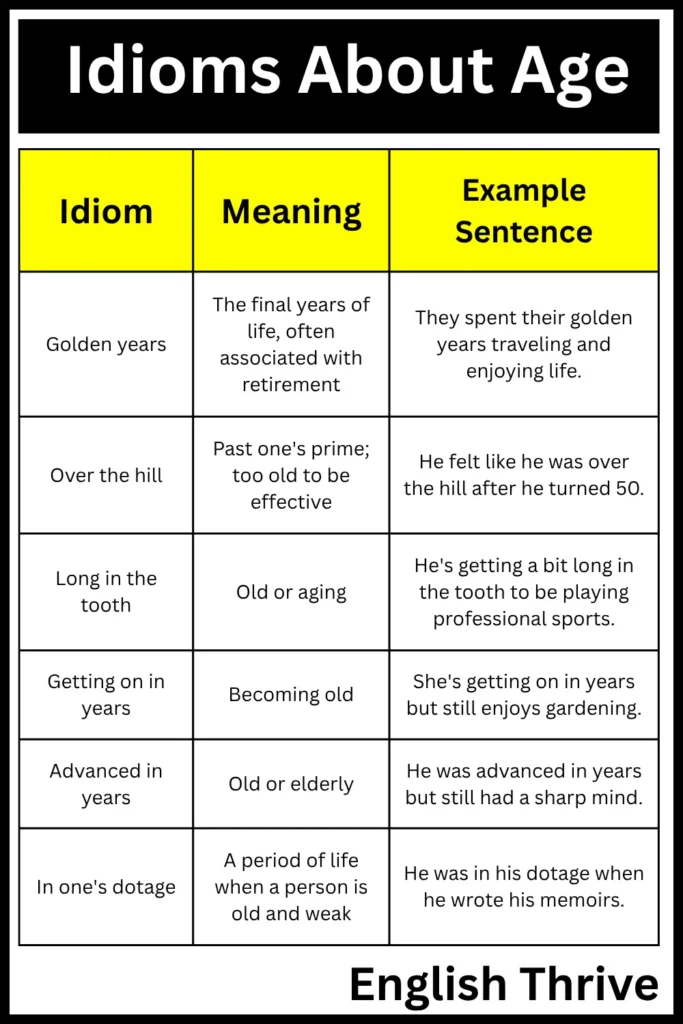
| Golden years | The final years of life, often associated with retirement | They spent their golden years traveling and enjoying life. |
| Over the hill | Past one’s prime; too old to be effective | He felt like he was over the hill after he turned 50. |
| Long in the tooth | Old or aging | He’s getting a bit long in the tooth to be playing professional sports. |
| Getting on in years | Becoming old | She’s getting on in years but still enjoys gardening. |
| Advanced in years | Old or elderly | He was advanced in years but still had a sharp mind. |
| In one’s dotage | A period of life when a person is old and weak | He was in his dotage when he wrote his memoirs. |
| One foot in the grave | Near death or very old | He’s got one foot in the grave, but he’s still full of life. |
| On the wrong side of (age) | Older than a certain age | She’s on the wrong side of fifty, but she looks much younger. |
| Past one’s prime | No longer at one’s best | The athlete was past his prime, but he still had a lot of experience to offer. |
| A senior citizen | An elderly person | The community center offers activities for senior citizens. |
| Fossil | An old person (often used humorously) | He’s a bit of a fossil when it comes to technology. |
| Old-timer | An experienced or elderly person | The old-timer shared stories of his youth with the younger generation. |
| Getting along in years | Becoming old | He’s getting along in years, but he still enjoys his daily walks. |
| No spring chicken | Not young anymore | She’s no spring chicken, but she’s still very active. |
| In the autumn of one’s life | In the later years of life | He is in the autumn of his life, reflecting on his accomplishments. |
| Past it | Too old to do something | Some people think he’s past it, but he still has a lot to offer. |
| Ripe in years | Very old | She was ripe in years and full of wisdom. |
| Second childhood | A period in old age when someone becomes like a child again | In his second childhood, he enjoyed playing with toys. |
| Three score years and ten | Seventy years old (biblical reference) | He lived beyond three score years and ten. |
| A relic of the past | Something or someone from a past era, often old-fashioned | He felt like a relic of the past in the modern world. |
| An old codger | An elderly man, often grumpy | The old codger complained about the noise. |
| An old fogey | A person who is old-fashioned and resistant to change | He’s a bit of an old fogey, always talking about the good old days. |
| In the twilight years | The final years of life | She enjoyed her twilight years surrounded by her family. |
| A graybeard | An old man | The graybeard shared his wisdom with the younger generation. |
| A geriatric case | An elderly person (often used humorously or disparagingly) | The hospital is full of geriatric cases. |
| Long-lived | Living for a long time | The tortoise is a long-lived animal. |
 Idioms About Age
Table 4: Idioms Describing Age-Related Behavior
This table includes idioms that describe behavior related to age, focusing on their meanings and usage within sentences.
| Idiom | Meaning | Example Sentence |
|---|---|---|
| Act your age | Behave in a manner appropriate for your age | Stop being silly and act your age! |
| Grow up | Become more mature and responsible | It’s time for you to grow up and take responsibility for your actions. |
| Young at heart | Having a youthful spirit despite being older | She’s 80 years old, but she’s still young at heart. |
| Childish | Immature or behaving like a child | His behavior was childish and inappropriate for his age. |
| Old before one’s time | Acting or seeming older than one’s actual age | He’s only 30, but he seems old before his time. |
| Sow one’s wild oats | Enjoy youthful adventures and experiences | He spent his twenties sowing his wild oats before settling down. |
| Go through a phase | Experience a temporary period of different behavior | She’s just going through a phase; she’ll grow out of it. |
| Live fast, die young | Live life intensely and recklessly, often leading to an early death | He lived by the motto “live fast, die young.” |
| Turn over a new leaf | Make a fresh start and change one’s behavior for the better | He decided to turn over a new leaf and start exercising regularly. |
| Get a new lease on life | Experience a renewed sense of energy and purpose | After surviving the illness, she felt like she had a new lease on life. |
| Throwing a tantrum | Behaving in an uncontrolled, childish way | He was throwing a tantrum when he didn’t get his way. |
| Getting a second wind | Experiencing renewed energy after being tired | He got a second wind and finished the marathon strong. |
| Running around like a chicken with its head cut off | Acting frantically and without purpose | She was running around like a chicken with its head cut off trying to get everything done. |
| Not a day over (age) | Looking younger than one’s actual age | She’s not a day over thirty, even though she’s forty. |
| Forever young | Always remaining youthful in spirit | He strives to stay forever young by staying active and positive. |
| An old soul | Someone who seems wise and experienced beyond their years | She’s an old soul, offering insightful advice to her friends. |
| Going gray | Becoming old or aging | He’s going gray, but he still has a lot of energy. |
| Losing one’s marbles | Becoming senile or losing one’s mental faculties | He’s starting to lose his marbles in his old age. |
| A grumpy old man/woman | An elderly person who is often irritable or complaining | The grumpy old man complained about the noise from the kids. |
| Living in the past | Dwelling on past events and being out of touch with the present | He’s living in the past, always talking about the good old days. |
Usage Rules for Idioms About Age
Using idioms correctly involves understanding their specific context and intended meaning. Here are some key rules to follow:
Context Matters
Always consider the context in which you’re using an idiom. The same idiom can have different connotations depending on the situation and the tone of the conversation.
Know Your Audience
Be mindful of your audience’s familiarity with idioms. Some idioms are more common than others, and using obscure idioms can confuse your listeners.
Avoid Overuse
While idioms can add color to your language, avoid overusing them. Too many idioms can make your speech sound unnatural or forced.
Maintain Grammatical Consistency
Ensure that the idiom fits grammatically into the sentence. Do not alter the structure of the idiom to fit your sentence; adjust the surrounding words instead.
Common Mistakes with Idioms About Age
Using idioms incorrectly can lead to miscommunication or sound awkward. Here are some common mistakes to avoid:
Literal Interpretation
The most common mistake is interpreting an idiom literally. Remember that idioms have figurative meanings, not literal ones.
* Incorrect: “He’s really wet behind the ears,” meaning he literally has water behind his ears.
* Correct: “He’s really wet behind the ears,” meaning he’s inexperienced.
Incorrect Word Choice
Using the wrong words within an idiom can change its meaning or make it nonsensical.
* Incorrect: “She’s an old head on young shoulders,” (changing the words)
* Correct: “She has an old head on young shoulders,” (using the correct wording)
Tense Confusion
Failing to use the correct tense within an idiom can make it grammatically incorrect.
* Incorrect: “He will be cut his teeth in the new job.”
* Correct: “He is cutting his teeth in the new job.”
Mixing Idioms
Combining parts of different idioms can create confusing and nonsensical expressions.
* Incorrect: “He’s burning the candle at both ends and sowing his wild oats.” (mixing idioms)
* Correct: “He’s burning the candle at both ends.” or “He’s sowing his wild oats.”
Practice Exercises: Idioms About Age
Test your understanding of idioms about age with these exercises. Choose the correct idiom to complete each sentence.
Exercise 1: Fill in the Blanks
Complete the following sentences with the appropriate idiom from the list provided.
Idiom List: Over the hill, Young at heart, Act your age, Wet behind the ears, Golden years
| Question | Answer |
|---|---|
| 1. Despite being 70, she’s still ________ and loves to dance. | Young at heart |
| 2. He’s still ________, so he needs a lot of guidance. | Wet behind the ears |
| 3. It’s time to ________ and start taking responsibility for your actions. | Act your age |
| 4. They are enjoying their ________ traveling the world. | Golden years |
| 5. Some people think he’s ________, but he’s still very capable. | Over the hill |
| 6. I am far from being ________, I still have a lot to offer. | Over the hill |
| 7. Even though he is retired, he is still ________. | Young at heart |
| 8. The interns are ________ and enthusiastic to learn. | Wet behind the ears |
| 9. ________ and start behaving like an adult. | Act your age |
| 10. They are entering their ________, retired and financially stable. | Golden years |
Exercise 2: Multiple Choice
Choose the correct meaning of the idiom in each sentence.
| Question | Options | Answer |
|---|---|---|
| 1. He’s getting a bit long in the tooth to be playing professional sports. What does “long in the tooth” mean? | a) Having long teeth b) Getting old c) Being grumpy d) Being inexperienced | b) Getting old |
| 2. She’s no spring chicken, but she’s still very active. What does “no spring chicken” mean? | a) Young and energetic b) Not young anymore c) Liking spring d) Being a chicken | b) Not young anymore |
| 3. He’s an old head on young shoulders. What does “old head on young shoulders” mean? | a) A young person with an old head b) A wise young person c) An old person with a young body d) A person with a large head | b) A wise young person |
| 4. He spent his twenties sowing his wild oats before settling down. What does “sowing his wild oats” mean? | a) Planting seeds b) Enjoying youthful adventures c) Growing oats d) Being wild | b) Enjoying youthful adventures |
| 5. She’s wise beyond her years. What does “wise beyond her years” mean? | a) Being very old b) Being older than she looks c) Having wisdom beyond her age d) Lying about her age | c) Having wisdom beyond her age |
| 6. He felt like he was over the hill after he turned 50. What does “over the hill” mean? | a) Climbing a hill b) Past one’s prime c) Feeling energetic d) Going on a trip | b) Past one’s prime |
| 7. The project is still in its infancy. What does “in its infancy” mean? | a) Very old b) In the early stages of development c) Fully developed d) Almost finished | b) In the early stages of development |
| 8. He’s just cutting his teeth in the accounting department. What does “cutting his teeth” mean? | a) Getting new teeth b) Gaining initial experience c) Feeling pain d) Sharpening teeth | b) Gaining initial experience |
| 9. After surviving the illness, she felt like she had a new lease on life. What does “a new lease on life” mean? | a) Moving to a new house b) Renewing a contract c) Experiencing renewed energy d) Getting a new job | c) Experiencing renewed energy |
| 10. He’s starting to lose his marbles in his old age. What does “losing his marbles” mean? | a) Losing toys b) Becoming senile c) Playing games d) Collecting marbles | b) Becoming senile |
Exercise 3: Sentence Completion
Choose the idiom from the list that best fits the context of the sentence.
Idiom List: No spring chicken, act your age, golden years, wet behind the ears, old soul
| Question | Answer |
|---|---|
| 1. My grandfather is enjoying his ________, traveling and pursuing his hobbies. | golden years |
| 2. You need to ________ and stop behaving like a child. | act your age |
| 3. Although she is young, she is an ________, always giving mature advice. | old soul |
| 4. He is ________ and needs more training before he can handle complex tasks. | wet behind the ears |
| 5. She may be experienced, but she is ________. | no spring chicken |
| 6. He is far from enjoying his ________. | golden years |
| 7. You are not ________, you need to be more responsible. | wet behind the ears |
| 8. I wish he would ________ and stop being so immature. | act your age |
| 9. She is an ________ trapped in a young body. | old soul |
| 10. I am ________, but I can still run a marathon. | no spring chicken |
Advanced Topics: Etymology and Cultural Context
Understanding the etymology and cultural context of age idioms can provide deeper insights into their meanings and usage. Many idioms have historical roots that reflect societal attitudes towards aging.
Etymology
The etymology of an idiom refers to its origin and how its meaning has evolved over time. For example, the idiom “wet behind the ears” is believed to originate from the idea that newborn animals are literally wet behind the ears, signifying their newness and inexperience.
Cultural Context
The cultural context of an idiom involves understanding the social and historical factors that have shaped its meaning. For instance, the idiom “golden years” reflects a cultural ideal of retirement as a time of leisure and fulfillment, which may not be universally experienced.
FAQs About Age-Old Wisdom
What is the difference between an idiom and a proverb?
An idiom is a phrase whose meaning is not predictable from the usual meanings of its constituent elements, while a proverb is a short, popular saying that expresses a common truth or belief. Idioms are more figurative and less direct than proverbs.
How can I improve my understanding of idioms?
Read widely, listen to native speakers, and pay attention to the context in which idioms are used. Keep a notebook of new idioms and their meanings, and practice using them in your own speech and writing. Flashcards can also be an excellent way to memorize idioms.
Are idioms universal across all cultures?
No, idioms are often culture-specific and may not translate directly into other languages. Understanding the cultural context of an idiom is crucial for using it correctly.
Is it okay to use idioms in formal writing?
It depends on the context. While idioms can add color to your writing, they are generally more appropriate for informal or creative writing. In formal academic or business writing, it’s best to use more direct and literal language.
How do I know when to use an idiom?
Use idioms when they fit naturally into the conversation and enhance your message. Avoid forcing idioms into situations where they don’t belong. If you’re unsure, it’s better to usedirect and clear language.
Conclusion: Idioms About Age
Mastering idioms about age enhances your understanding and command of the English language. By understanding their meanings, origins, and usage rules, you can confidently incorporate these expressions into your vocabulary.
Remember to consider the context, know your audience, and avoid overuse. With practice, you’ll be able to use idioms effectively and add depth and color to your communication.