

Understanding idioms is crucial for anyone looking to master the English language. Idioms are phrases or expressions whose meanings cannot be understood from the literal meanings of the individual words.
When it comes to confusion, idioms often paint a vivid picture of bewilderment, uncertainty, and lack of clarity. This article provides a comprehensive guide to idioms related to confusion, helping you understand their meanings, usage, and nuances.
Whether you’re an ESL learner, a student, or simply someone who wants to improve their English, this guide will equip you with the knowledge to navigate the confusing world of idioms.
Definition of Idioms for Confusion
An idiom is a phrase or expression whose meaning is different from the literal meaning of the individual words within it. Idioms related to confusion specifically describe states of bewilderment, uncertainty, misunderstanding, or lack of clarity.
These idioms often rely on figurative language, such as metaphors and similes, to convey complex emotions and situations. Understanding these idioms is vital for effective communication, as they are frequently used in everyday conversation and writing.
Idioms function as a form of figurative language, adding color and depth to communication. They can be classified based on their grammatical structure (e.g., phrasal verbs, prepositional phrases) or their conceptual meaning (e.g., idioms of uncertainty, idioms of misunderstanding).
The context in which an idiom is used determines its specific interpretation. For example, the idiom “to be in a fog” means to be confused or disoriented, not literally surrounded by fog.
Structural Breakdown of Idioms
Idioms can be structurally diverse, ranging from simple phrases to complex clauses. Many idioms are phrasal verbs, consisting of a verb and a particle (e.g., mix up). Others are prepositional phrases (e.g., in a haze). Some idioms are complete sentences or expressions (e.g., I’m at sea). The key characteristic is that the meaning cannot be derived from the individual words.
Understanding the structure of an idiom can sometimes help in grasping its meaning, but often the connection is arbitrary and must be learned through exposure and practice. Recognizing common patterns, such as the use of metaphorical language or specific verbs associated with confusion, can aid in comprehension.
For example, verbs like “lose,” “mix,” and “baffle” frequently appear in idioms related to confusion.
Types and Categories of Confusion Idioms
Idioms for confusion can be categorized based on the specific type of confusion they describe. Here are some common categories:
Idioms of Uncertainty
These idioms express a state of not knowing or being unsure about something.
Idioms of Misunderstanding
These idioms describe situations where there is a failure to understand something correctly.
Idioms of Bewilderment
These idioms convey a sense of being completely perplexed or disoriented.
Idioms of Lack of Clarity
These idioms indicate that something is not clear or easily understood.
Examples of Idioms for Confusion
Here are some examples of idioms related to confusion, categorized for clarity. Each table provides a comprehensive list of idioms, their meanings, and example sentences to illustrate their usage.
Table 1: Idioms of Uncertainty
This table presents idioms that convey a sense of uncertainty or not knowing something.
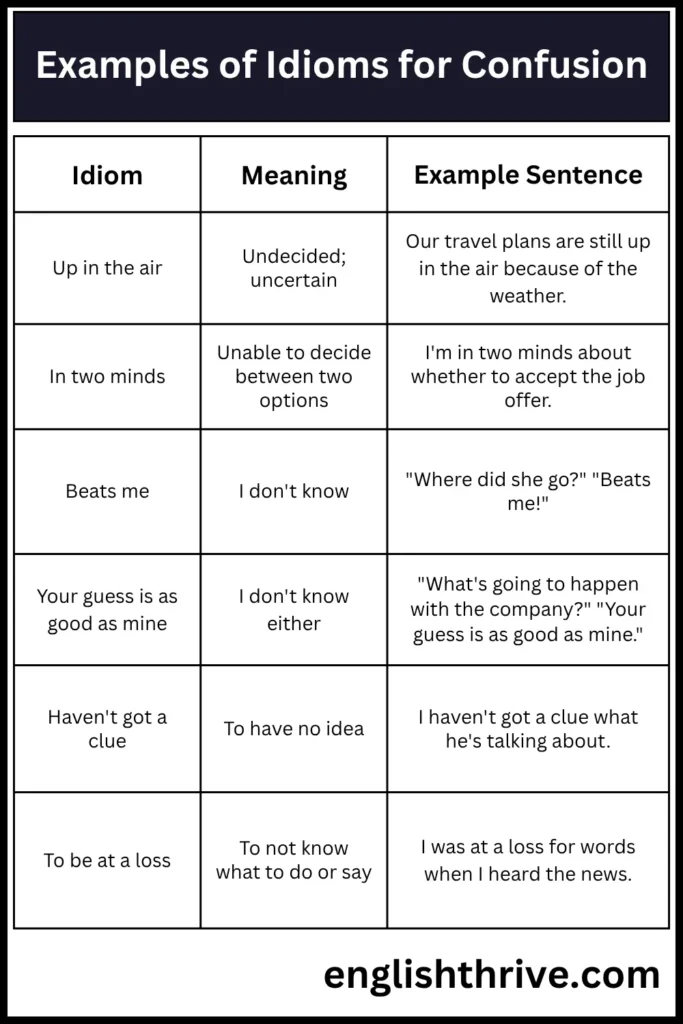
| Idiom | Meaning | Example Sentence |
|---|---|---|
| Up in the air | Undecided; uncertain | Our travel plans are still up in the air because of the weather. |
| In two minds | Unable to decide between two options | I’m in two minds about whether to accept the job offer. |
| Beats me | I don’t know | “Where did she go?” “Beats me!” |
| Your guess is as good as mine | I don’t know either | “What’s going to happen with the company?” “Your guess is as good as mine.” |
| Haven’t got a clue | To have no idea | I haven’t got a clue what he’s talking about. |
| To be at a loss | To not know what to do or say | I was at a loss for words when I heard the news. |
| To be on the fence | To be undecided | I’m still on the fence about which car to buy. |
| To be touch-and-go | Uncertain outcome | His recovery is touch-and-go. |
| To be iffy | Questionable or uncertain | The weather is looking a bit iffy for the picnic. |
| To be a toss-up | An outcome that is equally probable either way | The election is a toss-up between the two candidates. |
| To take a shot in the dark | To make a guess without much information | I’m just taking a shot in the dark, but I think the answer is C. |
| To leave someone in the dark | To keep someone uninformed | They left me in the dark about the changes to the project. |
| To not have the foggiest idea | To have absolutely no idea | I don’t have the foggiest idea how to fix this. |
| To not know the first thing about | To be completely ignorant about something | I don’t know the first thing about computers. |
| To sit on the fence | To remain neutral and not take sides | He’s sitting on the fence, waiting to see which way the wind blows. |
| To hedge your bets | To reduce your risk by supporting more than one possibility | I’m hedging my bets by applying to several different universities. |
| To play it by ear | To proceed without a definite plan | Let’s just play it by ear and see what happens. |
| Wait and see | Adopt a patient approach | We’ll just have to wait and see what the outcome is. |
| Undecided | Not having made a decision | The jury is still undecided on the verdict. |
| Unsure | Not certain or confident | I’m unsure about whether to go to the party tonight. |
| Questionable | Doubtful or uncertain | His story seems a bit questionable to me. |
| Speculative | Based on conjecture rather than knowledge | The report is speculative and lacks concrete evidence. |
| Provisional | Arranged for the present, but possibly to be changed later | The booking is provisional until we receive confirmation. |
Table 2: Idioms of Misunderstanding
This table presents idioms that indicate a failure to understand something correctly.
| Idiom | Meaning | Example Sentence |
|---|---|---|
| Get the wrong end of the stick | To misunderstand something | She got the wrong end of the stick and thought I was angry at her. |
| Lost in translation | Meaning is not clear due to language or cultural differences | The joke was lost in translation when I explained it to my friend. |
| Miss the point | To fail to understand the important part of something | You’re missing the point; it’s not about the money. |
| Talking at cross purposes | When people misunderstand each other because they are discussing different subjects without realizing it. | We were talking at cross purposes – I was referring to last year’s sales figures, and she was talking about this year’s. |
| Take something the wrong way | To be offended by a remark that was not intended to be offensive. | I didn’t mean to offend you, I’m sorry you took it the wrong way. |
| To be at cross purposes | To misunderstand each other’s intentions | They were at cross purposes, arguing about different things entirely. |
| To get your wires crossed | To misunderstand each other | We got our wires crossed and both bought the same gift. |
| To misread the situation | To misunderstand what is happening | I misread the situation and thought they were arguing, but they were just joking. |
| To not see eye to eye | To disagree | They don’t see eye to eye on most issues. |
| To not click with someone | To not understand or connect with someone | I just didn’t click with him during the interview. |
| To go over someone’s head | To be too difficult for someone to understand | The lecture went over my head completely. |
| To mix apples and oranges | To compare things that are fundamentally different | You’re mixing apples and oranges by comparing these two projects. |
| To fail to grasp something | To not understand something | I failed to grasp the main concept of the presentation. |
| To misunderstand | To fail to understand correctly | I think you misunderstood what I meant. |
| To misinterpret | To interpret wrongly | She misinterpreted my silence as anger. |
| To misconstrue | To interpret wrongly | They misconstrued my intentions. |
| To be out of sync | Not in agreement or understanding | We were out of sync on the project timeline. |
| To lose sight of the big picture | To fail to understand the overall context | He lost sight of the big picture and focused on minor details. |
| To not get the message | To not understand the intended communication | He didn’t get the message that he was being let go. |
| To take something amiss | To take offense at something | I hope she didn’t take my comment amiss. |
| To jump to conclusions | To form an opinion without sufficient evidence | Don’t jump to conclusions before you know all the facts. |
| To make a mountain out of a molehill | To exaggerate the importance of something | You’re making a mountain out of a molehill; it’s not that serious. |
| To read between the lines | To understand something that is not explicitly stated | You have to read between the lines to understand what he really means. |
Table 3: Idioms of Bewilderment
This table presents idioms that convey a sense of being completely perplexed or disoriented.
| Idiom | Meaning | Example Sentence |
|---|---|---|
| In a fog | Confused; disoriented | I’ve been in a fog since I woke up this morning. |
| At sea | Confused; lost | I’m completely at sea with this new software. |
| Baffled | Confused; perplexed | I’m baffled by the instructions. |
| All Greek to me | Incomprehensible, impossible to understand. | This computer manual is all Greek to me. |
| Head spinning | Feeling dizzy or confused due to a lot of information | After the lecture, my head was spinning with all the new concepts. |
| To be in a daze | To be confused and unable to think clearly | She was in a daze after the accident. |
| To be out of it | To be confused or disoriented | He was out of it after taking the medication. |
| To be flustered | To be agitated or confused | She became flustered when she couldn’t find her keys. |
| To draw a blank | To be unable to remember something | I drew a blank when the teacher asked me the question. |
| To not know whether you are coming or going | To be extremely confused and disoriented | I don’t know whether I’m coming or going with all these changes. |
| To be thrown for a loop | To be surprised and confused | I was thrown for a loop when I heard the news. |
| To be beside yourself | To be extremely agitated or confused | She was beside herself with worry. |
| To be discombobulated | To be confused and disoriented | I was completely discombobulated after the long flight. |
| To be dumbfounded | To be greatly astonished or amazed | I was dumbfounded by his sudden departure. |
| To be bewildered | To be perplexed and confused | I was bewildered by the complex instructions. |
| To be perplexed | To be completely baffled | I was perplexed by the strange behavior. |
| To be muddled | To be confused and disorganized | My thoughts were muddled after the long day. |
| To be rattled | To be nervous and confused | I was rattled by the unexpected question. |
| To be spaced out | To be inattentive or confused | He seemed spaced out during the meeting. |
| To be stumped | To be unable to answer or solve something | I was stumped by the difficult math problem. |
| To be at sixes and sevens | To be in a state of confusion and disarray | The office was at sixes and sevens after the power outage. |
| To be out to lunch | To be inattentive or out of touch with reality | He seems to be out to lunch most of the time. |
| To scratch your head | To show confusion or puzzlement | I had to scratch my head when I saw what he was wearing. |
Table 4: Idioms of Lack of Clarity
This table presents idioms that indicate that something is not clear or easily understood.
| Idiom | Meaning | Example Sentence |
|---|---|---|
| Clear as mud | Not clear at all; confusing | The instructions were as clear as mud. |
| Hazy | Unclear; vague | My memory of that night is a bit hazy. |
| Obscure | Not well known; difficult to understand | The meaning of the poem is rather obscure. |
| Clouded | Not clear because something is blocking it or causing confusion. | The issue is clouded by layers of bureaucracy. |
| Murky | Difficult to see through; not clear. | The legal waters surrounding the case are murky. |
| To be a gray area | To be unclear or undefined | The rules on this issue are a bit of a gray area. |
| To be shrouded in mystery | To be surrounded by secrecy or uncertainty | The circumstances of his death are shrouded in mystery. |
| To be up for grabs | To be available and not yet decided | The final decision is still up for grabs. |
| To be in the balance | To be uncertain; to depend on what happens | The fate of the project is in the balance. |
| To be a moot point | To be irrelevant or no longer worth discussing | Whether he was right or wrong is now a moot point. |
| To be double Dutch | To be incomprehensible | The technical jargon was double Dutch to me. |
| To be as plain as day | To be very clear and obvious | The answer was as plain as day. |
| To be open to interpretation | To have multiple possible meanings | The meaning of the artwork is open to interpretation. |
| To be subject to debate | To be a topic of disagreement or discussion | The issue is still subject to debate. |
| To be vague | To be unclear or imprecise | His instructions were vague and unhelpful. |
| To be nebulous | To be unclear or ill-defined | The concept of sustainability is often nebulous. |
| To be ambiguous | To have more than one possible meaning | The statement was ambiguous and could be interpreted in several ways. |
| To be enigmatic | To be mysterious and difficult to understand | Her behavior was enigmatic and puzzling. |
| To cloud the issue | To make something more difficult to understand | The new regulations only cloud the issue further. |
| To muddy the waters | To make something more confusing | The additional information only muddied the waters. |
| To leave something to the imagination | To not provide all the details, allowing people to guess | The ending of the book left a lot to the imagination. |
| To beat around the bush | To avoid talking directly about something | Stop beating around the bush and tell me what you really think. |
| To get to the bottom of something | To discover the truth about something | We need to get to the bottom of this mystery. |
Usage Rules for Confusion Idioms
Using idioms correctly requires understanding their specific meanings and contexts. Here are some general rules:
- Use idioms in appropriate contexts: Consider the formality of the situation. Idioms are generally more suitable for informal conversations and writing.
- Be aware of cultural differences: Some idioms may not translate well or have the same meaning in different cultures.
- Pay attention to word order: The word order in an idiom is usually fixed. Changing the order can alter the meaning or make the idiom nonsensical.
- Understand the connotations: Idioms can have positive, negative, or neutral connotations. Choose idioms that align with the intended tone of your message.
Common Mistakes with Confusion Idioms
One of the most common mistakes is interpreting idioms literally. For example, someone might misunderstand “get the wrong end of the stick” as physically holding a stick incorrectly, rather than misunderstanding a situation.
Another common mistake is using idioms out of context or in inappropriate situations.
Here are some examples of common mistakes and their corrections:
| Incorrect | Correct | Explanation |
|---|---|---|
| He is in a real fog, like it is raining. | He is in a fog; he seems completely confused. | The idiom refers to a state of confusion, not literal weather. |
| I have two minds about the decision. | I am in two minds about the decision. | The correct idiom is “in two minds.” |
| The instructions were clear as water. | The instructions were clear as mud. | “Clear as mud” is the correct idiom to indicate a lack of clarity. |
| She got the wrong leg of the stick. | She got the wrong end of the stick. | The correct idiom is “wrong end of the stick”. |
| It’s all Greek on me. | It’s all Greek to me. | The correct idiom is “all Greek to me”. |
Practice Exercises
Test your understanding of idioms for confusion with these exercises. Choose the correct idiom to complete each sentence.
Exercise 1: Fill in the Blanks
Complete each sentence with the appropriate idiom from the list provided.
- I didn’t understand a word he said; it was all __________ to me. (a. clear as mud, b. Greek, c. up in the air)
- She __________ when she realized she had sent the email to the wrong person. (a. was at sea, b. got the wrong end of the stick, c. drew a blank)
- The company’s future is still __________, so we don’t know what will happen next. (a. in a fog, b. up in the air, c. at sixes and sevens)
- I am __________ about whether to go to the party tonight. (a. in two minds, b. clear as mud, c. all Greek)
- The instructions were so complicated they were __________. (a. clear as mud, b. at sea, c. in a fog)
- I __________ and couldn’t remember her name. (a. drew a blank, b. got the wrong end of the stick, c. was up in the air)
- They were __________ and arguing about completely different things. (a. at cross purposes, b. in two minds, c. clear as mud)
- I always __________ when he explains quantum physics. (a. get the wrong end of the stick, b. am at sea, c. draw a blank)
- I’m not sure what’s going on, I ___________. (a. am at sea, b. Beats me, c. am in two minds)
- The situation is __________, we don’t know what the outcome will be. (a. up in the air, b. clear as mud, c. beats me)
Answer Key: 1. b, 2. a, 3. b, 4. a, 5. a, 6. a, 7. a, 8. b, 9. a, 10. a
Exercise 2: Multiple Choice
Choose the best idiom to fit the context of each sentence.
- After the long meeting, I was completely __________.
- clear as mud
- at sea
- in two minds
- He __________ and thought I was criticizing his work.
- got the wrong end of the stick
- was up in the air
- drew a blank
- The details of the agreement are still __________.
- clear as mud
- up in the air
- at sixes and sevens
- I __________ about whether to buy the new car.
- am at sea
- am in two minds
- am clear as mud
- The instructions were so confusing they were __________.
- at sea
- clear as mud
- up in the air
- When asked about his past, he __________.
- drew a blank
- got the wrong end of the stick
- was up in the air
- They were __________ and didn’t realize they were talking about different things.
- at cross purposes
- in two minds
- clear as mud
- I __________ when trying to solve the puzzle.
- get the wrong end of the stick
- am at sea
- draw a blank
- It ___________ where he went after the party.
- am at sea
- Beats me
- am in two minds
- The situation is __________, so we need to be careful.
- up in the air
- clear as mud
- beats me
Answer Key: 1. b, 2. a, 3. b, 4. b, 5. b, 6. a, 7. a, 8. b, 9. b, 10. a
Exercise 3: True or False
Decide whether the idiom is used correctly in the sentence. Mark T for True and F for False.
- (T/F) The instructions were so clear they were at sea.
- (T/F) I’m in two minds about whether to go to the concert.
- (T/F) She got the wrong end of the stick and thought I was angry.
- (T/F) The company’s future is clear as mud.
- (T/F) I drew a blank and couldn’t remember the answer.
- (T/F) They were at cross purposes because they agreed on everything.
- (T/F) I’m completely up in the air about this new software.
- (T/F) Beats me what she said.
- (T/F) The situation is completely clear as mud.
- (T/F) The answer is all Greek to me.
Answer Key: 1. F, 2. T, 3. T, 4. F, 5. T, 6. F, 7. F, 8. T, 9. F, 10. T
Advanced Topics in Confusion Idioms
For advanced learners, exploring the origins and etymology of idioms can provide a deeper understanding of their meanings and cultural significance. Analyzing how idioms evolve over time and how they are used in literature and media can further enhance comprehension.
Additionally, studying regional variations and non-standard idioms can broaden one’s linguistic repertoire. For example, some idioms may be more common in British English versus American English.
Another advanced topic involves understanding the cognitive processes behind idiom comprehension. Research in psycholinguistics explores how the brain processes idiomatic expressions and how factors such as context and familiarity influence understanding.
This knowledge can inform more effective language learning strategies.
Frequently Asked Questions
What is the difference between an idiom and a proverb?
An idiom is a phrase whose meaning is different from the literal meanings of the individual words, while a proverb is a short, well-known saying that expresses a general truth or piece of advice. For example, “break a leg” is an idiom meaning “good luck,” whereas “a penny saved is a penny earned” is a proverb offering financial advice.
How can I improve my understanding of idioms?
Immerse yourself in the language by reading books, watching movies, and listening to podcasts. Pay attention to how native speakers use idioms in different contexts. Keep a notebook of new idioms you encounter and try to use them in your own conversations and writing. Practice regularly and don’t be afraid to ask for clarification when you are unsure of an idiom’s meaning.
Are idioms used differently in different English-speaking countries?
Yes, idioms can vary significantly between different English-speaking countries. For example, some idioms are more common in British English than in American English, and vice versa. Be aware of these regional differences and adjust your usage accordingly. Exposure to diverse sources of English, such as British television shows or Australian literature, can help you become familiar with these variations.
Is it okay to use idioms in formal writing?
Generally, idioms are more appropriate for informal communication, such as conversations and personal emails. In formal writing, such as academic papers or business reports, it is usually best to avoid idioms and use more direct and precise language. However, there may be exceptions depending on the specific context and audience.
How can I avoid misusing idioms?
Double-check the meaning and usage of an idiom before using it. Use a dictionary or online resource to confirm its definition and ensure that it fits the context of your sentence. Pay attention to the word order and grammatical structure of the idiom. If you are unsure, it is better to use a more straightforward expression.
Conclusion
Mastering idioms for confusion can significantly enhance your understanding and use of the English language. By learning the definitions, structures, and usage rules of these idioms, you can communicate more effectively and navigate complex conversations with confidence.
Remember to practice regularly, pay attention to context, and be aware of cultural differences. With dedication and effort, you can unlock the richness and expressiveness of English idioms and avoid getting lost in translation.
The ability to understand and use idioms related to confusion not only improves your linguistic skills but also provides insight into the cultural nuances of the English language. Continue to explore and expand your knowledge of idioms, and you will find yourself becoming a more fluent and articulate communicator.
Embrace the challenge, and enjoy the journey of mastering these colorful and expressive phrases.