

Ever struggled to connect two ideas smoothly in a sentence? Relative pronouns are your best friends for creating clear, flowing sentences. Let’s explore helpful relative pronouns examples that will make your writing more elegant and precise. Whether you’re writing an email or crafting a story, these examples will show you exactly how to use who, which, that, and whose correctly.
Understanding Relative Pronouns
Relative pronouns connect a dependent clause to a main clause, helping us give more information about something without starting a new sentence. Think of them as bridge words that join ideas together smoothly.
Main Relative Pronouns
- Who (for people)
- Whom (for people as objects)
- Which (for things)
- That (for people or things)
- Whose (for possession)
Basic Rules for Using Relative Pronouns
1. People vs. Things
- Use who/whom for people
- Use which for things
- Use that for either
2. Restrictive vs. Non-restrictive Clauses
- Restrictive (no commas): Use “that”
- Non-restrictive (with commas): Use “which” or “who”
3. Possession
- Use whose for both people and things to show possession
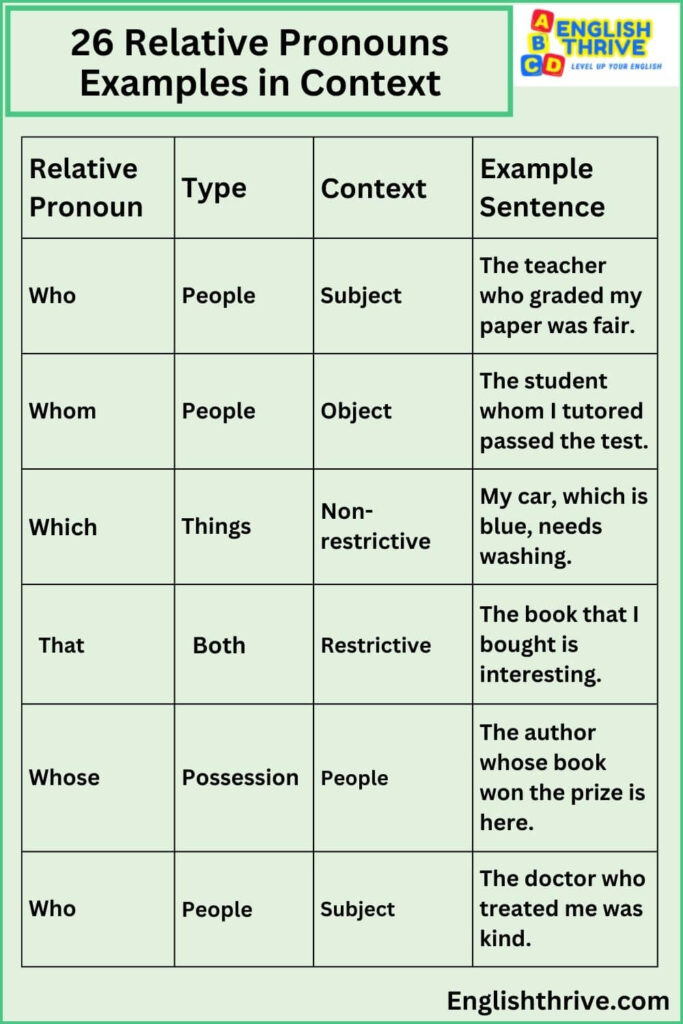
26 Relative Pronouns Examples
| Relative Pronoun | Type | Context | Example Sentence |
|---|---|---|---|
| Who | People | Subject | The teacher who graded my paper was fair. |
| Whom | People | Object | The student whom I tutored passed the test. |
| Which | Things | Non-restrictive | My car, which is blue, needs washing. |
| That | Both | Restrictive | The book that I bought is interesting. |
| Whose | Possession | People | The author whose book won the prize is here. |
| Who | People | Subject | The doctor who treated me was kind. |
| Which | Things | Non-restrictive | The house, which is old, needs repairs. |
| That | Things | Restrictive | The movie that we watched was exciting. |
| Whose | Possession | Things | The tree whose leaves fell early died. |
| Who | People | Subject | Students who study hard usually succeed. |
| Whom | People | Object | The person whom we met yesterday called. |
| Which | Things | Non-restrictive | This cake, which is homemade, tastes great. |
| That | Both | Restrictive | The phone that I lost was expensive. |
| Who | People | Subject | The artist who painted this is famous. |
| Whose | Possession | People | The girl whose cat ran away found it. |
| Which | Things | Non-restrictive | The computer, which crashed, is fixed now. |
| That | Things | Restrictive | The chair that broke needs replacing. |
| Who | People | Subject | People who exercise stay healthy. |
| Whom | People | Object | The client whom we helped was grateful. |
| Which | Things | Non-restrictive | My bike, which is red, was stolen. |
| That | Both | Restrictive | The song that played was beautiful. |
| Whose | Possession | Things | The building whose roof leaked is repaired. |
| Who | People | Subject | The musician who performed was talented. |
| Which | Things | Non-restrictive | The garden, which needs water, is dying. |
| That | Things | Restrictive | The food that we ordered arrived late. |
| Whose | Possession | People | The writer whose novel I read visited. |
FAQs about Relative Pronouns Examples
1. How do you identify relative pronouns in a sentence?
Relative pronouns connect clauses and provide additional information about a noun. To identify them:
- Look for words that introduce extra information about someone or something
- Check if the word is who, whom, which, that, or whose
- See if it connects two related ideas
- Verify that it refers back to a noun mentioned earlier
Example: “The book that I bought yesterday is fascinating.” Here, “that” connects “the book” with the extra information “I bought yesterday.”
2. What’s the difference between who and whom?
This common confusion can be solved by understanding their roles:
- Use who when it’s the subject (doing the action)
- Use whom when it’s the object (receiving the action)
Quick trick: If you can replace it with “he/she,” use who. If you can replace it with “him/her,” use whom.
3. When should you use that vs. which?
The choice depends on whether the information is essential:
- Use that for essential information (restrictive clauses)
- Use which for extra information (non-restrictive clauses, set off by commas)
Example:
- “The phone that I bought yesterday is new.” (essential)
- “My phone, which I bought yesterday, is new.” (extra information)
4. Can whose be used for things?
Yes, whose can be used for both people and things, though some prefer “of which” for things in formal writing. Examples:
- People: “The student whose paper won first prize”
- Things: “The tree whose leaves fell early” (or “the tree, the leaves of which fell early”)
5. How do relative pronouns affect sentence structure?
Relative pronouns help combine simple sentences into more complex ones by:
- Eliminating repetition
- Adding detail smoothly
- Creating more sophisticated sentence patterns
- Improving flow and readability
Conclusion
Understanding relative pronouns examples helps you write more sophisticated and clear sentences. Remember to match your relative pronouns to people or things appropriately, and pay attention to whether you’re adding essential or extra information. Practice using these connecting words, and you’ll find your writing becoming more natural and polished.