

The English language is rich with words that end in various letters, each giving our vocabulary a unique texture and sound. Among these, words ending with the letter N hold a special place, appearing frequently in everyday speech and writing. These words range from simple three-letter terms like “sun” to more complex words like “abstention.” Understanding words that end with N can greatly enhance your communication skills, whether you’re writing an essay, having a conversation, or solving a crossword puzzle. N-ending words span various parts of speech including nouns, verbs, adjectives, and more, making them essential building blocks of our language. This article explores the world of words ending with N, their meanings, and how they enrich our linguistic landscape.
What Are Words That End With N?
Words that end with N are those that have the letter N as their final character. This category encompasses a wide variety of terms from different language origins, including Latin, Greek, Germanic, and French influences. The letter N, as a final consonant, often gives words a distinctive resonance and clarity when spoken. This nasal consonant creates a natural closure to words that can be both subtle and impactful.
These words can be found across numerous categories:
- Common nouns (man, train, ocean)
- Action verbs (run, begin, explain)
- Adjectives (clean, green, certain)
- Adverbs (often, soon, again)
- Abstract concepts (passion, decision, information)
The frequency of N-ending words in English is particularly notable, with many basic and frequently used terms falling into this category. This prevalence makes understanding these words especially important for language learners and native speakers alike.
Common Words That End With N
To fully appreciate the diversity of words ending with N, let’s examine them by length, starting with the shortest and moving to progressively longer words. This approach helps us understand how these words function within different contexts and language levels.
3-Letter Words ending with N
| Word | Meaning |
|---|---|
| Ban | To prohibit or forbid something |
| Can | To be able to; a metal container |
| Den | A small, cozy room; an animal’s lair |
| Fan | A device that moves air; an enthusiastic admirer |
| Gin | A type of alcoholic spirit |
| Hun | A member of a nomadic Asian people |
| Inn | A pub that provides accommodation |
| Kin | One’s family and relations |
| Lan | A local area network in computing |
| Man | An adult human male |
| Nun | A woman who is a member of a religious community |
| Pan | A container used for cooking |
| Run | To move quickly on foot |
| Sin | An immoral act or offense |
| Sun | The star around which Earth orbits |
| Tan | To brown by exposure to sunlight |
| Tin | A silvery-white metal; a container |
| Van | A type of vehicle for transporting goods |
| Win | To be successful in a contest |
| Yen | A longing or desire; Japanese currency |
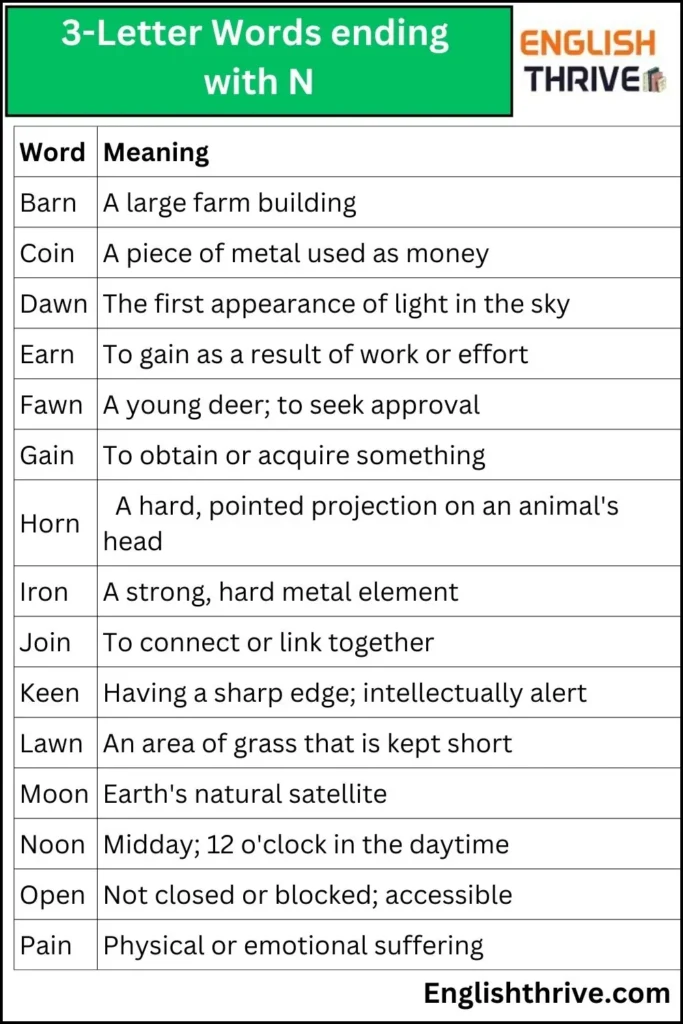
4-Letter Words Ending in N
| Word | Meaning |
|---|---|
| Barn | A large farm building |
| Coin | A piece of metal used as money |
| Dawn | The first appearance of light in the sky |
| Earn | To gain as a result of work or effort |
| Fawn | A young deer; to seek approval |
| Gain | To obtain or acquire something |
| Horn | A hard, pointed projection on an animal’s head |
| Iron | A strong, hard metal element |
| Join | To connect or link together |
| Keen | Having a sharp edge; intellectually alert |
| Lawn | An area of grass that is kept short |
| Moon | Earth’s natural satellite |
| Noon | Midday; 12 o’clock in the daytime |
| Open | Not closed or blocked; accessible |
| Pain | Physical or emotional suffering |
| Rain | Water falling from clouds |
| Sign | A gesture conveying information; a notice |
| Turn | To move around a central point |
| Warn | To inform of potential danger |
| Yarn | Spun thread; a long, detailed story |
5-Letter Words Ending in N
| Word | Meaning |
|---|---|
| Brain | The organ inside the skull |
| Chain | A series of connected links |
| Drain | To draw off liquid gradually |
| Grain | A small, hard seed |
| Learn | To gain knowledge or skill |
| Ocean | The vast body of saltwater |
| Plain | Clear; simple; a flat expanse of land |
| Queen | A female monarch |
| Reign | To rule as a monarch |
| Seven | The number 7 |
| Swain | A young man courting a woman |
| Train | A connected series of vehicles; to teach |
| Union | The action of joining together |
| Vixen | A female fox; a spiteful woman |
| Woven | Past participle of weave |
6-Letter Words Ending in N
| Word | Meaning |
|---|---|
| Action | The process of doing something |
| Beacon | A light or signal for guidance |
| Carbon | A chemical element present in all organic compounds |
| Dragon | A mythical monster resembling a giant reptile |
| Elixir | A magical potion; a special preparation |
| Frison | A heavy Flemish horse |
| Garden | A piece of ground for growing plants |
| Hidden | Concealed or kept out of sight |
| Lesson | A period of learning or teaching |
| Mignon | Small and delicately pretty |
7-Letter Words ending with N
| Word | Meaning |
|---|---|
| Abandon | To leave completely and finally |
| Balloon | An inflatable rubber bag filled with air or gas |
| Captain | The person in command of a ship or aircraft |
| Diction | The choice and use of words in speech or writing |
| Fashion | A popular trend, especially in clothing |
| Junction | A point where two or more things join |
| Mission | An important assignment, typically abroad |
| Pension | A regular payment made to someone in retirement |
8-Letter Words ending with N
| Word | Meaning |
|---|---|
| Addition | The process of adding something |
| Communion | The sharing of intimate thoughts and feelings |
| Dominion | Sovereignty or control |
| Function | The purpose or use of something |
| Occasion | A particular time, especially when something happens |
9-Letter Words ending with N
| Word | Meaning |
|---|---|
| Amendment | A minor change or addition to improve something |
| Companion | A person with whom one spends time |
| Detention | The action of detaining someone or the state of being detained |
| Extension | A part that is added to something to enlarge or prolong it |
| Formation | The action of forming or process of being formed |
10-Letter Words ending with N
| Word | Meaning |
|---|---|
| Abstention | The act of restraining oneself from doing something |
| Depression | Feelings of severe despondency and dejection |
| Expedition | A journey undertaken for a specific purpose |
| Impression | An idea, feeling, or opinion about something |
How Words That End With N Are Used in Sentences
Words ending with N serve numerous grammatical functions and appear in many different contexts. Understanding how to use these words effectively can enhance your communication and writing skills. Let’s explore various ways N-ending words function in sentences.
In Everyday Communication
N-ending words are essential components of daily conversation:
- “The sun is shining brightly today.”
- “I need to run to catch the train on time.”
- “Can you turn down the television?”
These examples demonstrate how simple N-ending words help us express basic ideas and actions in everyday situations.
In Academic and Professional Writing
In more formal contexts, N-ending words often convey complex ideas and concepts:
- “The function of this protein remains unknown.”
- “This decision will have lasting implications for our organization.”
- “The expedition to Antarctica yielded significant scientific information.”
Such usage shows how N-ending words can add precision and clarity to technical or professional communication.
In Descriptive Language
Writers frequently use N-ending words to create vivid descriptions:
- “The ocean sparkled like diamonds under the afternoon sun.”
- “The hidden garden was a lush green oasis in the urban landscape.”
- “Her keen observation skills made her an excellent detective.”
These examples illustrate how Words ending with N can help paint a clearer picture in the reader’s mind.
In Compound Words
N-ending words often appear as part of compound terms:
- “The classroom was filled with excited students on the first day.”
- “The sunburn on his shoulders was painful after a day at the beach.”
- “I need to upload this information to the mainframe computer.”
This demonstrates how N-ending words can combine with other words to create more specific terms.
Historical Origins of Words ending with N
Understanding the etymology of Words ending with N provides insight into their meanings and applications. The diverse origins of these words reflect the complex history of the English language.
Latin Influences
Many N-ending words, particularly those related to academic or formal contexts, have Latin origins:
- “Action” derives from the Latin “actio,” meaning a doing or performing
- “Function” comes from “functio,” relating to performance or execution
- “Union” originates from “unio,” meaning oneness or unity
These Latin-derived words often maintain formal or technical connotations in modern English.
Greek Contributions
Greek has also contributed significantly to our collection of N-ending words:
- “Demon” comes from “daimon,” originally referring to a divine power
- “Horizon” derives from “horizein,” meaning to limit or bound
- “Skeleton” originates from “skeletos,” meaning dried up or mummified
Greek-origin words frequently appear in scientific, philosophical, and technical vocabulary.
Germanic Roots
Some of our most common and everyday Words ending with N have Germanic origins:
- “Rain” comes from the Old English “regn”
- “Open” derives from “openian”
- “Queen” originates from “cwen”
These words tend to be among the most frequently used terms in everyday English speech and writing.
French Influences
The Norman Conquest brought many French-derived N-ending words into English:
- “Mountain” comes from the Old French “montaigne”
- “Certain” derives from “certain” in Old French
- “Garden” originates from “gardin” in Anglo-Norman
French-derived words often added a layer of sophistication to English vocabulary.
Conclusion & Final Tips on Words ending with N
Words ending with N form a fundamental part of the English language, appearing in all aspects of communication from casual conversation to formal writing. These words represent diverse grammatical functions and origins, reflecting the rich history and development of English over centuries. By exploring words ending with N by length and meaning, we gain a deeper understanding of our language’s structure and versatility.
To effectively use N-ending words in your writing and speech:
- Consider the context and choose the most appropriate word for your specific meaning
- Be aware of the connotations associated with words from different origins
- Practice using less common N-ending words to expand your vocabulary
- Pay attention to how N-ending words contribute to rhythm and flow in writing
- Remember that some N-ending words have specialized meanings in particular fields
Whether you’re a student building vocabulary, a professional writer seeking precision, or simply someone who loves language, having command of Words ending with N will strengthen your communication skills and linguistic flexibility. The distinctive sound of words ending with N gives them a natural cadence that can be powerful in both written and spoken English.
By incorporating a variety of Words ending with N into your language, you’ll express yourself more precisely and eloquently, enhancing your ability to communicate effectively in any situation.