

Noun suffixes are important tools in the English language that help form new words and provide meaning. They are the endings added to root words to change their meaning, part of speech, or usage. Understanding noun suffixes can enhance your vocabulary and grammar skills, whether you’re learning English as a second language, studying for an exam, or simply looking to improve your writing. This article will explore the most common noun suffixes, how they work, and provide examples to help you fully grasp their function.
What Are Noun Suffixes?
Noun suffixes are letter combinations added at the end of a word to form a noun. They help modify a root word to create new words that represent a person, thing, place, or idea. These suffixes are crucial in expanding vocabulary and improving communication, as they allow for the creation of more specific or varied nouns from existing words. By understanding noun suffixes, you can enhance your ability to express ideas and use more precise language.
When you add a suffix to a root word, it often changes the word’s meaning or turns the word into a different part of speech. Noun suffixes are particularly useful because they allow adjectives and verbs to be transformed into nouns, providing more options for expressing concepts, qualities, and actions.
For example:
- -er is a common noun suffix that turns a verb into a person who performs that action. For example, “teach” becomes “teacher”.
- -ness is another common noun suffix, which turns adjectives into nouns that describe a state or condition. For example, “happy” becomes “happiness”.
By adding these suffixes, you can create a range of new words to suit different contexts and needs. Understanding how noun suffixes work helps you expand your vocabulary and enhances your ability to communicate clearly and effectively.
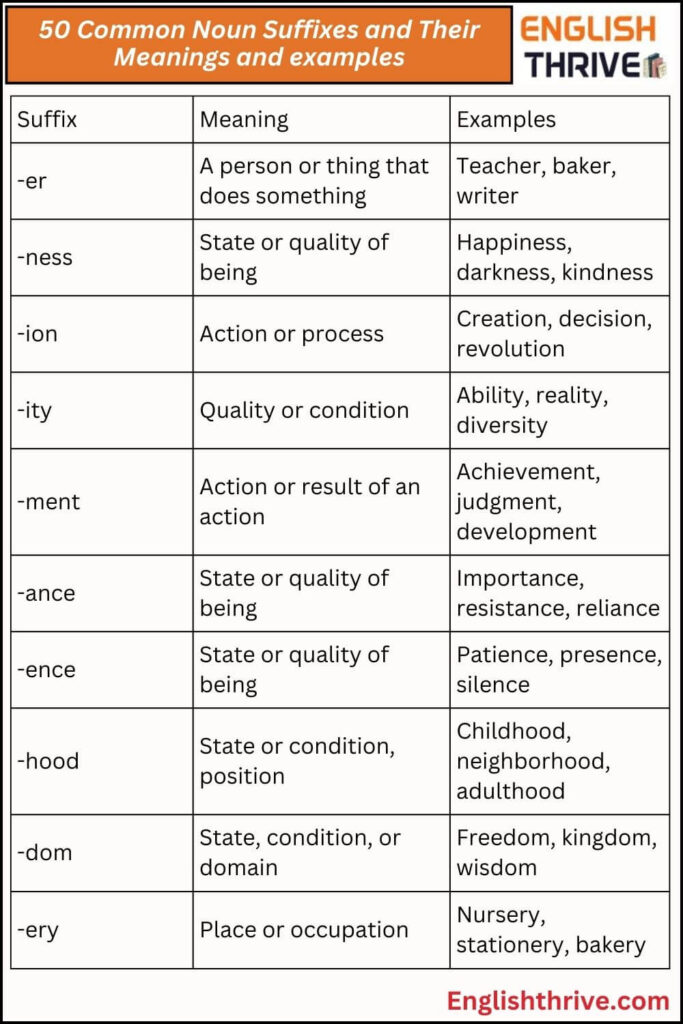
50 Common Noun Suffixes and Their Meanings and examples
| Suffix | Meaning | Examples |
|---|---|---|
| -er | A person or thing that does something | Teacher, baker, writer |
| -ness | State or quality of being | Happiness, darkness, kindness |
| -ion | Action or process | Creation, decision, revolution |
| -ity | Quality or condition | Ability, reality, diversity |
| -ment | Action or result of an action | Achievement, judgment, development |
| -ance | State or quality of being | Importance, resistance, reliance |
| -ence | State or quality of being | Patience, presence, silence |
| -hood | State or condition, position | Childhood, neighborhood, adulthood |
| -dom | State, condition, or domain | Freedom, kingdom, wisdom |
| -ship | State or quality of being | Friendship, leadership, partnership |
| -al | Relating to or characterized by | Refusal, approval, arrival |
| -ity | State or quality of being | Sensitivity, visibility, activity |
| -ess | Female (used to indicate gender) | Actress, waitress, princess |
| -ology | The study of something | Biology, psychology, anthropology |
| -ist | A person who specializes in something | Artist, scientist, journalist |
| -ous | Full of or having qualities of | Dangerous, curious, nervous |
| -ize | To make or become | Realize, organize, finalize |
| -er | A person or thing that performs an action | Singer, player, builder |
| -ity | State or quality of being | Unity, activity, reliability |
| -al | Relating to, or characterized by | National, personal, legal |
| -ance | Action or process | Defiance, reliance, performance |
| -ance | State or quality of being | Tolerance, allowance, appearance |
| -ness | State or quality of being | Roughness, bitterness, sweetness |
| -ism | A belief, doctrine, or practice | Capitalism, feminism, realism |
| -ment | Action or result of an action | Investment, excitement, treatment |
| -ity | State or quality of being | Sensitivity, humility, agility |
| -ery | Place for or condition of | Bakery, brewery, surgery |
| -age | Action or process; the result of something | Marriage, mileage, baggage |
| -ess | Female person or role | Princess, lioness, empress |
| -hood | State or condition | Adulthood, manhood, priesthood |
| -ism | A distinctive practice or philosophy | Humanism, realism, socialism |
| -ship | Position or status | Relationship, membership, ownership |
| -ment | The result or product of an action | Recruitment, payment, settlement |
| -ity | Quality or condition | Sensitivity, clarity, responsibility |
| -al | Pertaining to or relating to | Criminal, educational, natural |
| -er | A person or thing that performs an action | Dancer, driver, writer |
| -dom | Domain or condition | Wisdom, freedom, boredom |
| -ess | Female counterpart | Stewardess, hostess, poetess |
| -ness | State or quality | Darkness, fitness, weakness |
| -ure | Action or result of an action | Exposure, failure, culture |
| -ance | State or quality of being | Importance, elegance, endurance |
| -ology | The study of a field | Sociology, theology, criminology |
| -ment | Action, process, or result | Establishment, achievement, amusement |
| -ness | State, quality, or condition | Sadness, greatness, awareness |
| -ity | State or quality of being | Sensitivity, capability, flexibility |
| -ence | State or quality of being | Silence, difference, presence |
| -ship | State, condition, or relationship | Partnership, leadership, citizenship |
| -ism | A distinctive practice or ideology | Buddhism, Marxism, feminism |
| -ian | Pertaining to a person or thing | Librarian, electrician, historian |
| -cy | State or condition | Democracy, agency, efficiency |
| -ery | Place or occupation | Nursery, stationery, bakery |
Example Sentences:
- -er: The baker makes delicious bread every morning.
- -ness: Her happiness was evident when she received the good news.
- -ment: The achievement of finishing the project felt rewarding.
- -ship: Their friendship lasted through the toughest times.
By recognizing and understanding these common suffixes, you’ll be able to expand your vocabulary and use a variety of words to express different meanings and ideas.
How to Use Noun Suffixes in Sentences
When you use noun suffixes, you’re not only changing a word but also influencing how that word can function in a sentence. The right suffix can transform a verb, adjective, or another noun into a new word that fits the context better. Here are a few tips on how to use them effectively:
1. Understand the Function of the Word
- Adding -er to a verb like “run” gives us “runner”, a noun that refers to a person who runs.
- Adding -ness to an adjective like “sad” forms “sadness”, a noun that represents the state of being sad.
2. Match the Word Type to the Sentence
- -ship and -dom are often used to express states or conditions (e.g., “freedom” and “friendship”), while -ness can be used to describe qualities (e.g., “darkness”).
- -ment and -ion are used to describe actions or results (e.g., “development”, “creation”).
3. Use Noun Suffixes to Show Relationships
- -hood and -ship can be used to show relationships between people, like “childhood” (the period of being a child) or “partnership” (a relationship between business partners).
Understanding how each suffix can modify a word will help you write more fluently and express more detailed ideas.
Advanced Uses of Noun Suffixes
Noun suffixes not only serve to create new words but also help to modify the meaning of a base word in advanced and nuanced ways. Understanding how to use these suffixes effectively can improve your writing, make your arguments clearer, and help convey more specific ideas. Below are some advanced uses and techniques for applying noun suffixes.
1. Changing the Gender or Role of a Word
Certain suffixes are used to indicate gender or the role of a person. These suffixes allow a speaker or writer to specify whether they are talking about a male, female, or a specific profession. For example:
- -ess: Traditionally used to indicate a female person. While it’s still common, some people prefer gender-neutral terms.
- Actress (female actor), waitress (female server).
- -eer: This suffix is often used to refer to a person involved in a particular activity or occupation.
- Volunteer, engineer, pioneer.
However, be mindful that there’s an increasing shift toward using gender-neutral terms, such as “actor” for both genders and “server” instead of waitress.
2. Nouns Indicating Condition or State
Suffixes like -hood, -dom, and -ness often relate to a state of being or condition. These suffixes can help express the nature of an entity, its state, or its quality.
- -hood: Refers to a state or condition, often related to age or status.
- Childhood (the period when someone is a child), adulthood (the state of being an adult).
- -dom: Indicates a domain or state.
- Kingdom (territory ruled by a king), freedom (state of being free).
3. Expanding on a Process or Result
Suffixes like -ion, -ment, and -ance are used to represent actions, processes, or the results of an action. These suffixes are crucial for explaining the outcomes of events or actions.
- -ion: Used to indicate actions or processes.
- Creation (the process of creating), decision (the act of making a decision).
- -ment: Often refers to the result of an action.
- Achievement (the result of achieving), development (the process of developing something).
- -ance: Denotes a state or condition, sometimes indicating an action.
- Resistance (the act of resisting), importance (the state of being important).
These suffixes help form nouns that are essential for expressing abstract concepts or actions in academic writing, formal essays, or any descriptive language.
4. Creating Abstract Nouns
Some suffixes help form abstract nouns, which represent ideas, qualities, or conditions that cannot be seen or touched. These are useful in philosophical, scientific, and literary contexts.
- -ity: Used to form nouns that indicate a quality or state.
- Visibility (the quality of being visible), activity (the state of being active).
- -ness: Often used to create nouns that describe a state of being.
- Happiness (the state of being happy), darkness (the state of being dark).
These suffixes are key to discussions about abstract concepts like emotions, states of mind, and philosophical ideas.
Commonly Confused Noun Suffixes
Even though many noun suffixes are straightforward, some can be easily confused because they have similar meanings but slightly different uses. Understanding the subtle differences between these suffixes will help you use them correctly in various contexts.
1. -ance vs. -ence
Both -ance and -ence are used to form nouns indicating a state, condition, or quality, but they are often used with different roots.
- -ance: Generally used with verbs that end in -ant.
- Resistance (from resist), performance (from perform).
- -ence: Generally used with verbs that end in -ent.
- Patience (from patient), presence (from present).
Although the distinction can be subtle, these endings generally follow the verb’s form.
2. -er vs. -or
Both -er and -or are used to form nouns indicating a person who performs an action, but -er is more common in everyday English, while -or is often used for more formal terms.
- -er: Used for people who perform an action or work in a specific field.
- Teacher, baker, writer.
- -or: Used for people in certain professions or activities.
- Doctor, actor, creator.
3. -ion vs. -tion
-ion and -tion are both used to form nouns indicating actions or processes, but -tion is more specific and is typically used when the root word ends in -t.
- -ion: A broader term for action or process.
- Action, creation, revolution.
- -tion: A more formal or structured form of -ion.
- Information, situation, action.
Conclusion
Noun suffixes play a vital role in the English language by allowing us to transform words and create new nouns. By understanding how to use these suffixes, you can easily expand your vocabulary, improve your writing, and communicate more effectively. Whether you’re forming nouns to represent people, places, things, or ideas, suffixes such as -er, -ness, -ment, and -ology can help you express a wider range of meanings.
Through the simple act of adding a suffix, you can enhance the richness of your language and be more precise in your communication. Whether you are a student, a writer, or just someone looking to improve their language skills, mastering noun suffixes is an essential tool for success.
By exploring the list of common noun suffixes and their meanings, you’ll be better equipped to create more varied and descriptive sentences. Practice using these suffixes in everyday conversation and writing, and watch your vocabulary grow!