
Building a strong vocabulary in 5th grade is a major milestone in a child’s academic journey. At this stage, students encounter more complex texts, write longer essays, and engage in deeper discussions—so having the right vocabulary tools becomes essential. This guide provides a complete list of 5th grade vocabulary words, along with meanings, example sentences, word categories, learning tips, and printable-style lists. Teachers and parents can use these lists right away.
What Are 5th Grade Vocabulary Words?
5th grade vocabulary words are words that help students share ideas, read harder books, and write with more detail. These words are more advanced than basic words kids learn in earlier grades. Students learn:
- Descriptive words like “peculiar” and “radiant”
- Action words like “analyze” and “summarize”
- Science and math words like “photosynthesis” and “volume”
- Reading and writing words like “idiom” and “personification”
When students learn these words well, they build strong skills that help them in middle school and beyond.
Why Building Strong Vocabulary Matters in 5th Grade
Improved Reading Comprehension
5th graders read stories and articles with harder words and deeper meaning. A strong vocabulary helps them understand the text, themes, and author’s message.
Better Writing & Expression
Students write longer stories and essays in 5th grade. Knowing more words helps them write clearly and make their ideas sound stronger.
Preparation for Middle School
Middle school introduces new subjects like harder science and history. Vocabulary skills help students understand these new terms and ideas.
Boost in Test Performance
Many tests ask students to use clues to find word meanings. A strong vocabulary helps them answer these questions and improves their scores.
Below is your optimized, easy-to-read version of the full vocabulary section.
All sentences and definitions are simplified for elementary-level readability while keeping the meaning clear.
Master List of 5th Grade Vocabulary Words With Meaning
Here is a clear, kid-friendly list of common 5th grade vocabulary words. Each word has an easy meaning and a short example sentence.
General & Descriptive Vocabulary Words
| Word | Simple Meaning | Easy Sentence |
|---|---|---|
| Benevolent | Kind and helpful | The benevolent teacher gave us snacks. |
| Peculiar | Strange or different | I heard a peculiar sound in the attic. |
| Vibrant | Bright or full of life | The garden had vibrant flowers. |
| Radiant | Shining or glowing | Her radiant smile made us happy. |
| Cautious | Careful | Be cautious when you cross the street. |
| Distinct | Clearly different | Each bird has a distinct song. |
| Fierce | Strong or wild | The fierce storm broke many trees. |
| Grateful | Thankful | I am grateful for your help. |
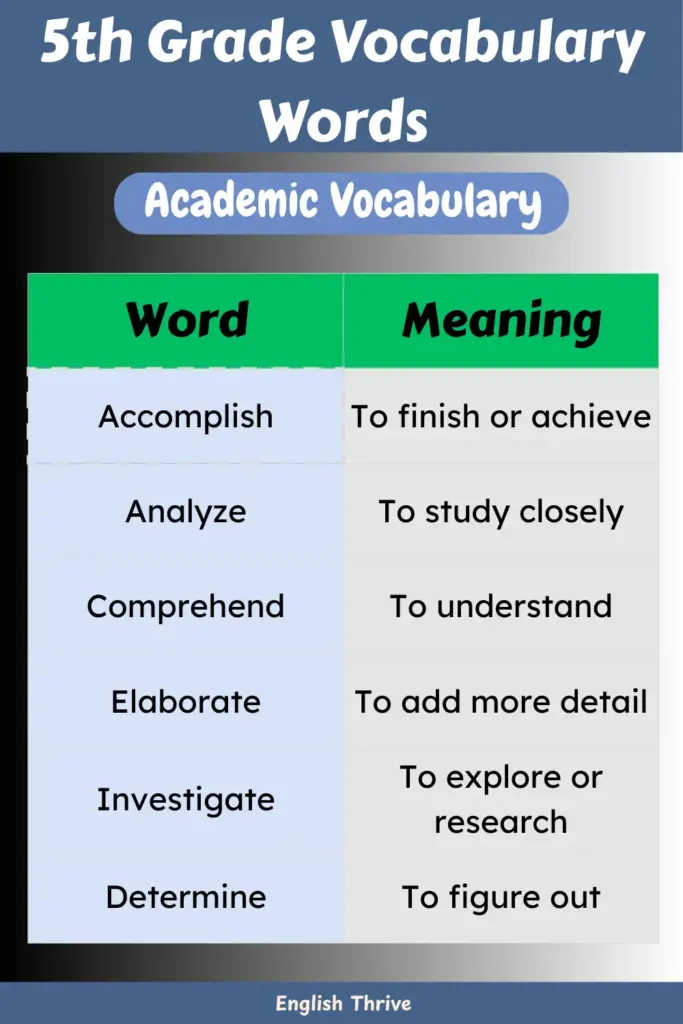
Action & Academic Vocabulary Words
| Word | Simple Meaning | Easy Sentence |
|---|---|---|
| Accomplish | To finish or achieve | She worked hard to accomplish her goal. |
| Analyze | To study closely | We analyze the text to find the main idea. |
| Comprehend | To understand | He could not comprehend the math question. |
| Elaborate | To add more detail | Please elaborate so we can understand. |
| Investigate | To explore or research | Scientists investigate how plants grow. |
| Determine | To figure out | We determine the answer using clues. |
| Persuade | To convince someone | She tried to persuade her parents to get a puppy. |
| Summarize | To tell the main points | Summarize the story in three lines. |
| Synthesize | To combine ideas | We synthesize facts from many books. |
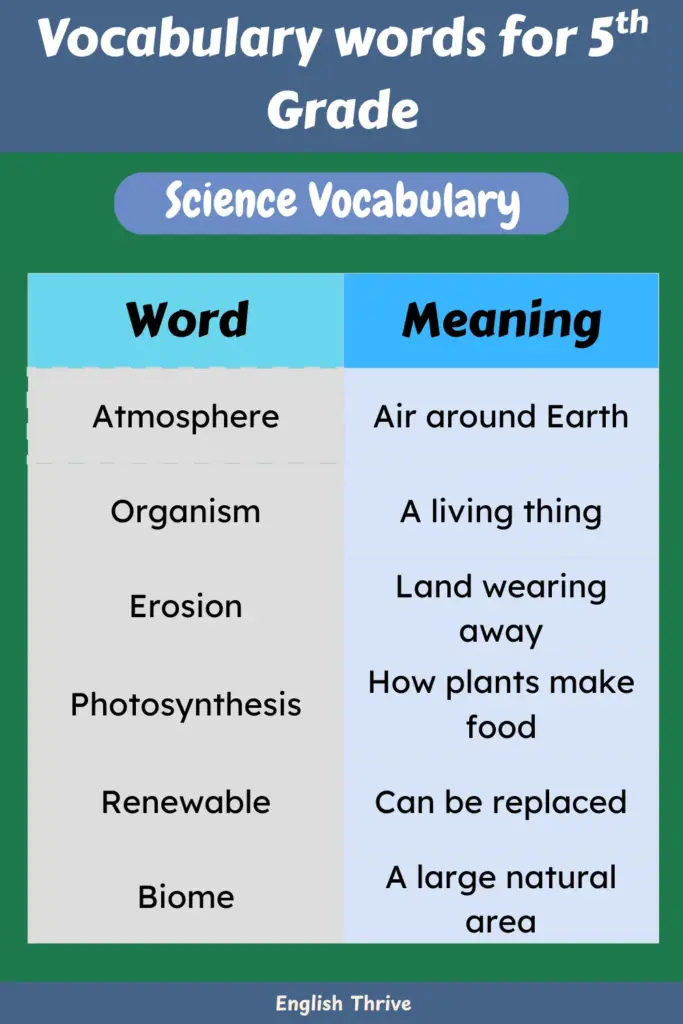
Science Vocabulary Words for 5th Grade
| Word | Simple Meaning | Easy Sentence |
|---|---|---|
| Atmosphere | Air around Earth | Earth’s atmosphere protects us. |
| Organism | A living thing | Every organism needs water. |
| Erosion | Land wearing away | The river caused erosion on the bank. |
| Photosynthesis | How plants make food | Plants use photosynthesis to make energy. |
| Renewable | Can be replaced | Solar energy is a renewable resource. |
| Biome | A large natural area | The desert biome is very dry. |
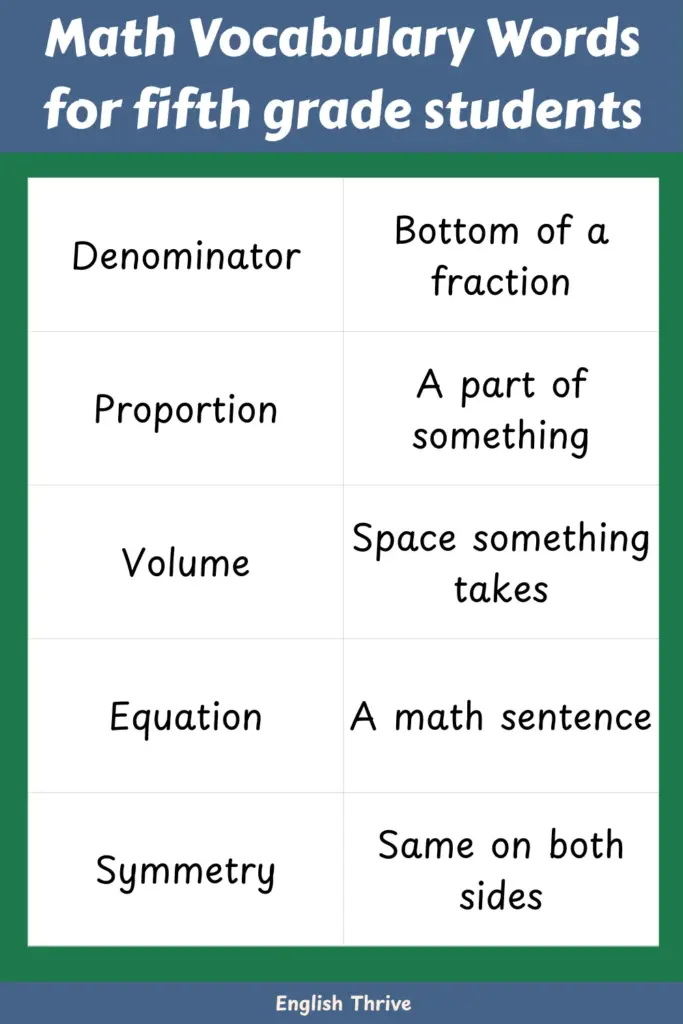
Math Vocabulary Words for 5th Grade
| Word | Simple Meaning | Easy Sentence |
|---|---|---|
| Denominator | Bottom of a fraction | The denominator shows the number of parts. |
| Proportion | A part of something | We used proportion to change the size. |
| Volume | Space something takes | We measured the volume of the box. |
| Equation | A math sentence | Solve the equation to find the number. |
| Symmetry | Same on both sides | The butterfly has perfect symmetry. |
Literary & Language Arts Vocabulary Words
| Word | Simple Meaning | Easy Sentence |
|---|---|---|
| Context | Words around a word | Use context clues to find the meaning. |
| Idiom | A phrase with a special meaning | “Break a leg” is an idiom for “good luck.” |
| Hyperbole | An extreme exaggeration | “I’m starving” is a hyperbole. |
| Onomatopoeia | Sound words | “Buzz” and “bang” are onomatopoeia. |
| Symbolism | When objects show ideas | A dove is a symbol of peace. |
| Point of View | How a story is told | The story is told from her point of view. |
100+ 5th Grade Vocabulary Words (Quick list)
 5th Grade Vocabulary Words with Meaning
Perfect for flashcards, weekly word lists, and spelling practice:
Benevolent
Meaning: kind and helpful
Peculiar
Meaning: strange or unusual
Vibrant
Meaning: full of life or bright
Radiant
Meaning: shining or glowing
Cautious
Meaning: careful to avoid danger
Distinct
Meaning: clearly different
Fierce
Meaning: strong or intense
Grateful
Meaning: thankful
Accomplish
Meaning: to achieve something
Analyze
Meaning: to study something closely
Comprehend
Meaning: to understand
Elaborate
Meaning: to add more detail
Investigate
Meaning: to look into or research
Justify
Meaning: to explain why something is right
Persuade
Meaning: to convince someone
Summarize
Meaning: to tell the main points
Synthesize
Meaning: to combine ideas
Atmosphere
Meaning: the layer of air around Earth
Organism
Meaning: a living thing
Erosion
Meaning: the slow wearing away of land
Photosynthesis
Meaning: how plants make food
Renewable
Meaning: can be replaced naturally
Biome
Meaning: a large natural environment
Denominator
Meaning: the bottom number in a fraction
Equation
Meaning: a math sentence that shows equality
Volume
Meaning: the amount of space something takes up
Symmetry
Meaning: having the same shape on both sides
Context
Meaning: words around a word that help explain it
Idiom
Meaning: a phrase with a non-literal meaning
Symbolism
Meaning: using objects to show ideas
Hyperbole
Meaning: an exaggerated statement
Onomatopoeia
Meaning: a word that imitates a sound (buzz, bang)
Persevere
Meaning: to keep trying even when it’s hard
Determine
Meaning: to figure out or decide
Collaborate
Meaning: to work together
Conclude
Meaning: to finish or decide something
Habitat
Meaning: the natural home of a plant or animal
Proportion
Meaning: a part compared to the whole
Fiction
Meaning: a story that is made up
Context Clues
Meaning: words that help you understand another word
Figurative
Meaning: not literal; uses creative language
Narrative
Meaning: a story
Variable
Meaning: something that can change
Research
Meaning: to search for facts or information
Hypothesis
Meaning: an educated guess
Establish
Meaning: to set up or create
Exaggerate
Meaning: to make something seem bigger than it is
Independent
Meaning: able to do things alone
Conflict
Meaning: a problem or struggle
Acknowledge
Meaning: to admit or accept something
Appreciate
Meaning: to value or be thankful for something
Abundant
Meaning: more than enough
Harmonious
Meaning: working well together
Quest
Meaning: a long search or mission
Triumph
Meaning: a great win or victory
Suspense
Meaning: a feeling of excitement or uncertainty
Resourceful
Meaning: good at finding solutions
Patient
Meaning: able to wait calmly
Loyal
Meaning: faithful or trustworthy
Mystify
Meaning: to confuse or puzzle
Constant
Meaning: something that does not change
Fraction
Meaning: a part of a whole
Perimeter
Meaning: the distance around a shape
Sediment
Meaning: small pieces of rock or soil
Magnify
Meaning: to make something look bigger
Revise
Meaning: to change or fix writing
Accelerate
Meaning: to speed up
Numerous
Meaning: many
Portable
Meaning: easy to carry
Preserve
Meaning: to protect or save something
Route
Meaning: a path or way
Resemble
Meaning: to look like something else
Visible
Meaning: able to be seen
Vivid
Meaning: bright, clear, and full of detail
Tropical
Meaning: warm and humid, like climates near the equator
Wilderness
Meaning: a wild, natural area
Summit
Meaning: the highest point of a mountain
Strategy
Meaning: a plan to reach a goal
Translate
Meaning: to change words from one language to another
Suffix
Meaning: a word ending added to change meaning
Prefix
Meaning: a word part added at the beginning
Evaporate
Meaning: when liquid turns into gas
Convert
Meaning: to change something into a new form
Occasion
Meaning: a special event or time
Reassure
Meaning: to make someone feel calm or safe again
Realistic
Meaning: something that seems real or true
Ancient
Meaning: very old