

Understanding opposite words in English is a fun and effective way to expand your vocabulary and improve your language skills. Whether you’re a student, a parent helping your child learn, or someone who simply enjoys enhancing their communication abilities, knowing opposites can make your sentences more interesting and impactful.
In this blog, we’ll explore a variety of opposite words in English, from everyday terms to more complex ones, that will help you express contrasting ideas clearly. Learning opposites not only broadens your vocabulary but also helps you gain a deeper understanding of how words function in different contexts.
So, let’s dive into this exciting language journey and explore how mastering opposite words in English can make your conversations and writing more dynamic!
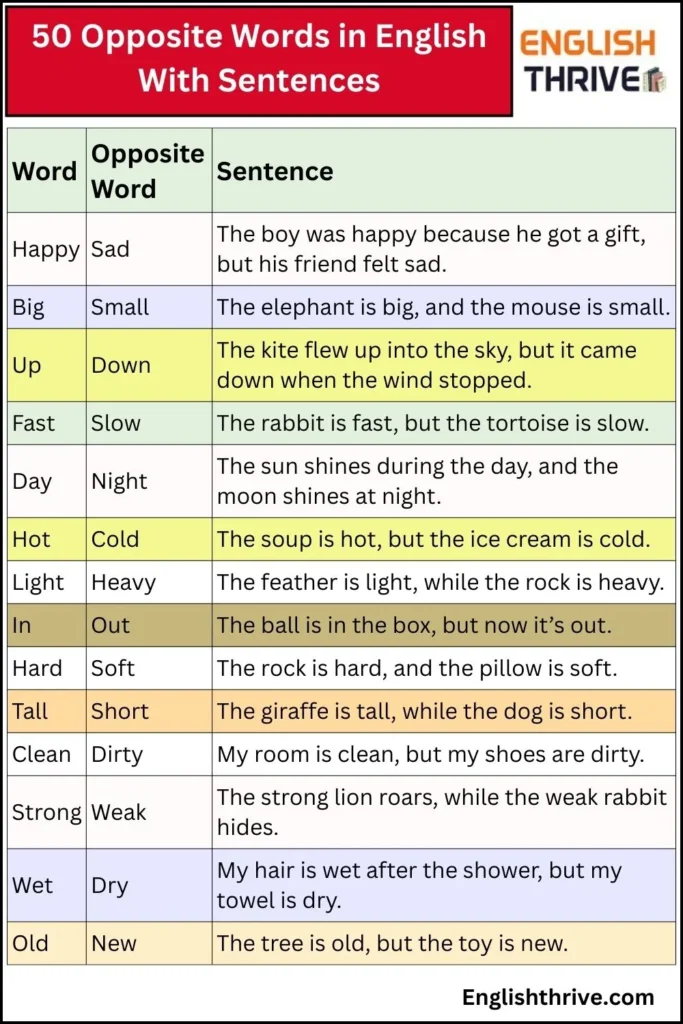
50 Opposite Words in English With Sentences
| Word | Opposite Word | Sentence |
|---|---|---|
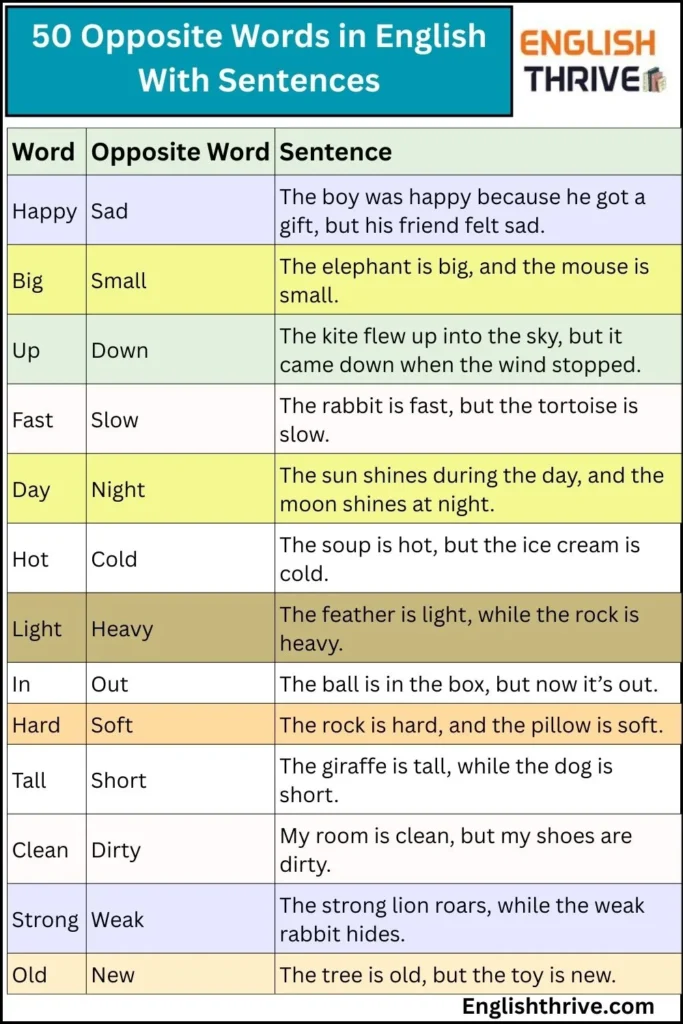
| Happy | Sad | The boy was happy because he got a gift, but his friend felt sad. |
| Big | Small | The elephant is big, and the mouse is small. |
| Up | Down | The kite flew up into the sky, but it came down when the wind stopped. |
| Fast | Slow | The rabbit is fast, but the tortoise is slow. |
| Day | Night | The sun shines during the day, and the moon shines at night. |
| Hot | Cold | The soup is hot, but the ice cream is cold. |
| Light | Heavy | The feather is light, while the rock is heavy. |
| In | Out | The ball is in the box, but now it’s out. |
| Hard | Soft | The rock is hard, and the pillow is soft. |
| Tall | Short | The giraffe is tall, while the dog is short. |
| Clean | Dirty | My room is clean, but my shoes are dirty. |
| Strong | Weak | The strong lion roars, while the weak rabbit hides. |
| Wet | Dry | My hair is wet after the shower, but my towel is dry. |
| Old | New | The tree is old, but the toy is new. |
| Bright | Dull | The sun is bright, but the sky is dull on a cloudy day. |
| Sweet | Sour | The apple is sweet, but the lemon is sour. |
| Soft | Hard | The bunny’s fur is soft, but the stone is hard. |
| Sweet | Bitter | The chocolate is sweet, while the coffee is bitter. |
| Tall | Short | The mountain is tall, but the hill is short. |
| Open | Closed | The door is open, but the window is closed. |
| Thin | Thick | The paper is thin, but the book is thick. |
| Full | Empty | The glass is full of water, but the cup is empty. |
| Strong | Fragile | The superhero is strong, while the vase is fragile. |
| Smooth | Rough | The table is smooth, but the wall is rough. |
| Light | Dark | The room is light during the day, but dark at night. |
| Rich | Poor | The prince is rich, while the beggar is poor. |
| High | Low | The bird flew high in the sky, and the cat stayed low to the ground. |
| Noisy | Quiet | The playground is noisy, but the library is quiet. |
| Healthy | Sick | She is healthy because she eats vegetables, but her brother is sick. |
| Young | Old | The puppy is young, and the dog is old. |
| Tall | Short | The tree is tall, and the bush is short. |
| Clean | Messy | The kitchen is clean, but the bedroom is messy. |
| Near | Far | The store is near, but the park is far. |
| Fast | Slow | The cheetah is fast, and the snail is slow. |
| Open | Closed | The book is open, but the box is closed. |
| Thick | Thin | The wool sweater is thick, but the shirt is thin. |
| Wet | Dry | My shoes are wet from the rain, but my socks are dry. |
| Little | Big | The bug is little, and the elephant is big. |
| Friendly | Unfriendly | The puppy is friendly, but the cat is unfriendly. |
| High | Low | The airplane is high in the sky, but the car is low on the road. |
| Sharp | Blunt | The knife is sharp, but the pencil is blunt. |
| Strong | Weak | The superhero is strong, but the villain is weak. |
| Happy | Unhappy | She is happy with her gift, but he is unhappy. |
| Hard | Soft | The table is hard, but the chair is soft. |
| Bright | Dark | The light is bright, but the room is dark. |
| Warm | Cool | The weather is warm, but the water is cool. |
| Friendly | Hostile | The puppy is friendly, but the wolf is hostile. |
| Clean | Dirty | The floor is clean, but the shoes are dirty. |
| Fast | Slow | The rabbit is fast, but the turtle is slow. |
| Young | Old | The kitten is young, and the cat is old. |
| Tall | Short | The tree is tall, but the bush is short. |
| Big | Small | The house is big, but the car is small. |
| Strong | Weak | He is strong because he exercises, but she is weak. |
FAQs on Opposite Words in English
What are opposite words in English?
Opposite words, or antonyms, are words that have contrasting meanings.
Example: Hot × Cold, Big × Small.
Why are opposite words important?
Learning opposites improves your vocabulary, helps you describe things clearly, and makes communication more expressive and balanced.
What is an example of an opposite word sentence?
“The soup is hot, but the juice is cold.”
Here, hot and cold are opposite words.
How can students learn opposite words easily?
Use flashcards, word games, and daily examples. Practice using opposites in sentences to remember them better.
Are antonyms and opposite words the same?
Yes. “Antonyms” is the formal term for words that have opposite meanings, like happy and sad.
Conciliation on opposite words in English
To wrap things up, using opposite words in English is an effective and enjoyable way to improve your language skills. By learning opposites, you not only expand your vocabulary but also make your writing and conversations more interesting and clear. Whether you’re writing creatively, preparing for exams, or simply enhancing your everyday communication, understanding opposite words in English is a powerful tool.
As you practice and incorporate these opposites into your language, you’ll notice how much more dynamic and engaging your communication becomes. Keep exploring new opposites and challenge yourself to use them in different contexts. With time, these words will become second nature, helping you speak and write with confidence and clarity.