

You don’t need to memorize thousands of difficult words to start understanding English. In fact, many everyday conversations are built around a surprisingly small group of words that appear again and again.
The 100 most common words in English include everyday words such as the, you, have, go, can, this, and with. They may look simple, but learning how to use them correctly can make speaking, reading, and writing English much easier.
In this guide, you’ll find a complete list of 100 common words, simple meanings and examples for important words, useful sentence patterns, common mistakes, and short practice exercises. Instead of just memorizing the list, you’ll learn how these words actually work in everyday English.
How to Study These Common Words
- Learn in groups: Study pronouns, verbs, prepositions, and connectors together.
- Read the example aloud: This helps you connect meaning, grammar, and pronunciation.
- Change one part: Turn “I go to school” into “We go to work.”
- Review in context: Write three short sentences instead of copying a word ten times.
Important: A word can have several meanings and grammar roles. The short explanations below show common beginner uses, not every possible use.
The 100 Most Common Words in English
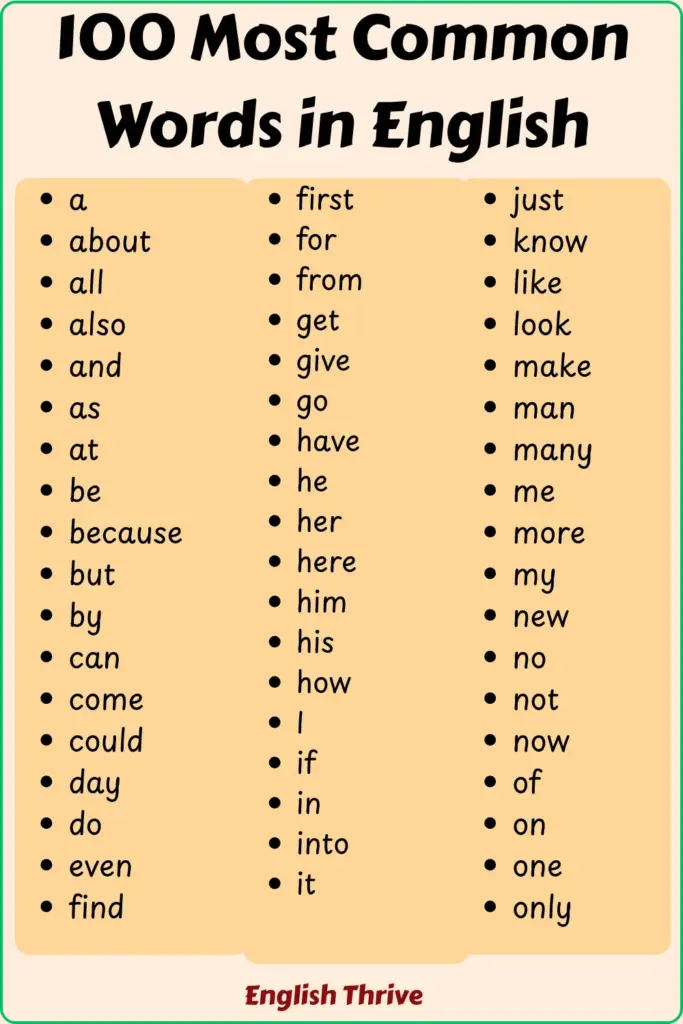
| 1. a | 2. about | 3. all | 4. also |
| 5. and | 6. as | 7. at | 8. be |
| 9. because | 10. but | 11. by | 12. can |
| 13. come | 14. could | 15. day | 16. do |
| 17. even | 18. find | 19. first | 20. for |
| 21. from | 22. get | 23. give | 24. go |
| 25. have | 26. he | 27. her | 28. here |
| 29. him | 30. his | 31. how | 32. I |
| 33. if | 34. in | 35. into | 36. it |
| 37. its | 38. just | 39. know | 40. like |
| 41. look | 42. make | 43. man | 44. many |
| 45. me | 46. more | 47. my | 48. new |
| 49. no | 50. not | 51. now | 52. of |
| 53. on | 54. one | 55. only | 56. or |
| 57. other | 58. our | 59. out | 60. people |
| 61. say | 62. see | 63. she | 64. so |
| 65. some | 66. take | 67. tell | 68. than |
| 69. that | 70. the | 71. their | 72. them |
| 73. then | 74. there | 75. these | 76. they |
| 77. thing | 78. think | 79. this | 80. those |
| 81. time | 82. to | 83. two | 84. up |
| 85. use | 86. very | 87. want | 88. way |
| 89. we | 90. well | 91. what | 92. when |
| 93. which | 94. who | 95. will | 96. with |
| 97. would | 98. year | 99. you | 100. your |
This list contains exactly 100 entries. Some frequency lists differ because they use different collections of books, conversations, news, or online writing. You can compare approaches in the Corpus of Contemporary American English.
Meanings and Simple Examples for 30 Core Words
| Word | Common beginner use | Example |
|---|---|---|
| the | points to a specific noun | Please close the door. |
| a | means one, but not a specific one | I need a pen. |
| I | the speaker | I study English every day. |
| you | the listener or reader | You can sit here. |
| we | the speaker and another person | We are ready. |
| they | two or more people or things | They live nearby. |
| it | a thing, animal, situation, weather, or time | It is cold today. |
| this | a nearby person or thing | This book is useful. |
| that | a more distant person or thing | That bus is ours. |
| be | exist or have a state; changes to am, is, are, was, were | She wants to be a nurse. |
| have | own, experience, or receive | We have enough time. |
| do | perform an action; also helps form questions | Do you work here? |
| go | move to another place | I go to school by bus. |
| get | receive, obtain, arrive, or become | They get home at six. |
| make | create or produce | Let us make a plan. |
| can | shows ability or possibility | He can swim. |
| will | helps talk about the future | I will call tomorrow. |
| in | inside a place or during a period | The keys are in my bag. |
| on | touching a surface; also used for days | The class is on Monday. |
| at | a specific place or time | Meet me at the library at five. |
| and | joins similar ideas | Mina bought bread and milk. |
| but | joins contrasting ideas | The task is hard but useful. |
| because | introduces a reason | I stayed home because it rained. |
| if | introduces a condition | Call me if you need help. |
| not | makes an idea negative | This answer is not correct. |
| there | shows a place or introduces something | There is a cup on the desk. |
| their | shows that something belongs to them | Their house is near ours. |
| then | means next or at that time | Finish your work, then take a break. |
| than | is used in comparisons | This lesson is easier than the last one. |
| which | asks about or identifies a choice | Which color do you prefer? |
Learn the Words by Grammar Job
Articles and determiners
a, the, this, that, these, those, some, many, more, all, one, two help us identify or count nouns.
- I saw a dog. (one, not specific)
- The dog followed me. (now specific)
- These shoes are new. (plural and nearby)
Pronouns and possessive words
I, you, he, she, it, we, they, me, him, her, them, my, your, his, its, our, their prevent unnecessary repetition.
Instead of “Rafi saw Rafi’s teacher, and Rafi greeted the teacher,” write: “Rafi saw his teacher, and he greeted her.”
High-use verbs and helpers
be, have, do, can, could, will, would, go, come, get, give, make, know, look, say, see, take, tell, think, use, want, find express actions, states, ability, and time.
Notice the helper pattern: Can + subject + base verb? → “Can you help?” Do not write “Can you to help?”
Prepositions and connectors
in, on, at, into, from, to, for, with, by, about, of, up, out show relationships. and, but, or, because, if, so, than, as connect ideas.
Compare: “I went out because I needed milk” gives a reason; “I needed milk, so I went out” gives a result.
Five Useful Sentence Patterns
| Pattern | Example | Try changing |
|---|---|---|
| There + be + noun + place | There is a book on the table. | book / table |
| Subject + can + base verb | We can finish this today. | subject / verb / time |
| Subject + want + to + verb | They want to learn English. | subject / goal |
| Idea + because + reason | I am happy because you are here. | feeling / reason |
| If + condition, + result | If it rains, we will stay in. | condition / result |
Common Mistakes to Avoid
- there / their / they’re: “There is their car” uses place first and possession second. “They’re” means “they are.”
- then / than: Use then for time or sequence and than for comparison.
- its / it’s: Its shows possession; it’s means “it is” or “it has.”
- your / you’re: Your shows possession; you’re means “you are.”
- in / on / at for time: Use in for months or years, on for days or dates, and at for clock times.
Practice: Complete the Sentences
- ___ is a bus outside. (There / Their)
- We stayed home ___ it was raining. (because / than)
- She is taller ___ her brother. (then / than)
- ___ you help me? (Can / At)
- The children put ___ books away. (their / there)
- I will finish my work, ___ I will call you. (then / than)
- Meet me ___ six o’clock. (in / at)
- ___ are learning together. (We / Our)
Show answers
- There
- because
- than
- Can
- their
- then
- at
- We
Turn the List into Active Vocabulary
Choose ten words each day. Say one sentence with each word, then combine two or three words in a longer sentence. For a broader A–Z collection with meanings and examples, continue with our 1,000 daily-use English words. If you prefer topic groups, use the 250+ common English words by topic.
Frequently Asked Questions
Should beginners memorize all 100 words?
Use the list as a study guide, but learn the words through short sentences and reading. Function words are easiest to remember when you see their grammar job.
Are these the same as the 100 most useful spoken words?
Not exactly. Frequency changes by source and by whether the material is spoken or written. This page focuses on a practical beginner list and teaches how the words work.
Why do short words have many meanings?
Very common words appear in many situations, so they often develop several uses. Learn one frequent use first, then add new meanings as you meet them.
Final Thoughts
Learning the 100 most common words in English is a simple but powerful way to build a stronger foundation in English. These words appear everywhere, so the more comfortable you become using them, the easier everyday sentences will feel.
Don’t try to memorize all 100 words at once. Practice a few each day, use them in your own sentences, and pay attention to how they appear when you read or listen to English. With regular practice, these small words can make a big difference in your speaking, writing, and understanding.